
Edible
African Basil
Ocimum gratissimum
Also known as Clove basil, Scent leaf, Tree basil, Vana tulsi
How to grow African basil, Ocimum gratissimum. The clove-scented woody basil of West African cooking, keeping it as a perennial under glass, and taking cuttings.
At a glance
- Difficulty
- Moderate
- Water
- When the top 2 cm of compost is dry
- Light
- Full sun, and under glass wherever frost comes
- Temperature
- Damaged below 10 deg C and killed by frost
- Hardiness
- USDA 10-11, RHS H1b, hardy to 8 C
- Type
- Tender perennial sub-shrub, grown under glass where summers are cool
- Height
- 60-180 cm
- Native to
- tropical Africa and Asia
- Best month
- June and August in the Northern Hemisphere, December and February in the Southern Hemisphere
A woody perennial where frost never comes, cropping for several years from one plant, and killed outright anywhere else. It carries eugenol rather than the linalool of sweet basil, which is why it smells of cloves. Across East Africa it is planted around houses against mosquitoes.
Hardiness zones describe winter cold alone. Summer heat, humidity, rainfall and the length of the growing season decide as much, so treat the range as the outer limit rather than as a recommendation.
Every month named in this guide is for the temperate Northern Hemisphere. If you garden in the Southern Hemisphere, shift each one by six months, so June becomes December. Closer to the equator the wet and dry seasons matter more than the calendar, and the shift stops being a useful guide.
Not known to be toxic
- Safe to eat
- Leaves and flowering tops
Non-toxic. African basil is a widely eaten culinary herb across west Africa, and it appears on neither the RHS list of potentially harmful garden plants nor the ASPCA list. Leaves are used in soups and stews in considerable quantity. The essential oil is very high in eugenol, the same compound that dominates clove oil, and that is the part to treat with respect: eugenol in concentrated form irritates skin and mucous membranes and is toxic to the liver in large doses. The leaf in food is a different matter and carries a long record of safe use.
Sources: RHS potentially harmful garden plants, ASPCA toxic and non-toxic plants
About
African basil is the woody one. Where the other basils in this collection die at the end of a season, this is a tender perennial sub-shrub that will run for years under glass and reach nearly two metres in a warm climate.
The scent is clove rather than aniseed, from a high eugenol content, and it is strong enough that a plant scents a greenhouse. West African cooking uses it heavily, where it is scent leaf in Nigeria, efirin in Yoruba and nchanwu in Igbo, going into pepper soup, into stews and into the sauce served with yam.
Outside the tropics it needs a greenhouse or a conservatory. It will spend the summer outside in a pot and it must come in well before the nights cool, because it suffers below 10 deg C and dies below about 5 deg C.
Appearance and character
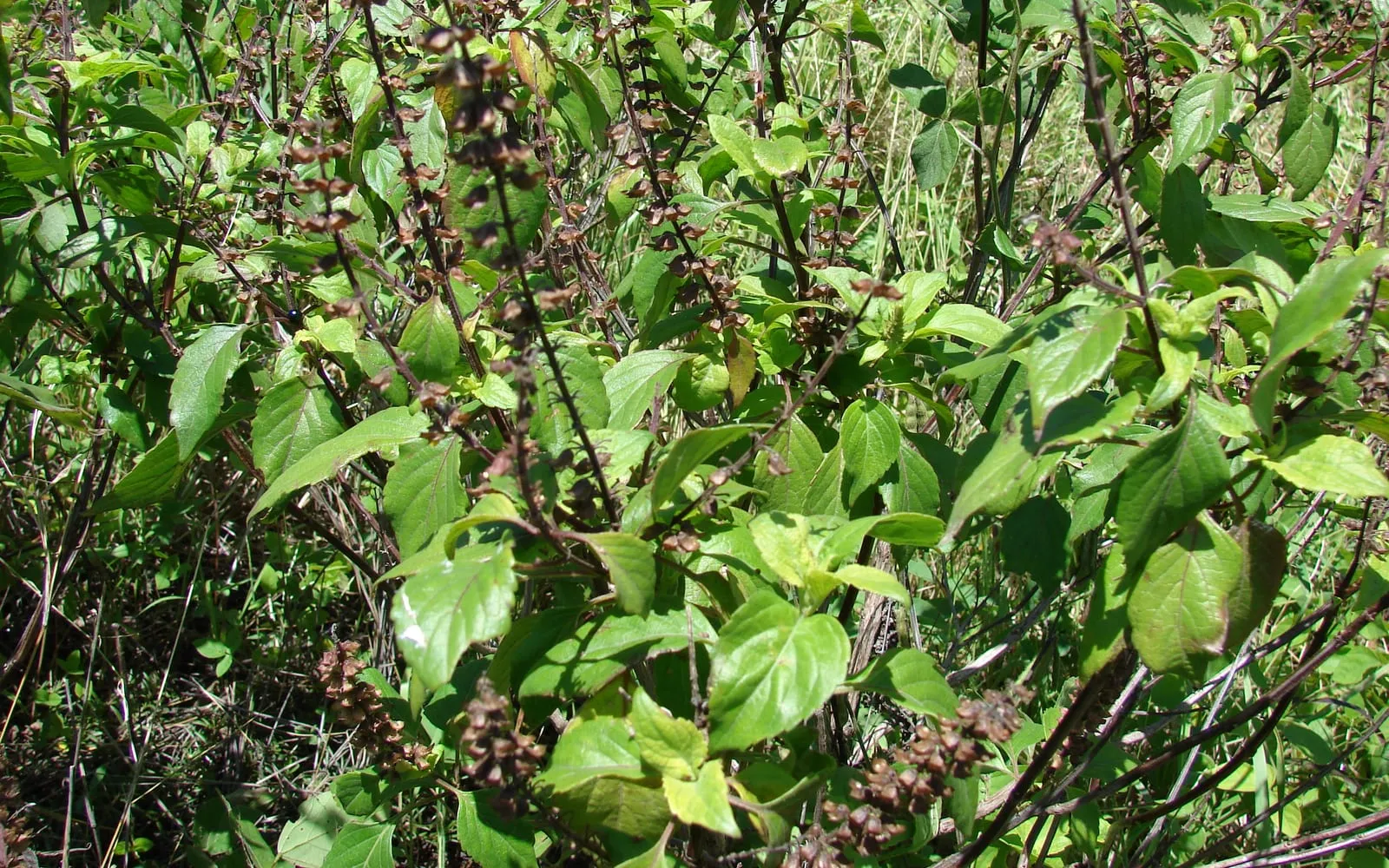
A bushy upright sub-shrub, 60 cm to 1.8 m, going woody at the base from its second year.
Leaves are larger than most basils, 5 to 12 cm, oval, pointed, coarsely toothed and softly hairy, mid green and slightly wrinkled.
Flowers open in branched spikes at the shoot tips, small and greenish-white to pale yellow, held in whorls. They are less showy than the coloured spikes of holy basil.
Stems are square, hairy and green, turning brown and woody with age.
The scent is clove, sharp and penetrating, and it is much stronger than any of the annual basils.
An old plant makes a substantial shrub rather than a herb, which is why it is sometimes sold as tree basil.
Where it is from
African basil is native to tropical Africa and to south and south-east Asia, and it grows across both regions on disturbed ground and forest edges.
West African cooking is where it is used most. In Nigeria it is scent leaf, and it goes into pepper soup, into egusi and ogbono stews, and into the sauces served with yam and rice. Ghana, Cameroon and Benin all use it similarly.
In India it is one of the plants called tulsi, specifically vana tulsi or wild tulsi, and it is used in the same way as holy basil though with a lighter scent.
Its essential oil is extracted commercially in India, Africa and Brazil for its eugenol content, which competes with clove oil as a source of that compound.
It arrived in European horticulture through the seed trade rather than the nursery trade, and it is more often grown from seed here than bought as a plant.
How it grows
Sow indoors from March at 20 to 25 deg C. Surface sow and press the seed in.
Germination takes one to three weeks in warmth and can be uneven.
Prick out into small pots and grow on somewhere bright and warm.
Pot on into 25 cm pots as the plant grows. It gets large and it wants the room.
Take cuttings, which is the easier route once you have a plant. Softwood cuttings root readily in warm gritty compost, and this is how to keep a good plant going rather than resowing.
Grow it under glass. A greenhouse or conservatory suits it, and it will stand outside on a warm patio from late June to early September.
Pinch the tips to keep it bushy, and cut it back by a third in spring.
Keep it above 12 deg C through the winter, watering sparingly. It will drop some leaves and recover in spring.
Harvest leaves and shoot tips through the growing season.
Through the seasons
Winter is survival under glass. Keep it above 12 deg C, water sparingly and expect some leaf drop.
Spring brings new growth from April. Cut back by a third, repot, and take cuttings.
Early summer is when growth accelerates. Move it outside once the nights are reliably above 12 deg C, which in a cool climate means late June.
Midsummer is the main harvest. Pinch tips and cut shoots freely.
Late summer is flowering. Leave the spikes if you want seed, or pinch them out for leaf.
Early autumn is the deadline. Bring the plant back under glass in September, well before the nights cool.
Care difficulty
Moderate, and the difficulty is heat and overwintering rather than anything about the plant itself.
It is a true tender perennial. Keeping it through a winter means holding it above about 12 deg C, which needs a heated greenhouse or a warm room, and that is more than most people will do for a herb.
Taking cuttings each summer is the practical answer. A rooted cutting on a warm windowsill takes far less space than a two-metre parent.
Overwatering rots it, as it does every basil. Water in the morning and never leave it standing.
Greenhouse pests find it. Whitefly in particular takes to a soft-leaved basil quickly, and a biological control is the sensible answer on a food plant.
Given warmth it grows vigorously and produces a great deal of leaf.
Watering
Water in the morning, when the top 2 cm of compost has dried.
Water more generously in summer than any other basil here, since the plant is large and growing fast.
Reduce sharply from October and keep an overwintering plant barely moist.
Never leave the pot standing in water.
Use tepid water in winter.
Ventilate as well as watering under glass, since still humid air is what brings on mould.
Warning signs, diseases and pests
Whitefly builds up fast under glass, showing as small white insects rising in a cloud when the plant is disturbed, with sticky honeydew below. Use sticky traps and a biological control.
Aphids gather on the growing tips. Rub them off.
Spider mite produces fine stippling and webbing in a hot dry greenhouse. Raise the humidity and use a predatory mite.
Root rot from cold wet compost blackens the base of the stem and kills the plant.
Leaf drop over winter is normal on a plant kept cool, and heavy leaf drop means it is too cold.
Grey mould on crowded stems in still air needs thinning and ventilation.
Leggy growth means too little light.
Growing environment
Under glass where summers are cool. A greenhouse or conservatory, with a summer holiday outdoors from late June to early September.
Full sun and warmth. Minimum 12 deg C in winter and 18 deg C or more for good growth.
Free-draining compost in a large pot, or a greenhouse border.
pH around 6 to 7.
Ventilation matters as much as heat, because whitefly and mould both take hold in still humid air.
It gets large. Allow for a plant a metre and more across in a greenhouse, and prune it in spring to keep it manageable.
Feeding
Feed a balanced liquid feed every three weeks from May to August. This is a larger, more vigorous plant than the annual basils and it takes more.
Stop feeding from September so the growth firms before winter.
Avoid heavy nitrogen, which produces soft growth that whitefly finds and that carries less scent.
Repot into fresh compost each spring rather than feeding an exhausted pot.
Potash in late summer helps ripen the growth before winter.
Troubleshooting
It died over the winter. Too cold. African basil needs to be kept above about 12 deg C and it dies below 5 deg C. Take cuttings in summer and overwinter small plants on a warm windowsill instead.
Why does it smell of cloves? Eugenol, the compound that dominates clove oil. This species carries a great deal of it.
Is it the same as tulsi? It is one of the plants called tulsi, specifically vana tulsi. Holy basil, Ocimum tenuiflorum, is the main one. The scents differ, and this species is stronger and more clove-like.
The greenhouse is full of whitefly. They find soft-leaved basils quickly. Use sticky traps and a biological control rather than spraying a food plant.
It went woody and stopped producing leaf. Cut it back by a third in spring and take cuttings, since a young plant produces far more than an old one.
Can I grow it outside? Only from late June to early September in a warm sheltered spot, in a pot you can bring in.
How is it used in cooking? In west African soups and stews, added towards the end so the scent survives. It is strong, so use less than you would use sweet basil.