
Edible
Chilli Pepper
Capsicum frutescens
Also known as Bird's eye chilli, Tabasco pepper, Piri piri, Thai chilli
How to grow bird's eye chillies, Capsicum frutescens. The upright fruit that gives tabasco its name, growing it as a perennial, and picking the small hot pods.
At a glance
- Difficulty
- Moderate
- Water
- Every two or three days in summer, sparingly in winter
- Light
- Full sun under glass or on a bright windowsill
- Temperature
- 22-30 deg C. Growth stops below 15 deg C
- Hardiness
- USDA 10-11, RHS H1b, hardy to 5 C
- Type
- Tender perennial grown as an annual, or kept for several years
- Height
- 60-150 cm
- Native to
- Central and South America
- Best month
- February in the Northern Hemisphere, August in the Southern Hemisphere
A tropical perennial that fruits continuously where nothing checks it, so in a frost-free garden it crops for years and gets woody rather than stopping. Cool nights below 15 deg C halt it. Birds eat the fruit and spread the seed, since they lack the receptor that responds to capsaicin, and that is how it has naturalised across the tropics.
Hardiness zones describe winter cold alone. Summer heat, humidity, rainfall and the length of the growing season decide as much, so treat the range as the outer limit rather than as a recommendation.
Every month named in this guide is for the temperate Northern Hemisphere. If you garden in the Southern Hemisphere, shift each one by six months, so February becomes August. Closer to the equator the wet and dry seasons matter more than the calendar, and the shift stops being a useful guide.
Toxic if eaten
- Safe to eat
- The ripe fruit, in small quantities
- Harm from
- Eating it, handling it and sap in the eyes
- Affects
- People, cats and dogs
Bird's eye chilli fruit is a food used across Asia, Africa and the Americas, and the hazard is capsaicin rather than poison. Capsicum frutescens varieties run from around 30,000 to 100,000 Scoville heat units, which is hotter than a jalapeno and below a habanero. At that concentration capsaicin is a real irritant. Cut fruit transfers readily to eyes and other mucous membranes and causes severe pain lasting hours, so wear gloves for anything more than a couple of pods and do not rub your eyes. Capsaicin does not dissolve in water, so milk, yoghurt or oil remove it where water spreads it. Ventilate the kitchen when frying them, since the airborne compound irritates airways. The ASPCA lists Capsicum species as toxic to cats and dogs on the same irritant grounds, and pets have no reason to stop eating once they start, so keep plants and dried pods out of reach. Eating a quantity causes vomiting and abdominal pain rather than lasting harm.
Sources: ASPCA toxic and non-toxic plants, RHS potentially harmful garden plants
About
Capsicum frutescens is the species that gives Tabasco sauce its pepper, piri piri its heat and Thai cooking its small fierce pods. The fruit is little, held pointing upwards rather than hanging, and it comes in enormous quantity from a single plant. It is one of five Capsicum species domesticated in the Americas, and the one that spread across Africa and Asia fastest once Europeans found it.
This is a genuine perennial, woodier and longer-lived than the annual chillies. A plant kept frost-free will crop for three or four years, getting larger and more productive each season, and in the tropics it becomes a shrub.
That matters wherever the season is short. A first-year plant sown in February produces a modest crop of small green pods that struggle to ripen. The same plant in its second year, already woody and rooted, ripens a heavy crop of red ones.
Appearance and character
A bushy plant with a woody base, 60 cm to 1.5 m under glass and up to 2 m as a perennial in the tropics.
Leaves are oval and pointed, mid-green, smaller and narrower than a sweet pepper’s.
Flowers are the identification. Greenish-white to yellowish, held one or two per node on erect stalks, and the pale green throat distinguishes them from the white flowers of Capsicum annuum.
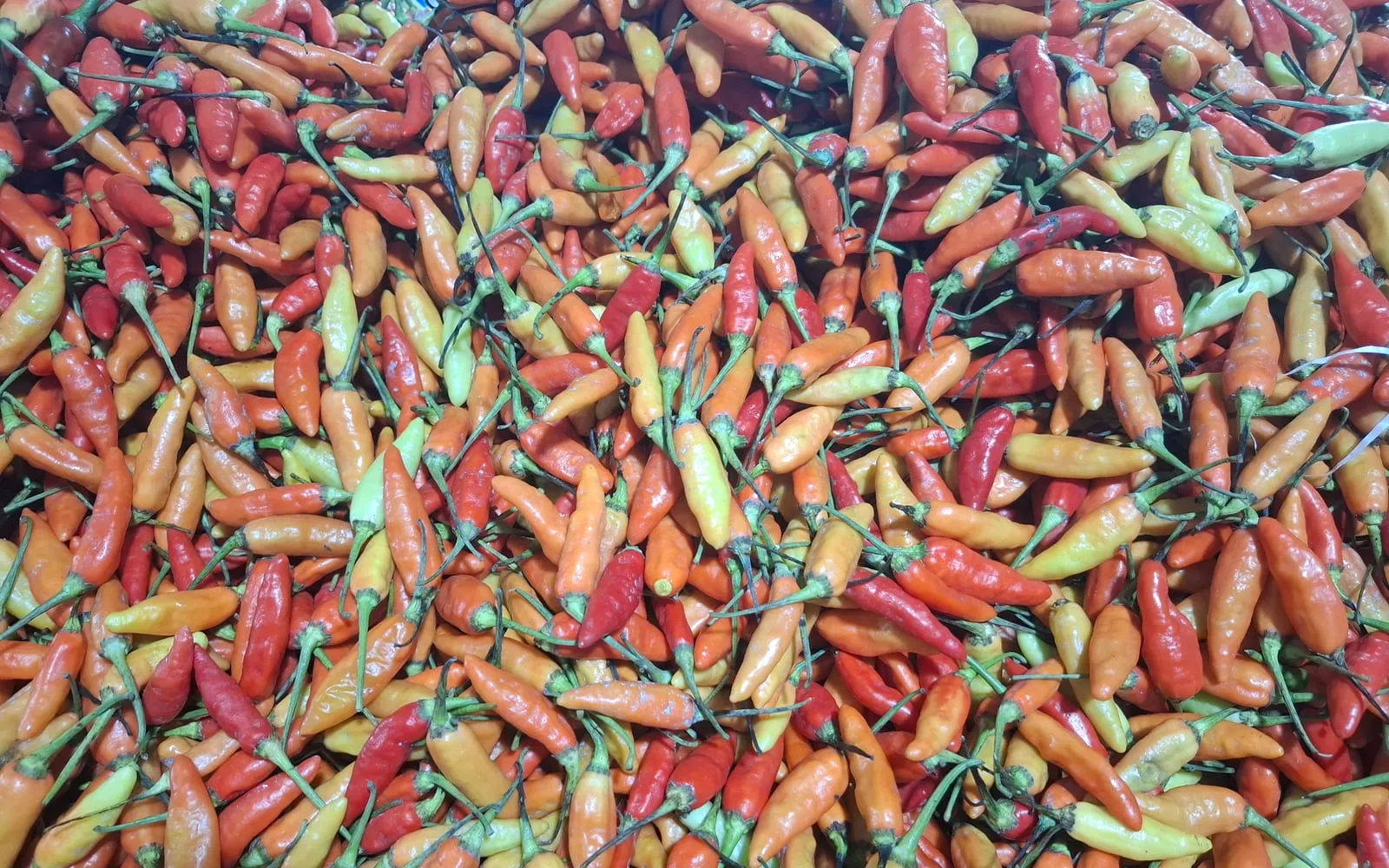
Fruit is small, 1 to 4 cm, narrow and pointed, and held upright above the foliage rather than hanging. That upright habit is the most reliable field mark for the species.
Colour ripens from green through yellow or orange to red, and a plant carries all stages at once, which is why a fruiting bird’s eye is such a striking thing.
Flavour is clean and sharply hot with a smoky note in the tabasco types, and without the fruity complexity of a habanero.
Where it is from
Capsicum frutescens originated in Central and South America, most likely around the Amazon basin and Central America, and it was carried through the Caribbean before European contact.
Portuguese trade spread it further and faster than any other chilli species. Within decades of 1500 it was established across Africa, India and South East Asia, which is why piri piri is Mozambican, bird’s eye is Thai, and neither is native to those places.
Tabasco is a variety of this species, selected in Louisiana and used by the McIlhenny Company from 1868.
Europe has grown it under glass since the Victorian period and has never treated it as an outdoor crop.
Taxonomists have argued for decades over whether frutescens and chinense are separate species, since they cross readily and share much of their genetics. Both names remain in use.
How it grows
Sow in January or February, indoors, with the compost held at 22 to 25 deg C. Seed sits for ten days to three weeks and a heated propagator is what makes that reliable rather than a gamble.
Move each seedling into a 9 cm pot as the first true leaf opens, and keep it above 18 deg C from then on. Check overnight temperatures rather than daytime ones, since a windowsill that reads 20 deg C at teatime can drop to 12 deg C behind a closed curtain.
Into a 25 cm pot, a growbag or the greenhouse border in May.
Take the growing tip out at about 20 cm. The plant branches from below the cut and a branched frame carries several times the crop of a single stem.
Stake it. The pods are small but a plant in full bearing carries hundreds of them held upright above the foliage, and the weight is all at the top.
Start picking in August. Green pods work and red ones are better, and the plant sets more the more you take.
Bring it in for the winter at 10 to 15 deg C, cut back by two thirds and watered barely. This is the species that most repays the trouble. It lives for years rather than a season, and a three-year-old plant with a woody base at the stem crops earlier and heavier than any seedling you could raise alongside it.
Cuttings root easily in warmth in late summer, which is the way to keep a plant whose heat and habit you like.
Through the seasons
Midwinter is the sowing window, with a propagator at 22 to 25 deg C.
Spring is two pottings-on and a careful eye on night temperatures. Any plant carried through the winter wakes in March and wants repotting and its first feed then.
Early summer puts everything into its final pot or into the border, with the tip pinched at 20 cm and a stake in beside it.
Summer brings the greenish-white flowers, often several at a node rather than the single bloom most chillies carry, and the pods that follow stand upright in clusters. Water every second or third day, feed weekly with high potash once fruit has set, and damp the floor down to keep red spider mite off.
Autumn is picking, from August into October, with the last pods ripening slowly as the light goes.
Late autumn is when to ease off the water and food, cut the plant back and move it somewhere frost free for the winter.
Care difficulty
Moderate in the first year and easy thereafter, which is the opposite of most crops here.
Overwintering is the technique that makes the difference. A second or third-year plant is far more productive than a seedling and needs nothing but a frost-free windowsill and occasional water.
Heat is the requirement. Growth stops below 15 deg C, and glass or a bright warm windowsill is what it needs outside the subtropics.
Germination is slow and needs warmth.
Blossom drop follows cold nights, dry roots or excess nitrogen.
Handling the fruit is where care is needed, and the heat level makes gloves sensible for any quantity.
Watering
Water every two or three days in summer, keeping the compost evenly damp.
Never waterlog. Root rot in a saturated pot kills more chillies than drought does.
A little drought stress once fruit has set raises the capsaicin content, so ease off slightly from August if you want more heat.
Damp the greenhouse floor on hot mornings against red spider mite.
Water an overwintered plant perhaps once a fortnight, just enough to keep the compost from drying out completely.
Container plants in a 25 cm pot need daily watering in a hot greenhouse.
Warning signs, diseases and pests
Red spider mite bronzes and speckles the leaves and webs the growing tips in dry heat. Damp down daily and introduce Phytoseiulus predators early.
Aphids cluster on the growing tips and distort new growth. Wash them off and use Aphidius under glass.
Whitefly coat the leaves in sticky honeydew. Use Encarsia parasitic wasps.
Blossom drop follows cold nights, dry roots or too much nitrogen.
Root rot follows waterlogging. Use a free-draining compost and a pot with good drainage.
Green fruit at the end of the season means a first-year plant in a short summer. Overwinter it and the second year will be different.
Leaf drop on an overwintered plant in December is normal and not a sign of death.
Growing environment
Full sun under glass, in a polytunnel, or on a bright south-facing windowsill.
Free-draining, moderately fertile compost with added grit.
Neutral to slightly acid, pH 6 to 7.
Temperatures of 22 to 30 deg C by day and above 15 at night.
A 25 cm pot is enough for a first-year plant and a 30 cm one for an overwintered plant.
Frost-free space at 10 to 15 deg C over winter.
Rotate with tomatoes, aubergines and potatoes on three years, or use fresh compost.
Feeding
Use a balanced liquid feed from potting on until the first flowers open.
Switch to a high-potash tomato feed weekly once the first fruit has set.
Avoid nitrogen after flowering, which gives leaf, delays fruiting and causes blossom drop.
Stop feeding in October.
Repot an overwintered plant into fresh compost in March and resume feeding when new growth appears.
Troubleshooting
A small crop of green pods in the first year. Normal for this species in a short season. Overwinter the plant. A second-year plant is far more productive and ripens its fruit.
Nothing germinated. Too cold. Capsicum frutescens needs 22 to 25 deg C and up to three weeks. Use a heated propagator.
Flowers appear and drop off. Blossom drop from cold nights, dry roots or too much nitrogen. Keep nights above 15 deg C, water evenly and feed with potash.
Fine webbing and speckled leaves. Red spider mite. Damp down every morning and introduce Phytoseiulus predators.
The plant lost its leaves in December. Normal on an overwintered plant. Reduce watering, keep it above 10 deg C, and it will reshoot in March.
The chillies are not very hot. Heat rises with sun, warmth and slight drought stress. Water a little less from August and let the pods colour fully.
How do I tell this from an ordinary chilli? The pods point upwards rather than hanging, and the flowers have a greenish rather than pure white throat. Capsicum annuum pods hang and its flowers are white.
Can I take cuttings? Yes, readily, in late summer with bottom heat. It is the best way to keep a good plant going and to share it.
Chilli Pepper problem guides
Not sure what is wrong? See the common vegetable pests guide.