
Edible
Aji Pepper
Capsicum baccatum
Also known as Aji amarillo, Aji limo, Lemon drop, Peruvian pepper
How to grow aji peppers, Capsicum baccatum. The Peruvian chilli with a fruity flavour, the tall plant it makes, and the spotted flowers that identify the species.
At a glance
- Difficulty
- Moderate
- Water
- Every two or three days in summer, sparingly in winter
- Light
- Full sun under glass or in a polytunnel
- Temperature
- 20-28 deg C. Growth stops below 15 deg C
- Hardiness
- USDA 10-11, RHS H1b, hardy to 5 C
- Type
- Tender perennial grown as an annual, or overwintered
- Height
- 100-200 cm
- Native to
- Bolivia and Peru
- Best month
- February in the Northern Hemisphere, August in the Southern Hemisphere
It needs a longer season than Capsicum annuum, often 120 days to the first ripe fruit, which is what keeps it out of short summers rather than any special tenderness. Warm nights matter more than hot days. Overwintering the plant under cover gives a far earlier crop in its second year.
Hardiness zones describe winter cold alone. Summer heat, humidity, rainfall and the length of the growing season decide as much, so treat the range as the outer limit rather than as a recommendation.
Every month named in this guide is for the temperate Northern Hemisphere. If you garden in the Southern Hemisphere, shift each one by six months, so February becomes August. Closer to the equator the wet and dry seasons matter more than the calendar, and the shift stops being a useful guide.
Toxic if eaten
- Safe to eat
- The ripe fruit
- Harm from
- Eating it, handling it and sap in the eyes
- Affects
- People, cats and dogs
Aji fruit is a food used across the Andes and the hazard is capsaicin rather than poison. Capsicum baccatum varieties run from around 30,000 to 50,000 Scoville heat units, which is comparable to a cayenne and well below a habanero, and the flavour is fruitier and more citrus-like than the heat alone would suggest. Cut fruit still transfers capsaicin readily to eyes and mucous membranes and causes hours of pain, so wear gloves when handling a quantity and do not rub your eyes. Capsaicin is not water-soluble, so milk, yoghurt or oil remove it where water spreads it. The ASPCA lists Capsicum species as toxic to cats and dogs on the same irritant grounds. The leaves of Capsicum species also contain solanine-type glycoalkaloids, like other Solanaceae, so the foliage is not eaten and pets should be kept from chewing the plant. Eating a quantity of fruit causes vomiting and abdominal pain rather than lasting harm.
Sources: ASPCA toxic and non-toxic plants, RHS potentially harmful garden plants
About
Capsicum baccatum is the chilli of Peru and Bolivia, and the one most worth growing for flavour rather than for heat. Aji amarillo is the orange-yellow backbone of Peruvian cooking, and the fruit tastes of apricot and citrus with a warm rather than searing burn. It is one of five Capsicum species domesticated in the Americas, and the one that stayed closest to home the longest.
Under glass it has one considerable practical drawback. The plant is enormous. Two metres is normal, the branches spread wide, and a plant that is comfortable in a 25 cm pot in June is pushing at the roof by August.
The species is easy to identify from the flowers, which carry yellow or green spots on white petals. No other domesticated chilli does that, and it is the quickest way to know what you have when a seed packet is vague.
Appearance and character
A tall spreading plant, 1 to 2 m in a greenhouse, with long arching branches and a woody base in an established specimen.
Leaves are large, oval and pointed, mid-green, and noticeably bigger than those of most chillies.
Flowers are diagnostic. White petals with distinct yellow, tan or green blotches at the base of each lobe, held singly at the nodes. Every other cultivated Capsicum has plain flowers.
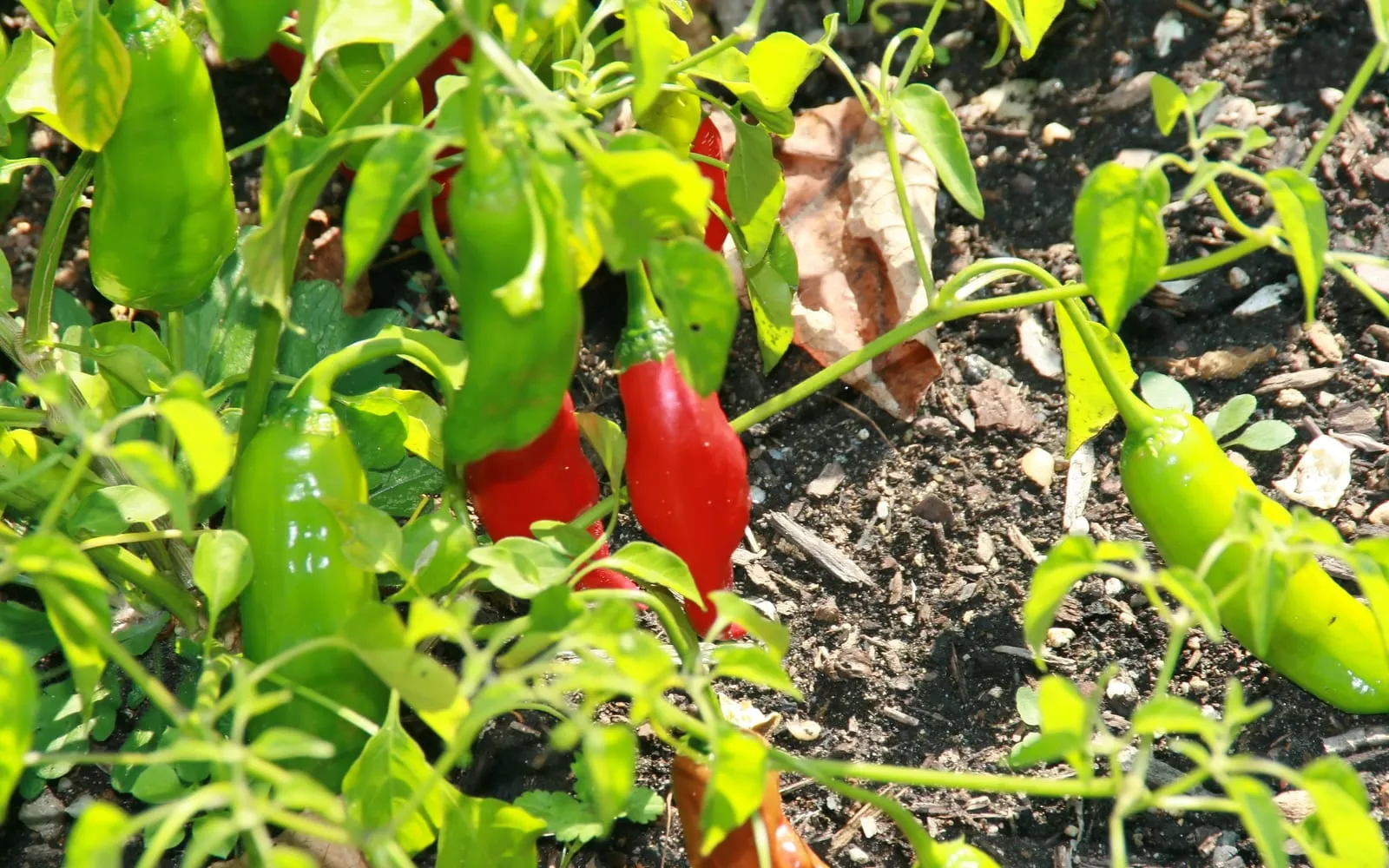
Fruit hangs rather than standing upright, and shape varies enormously by variety. Aji amarillo is long, tapering and 10 to 15 cm; lemon drop is short and conical; some are round.
Colour ripens through green to bright orange, yellow, red or brown.
Flavour is the reason to grow it. Fruity, citrusy and slightly berry-like under a clean moderate heat that builds slowly rather than hitting at once.
Where it is from
Capsicum baccatum was domesticated in Bolivia and Peru, and the wild variety baccatum still grows there.
Archaeological remains from coastal Peru go back several thousand years, and the species appears in Nazca and Moche art.
It stayed regional in a way the other domesticated chillies did not. While annuum and frutescens spread worldwide within decades of European contact, baccatum remained an Andean crop and only reached wider cultivation in the twentieth century.
Peru grows it on a large scale. Aji amarillo is one of the three foundational ingredients of Peruvian cooking, alongside garlic and red onion, and it is sold fresh, dried as aji mirasol and as a paste.
European seed has only been widely available since the 2000s, through specialist chilli nurseries rather than the general trade.
How it grows
Sow indoors in January or February at 22 to 25 deg C. Germination takes ten to twenty-one days.
Prick out into 9 cm pots at the first true leaf and grow on above 18 deg C.
Pot on generously. This plant needs a 30 cm pot at minimum and does better in a greenhouse border, since a restricted root run limits an already long season.
Pinch out the growing tip at 25 cm to force branching, and be prepared to prune the plant through the summer to keep it in the space available.
Stake or cage it properly. Long arching branches carrying fruit snap at the joint without support.
Pick from late August. The fruit is usable green and much better fully coloured, and the flavour that makes the species worth growing only arrives with the colour.
Overwinter at 10 to 15 deg C, cut back hard by two thirds. A second-year plant starts far ahead and copes with a short season much better.
Through the seasons
Midwinter is sowing, in January or February at 22 to 25 deg C.
Spring grows the plants on above 18 deg C, potting on twice. Pinch out at 25 cm.
Early summer plants into a 30 cm pot or a greenhouse border in May, with support in place from the start.
Summer is growth, flowering and fruiting. Water every two or three days, feed weekly with high potash from first fruit set, prune to keep the plant in bounds, and damp down against red spider mite.
Autumn is the harvest, from late August to October. Reduce watering and feeding from late September, then cut back hard and overwinter.
Care difficulty
Moderate, with size as the specific problem.
The plant is the largest of the domesticated chillies and outgrows a small greenhouse. Prune it through the summer without hesitation, since it fruits on new growth and responds well.
The season is long, so sow in January or February and consider overwintering.
Heat is needed as for any chilli. Growth stops below 15 deg C.
Support is essential rather than optional, because the branch structure is long and brittle.
Ripening is the last hurdle. Green aji has little of the flavour that makes the species interesting, so a plant that ripens nothing is a wasted season.
Watering
Water every two or three days in summer, keeping the compost evenly damp.
A large plant in a small pot dries out fast, which is one more argument for a 30 cm pot or a border.
Never waterlog. Root rot in a saturated pot kills chillies quickly.
A slight drought stress from August raises the heat, at some cost to fruit size.
Damp the greenhouse floor on hot mornings against red spider mite.
Water an overwintered plant sparingly, once a fortnight at most.
Warning signs, diseases and pests
Red spider mite bronzes and speckles the leaves and webs the tips in dry heat. Damp down every morning and introduce Phytoseiulus predators early.
Aphids cluster on the growing tips. Wash them off and use Aphidius under glass.
Whitefly coat the leaves in honeydew. Use Encarsia parasitic wasps.
Blossom drop follows cold nights, dry roots or excess nitrogen.
Snapped branches follow an unsupported plant carrying fruit. Cage or stake at planting.
A plant filling the greenhouse with no fruit usually means too much nitrogen. Switch to potash.
Green fruit at the end of the season means a late sowing or too cool a summer.
Growing environment
Full sun under glass or in a polytunnel. A windowsill is too small for this species.
Free-draining, moderately fertile compost or a greenhouse border.
Neutral to slightly acid, pH 6 to 7.
Temperatures of 20 to 28 deg C by day and above 15 at night.
Headroom. Allow at least 1.5 m and preferably 2 m, or plan to prune.
A cage, a stake or a string trained up to the greenhouse roof.
Frost-free space at 10 to 15 deg C over winter.
Feeding
Use a balanced liquid feed from potting on until the first flowers open.
Switch to a high-potash tomato feed weekly once fruit has set.
Avoid nitrogen after flowering. On a plant this vigorous it produces an enormous amount of leaf and delays the crop badly.
Stop feeding in October.
Repot an overwintered plant into fresh compost in March and resume feeding when new growth appears.
Troubleshooting
The plant filled the greenhouse and set little fruit. Too much nitrogen, or too small a pot forcing all the growth into stems. Feed with potash from first flower and prune the plant to shape through the summer.
Branches snapped under the fruit. Long brittle branches without support. Cage or stake at planting and tie in the main limbs.
The fruit is green in October. A late sowing or a cool summer. Sow in January, or overwinter a plant so it starts months ahead.
Flowers appear and drop. Blossom drop from cold nights, dry roots or too much nitrogen. Keep nights above 15 deg C and switch to potash.
Fine webbing and speckled leaves. Red spider mite. Damp down every morning and introduce Phytoseiulus predators.
Green aji tastes of nothing much. Correct. The fruity citrus flavour that makes this species worth growing arrives with the colour. Let the fruit ripen fully.
How do I know it is baccatum? Look at the flowers. White petals with yellow, tan or green blotches at the base of each lobe. No other domesticated chilli has spotted flowers.
Can I prune it hard? Yes. It fruits on new growth and takes summer pruning well, which is what makes it manageable in a small greenhouse.
Aji Pepper problem guides
Not sure what is wrong? See the common vegetable pests guide.