
Pest
Queensland fruit fly
Bactrocera tryoni
Also called Qfly
Fruit that looks sound and turns to a rotting, maggot-riddled mush from the inside within days, caused by a fly native to eastern Australia that attacks nearly two hundred kinds of fruit and vegetable. The pest behind the fruit-fly-free zones and quarantine checkpoints that structure so much of Australian and New Zealand produce movement.
At a glance
- Type
- Pest
- Cause
- Insect
- Severity
- Destroys the crop or display
- Affects
- Herbs and edibles
- Active
- November to April
- Established in
- Australia and Pacific Islands
What you are seeing
- Tiny puncture marks, or "stings", in the skin of ripening fruit where a female has laid eggs, often invisible until the fruit is cut open
- Fruit collapsing into a soft, rotting, maggot-riddled mass from the inside within a few days of looking completely sound
- Small cream-coloured maggots, tapered at one end, feeding inside the flesh, sometimes visible wriggling if the fruit is cut and left in the sun
- Premature fruit drop, with dropped fruit often still looking externally intact
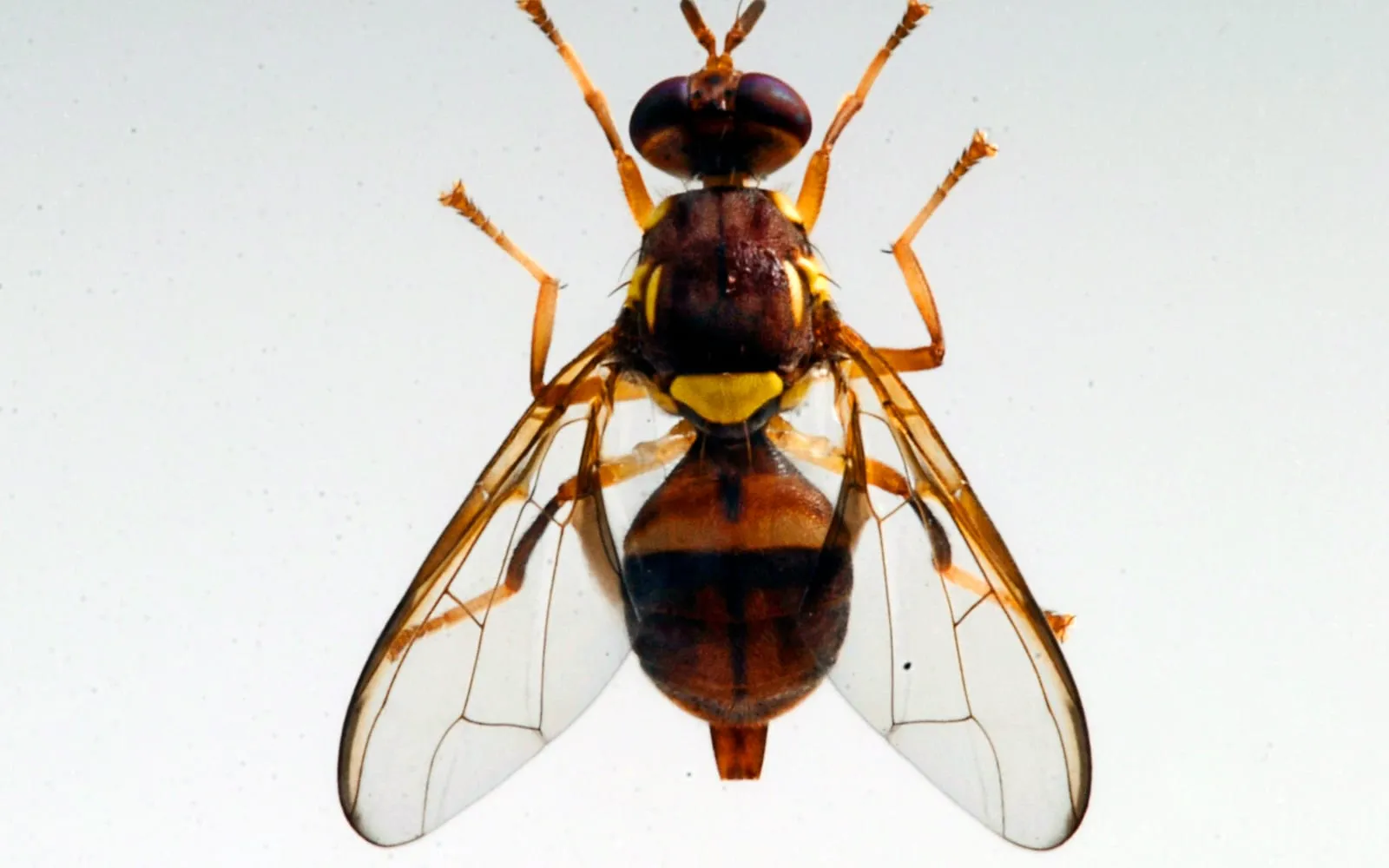
- Adult flies about 5 to 8 mm long, reddish brown with clear wings and pale yellow markings on the thorax, seen resting on foliage in warm weather
- Damage across an very wide range of fruiting plants rather than one or two, since this species is one of the least fussy fruit flies known
Before you treat anything
Fruit with visible maggots should be discarded rather than eaten. Fruit picked before any sting is visible and found sound when cut open is safe.
What you are looking at
Fruit that looked completely sound yesterday and has collapsed into a soft, rotting, maggot-riddled mass today. The damage starts with a tiny puncture, or “sting”, where a female has laid eggs beneath the skin, usually invisible until the fruit is cut open or has already begun to fail from the inside. Small cream-coloured maggots, tapered at one end, feed within the flesh, and affected fruit often drops from the plant while still looking intact from outside.
The adult fly is 5 to 8 mm long, reddish brown with clear wings and pale yellow markings across the thorax, and is often first noticed resting on foliage in warm weather rather than caught in the act of laying eggs.
Extraordinarily unfussy, and extraordinarily consequential
Few fruit flies attack as wide a range of hosts as this one, which has been recorded damaging close to two hundred different kinds of cultivated fruit and fruiting vegetable, a breadth that makes it one of Australian horticulture’s most significant pests by economic impact. Native to tropical and subtropical coastal Queensland and northern New South Wales, it has since spread along most of the eastern seaboard into Victoria and inland areas of both states, and into parts of the Pacific.
Western Australia and large parts of South Australia have invested heavily in staying free of it, maintaining officially recognised pest-free status through continuous monitoring, baiting and strict quarantine on fruit movement from affected areas. A confirmed detection inside one of those zones triggers the same kind of eradication response as a first arrival anywhere else the fly has never been established, rather than being treated as routine. New Zealand has never had an established population and responds to occasional incursions, several of them successfully eradicated since the 1990s, with comparable urgency. It has never reached North America, Europe, Africa or Asia.
What to do about it
Never move home-grown fruit out of a fruit fly restricted or quarantine area; check current local restrictions before transporting any fruit between regions.
Net susceptible plants with fine exclusion mesh before fruit begins to ripen.
Pick fruit on schedule and clear fallen fruit daily through the risk season.
Use a commercial lure-and-kill device alongside netting rather than as a substitute for it, and reserve a broader protein bait spray as a last resort for an outbreak that netting and trapping have not held back.
Solarise collected fallen and infested fruit in a sealed clear bag in full sun for several days before disposal, or bury it deeply, following local council guidance in an affected area.
What it gets mistaken for
Grey mould shows visible fungal growth on the fruit surface, spreading from an existing wound. This fly’s damage starts invisibly from within, and a fruit that collapses from the inside with maggots present rather than fuzzy grey growth on the outside points to this pest rather than a fungal one.
Not established in New Zealand
Do not prune, spray or otherwise treat a suspected case. Doing so risks spreading an organism the country has kept out, and it disturbs the evidence needed to identify it. Photograph what you can see, leave the plant alone, and contact your national or state plant health authority. The control advice further down this page is written for regions where this problem is already established.
Native to tropical and subtropical coastal Queensland and northern New South Wales, and now established along most of the eastern Australian seaboard into Victoria and inland areas of both states, as well as parts of the Pacific. Western Australia and large parts of South Australia maintain officially recognised pest-free status through ongoing detection, baiting and quarantine programmes, and a confirmed find inside one of those zones triggers an eradication response rather than routine control, the same way a first detection would anywhere the fly has never been established. It has never established in New Zealand, which treats a suspected find with the same urgency as Western Australia does and has eradicated several incursions since the 1990s. It has never reached North America, Europe, Africa or Asia.
What to do, in order
The steps below apply where this problem is already established.
Start here
Prevention, and the changes that stop the problem returning. Most of these pages should end at this tier.
- Never move home-grown fruit out of a fruit fly restricted or quarantine area
- Moving fruit, even a few pieces in a car or a parcel, is one of the main ways this fly has spread beyond its native range and continues to threaten pest-free zones in Western Australia, South Australia and across the Tasman in New Zealand. Check and follow current quarantine restrictions before transporting any home-grown fruit between regions, and dispose of garden fruit within the property it was grown on if local rules require it.
- Pick fruit as soon as it ripens and collect fallen fruit daily
- Ripening and overripe fruit left on the plant or the ground gives the fly a place to lay eggs and complete its life cycle undisturbed. Picking on schedule and clearing windfalls every day through the risk season denies it that opportunity.
Then reach for a barrier
Netting, hand removal and water. Nothing here harms anything except the target.
- Net susceptible crops with fine exclusion mesh
- Mesh fine enough to exclude the adult fly, fitted before fruit begins to ripen and sealed at the base, is the most reliable physical control for a home garden planting and is widely recommended by state agriculture departments across the fly's Australian range.
- Use a commercial lure-and-kill trap
- A self-contained lure-and-kill device draws in and kills adult flies before they lay eggs using a small, targeted amount of attractant rather than a sprayed area, and is a standard home-garden control across the affected states, used alongside netting rather than instead of it. Reserve a broader protein bait spray for a genuine outbreak that netting and trapping have not held back.
- Dispose of fallen and infested fruit by solarising or deep burial
- Sealing collected fruit in a clear plastic bag left in full sun for several days kills eggs and larvae inside through heat before disposal, and is a practical alternative to deep burial where a council green bin is not a safe disposal route in an affected area.
Then bring in the predators
Encourage what already lives in the garden, and buy predators in where the problem is under glass and nothing will arrive on its own.
- Support parasitic wasps where established
- Where established, these wasps give a meaningful background reduction in fly numbers, though not enough alone to protect a home garden's fruit without netting or baiting as well.Diachasmimorpha tryoni and other native or naturalised parasitoid wasps attack fly larvae in parts of the fly's Australian range and are the subject of ongoing augmentative release programmes; not something a home gardener buys or releases independently.
Biological controls are live organisms and their sale and release are regulated country by country. An agent sold freely in one place may be unapproved in another, so buy from a licensed supplier where you live and never import or move one yourself.
Plants affected
Guides that name it among the problems to watch for. The list is the plants it is characteristic of rather than everything it will feed on.