
Pest
Pod borer
Helicoverpa armigera
Also called Cotton bollworm, Old World bollworm, Gram pod borer, Legume pod borer, African bollworm, Tomato grub
A caterpillar bores into pods, bolls and fruit, then moves on before finishing the first one. Control depends on catching small larvae before they enter the crop and protecting the parasitoids that suppress them.
At a glance
- Type
- Pest
- Cause
- Insect
- Severity
- Destroys the crop or display
- Affects
- Garden plants, Herbs and edibles
- Active
- May to October
- Established in
- Europe, Africa, Asia, Australia, New Zealand, Pacific Islands and Central and South America
What you are seeing
- A round hole bored into a pod, boll or fruit, with the edges clean rather than chewed
- A caterpillar with its head and shoulders inside the pod and the rest of its body outside
- Seeds eaten out of a pod that looks sound until it is opened
- Damp dark frass packed around the entry hole and inside the pod
- Several pods on one plant damaged and abandoned rather than one eaten out
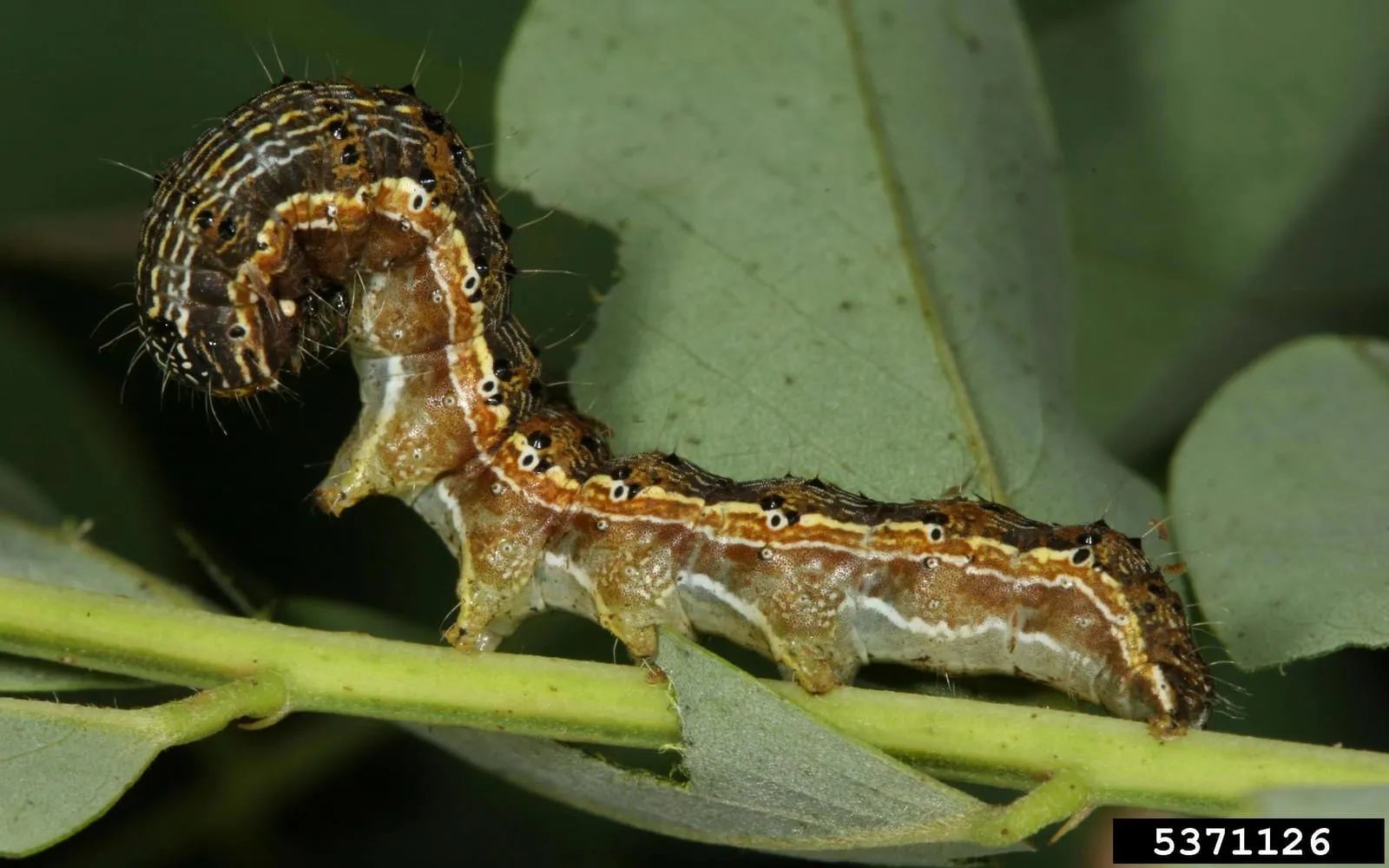
- Caterpillars varying wildly in colour, from pale green through pink to almost black
- Pale stripes running the length of the body and short stiff hairs on dark bumps
- Only one caterpillar in a pod, whatever the number of eggs laid on the plant
- Flowers and growing tips eaten before the pods have set
Before you treat anything
This is the insect that made insecticide resistance a mainstream agricultural problem. Resistance to pyrethroids, organophosphates and carbamates is documented across India, China, Australia and Africa, in some populations at levels that make a labelled rate useless. Spraying a resistant population kills the wasps and predators holding the pest down and leaves the pest, so the crop gets worse rather than better. Where a spray is needed, the choice of product and the rotation of modes of action are decisions for a local advisory service, because what still works is regional and changes.
What you are looking at
A round hole bored into a pod, a boll or a fruit, cut cleanly rather than chewed, and often a caterpillar with its head and shoulders pushed inside and the rest of its body hanging out in the open.
Open the pod and the seeds are gone or half eaten, with damp dark frass packed around them.
The caterpillar is up to about 40 mm long and comes in almost any colour. Pale green, straw, pink, brown and nearly black all occur in the same field, with pale stripes running the length of the body and short stiff hairs standing on small dark bumps. Colour identifies nothing here.
Look along the row and you will find several damaged pods on one plant rather than one pod eaten out. That pattern separates this insect from most caterpillars.
One caterpillar, a dozen ruined pods
A leaf-eating caterpillar eats a leaf and the plant grows another. This one eats the part you are growing the crop for, and it does not finish what it starts.
A larva bores into a pod, eats some of the seed, leaves, and bores into the next. Over its development it damages far more pods than it could eat, so the loss runs well ahead of the number of insects present. Ten caterpillars in a row of chickpea is not ten damaged pods.
There is also only ever one of them in a pod, however many eggs were laid on the plant, because they eat each other on meeting. When you open pods to assess a crop, the count of caterpillars is lower than the number that hatched.
A single female lays several hundred eggs and sometimes over a thousand, one at a time, on buds, flowers and growing tips. Moths are drawn to plants in flower, so the fortnight either side of flowering is the key inspection window.
Why spraying usually fails
By the time the damage is visible the caterpillar is inside the pod, where no spray reaches it. That alone makes chemistry a poor tool here.
The larger problem is resistance. This insect carries documented resistance to pyrethroids, organophosphates and carbamates across India, China, Australia and much of Africa, in some populations at levels that make the labelled rate pointless. Everything about the insect speeds that up. It runs several generations a year, each female lays hundreds of eggs, the host list is long enough that a population never runs out of somewhere to breed, and the moths fly far enough to mix resistance genes across a whole region.
Spraying a resistant population still kills the Trichogramma wasps that parasitise the eggs and the Campoletis and Bracon wasps that attack the caterpillars. The pest survives and its natural enemies do not, so the next generation arrives into a crop with nothing holding it back.
Bt and the nucleopolyhedrovirus can work, but only while larvae are small and still feeding outside the pod. A late treatment is wasted even if the product is right.
Inspect during flowering
Moths lay on plants in flower. On chickpea and pigeon pea that gives a window of roughly a fortnight either side of flowering when the eggs arrive and the young caterpillars are feeding on the surface where they can be reached.
Inspect twice a week through it. A crop looked at after podding has already taken its losses.
The other lever is the sowing date. Populations build through the season, so a crop that pods before the moths peak escapes much of what a later crop meets. Local advisory services publish the peak flight, and a single pheromone trap will find it where they do not.
Longer term, the rotation matters more than anything applied. Cotton, chickpea, pigeon pea, tomato, maize, sorghum, okra and sunflower are all hosts, so a rotation between two of them lets numbers run straight from one crop into the next. Cultivating after harvest turns the overwintering pupae up for the birds.
What to do about it
Inspect twice a week from first flower, and act while the caterpillars are small and outside the pods.
Pick them off by hand where the plot is small enough, in the evening, every few days.
Put bird perches through the crop before flowering, one every ten metres or so.
Sow early enough that podding happens before the moths peak, where the season allows it.
Plant marigold as a trap crop and pull the heads off with the eggs on them.
Spray Bt or the nucleopolyhedrovirus at egg hatch rather than at first damage.
Take damaged pods off the plant and out of the plot.
Cultivate after harvest to expose the pupae.
Put a non-host crop between susceptible ones.
Leave the parasitic wasps alone, and treat a broad-spectrum insecticide as the thing that makes next season worse.
What it gets mistaken for
Corn earworm is the same animal for practical purposes and a different species, confined to the Americas.
Fall armyworm strips leaves and feeds in the maize whorl rather than boring into pods.
Pink bollworm lives its whole larval life inside a cotton boll and leaves a tiny exit hole.
Pea and bean weevil notches the leaf edges and never goes near a pod.
Fruit fly leaves a sting and soft rot rather than a hole you could put a pencil in.
Not established in North America
Do not prune, spray or otherwise treat a suspected case. Doing so risks spreading an organism the country has kept out, and it disturbs the evidence needed to identify it. Photograph what you can see, leave the plant alone, and contact your national or state plant health authority. The control advice further down this page is written for regions where this problem is already established.
Established across the warm and warm-temperate parts of the Old World and through southern Europe, and in South America since it was found in Brazil in 2013. Where winters are mild enough it breeds all year and there is no season in which the crop is safe, and at higher latitudes it overwinters as a pupa in the soil or arrives on migration. Mainland North America is the exception. Detections in Florida and Puerto Rico have each been treated as an incursion to be eradicated rather than an establishment, so a suspected finding there is a matter for the plant health authority. Its niche in the Americas is filled by corn earworm, a close relative that cannot be told from it without dissection.
What to do, in order
The steps below apply where this problem is already established.
Start here
Prevention, and the changes that stop the problem returning. Most of these pages should end at this tier.
- Watch the flowering window, since that is when the crop is decided
- Moths are drawn to plants in flower and lay on the buds and young pods. On chickpea and pigeon pea the fortnight either side of flowering is when the eggs arrive, and a crop inspected twice a week through it can be acted on while the caterpillars are small and still outside the pod. A crop inspected after podding has already lost what it is going to lose.
- Sow so that podding misses the peak
- Populations build through the season, so an early-sown crop that pods before the moths peak takes far less damage than a late one. Sowing dates are the single largest lever a grower has here and they cost nothing. Local advisory services publish the peak flight for the area, and where they do not, a pheromone trap will find it in one season.
- Grow a trap crop the moths prefer
- Marigold planted through or around a chickpea or tomato crop draws egg-laying females away from it, and the marigold heads can then be picked off and destroyed with the eggs on them. Intercropping chickpea with coriander or linseed works the same way and also feeds the parasitic wasps.
- Choose a variety with some resistance where one exists
- Chickpea leaves and pods secrete an acid that deters young larvae, and varieties differ in how much. Pigeon pea varieties differ in pod wall thickness and in how tightly the pods sit. Neither gives immunity, and on land with a history both are worth more than the yield points they cost.
- Cultivate after harvest to turn the pupae up
- The insect passes the gap between crops as a pupa a few centimetres down in the soil. Ploughing or deep hoeing after harvest brings those pupae to the surface for birds and heat, and it is one of the few actions that reduces next season's population rather than this season's damage.
- Do not grow its hosts back to back
- The host list runs past a hundred and eighty species and takes in cotton, chickpea, pigeon pea, tomato, maize, sorghum, okra and sunflower, so a rotation of two of those is no rotation at all. Putting a cereal or a fallow between susceptible crops breaks the sequence that lets numbers build from one crop straight into the next.
Then reach for a barrier
Netting, hand removal and water. Nothing here harms anything except the target.
- Pick the caterpillars off by hand while there are few
- On a garden scale this is the whole of the control and it works, because the caterpillars are large, obvious and sitting half out of the pod. Go over the plants in the evening, drop what you find into water, and repeat every few days through podding.
- Put bird perches through the crop
- Insectivorous birds take large numbers of caterpillars and will not cross an open field with nowhere to sit. Bamboo or branch perches at roughly one every ten metres, put in before flowering, turn a chickpea field into somewhere drongos and shrikes will hunt. This is standard practice in Indian chickpea and it costs the price of the sticks.
- Hang pheromone traps to know what is flying
- A trap tells you when the moths arrive, which is what the timing of everything else depends on. It will not control the pest, and treating a trap catch as control is how growers end up spraying a fortnight too late.
- Collect and destroy damaged pods
- A pod with a hole in it has a caterpillar in it or has just lost one. Taking those off the plant and out of the plot removes the next generation rather than tidying up after the last.
Then bring in the predators
Encourage what already lives in the garden, and buy predators in where the problem is under glass and nothing will arrive on its own.
- Spray Bacillus thuringiensis while the caterpillars are small
- Bt kills young larvae that eat treated tissue and does nothing to a larva already inside a pod. That makes timing the whole of it. Apply when eggs are hatching and the caterpillars are still feeding on the surface, repeat after rain, and accept that a late application is wasted. It spares the parasitic wasps, which a broad-spectrum insecticide does not.
- Use the nucleopolyhedrovirus where it is sold
- HaNPV is a virus specific to this insect, produced commercially in India and several other countries and applied like a spray. It is slow, taking several days to kill, and it is harmless to everything else in the crop. Like Bt it has to reach a small caterpillar out in the open.
- Leave the parasitic wasps and predators alone
- Trichogramma wasps parasitise the eggs and Campoletis and Bracon species attack the caterpillars, and in an unsprayed crop they take a substantial share. They are also the first thing a broad-spectrum insecticide kills, which is how spraying a resistant pest makes the next generation worse.
Biological controls are live organisms and their sale and release are regulated country by country. An agent sold freely in one place may be unapproved in another, so buy from a licensed supplier where you live and never import or move one yourself.
Plants affected
Guides that name it among the problems to watch for. The list is the plants it is characteristic of rather than everything it will feed on.