
Edible
Great Millet
Sorghum bicolor
Also known as Sorghum, Milo, Durra, Jowar, Broom corn, Guinea corn
How to grow sorghum, Sorghum bicolor. Heat, drought tolerance, grain heads, harvest timing and cyanide risk in stressed plants.
At a glance
- Difficulty
- Easy
- Water
- Through establishment, then very little. It waits out drought
- Light
- Full sun
- Temperature
- Wants 25-30 deg C and stalls below 15
- Hardiness
- USDA 9-11, RHS H2, hardy to 10 C
- Type
- Tender annual grass, killed by frost
- Height
- 100-400 cm depending on type
- Native to
- Sudan, north-eastern Africa
- Best month
- May and September in the Northern Hemisphere, November and March in the Southern Hemisphere
A C4 grass that outlasts maize in drought by rolling its leaves and going dormant, and it is a short-day plant. A tropical variety at high latitude will grow all season and never flower, because nights never lengthen past its threshold, so grain in a temperate garden needs a photoperiod-insensitive cultivar bred for it. Soil needs 15 C to germinate and it wants sustained warmth above 25 C to fill a head. Young plants and regrowth after drought carry dhurrin, which releases cyanide, so do not graze stressed sorghum.
Hardiness zones describe winter cold alone. Summer heat, humidity, rainfall and the length of the growing season decide as much, so treat the range as the outer limit rather than as a recommendation.
Every month named in this guide is for the temperate Northern Hemisphere. If you garden in the Southern Hemisphere, shift each one by six months, so May becomes November. Closer to the equator the wet and dry seasons matter more than the calendar, and the shift stops being a useful guide.
Toxic if eaten
- Safe to eat
- The mature grain, and the stem juice in sweet sorghum types
- Do not eat
- Young shoots, regrowth after cutting, and any growth stressed by drought or frost
- Harm from
- Eating it
- Affects
- People, horses, cats and dogs
The mature grain is safe, contains no gluten, and is a staple for hundreds of millions of people. The green plant is a different matter. Sorghum leaves and shoots contain dhurrin, a cyanogenic glycoside that releases hydrogen cyanide when the tissue is crushed or damaged. Concentrations are highest in young shoots, in regrowth after cutting or grazing, and in plants stressed by drought or hit by frost, and livestock deaths from grazing sorghum in those conditions are a well documented veterinary problem across Africa, Australia and the United States. The rule in agriculture is to keep animals off young growth below about 50 cm, off regrowth, and off a crop for several days after frost. A second hazard appears where sorghum has been cut for forage and stored, since nitrate can accumulate in stressed plants. None of this affects the threshed grain, which is what people eat.
Sources: British Horse Society on poisonous plants, RHS on potentially harmful garden plants
About
Sorghum is the fifth cereal by world production, behind maize, wheat, rice and barley, and it is the one that grows where the others fail. It handles heat, drought, poor soil and periodic flooding, and when conditions turn against it, it stops growing and waits rather than dying. That ability to pause and resume is what makes it the staple across the African Sahel and the Indian Deccan.
The plant is a C4 grass, using the same efficient photosynthesis that maize and sugar cane do, and it looks like a coarse maize with a head instead of a cob. Its root system is twice as extensive as maize’s and its leaves carry a waxy bloom that cuts water loss.
One species covers several crops. Grain sorghum is grown for the seed. Sweet sorghum has a juicy stem that is crushed for syrup. Broom corn is the type with long stiff panicle branches, and it made brooms for two centuries. Forage types are grown for animal feed, and they are the ones most involved in cyanide poisoning.
Appearance and character
Sorghum looks like maize until you reach the top. The stems are stout and solid, the leaves are long, broad and blue-green with a distinct white midrib, and the plant stands anywhere from a metre in modern grain varieties to four metres in traditional African ones.
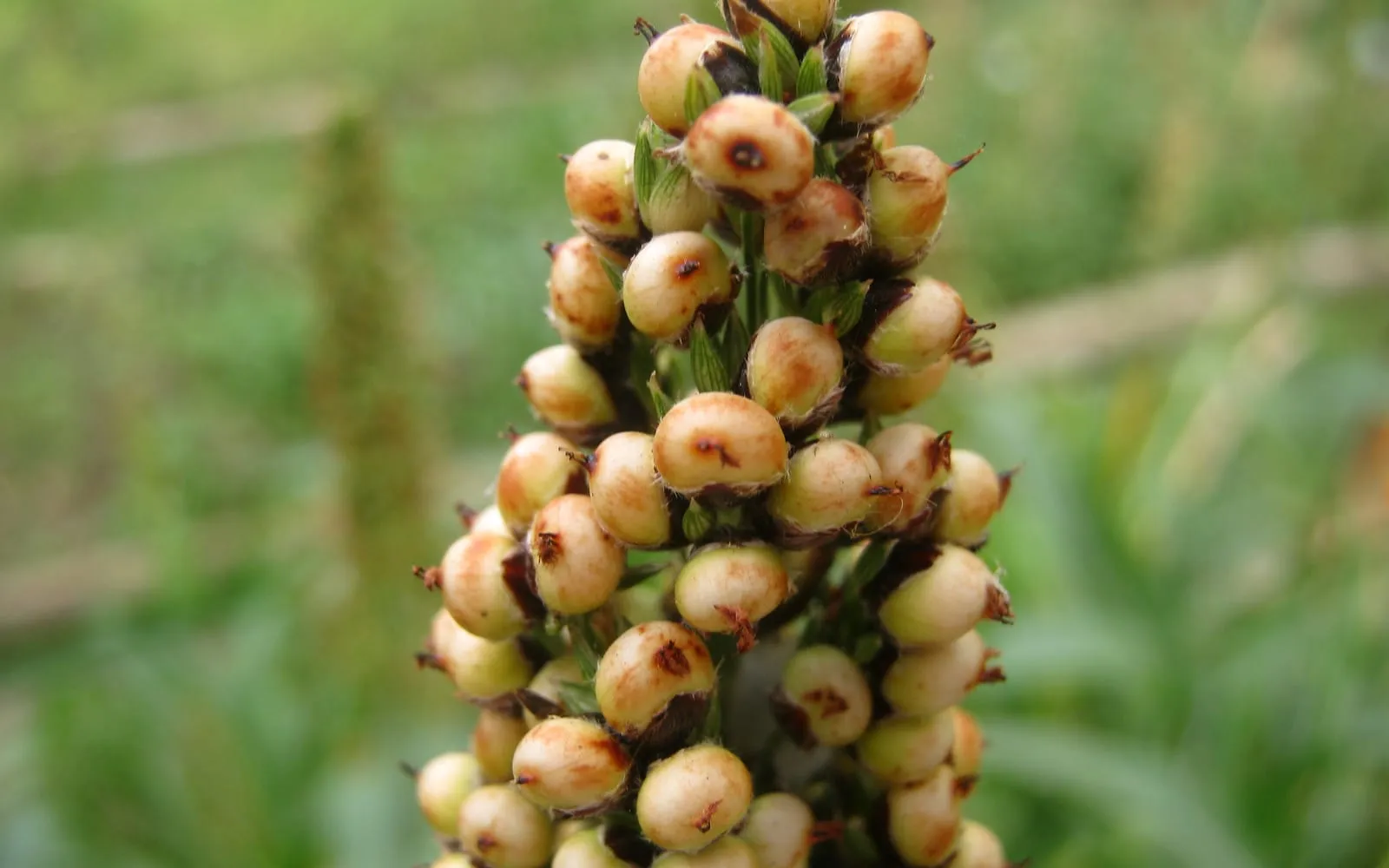
The head is a panicle rather than a cob, dense and upright in grain types and loose and spreading in broom corn. It carries hundreds of grains, and depending on the variety they ripen white, cream, yellow, red or a deep brown.
Where maize carries its male flowers in a separate tassel and its female flowers on a cob, sorghum has ordinary perfect flowers in the panicle and pollinates itself. That is the quickest way to be certain which plant you are looking at.
Where it is from
Sorghum was domesticated in north-eastern Africa, in the region of modern Sudan and Ethiopia, from wild Sorghum bicolor subspecies verticilliflorum. The archaeological evidence points to somewhere around 4000 to 3000 BC, and the domestication was slow and multi-centred.
From Africa it moved east along trade routes into India by around 2000 BC, and into China. Indian sorghum, jowar, became a staple of the Deccan plateau and remains so. The crop reached the Americas in the transatlantic slave trade and became a major feed grain in the United States.
Africa retains the greatest diversity, with distinct races developed for different climates and uses. Durra belongs to the dry Sahel, guinea to the wetter west, kafir to southern Africa and caudatum to the centre. That diversity is the reason sorghum can be adapted to conditions from the Sahara’s edge to the Ethiopian highlands.
How it grows
Sorghum germinates in warm soil and grows slowly for the first month, putting its energy into roots. Once the root system is established it accelerates and can put on several centimetres a day in warmth.
Many traditional varieties are short-day plants that will not flower until the nights lengthen, which is why an African variety grown in Britain may grow all summer and never produce a head. Varieties bred for temperate agriculture are day-neutral and flower on a schedule.
The panicle emerges from the top of the stem, flowers over about a week from the top downward, and fills over five to six weeks. The plant will regrow from the base after cutting, and that regrowth is the highest-cyanide tissue it produces.
Through the seasons
In Britain, sow under cover in April and plant out at the end of May, or sow directly in late May once the soil is reliably above 15 deg C. Cold soil gives poor patchy germination.
Growth is slow through June and rapid through July and August. A day-neutral grain variety should head in August and start filling immediately.
Harvest in September or early October, cutting the heads once the grain is hard and the panicle has coloured. The first frost ends the plant, so a late season is a race. Dry the heads under cover and rub the grain out.
Care difficulty
Sorghum is easy to grow and hard to ripen in Britain. The plant itself asks for almost nothing once it is up, tolerating drought, poor soil and neglect better than any other cereal you could sow beside it.
Heat is the constraint. It needs soil above 15 deg C to germinate properly and sustained warmth to fill grain, so a cool summer produces a handsome plant with an unfilled head. A sheltered sunny wall or a polytunnel changes the odds considerably.
Choose the variety with the season in mind. A day-neutral early grain variety sold for temperate growing will head in August. An ornamental or African landrace may be a short-day type that never flowers at high latitude at all.
Watering
Water at sowing and through the first month while the roots establish. After that, sorghum needs very little. Faced with drought it rolls its leaves, shuts down and waits, then starts again when water returns.
A deep soak in a long dry spell is better than frequent light watering, since the roots go down and shallow watering keeps them near the surface.
Do not water a crop that has stopped growing in a drought. The plant is doing what it evolved to do, and it will start again. Watering a drought-stressed crop and then leaving it can also produce a flush of high-cyanide regrowth.
Warning signs, diseases and pests
Birds cause more sorghum loss worldwide than anything else, and the red-billed quelea is the most destructive bird in agriculture anywhere. On a temperate plot it is pigeons and finches, and a ripening head needs netting.
Aphids gather on the undersides of leaves and on the head, and the sugarcane aphid has become a serious sorghum pest in warm climates. Look for sticky honeydew and sooty mould on the leaves below a colony.
Leaf blights and anthracnose show as elongated purple or red lesions on the leaves in humid weather. Sorghum’s own pigments make the symptoms colourful and easy to see, and a garden crop rarely suffers enough to matter.
Smut replaces individual grains with sooty black masses in the head, and any affected head should be cut and burned rather than composted. Slugs take young plants in a cool wet start, which in Britain is the commonest early setback.
Fall armyworm, a striped caterpillar that feeds hidden in the whorl and can kill a young seedling outright, has spread across Africa since 2016, Asia since 2018 and Australia since 2020, and is now a major threat to this crop across most of the tropical and subtropical world. Check the whorl for frass from the seedling stage where it occurs. It has not established in Europe or New Zealand.
Desert locust swarms can strip a sorghum field to bare stems within hours during an upsurge, across an invasion area spanning North and West Africa, the Middle East and south-west Asia. It is the most destructive migratory pest on earth, and a hopper band or swarm should be reported to the national locust control authority immediately rather than treated as a field-level problem.
Growing environment
Full sun, and as much heat as the site can supply. A south-facing wall, a raised bed that warms early, or a polytunnel all improve the chance of a filled head.
Soil tolerance is very broad. Sorghum grows on heavy clay, on sand, on alkaline soil to pH 8.5, and on ground with a salinity that would stop maize. It also tolerates short periods of waterlogging better than most cereals.
Temperature sets the limits. The crop stalls below 15 deg C, is damaged at 5, and is killed by frost. In Britain that means the growing season runs from the end of May to the end of September, which is exactly long enough for an early variety and not enough for anything else.
Feeding
Sorghum is a bulky plant and takes a reasonable amount of nitrogen, though less than maize does for the same growth. One dressing of a balanced granular feed at around six weeks covers a garden crop.
Stop feeding once the head has emerged. Late nitrogen delays maturity, which is the wrong direction in a short season, and produces soft growth that lodges.
Nitrogen and stress interact. A crop given plenty of nitrogen and then hit by drought accumulates nitrate in the stems as well as cyanogenic glycoside in the leaves, which is why forage sorghum has feeding rules attached to it.
Troubleshooting
Is sorghum gluten-free? Yes. It contains no gluten and is used as a gluten-free flour, particularly in the United States and across west Africa.
Will it fill a head where I am? The plant itself grows easily almost anywhere. Filling a head takes a warm summer and an early day-neutral variety, and in a cool climate a polytunnel or a sunny wall improves the odds a great deal.
My sorghum never produced a head. Most likely a short-day variety, which will not flower until nights lengthen past a threshold that a high-latitude summer reaches too late in the year. Buy an early grain variety bred for temperate growing.
Is sorghum poisonous? The mature grain is not. The green plant contains dhurrin, which releases cyanide when the tissue is damaged, and concentrations are highest in young shoots, in regrowth after cutting, and in drought-stressed or frosted plants. Keep livestock off it in those conditions.
What is sweet sorghum? A type grown for the juice in its stems rather than for grain. The canes are crushed and the juice boiled down into a dark syrup, which was a common sweetener in the American South before cheap cane sugar.
What is broom corn? A sorghum type with long stiff branches in the panicle, grown to be made into brooms. It is the same species and it makes poor eating.
How do I use the grain? Whole, boiled like rice for about 50 minutes; milled into flour for flatbreads and porridge; or popped in a dry pan like popcorn, which works and produces something much smaller.
How is it different from maize? Sorghum carries perfect flowers in a panicle at the top of the stem and pollinates itself. Maize carries a male tassel at the top and female cobs at the leaf joints. The leaves look similar and the heads settle it.
Great Millet problem guides
Not sure what is wrong? See the common vegetable pests guide.
- Aphids, particularly the sugarcane aphid on the leaf undersides
- Birds, which are the single largest cause of sorghum loss worldwide
- Leaf blights and anthracnose in humid weather
- Slugs on young plants in a cool wet start
- Smut, which replaces grains with sooty black masses
- Frost, which ends the crop at both ends of the season
- Fall armyworm, established across Africa, Asia and Australia since 2016
- Desert locust, capable of stripping a whole crop in a swarm year