
Edible
Pigeon Pea
Cajanus cajan
Also known as Toor dal, Arhar, Red gram, Congo pea, Gungo pea
How to grow pigeon peas, Cajanus cajan. A shrub that behaves like a bean, roots that go down two metres, and the dal that feeds a fifth of the world.
At a glance
- Difficulty
- Moderate
- Water
- Very little once established. The taproot goes deep
- Light
- Full sun
- Temperature
- 20-35 deg C, and frost kills it
- Hardiness
- USDA 9-12, RHS H1b, hardy to 5 C
- Type
- Short-lived perennial shrub, grown as an annual
- Height
- 100-350 cm
- Native to
- India, the eastern Ghats
A short-lived perennial shrub rather than an annual, cropping for three to five years where frost never comes, and its deep taproot makes it one of the most drought-tolerant pulses grown. Traditional long-duration types are strongly short-day and take nine to eleven months. Modern short-duration cultivars crop in four to six and travel far better.
Hardiness zones describe winter cold alone. Summer heat, humidity, rainfall and the length of the growing season decide as much, so treat the range as the outer limit rather than as a recommendation.
Edible, with limits
- Safe to eat
- The dried seed cooked, the green seed cooked, and the young pods cooked
- Do not eat
- Raw seed
- Harm from
- Eating it
- Affects
- People, dogs and cats
Pigeon pea is safe cooked and is a staple across India, east Africa and the Caribbean. Raw seed carries the usual pulse lectins and protease inhibitors and should be boiled rather than eaten raw. Levels are moderate and well below those in raw kidney beans. Pigeon pea is not one of the 14 named allergens in Britain, though legume allergy exists and cross-reactivity between pulses is documented. The leaves are used medicinally in several traditions, and this site describes the plant rather than any preparation made from it. Cooked pigeon pea in small amounts is safe for dogs and cats.
Sources: Food Standards Agency on the 14 named allergens, Food Standards Agency on food allergy and intolerance
About
Pigeon pea is a shrub that ended up in the pulse aisle. It is woody, it lives for three to five years where the climate allows, and it grows to three metres, and yet it is grown and eaten as a bean. Most of the world’s crop is treated as an annual and pulled up after one harvest.
India grows and eats most of it. Toor dal, the split yellow pulse, is one of the foundations of Indian cooking, and the crop covers around five million hectares there. It is also a staple in eastern and southern Africa and across the Caribbean, where gungo peas and rice is a Christmas dish in Jamaica.
The plant does more than produce food. Its taproot goes down two metres, breaking compaction and reaching water and phosphate other crops cannot, and it fixes nitrogen while doing so. Farmers in India and Africa grow it in rows between cereals for that reason, and it is one of the standard species in tropical agroforestry.
Appearance and character
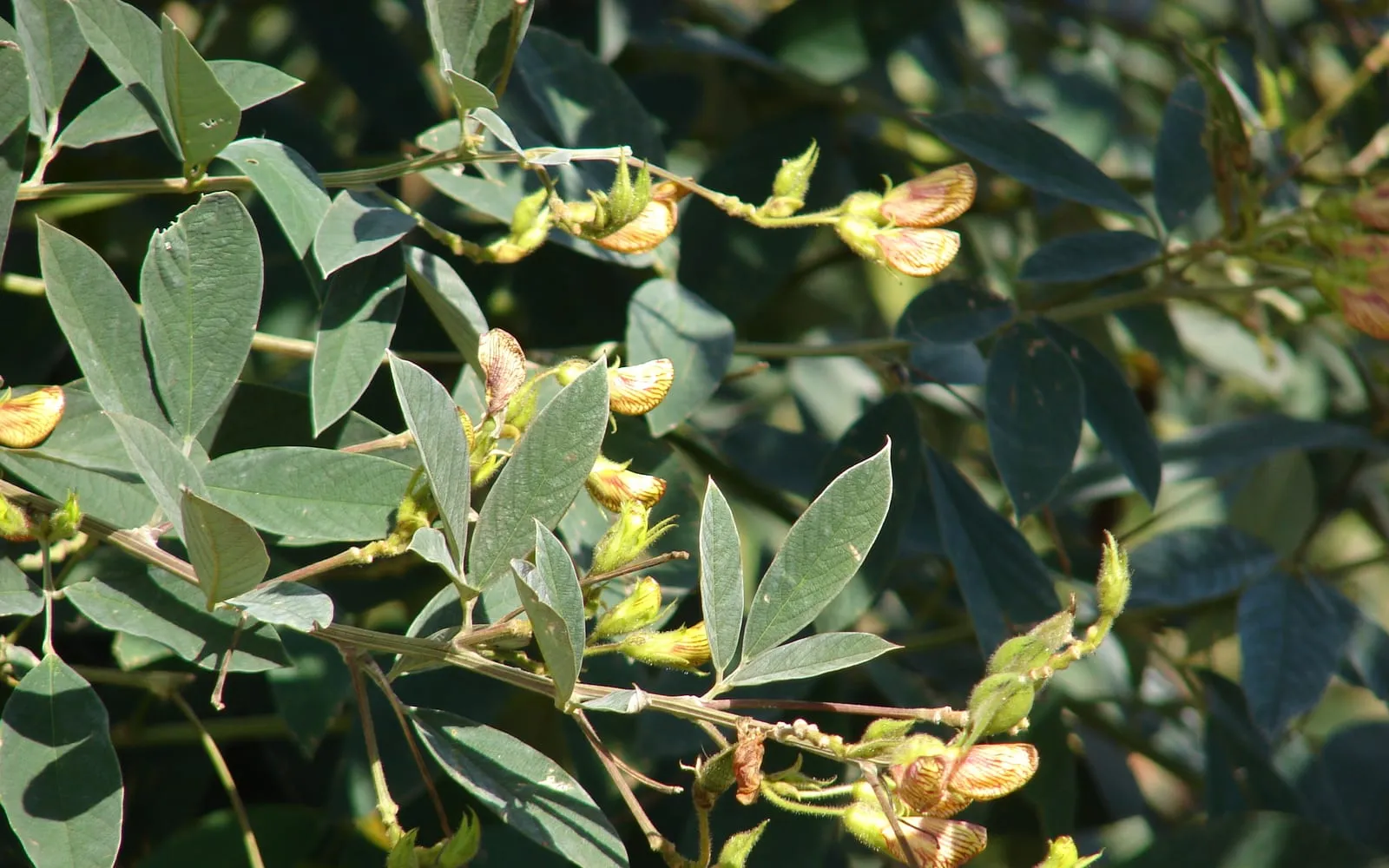
The plant is a branching shrub with woody lower stems and green upper growth, carrying trifoliate leaves whose leaflets are narrow, pointed and covered in fine hairs, with a silvery cast underneath. It looks more like a broom or a laburnum than like a bean.
The flowers are typical pea flowers, 2 cm across, usually yellow with red or maroon streaking on the back of the standard petal, carried in loose clusters at the branch tips. They are largely self-pollinating with a substantial amount of insect outcrossing, so saved seed drifts.
The pods are flat, 5 to 10 cm long, often marked with dark diagonal streaks, and they carry three to six seeds separated by visible constrictions. The seeds are round or lens-shaped and come in cream, brown, red, purple and mottled forms.
Where it is from
Pigeon pea was domesticated in India from the wild Cajanus cajanifolius, which grows in the eastern Ghats of Odisha and Andhra Pradesh. The archaeological record places cultivation from around 1500 BC, with finds from sites in south India.
It crossed to east Africa early, probably by 2000 years ago through Indian Ocean trade, and Africa developed its own distinct varieties. From Africa it went to the Caribbean in the transatlantic slave trade, which is why gungo peas are part of Jamaican cooking.
India remains dominant, producing the majority of the world’s crop, with Myanmar, Malawi and Tanzania following. The Caribbean and Latin America grow substantial quantities as a green vegetable rather than a dry pulse.
How it grows
Pigeon pea germinates in warm soil and grows slowly for the first two months while it builds a taproot. That slow start is deceptive, and the plant accelerates once the root is down.
Nodules form on the roots and fix nitrogen. The species associates with a broad range of rhizobia, which is part of why it establishes on land that has not grown legumes before.
Most traditional varieties are short-day plants that flower only as nights lengthen, which puts flowering in the autumn and makes them impossible at high latitude. Short-duration varieties bred since the 1970s flower in four months regardless, and those are the ones to look for.
The plant flowers and pods over a long period, and where it is grown as a perennial it will crop for several years, ratooning from the woody base after cutting.
Through the seasons
Sow indoors in March or April in deep pots, since the taproot resents disturbance and a shallow module produces a checked plant. Plant out at the end of May once frost has passed, 60 to 90 cm apart.
Growth is slow through June and rapid through July and August. A short-duration variety flowers in August.
Harvest green pods in September for use as a fresh vegetable, or leave them to dry on the plant into October for a dry pulse. Frost ends the crop, so a harvest in a cool climate is a race and a polytunnel improves the odds considerably.
Care difficulty
The plant is easy and the season is the obstacle. Pigeon pea asks almost nothing once established, tolerating drought, poor soil and heat, and it is unbothered by most of what troubles a bean.
Two things decide the outcome here. Variety choice comes first, since a traditional long-duration type will not flower before the frost. And root disturbance comes second, because the taproot is the whole basis of the plant and a seedling raised in a shallow tray never recovers properly.
Grow it in a large deep container or a polytunnel bed, choose a short-duration variety, and treat a green harvest as the realistic outcome rather than a dry one.
Watering
Water at planting and through the first month while the taproot goes down. After that the plant is one of the most drought tolerant pulses in cultivation and needs very little.
In a temperate climate, rainfall usually covers it. In a container the calculation changes entirely, since the taproot cannot escape the pot, and a large deep container still needs regular watering.
Waterlogging is fatal. Pigeon pea will not tolerate wet feet at any stage, and root rot on heavy ground is the commonest way to lose a plant.
Warning signs, diseases and pests
Fusarium wilt is the major disease of the crop in India, causing plants to yellow and die from one side, with a dark band visible under the bark of the stem near the base. It is soil-borne and does not usually appear on a first planting outside its homeland.
Botrytis attacks flowers and young pods in a wet September, coating them in grey fuzz and dropping them. Ventilation under cover is the answer.
Root rot follows waterlogging and shows as sudden collapse with brown roots.
Aphids gather on the growing tips. Red spider mite appears under glass in dry air, showing as fine speckling on the leaves and webbing at the tips. The pod borer caterpillar that is the principal pest across India is not present here.
Growing environment
Full sun, warmth and drainage. Pigeon pea grows at 20 to 35 deg C and is killed outright by frost, which limits it to the summer months anywhere with frost.
Soil tolerance is broad. The plant grows on poor, shallow, sandy and slightly acid ground and is valued for producing where other legumes fail. It needs free drainage more than fertility, and pH from 5 to 7.5 is acceptable.
The taproot wants two metres, so a deep bed or a tall container gives a better plant than a wide shallow one.
Feeding
Feed nothing. The plant fixes its own nitrogen and reaches phosphate that other crops cannot, releasing organic acids from its roots that unlock forms of it bound in the soil.
That phosphate-mobilising ability is part of why pigeon pea is grown in intercropping systems on poor tropical soils, where it improves what grows beside it.
If the plant is in a container, a low-nitrogen potash feed at flowering is reasonable, since a pot cannot supply what open ground would.
Troubleshooting
Is toor dal the same thing? Yes. Toor, arhar and red gram all name this species, and toor dal is the split hulled pulse that is a foundation of Indian cooking.
Why did my plant not flower? A long-duration variety, most likely. Those are short-day plants waiting for autumn nights that arrive after the first frost at high latitude. Buy a short-duration cultivar that flowers in about four months.
Can I grow it outdoors in a cool climate? In a hot summer, in a sheltered spot, a short-duration cultivar may give a green crop. A polytunnel makes it much more likely. Frost ends the plant entirely.
Is it a perennial? Yes, where the climate allows. It lives three to five years and can be cut back and regrown from the base. Anywhere with frost it is an annual, because frost kills it.
Why does it need a deep pot? The taproot goes down two metres in open ground and the plant depends on it. A seedling raised in a shallow module has its taproot checked and never grows properly afterwards.
Can I eat the green seeds? Yes, and much of the Caribbean and Latin American crop is used that way. Green pigeon peas are shelled and cooked like garden peas, and they are the peas in Jamaican rice and peas at Christmas.
Does it improve the soil? Substantially. It fixes nitrogen, breaks compaction with a deep taproot, and releases root acids that unlock phosphate other plants cannot reach, which is why it is grown between rows of cereals across India and east Africa.
Pigeon Pea problem guides
Not sure what is wrong? See the common vegetable pests guide.