
Edible
Mung Bean
Vigna radiata
Also known as Green gram, Moong, Beansprout bean, Golden gram
How to grow mung beans, Vigna radiata. The bean behind every punnet of beansprouts, a crop that finishes in ninety days, and the dal that fed India before rice.
At a glance
- Difficulty
- Moderate
- Water
- Moderate through flowering, then reduce
- Light
- Full sun
- Temperature
- 25-35 deg C, and it does nothing below 15
- Hardiness
- USDA 10-11, RHS H1b, hardy to 5 C
- Type
- Fast tender annual legume
- Height
- 40-90 cm
- Native to
- India, the western Ghats
Among the fastest pulses there is, at 60 to 90 days from sowing, and it wants 25 to 35 deg C throughout with nothing below 15. Rain at ripening sprouts the seed in the pod. That combination puts the field crop in dry warm regions and leaves sprouting on a windowsill as the option everywhere else.
Hardiness zones describe winter cold alone. Summer heat, humidity, rainfall and the length of the growing season decide as much, so treat the range as the outer limit rather than as a recommendation.
Edible, with limits
- Safe to eat
- The dried seed cooked, the sprouts, and the young pods cooked
- Do not eat
- Raw dried seed in quantity
- Harm from
- Eating it
- Affects
- People, dogs and cats
Mung beans are safe cooked and are among the mildest pulses. Raw dried seed contains lectins and protease inhibitors in the way all pulses do, at levels far below those in raw kidney beans, and it should still be cooked rather than eaten dry. Sprouted mung beans are eaten raw worldwide and the concern with them is microbial rather than chemical. Home sprouting creates warm damp conditions that suit salmonella and E. coli, and sprouts have caused outbreaks traceable to contaminated seed, so use seed sold for sprouting, rinse two or three times a day, keep the jar clean, and refrigerate the result. Anyone pregnant, elderly, very young or immunosuppressed is advised to eat sprouts cooked rather than raw. Mung bean is not one of the 14 named allergens in Britain, although legume allergy exists and cross-reactivity between pulses occurs.
Sources: Food Standards Agency on the 14 named allergens, NHS on food poisoning
About
Mung bean is the bean in a punnet of beansprouts. Almost every commercial beansprout sold anywhere is a sprouted mung bean, and the plant behind that familiar white shoot is a small fast bushy legume from India.
In its home range it is a major pulse. Moong dal, whole or split, hulled or unhulled, is everyday food across the Indian subcontinent, and the crop’s speed lets farmers fit it between two others in a season. Ninety days from sowing to harvest is normal and sixty is possible.
The starch has one other use. Mung bean starch, extracted and extruded, makes the translucent cellophane noodles used across East and South East Asia, which behave quite differently from wheat or rice noodles in a pan.
Appearance and character
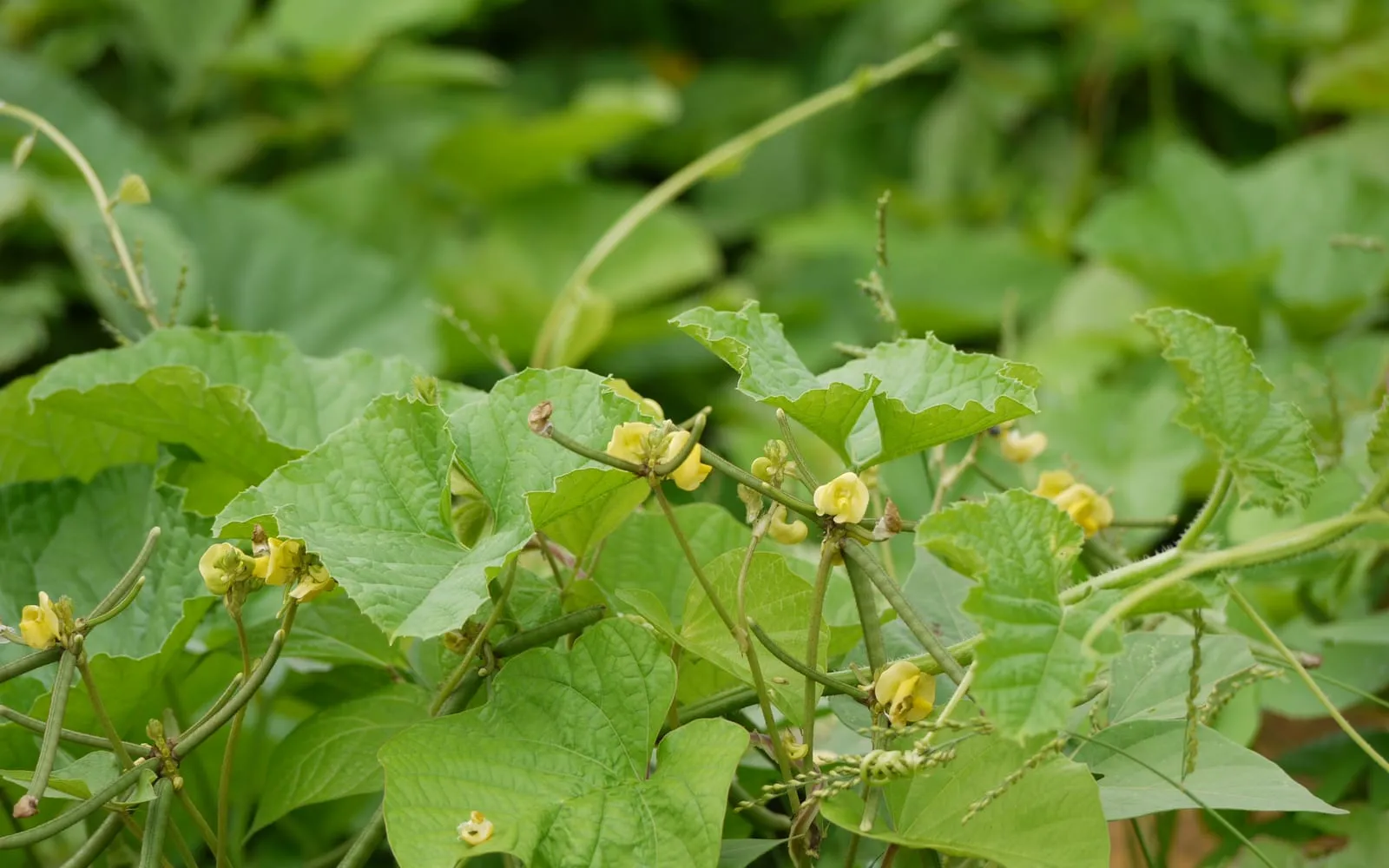
The plant is a low bushy annual, knee high at most, with trifoliate leaves whose leaflets are broadly oval and pointed. The whole plant carries fine brown hairs, and the stems have a slightly angular feel.
The flowers are small pea flowers, pale yellow to greenish yellow, carried in clusters at the tips of long stalks that stand clear of the foliage. They self-pollinate.
The pods are the field mark. They are thin, cylindrical, 6 to 10 cm long, hairy when young, and they turn from green through brown to almost black as they ripen, sticking out from the plant in all directions. Each holds ten to fifteen small seeds, usually the familiar dull green, occasionally yellow or black.
Where it is from
Mung bean was domesticated in India from the wild Vigna radiata variety sublobata, which grows across the subcontinent and into Australia. The archaeological record places cultivation in India from around 1500 BC, with finds from sites in Rajasthan and the south.
It spread east into China and south east Asia, and south into Africa. China adopted it thoroughly, and the sprouting tradition that gives the plant its visibility in the West is East Asian rather than Indian.
India remains the largest producer and consumer, with China, Myanmar and Indonesia following. The crop is grown across the tropics and subtropics wherever a short-season pulse fits between two other crops.
How it grows
Mung germinates fast in warm soil, within three or four days, and pushes its seed leaves above ground. Growth accelerates quickly once the plant has three true leaves.
Nodules form on the roots and fix nitrogen, hosting Bradyrhizobium strains that also nodulate cowpea and several other Vigna species, so a plot that has grown those will usually nodulate mung without an inoculant.
Flowering starts six to seven weeks after sowing and continues for several weeks, so pods at every stage from flower to black and dry appear on the same plant at once. Ripe pods shatter, twisting open and flicking seed several feet, which makes the harvest a matter of picking over the plant more than once.
Through the seasons
Sow indoors in April in modules, or outdoors from late May once the soil has reached 18 deg C. Cold soil gives poor patchy germination.
Plant out or thin to 10 cm apart in rows 45 cm apart. Growth is slow in a cool June and rapid in a warm July, and flowering starts about seven weeks in.
Harvest from late August, picking pods as they blacken rather than waiting for the whole plant, since ripe pods shatter. Dry the pods thoroughly, then shell them by hand or beat them in a bag. A polytunnel makes a crop in a cool climate far more reliable.
Care difficulty
Mung beans are easy where it is hot and marginal where it is not. The plant needs soil above 18 deg C to germinate cleanly and sustained warmth to fill pods, which in a cool climate means a polytunnel, a sunny wall or an exceptional summer.
Given warmth, nothing about the crop is difficult. It fixes its own nitrogen, resists most diseases, and finishes fast enough to fit after an early crop.
Harvesting is the fiddly part. The plant flowers over weeks and the pods ripen in sequence and shatter when ready, so a single harvest either takes unripe pods or loses ripe ones. Pick over the row two or three times.
Watering
Water through establishment and keep the plant moist through flowering and pod fill, which is when drought costs the most.
A weekly soak in a dry July is enough. The crop is drought tolerant by pulse standards and finishes fast, so it usually escapes the worst of a dry summer.
Reduce watering once the first pods have blackened, since moisture at that stage brings powdery mildew and encourages the plant to keep flowering rather than to finish.
Warning signs, diseases and pests
Powdery mildew appears late as a white dusty coating on the upper leaf surfaces, and it is the commonest disease of a crop grown under glass. Improve ventilation and accept some damage on a plant that is nearly finished.
Root rot follows cold wet ground and shows as yellowing plants that lift with brown roots. Free drainage and a warm start prevent it.
Aphids colonise the growing tips and the flower clusters, where they reduce pod set and spread virus. Slugs and pigeons take the seedlings, which come up with large soft seed leaves.
Pod shattering is the loss that costs seed. A ripe mung pod twists open sharply and throws its seed, so pick over the plants repeatedly rather than waiting for a single harvest.
Mexican bean beetle, a coppery ladybird-like beetle that eats leaves rather than aphids, skeletonises the foliage from the underside and is worst in the Mid-Atlantic and Appalachian United States. It has not established outside the Americas.
Growing environment
Full sun and heat. Mung bean wants 25 to 35 deg C, which is warmer than a temperate garden usually gets, so a polytunnel or the foot of a sunny wall is the right place.
Soil should be light, free-draining and near neutral to slightly alkaline, from pH 6.2 to 7.5. Heavy wet ground causes root rot and poor nodulation.
The crop tolerates drought and short seasons and does not tolerate cold. Frost kills it, and temperatures below 15 deg C stop growth entirely, which sets the sowing date at the end of May and the harvest deadline in early October.
Feeding
Feed nothing. Mung fixes its own nitrogen, and adding fertiliser suppresses the nodules and produces a leafy plant with fewer pods.
If the plot has never grown a Vigna, an inoculant sold for cowpea will usually serve, since the same bacterial group nodulates several species in the genus.
Cut the plants at the base at harvest and leave the roots in the ground, which keeps the fixed nitrogen where the next crop can use it.
Troubleshooting
Are beansprouts mung beans? Almost always. The white shoots sold in punnets are sprouted mung beans, and the crunchy stem is the hypocotyl rather than the root.
How do I sprout them at home? Rinse a couple of tablespoons of seed, soak overnight, drain, then keep them in a jar covered with muslin, rinsing and draining two or three times a day for three or four days. Use seed sold for sprouting, keep the jar clean, and refrigerate the result.
Are home-grown sprouts safe? With care. The warm damp conditions that sprout a seed also suit salmonella and E. coli, and outbreaks have been traced to contaminated seed. Anyone pregnant, elderly, very young or immunosuppressed should eat sprouts cooked.
Can I grow them outdoors in a cool climate? In a hot summer, in a sheltered sunny spot, you may get a crop. A polytunnel makes it far more likely, since the plant wants 25 deg C and above.
What is moong dal? The same bean, prepared several ways. Whole green moong is the intact seed; split moong with the skin on is chilkewali dal; hulled and split gives the yellow moong dal that cooks in twenty minutes.
Why are my pods bursting open? Ripe mung pods shatter, twisting sharply and throwing seed. Pick pods as they blacken rather than waiting for the whole plant to finish.
Are cellophane noodles made from these? Yes. Mung bean starch is extracted and extruded into the translucent noodles sold as glass or cellophane noodles, which stay slippery and never go starchy in the way wheat noodles do.
Do I need to inoculate the seed? Usually not, if the plot has grown cowpeas or another Vigna. The same bacterial group nodulates several species in the genus.
Mung Bean problem guides
Not sure what is wrong? See the common vegetable pests guide.