
Pest
Fall armyworm
Spodoptera frugiperda
A grass or grain crop stripped from the growing point outward by a striped caterpillar with a pale upside-down Y on its head. Native to the Americas, established across Africa since 2016, Asia since 2018 and Australia since 2020, and now one of the most consequential crop pests in the world.
At a glance
- Type
- Pest
- Cause
- Insect
- Severity
- Destroys the crop or display
- Affects
- Herbs and edibles
- Active
- June to September
- Established in
- North America, Central and South America, Africa, Asia, Australia and Pacific Islands
What you are seeing
- Ragged, elongated holes eaten in young leaves, often before the leaf has fully unrolled, leaving a distinctive row of holes once it opens
- Sawdust-like frass packed into the whorl at the centre of a maize or sorghum plant, where the caterpillar feeds hidden from view
- The growing point itself eaten out, killing the plant outright in a young seedling
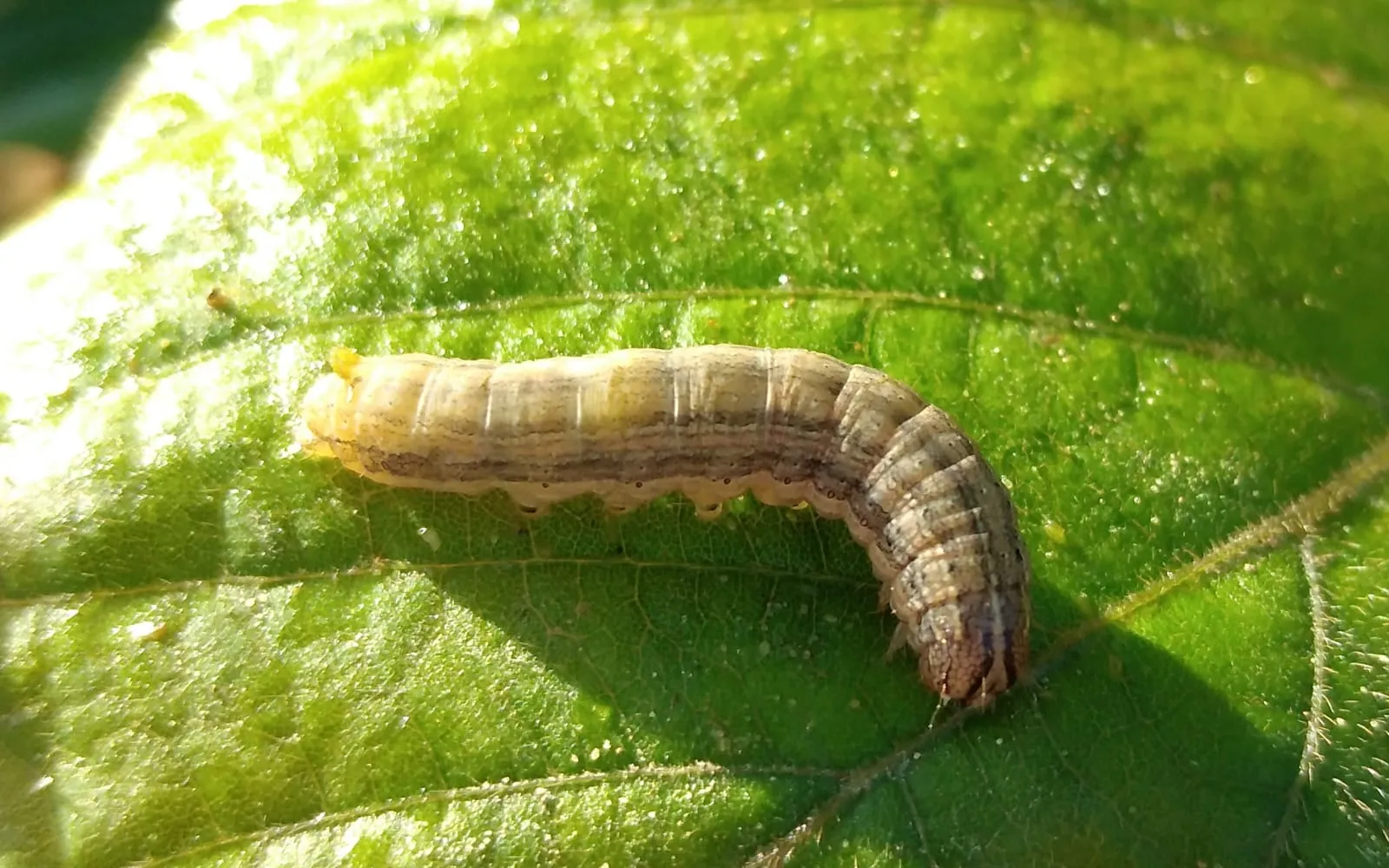
- Caterpillars pale brown to nearly black with three thin pale lines down the back, a pale inverted Y-shaped mark on the head, and four raised black spots arranged in a square near the tail end
- Damage appearing suddenly and heavily across a field, since the moths disperse and lay in large numbers rather than building up gradually
- Grain crops other than maize and sorghum, including rice and the smaller millets, showing the same whorl damage where those are the dominant local crop
Before you treat anything
None beyond ordinary care handling caterpillars. Grain from a damaged crop is safe once cleaned; the loss is in yield rather than food safety.
What you are looking at
Young leaves with ragged, elongated holes eaten through them, often in a neat row once the leaf unrolls, because the caterpillar was feeding on it while it was still furled. Look into the whorl at the centre of the plant, where maize, sorghum and the millets all carry their youngest growth, and there is usually moist, sawdust-like frass packed into it, with the caterpillar itself hidden inside. On a young seedling, the growing point can be eaten out entirely, killing the plant.
The caterpillar is pale brown to nearly black, marked with three thin pale lines running down its back, and carries two features that identify it reliably with a hand lens: a pale, upside-down Y-shaped mark on the head, and four raised black spots arranged in a square close to the tail end.
A pest that crossed four continents in under a decade
This species has always been a recurring seasonal pest across the warmer Americas, where local natural enemies and generations of crop breeding have kept it manageable. Its arrival everywhere else has been anything but gradual. First confirmed in West Africa in 2016, it spread across almost the entire continent within two years, helped by an adult moth able to fly several hundred kilometres in a single night at altitude. It reached South and Southeast Asia by 2018 and northern Australia in February 2020, and is now considered established across most of the tropical and subtropical world, a spread that took the fastest-moving crop pests of the twentieth century decades to match.
Europe and New Zealand have so far avoided an overwintering, self-sustaining population, though both see occasional wind-assisted or imported moths arrive. A confirmed find in either is reportable rather than something to manage as an established pest, because the pattern everywhere else has been rapid establishment once a population takes hold.
What to do about it
Scout the crop weekly from the seedling stage, checking whorls for frass and holes, and act on the first plants found rather than waiting for field-wide damage to appear.
Work a pinch of fine sand, wood ash or soil into the whorl of affected plants, an effective and widely used low-input control where other options are limited.
Hand-pick caterpillars from the whorl on a garden-scale planting.
Plant early within the locally recommended window so the crop is past its most vulnerable seedling stage before moth numbers peak.
Where available, grow varieties bred for tolerance, and consider a push-pull intercropping system, which has shown a real reduction in damage in the same maize-growing regions it was developed for.
Spray Bacillus thuringiensis on young larvae feeding in the open, before they move into the whorl where sprays struggle to reach them.
What it gets mistaken for
General caterpillars found on maize and sorghum rarely feed hidden inside the whorl or leave frass packed into it the way this species does, and the pale Y-mark on the head and the square of four spots near the tail are reliable features to check with a hand lens.
Corn smut and other fungal galls swell and distort plant tissue into grey or black growths with no chewing damage present, which is a different failure mode entirely from this species’ ragged holes and frass.
Not established in Europe and New Zealand
Do not prune, spray or otherwise treat a suspected case. Doing so risks spreading an organism the country has kept out, and it disturbs the evidence needed to identify it. Photograph what you can see, leave the plant alone, and contact your national or state plant health authority. The control advice further down this page is written for regions where this problem is already established.
Native throughout the warmer Americas, where it has always been a recurring seasonal pest of maize rather than a novel one. Everything changed from 2016, when it was first confirmed in West Africa and then spread across almost the entire continent within two years, helped by an adult moth capable of flying several hundred kilometres in a single night at altitude. It reached South and Southeast Asia by 2018 and northern Australia in February 2020, and is now considered established across most of the tropical and subtropical world. Europe and New Zealand remain free of an overwintering, self-sustaining population, though both receive occasional wind-blown or imported moths, and both treat a confirmed find as reportable given how fast this species has moved everywhere else it has reached.
What to do, in order
The steps below apply where this problem is already established.
Start here
Prevention, and the changes that stop the problem returning. Most of these pages should end at this tier.
- Scout the crop weekly from seedling stage
- Early detection matters more with this pest than almost any other, because a young seedling can be killed outright if the growing point is eaten before other leaves have formed. Checking whorls for frass and holes from the first true leaves onward, and acting on the first plants found rather than waiting for visible field-wide damage, saves far more of a crop than treating an established infestation.
- Plant early where the local season allows it
- Younger, more vigorous plants tolerate leaf feeding better than seedlings do, and a crop planted at the start of the optimal local window is past its most vulnerable stage before moth numbers peak in many regions.
- Grow a resistant or push-pull companion system where available
- Several maize varieties bred for the smallholder farming systems most affected carry useful tolerance. Push-pull systems, which intercrop maize with a repellent companion such as Desmodium and border it with an attractive trap grass such Napier grass, were developed against a related stem borer in East Africa and have shown a genuine reduction in fall armyworm damage in the same fields.
Then reach for a barrier
Netting, hand removal and water. Nothing here harms anything except the target.
- Apply sand, ash or soil mixed with a little detergent into the whorl
- A pinch of fine sand, wood ash or soil worked into the funnel of leaves at the centre of a young maize plant physically abrades and smothers small caterpillars feeding there, and it is practical for a smallholder without access to other inputs, though it needs repeating and works best while caterpillars are still small.
- Hand-pick caterpillars from the whorl on a small planting
- On a garden scale, unrolling the whorl of an affected plant and removing caterpillars by hand is effective, since a single plant rarely carries more than one or two large larvae, which are cannibalistic and kill each other when crowded.
Then bring in the predators
Encourage what already lives in the garden, and buy predators in where the problem is under glass and nothing will arrive on its own.
- Conserve natural predators and parasitoid wasps
- A wide range of generalist predators and several parasitoid wasp species attack fall armyworm eggs and larvae across its expanded range, including some already established in Africa and Asia before this species arrived. Avoiding broad-spectrum insecticide use preserves this background control, which research across smallholder fields has found reduces damage meaningfully on its own.
- Apply Bacillus thuringiensis on young larvae
- Bt sprays work on young larvae feeding in the open before they move into the whorl, where they become far harder for any spray to reach. Timing to the first sign of damage rather than waiting matters more than the product used.Widely available across the Americas and increasingly registered in Africa and Asia; check local registration before buying.
Biological controls are live organisms and their sale and release are regulated country by country. An agent sold freely in one place may be unapproved in another, so buy from a licensed supplier where you live and never import or move one yourself.
Plants affected
Guides that name it among the problems to watch for. The list is the plants it is characteristic of rather than everything it will feed on.