
Edible
Chickpea
Cicer arietinum
Also known as Garbanzo, Chana, Gram, Bengal gram, Egyptian pea
How to grow chickpeas, Cicer arietinum. A plant that sweats acid onto its own leaves, the difference between desi and kabuli, and the water you should stop pouring away.
At a glance
- Difficulty
- Moderate
- Water
- Sparingly. Water through flowering and then stop
- Light
- Full sun
- Temperature
- 15-30 deg C, and the crop wants a dry warm ripening
- Hardiness
- USDA 5-10, RHS H3, hardy to -5 C
- Type
- Annual legume
- Height
- 30-70 cm
- Native to
- south-eastern Turkey, the upper Euphrates
- Best month
- April, May and September in the Northern Hemisphere, October, November and March in the Southern Hemisphere
A dry ripening period is the condition, and rain on a maturing crop brings ascochyta blight and splits the pods. That confines it to Mediterranean and continental climates with reliable summer drought. Desi types tolerate more heat and poorer soil than the larger kabuli ones.
Hardiness zones describe winter cold alone. Summer heat, humidity, rainfall and the length of the growing season decide as much, so treat the range as the outer limit rather than as a recommendation.
Every month named in this guide is for the temperate Northern Hemisphere. If you garden in the Southern Hemisphere, shift each one by six months, so April becomes October. Closer to the equator the wet and dry seasons matter more than the calendar, and the shift stops being a useful guide.
Edible, with limits
- Safe to eat
- The dried seed cooked, and the young pods and shoots cooked
- Do not eat
- Raw and undercooked seed
- Harm from
- Eating it
- Affects
- People, dogs and cats
Chickpeas are safe and widely eaten once cooked. Raw and undercooked seed contains lectins and protease inhibitors that cause digestive upset, so dried chickpeas should be soaked and boiled properly rather than eaten raw or sprouted uncooked. Chickpea is not one of the 14 named allergens in Britain, although legume allergy is real and reactions to chickpea are documented, sometimes in people who also react to lentil. Anyone handling the growing plant should know about the acid. Chickpea leaves and pods are covered in glandular hairs that exude a mixture of malic and oxalic acid, strong enough to sting broken skin and to have been collected historically as a source of vinegar in India. Wear gloves when harvesting a large quantity in warm weather. In dogs and cats, plain cooked chickpeas in small amounts are safe, and the unresolved veterinary question about grain-free pet foods high in pulses is a matter for a vet.
Sources: Food Standards Agency on the 14 named allergens, RHS on potentially harmful garden plants
About
The chickpea is another of the eight founder crops, domesticated in south-eastern Turkey around 8000 BC, and it is now the second most important pulse in the world after the common bean. India grows and eats most of it.
The plant does something unusual. Its leaves, stems and pods are covered in glandular hairs that secrete a mixture of malic and oxalic acid, so the whole plant is sticky and sour to the touch. That secretion deters insects, and in India it was traditionally collected by spreading cloths over a crop overnight and wringing out the dew, which gave a usable vinegar.
Two types divide the crop. Desi chickpeas are small, angular, dark and thick-skinned, and they dominate in India, where they are split into chana dal and milled into gram flour. Kabuli chickpeas are larger, paler, rounder and thinner-skinned, and they are what a European or North American tin of chickpeas contains.
Appearance and character
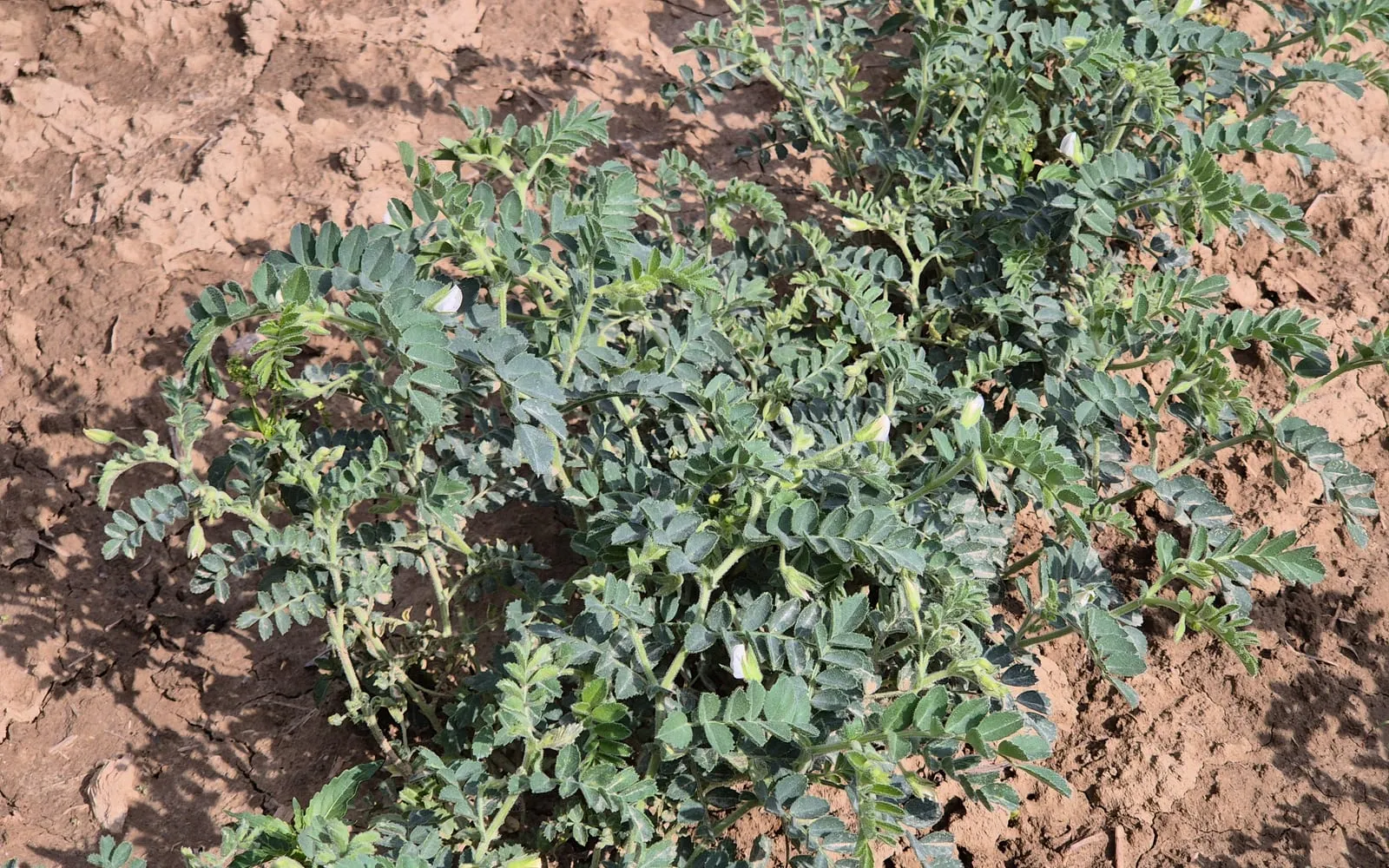
The plant is a low branching bush, 30 to 70 cm tall, with fine pinnate leaves made of nine to fifteen small toothed leaflets. It looks feathery from a distance, and the whole plant is covered in fine hairs that make it sticky in warm weather.
The flowers are small pea flowers, 8 to 10 mm, white in kabuli types and pink, blue or violet in desi types, carried singly on a stalk from a leaf joint. They self-pollinate before they open.
The pod is inflated and oval, about 2 to 3 cm long, and it usually holds one or two seeds. The seed has a distinctive beaked shape with a small point at one end, which the botanical name records: arietinum means ram-like, after a supposed resemblance to a ram’s head.
Where it is from
The wild ancestor is Cicer reticulatum, which has an extremely restricted range in south-eastern Turkey, near the upper Euphrates in the same region that produced einkorn. Domestication happened there around 8000 BC.
Chickpeas spread with Neolithic farming into the Mediterranean, Egypt, Ethiopia and the Indian subcontinent, and India became the centre of production and consumption it remains. The desi type developed there.
The kabuli type is a later development, larger-seeded and pale, which spread through the Mediterranean and reached India via Afghanistan, hence the name. Australia, Turkey and Myanmar are now major exporters, and Britain has grown small commercial areas since the 2010s.
How it grows
Chickpeas germinate in warm soil and, like lentils, keep their seed leaves below ground, so a plant grazed off at the surface can regrow.
Root nodules form within a few weeks, hosting Mesorhizobium bacteria that fix nitrogen from the air. The nodules are pink inside when they are working, and the partnership is specific enough that a plot which has never grown chickpeas may benefit from an inoculant.
The plant branches into a low bush, flowers over several weeks from midsummer, and forms pods behind the flowers as it goes. Ripening is uneven for the same reason. The crop needs a dry warm period to finish, and rain during pod fill brings the disease that limits chickpeas in a wet climate.
Through the seasons
Sow from mid-April to May, once the soil has warmed to 10 deg C, at 5 cm deep in rows 30 to 45 cm apart. Sowing into cold wet soil rots the seed.
The plant grows slowly through May and branches through June. Flowering starts in July and runs for several weeks, with pods swelling behind the flowers.
Harvest in September when the plants have yellowed and the pods rattle. Pull or cut the whole plants, dry them under cover, and thresh by beating them in a bag. Wear gloves for the pulling if the weather is warm, since the acid secretion stings broken skin.
Care difficulty
Chickpeas grow easily in a cool climate and ripen with difficulty. The plant establishes readily, needs no feeding, tolerates drought and poor ground, and looks after itself through the summer.
Ascochyta blight is what decides the outcome. It is a seed-borne and rain-splashed fungus that thrives in cool wet conditions and can take a crop down in a fortnight, and a wet August supplies exactly what it wants. Space the plants widely, keep them off ground that grew chickpeas last year, and do not save seed from an affected crop.
Given a dry late summer, a garden row will produce a reasonable crop. Given a wet one, expect to lose it, and treat the whole thing as a rotation benefit rather than a food supply.
Watering
Water sparingly. Chickpeas root deeply and are among the more drought tolerant pulses, which is why they are grown on residual moisture across India after the monsoon.
The one period worth watering is flowering in a dry July, since drought then reduces pod set. Once the pods are filling, stop, because moisture at that stage delays ripening and feeds the blight.
Waterlogging kills them. Chickpeas want free drainage at every stage, and heavy wet ground causes root rot and poor nodulation.
Warning signs, diseases and pests
Ascochyta blight is what takes a chickpea crop in a damp summer. It shows as circular tan lesions with dark brown margins on leaves, stems and pods, often carrying small black dots in concentric rings, and stems girdled by a lesion break. It spreads in rain splash and is carried on seed, so an affected crop should not be saved from.
Botrytis grey mould takes hold in a dense crop in wet weather, coating stems and pods, and it is a second reason to space plants widely rather than crowding them.
Aphids colonise the growing tips and spread virus. The plant’s acid secretion deters many insects but not these.
Root rot follows waterlogging, showing as yellowing plants that pull up easily with brown roots. Slugs take seedlings, and pigeons graze young plants. The pod borer caterpillar that is the major chickpea pest across India does not occur here.
Growing environment
Full sun and free drainage, on the lightest and driest ground available. A raised bed or a sloping site both help.
The soil should be neutral to alkaline, from pH 6 to 8, and a chalky or limy plot suits the crop well. On acid ground both the plant and its nitrogen-fixing bacteria perform poorly.
The seed rots in cold wet soil, so wait until mid-April, and the crop needs a dry warm September to ripen. A sheltered south facing bed is the right place for it, and a polytunnel makes the crop far more reliable.
Feeding
Do not feed nitrogen. The plant fixes its own, and adding nitrogen suppresses nodulation and produces a leafy plant with fewer pods.
Phosphate matters for nodule formation, so a plot short of it is worth correcting before sowing rather than after. A light potash dressing at flowering helps on poor ground.
Cut the plants at the base at harvest rather than pulling them, so the nodules and the nitrogen they hold stay in the soil for whatever follows.
Troubleshooting
What is the difference between desi and kabuli? Size, colour and skin. Desi chickpeas are small, angular, dark and thick-skinned, and they are split into chana dal and milled into gram flour. Kabuli are larger, paler, rounder and thinner-skinned, and they are what a European or North American tin contains.
Can I grow them in a cool climate? Yes, and whether you get a crop depends on September. The plant grows well, and ascochyta blight in a wet late summer is what takes the harvest. A polytunnel improves the odds considerably.
Why is the plant sticky? Glandular hairs all over the leaves and pods exude malic and oxalic acid, which deters insects. It stings broken skin, so wear gloves when pulling a crop in warm weather. In India the dew was traditionally collected off the plants as a vinegar.
What is aquafaba? The water from a tin of chickpeas, or from cooking your own. It contains dissolved proteins and starches that whip like egg white, and it is used as a vegan meringue and mayonnaise base. Stop pouring it away.
Do I have to soak dried chickpeas? Yes, for eight hours or overnight, and then boil them properly. Undercooked chickpeas contain lectins and protease inhibitors that cause digestive upset, and they are unpleasantly hard besides.
Can I sow chickpeas from the kitchen? Whole dried chickpeas often germinate. Check a few on damp kitchen paper first, since some are heat treated.
Can I eat the young pods? Yes, cooked. Young green chickpeas in the pod are eaten in India as hara chana, and the fresh seeds are good. Cook them rather than eating them raw.
Do I need to inoculate the seed? It is more worthwhile than with lentils or peas, since the bacteria that nodulate chickpeas are less common in cool temperate soil. A plot that has never grown them may nodulate poorly in the first year.
Chickpea problem guides
Not sure what is wrong? See the common vegetable pests guide.