
Outdoor plant
Cotton
Gossypium hirsutum
Also known as Upland cotton, American cotton, Mexican cotton
How to grow upland cotton, Gossypium hirsutum. The seed hair that clothes the world, the boll that has to open before frost, and the poison in the seed.
At a glance
- Difficulty
- Moderate
- Water
- Twice a week through growth, tapering as the bolls form
- Light
- Full sun
- Temperature
- 21-30 deg C, and it stops below 15
- Humidity
- Moderate, with a dry spell wanted as the bolls open
- Hardiness
- USDA 8-11, RHS H2, hardy to 10 C
- Type
- Tender perennial shrub grown as an annual
- Height
- 1-1.5 m as an annual
- Native to
- Mexico, Central America
- Best month
- April and September in the Northern Hemisphere, October and March in the Southern Hemisphere
Bolls need roughly 1,500 to 1,800 growing degree days above a 15.5 C base to open, and about 180 to 200 frost-free days, which is the number that decides whether a season is long enough anywhere. Upland cotton, Gossypium hirsutum, is around ninety per cent of the world crop. It is a perennial shrub grown as an annual, and it wants heat and sun through boll fill and dry weather at picking, since rain on an open boll stains and weakens the fibre.
Hardiness zones describe winter cold alone. Summer heat, humidity, rainfall and the length of the growing season decide as much, so treat the range as the outer limit rather than as a recommendation.
Every month named in this guide is for the temperate Northern Hemisphere. If you garden in the Southern Hemisphere, shift each one by six months, so April becomes October. Closer to the equator the wet and dry seasons matter more than the calendar, and the shift stops being a useful guide.
Toxic if eaten
- Do not eat
- The seed, which contains gossypol
- Harm from
- Eating it
- Affects
- People, cats, dogs and horses
Cotton is a fibre crop rather than a food and its seed carries gossypol, a yellow polyphenol the plant makes as a defence. Gossypol damages the liver and the heart, causes reproductive harm, and is toxic to monogastric animals including pigs, poultry, dogs and people. Ruminants tolerate more of it, which is why cottonseed meal is fed to cattle and not to pigs. Refined cottonseed oil is safe because processing removes the gossypol, and glandless cultivars bred to lack it exist but have never taken over. Do not eat raw cottonseed, do not feed it to pets or poultry, and clear fallen seed where animals graze. EFSA treats gossypol as an undesirable substance in animal feed and sets limits by species. The lint itself is inert. Neither the RHS nor the ASPCA lists Gossypium hirsutum by name, and the gossypol evidence is reason enough for care.
Sources: EFSA on gossypol as an undesirable substance in animal feed, RHS potentially harmful garden plants, ASPCA toxic and non-toxic plants
About
Cotton is a seed hair. Each fibre is a single elongated cell growing out of the seed coat, and its job in nature is to help the seed travel. Upland cotton, Gossypium hirsutum, supplies about ninety per cent of the world crop, and almost every cotton garment in your wardrobe began as this plant.
The flower is a hibiscus and looks it. It opens creamy white or pale yellow, turns pink over the next day, then deep red before falling, so a plant in flower carries three colours at once and a grower can read the age of each bloom off its colour.
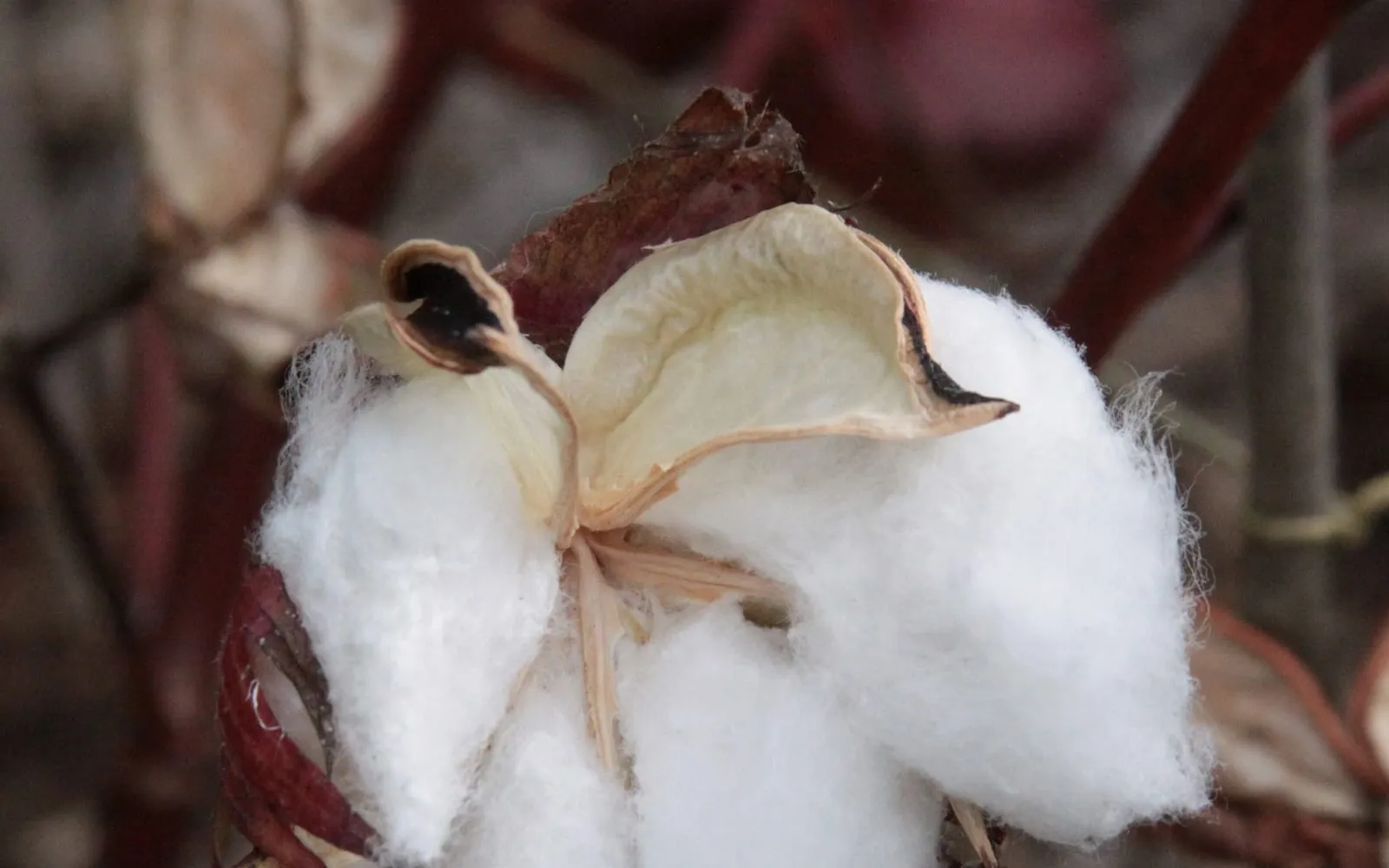
What follows is the boll, a leathery capsule that dries, splits into four or five segments, and lets the packed lint spring out.
Cotton drove the plantation economy of the American South and the enslavement of millions, and it fed the mills of Lancashire. When the American Civil War cut the supply, the cotton famine closed those mills and starved the people who worked in them.
Appearance and character
A bushy shrub, grown as an annual at 1 to 1.5 m, woody at the base by the end of the season.
Stems are green flushing red, with fine hairs.
Leaves are broad and palmate with three to five lobes, 5 to 15 cm across, on long stalks, with small dark glands visible against the light.
Flowers are large hibiscus flowers, 5 to 7 cm across, opening cream or pale yellow and ageing through pink to deep red over two or three days.
Three large fringed bracts wrap the base of each flower and stay on to enclose the developing boll.
The boll is an oval leathery capsule 2 to 5 cm, ripening brown, splitting into four or five segments to reveal the lint.
Lint is white and 2 to 3 cm long in upland cotton, shorter than the extra-long staple of Gossypium barbadense.
Inside the lint sit the seeds, dark and covered in short fuzz, each carrying gossypol in visible dark glands.
Where it is from
Gossypium hirsutum was domesticated in Mesoamerica, in southern Mexico and Guatemala, at least five thousand years ago, from wild perennial forms that still grow around the Caribbean.
Cotton was domesticated four separate times on two continents. Two Old World species in Africa and India and two New World species in Mesoamerica and Peru, all independently, all producing spinnable lint.
Indian cotton reached the ancient Mediterranean through trade, and Indian cotton cloth dominated world markets until the eighteenth century.
Upland cotton took over after the American cotton gin of 1793 made short-staple cotton economic to process. What followed was the expansion of slavery across the American South and the industrialisation of Lancashire on the other side of the Atlantic.
China, India, the United States, Brazil and Pakistan are the main producers now. It needs roughly 1,500 to 1,800 growing degree days to open a boll, so anywhere with a shorter or cooler season a plant under glass is a curiosity and a history lesson.
How it grows
Sow in April at 20 to 25 deg C, two seeds to a 9 cm pot, 1.5 cm deep.
Germination takes one to two weeks in warmth and is poor in cold compost.
Plant out into a greenhouse or polytunnel border in late May, 45 to 60 cm apart. In a cool summer it will grow outdoors and rarely open a boll.
Give full sun and heat, with 21 to 30 deg C for real growth.
Water steadily through flowering and boll development.
Feed a balanced feed to start and switch to high potash once flowering begins.
Pinch the growing tip in August, which stops the plant setting flowers that have no time to mature.
Reduce watering as the bolls fill, since a dry spell is what makes them open cleanly.
Harvest by picking the lint out of each open boll by hand, which is how it is still done in much of the world.
Separate the seed from the lint by hand, which takes a surprising amount of time and explains why the cotton gin mattered so much.
Discard the seed safely, since it contains gossypol.
Through the seasons
April is for sowing in warmth.
May is growing the young plants on and planting out under cover at the end of the month.
June and July are branching growth and the start of flowering.
July and August are the main flowering period, with each flower passing from cream through pink to red in two or three days.
August is when to pinch the growing tips and stop new flowers.
September is boll development, and the point to reduce watering.
October is when the bolls split, if the season has been warm enough.
Winter does not apply outside the tropics. Cotton is sown fresh each year wherever it frosts.
Care difficulty
Moderate under glass, and the difficulty is finishing rather than growing.
Germination needs 20 deg C and warm compost.
The plant grows and flowers readily in a greenhouse in a cool climate.
Opening the bolls is the hard part, since it needs a long warm autumn and a dry spell.
Whitefly is the standard greenhouse problem and it multiplies fast on cotton.
Pinching the tips in August is what concentrates the plant’s effort on bolls that can finish.
Watering
Water twice a week from planting out.
Increase through flowering.
Water at the root in the morning and keep the foliage dry.
Reduce as the bolls fill in September, which encourages them to open.
Stop watering once the first bolls split.
Never leave the plant standing wet, which brings root rot in a cool greenhouse.
Warning signs, diseases and pests
Clouds of small white insects rising from the plant are whitefly, which cotton attracts strongly and which sticks the lint together with honeydew.
Fine speckling with webbing is red spider mite in dry glasshouse air.
Curled tips with sticky residue are aphids.
Flower buds dropping before opening usually means cold nights or dry roots.
Bolls that stay green and closed into November have run out of season.
Lint that is grey and matted has been rained on or has had honeydew and sooty mould on it.
Wilting with brown staining in a cut stem is verticillium wilt.
Yellowing lower leaves with wilting in wet compost is root rot.
Boll weevil, a snout weevil that punctures flower buds and bolls, was once the defining pest of American cotton before a decades-long eradication campaign removed it from nearly the entire United States. It survives only in a small area of southern Texas and remains established through Mexico and Central America, and has never established outside the Americas.
Desert locust swarms can strip a cotton field to bare stems within hours during an upsurge, across an invasion area spanning North and West Africa, the Middle East and south-west Asia. It is the most destructive migratory pest on earth, and a hopper band or swarm within that range should be reported to the national locust control authority immediately.
Pink bollworm tunnels inside the boll from the flower stage, fusing petals into a tight rosette and staining the lint yellow or brown. It was eradicated from the continental United States in 2018 after a five-decade campaign, but it remains one of the most damaging cotton pests across Africa, Asia and Latin America. Destroy crop residue after harvest and use certified seed.
Growing environment
A greenhouse or polytunnel wherever the season is short of about 180 frost-free days. Outdoors below that will give a plant and rarely a boll.
Full sun.
Minimum 15 deg C, with 21 to 30 deg C for growth.
Deep free-draining moderately fertile soil.
Spacing of 45 to 60 cm.
A dry warm autumn under cover, which is what opens the bolls.
Good ventilation to keep whitefly and mite in check.
Feeding
Dig in compost before planting, without overdoing it.
Feed a balanced liquid feed fortnightly from planting out.
Switch to a high-potash tomato feed once flowering starts.
Avoid heavy nitrogen after midsummer, which delays boll opening and produces leaf.
Mulch to hold moisture through the flowering period.
Stop feeding at the end of August.
Troubleshooting
Is cotton a seed or a fruit? Neither. Each fibre is a single elongated cell growing from the seed coat, so a boll of cotton is a mass of seed hairs.
Why do the flowers change colour? They open cream or pale yellow, turn pink on the second day and deep red on the third before falling. A plant in flower shows all three at once.
My bolls never opened. The season ran out. Bolls need a long warm autumn and a dry spell to split. Pinch the growing tips in August so the plant stops setting flowers it cannot finish.
Can I grow it outdoors where I am? It needs about 180 to 200 frost-free days and 1,500 growing degree days to open a boll, which USDA zone 8 and warmer supplies. In a cool summer it will grow and flower and rarely open a boll, and under cover is the only reliable route.
Is the seed edible? No. Cottonseed contains gossypol, which damages the liver and heart and is toxic to people, pigs, poultry and dogs. Refined cottonseed oil is safe because processing removes it.
Can I feed the seed to chickens? No. Poultry are monogastric and gossypol is toxic to them, and only ruminants tolerate cottonseed meal in any quantity.
How do I get the seed out of the lint? By hand, slowly. Separating short staple cotton from its seed was the bottleneck that the cotton gin removed in 1793, with consequences that reshaped a continent.
What is the difference between this and Egyptian cotton? Species. Upland cotton is Gossypium hirsutum with lint of 2 to 3 cm. Egyptian, Pima and Sea Island cottons are Gossypium barbadense, with a longer finer staple.
Is it a perennial? In the tropics, yes, and it can be grown as a shrub for several years. Anywhere that frosts it is treated as an annual because it will not survive the winter.
Cotton problem guides
Not sure what is wrong? See the common vegetable pests guide.
- Whitefly under glass, which cotton attracts strongly
- Red spider mite in dry glasshouse air
- Aphids on the growing tips
- Root rot in cold wet compost
- Verticillium wilt, a major disease of the crop worldwide
- Boll weevil, eradicated from nearly all of the US but present in Mexico and Central America
- Desert locust, capable of stripping a whole crop across Africa and south-west Asia
- Pink bollworm, eradicated from the US but still a major threat across Africa, Asia and Latin America