
Edible
Okra
Abelmoschus esculentus
Also known as Lady's fingers, Bhindi, Gumbo, Bamia, Quiabo
How to grow okra, Abelmoschus esculentus. Getting the seed to germinate, picking before the pod turns to string, and what to do about the slime if you would rather not have it.
At a glance
- Difficulty
- Moderate
- Water
- Twice a week, more once the pods are coming
- Light
- Full sun
- Temperature
- 25-30 deg C, with nothing below 15
- Humidity
- Moderate
- Hardiness
- USDA 10-11, RHS H1b, hardy to 5 C
- Type
- Tender annual
- Height
- 1-2 m
- Native to
- East Africa, Ethiopia
- Best month
- April and August in the Northern Hemisphere, October and February in the Southern Hemisphere
Soil below 18 deg C stops germination outright, which is a higher floor than any bean or cucurbit and the reason okra fails from a direct sowing in a cool spring. Heat and humidity suit it, and it takes drought once away. Pods go woody within two or three days of reaching size, so picking is a daily job in warm weather.
Hardiness zones describe winter cold alone. Summer heat, humidity, rainfall and the length of the growing season decide as much, so treat the range as the outer limit rather than as a recommendation.
Every month named in this guide is for the temperate Northern Hemisphere. If you garden in the Southern Hemisphere, shift each one by six months, so April becomes October. Closer to the equator the wet and dry seasons matter more than the calendar, and the shift stops being a useful guide.
Skin irritant
- Safe to eat
- The young pods, the young leaves, and the seeds when roasted
- Do not eat
- None, though the bristles on the pods and stems irritate skin
- Harm from
- Handling it
- Affects
- People
Okra is food and nothing about it is poisonous. The only complaint is mechanical. The pods, stems and leaves of many cultivars are covered in fine stiff bristles that break off in the skin and cause an itching rash on the forearms of anyone picking a row, which is why commercial pickers wear long sleeves and gloves. The bristles wash off the pods and cook away. Spineless cultivars exist and are worth choosing for a garden. Neither the RHS nor the ASPCA lists Abelmoschus esculentus, and cooked pods in small amounts do no harm to cats or dogs.
Sources: RHS potentially harmful garden plants, ASPCA toxic and non-toxic plants
About
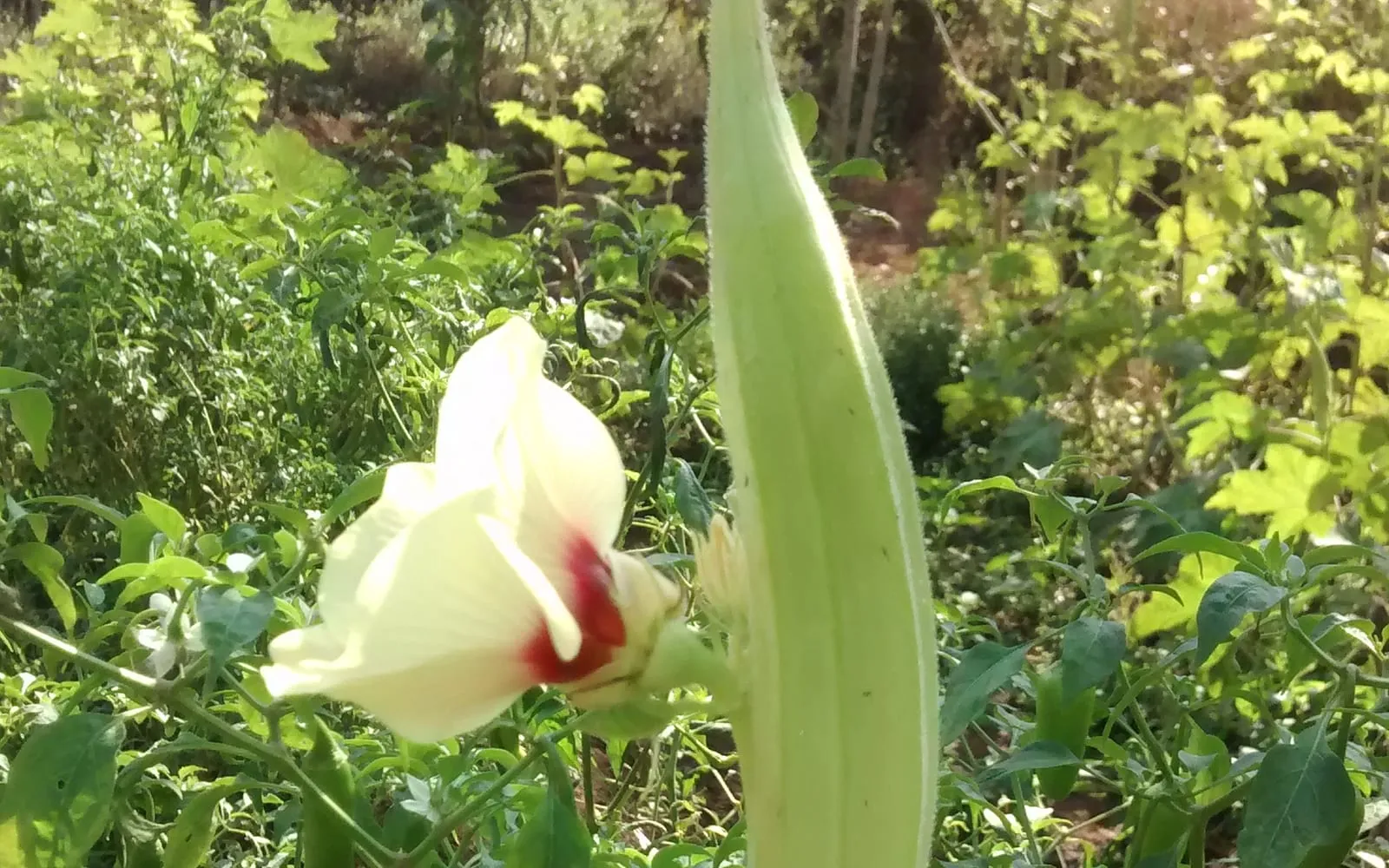
Okra is a hibiscus. Cut a flower open and the family shows immediately, with the same five broad pale petals, the same dark maroon throat and the same column of fused stamens standing in the middle. The pod that follows is the seed capsule, picked before it can finish the job.
Its reputation rests on the mucilage. Cut okra releases a clear slippery polysaccharide that thickens whatever it is cooked in, which is what makes a Louisiana gumbo a gumbo and an Egyptian bamia a stew rather than a soup. Cooks who want the pods without the slime keep them whole, cook them fast and hot, or add an acid.
Cool climates grow it under glass or not at all. The plant wants 25 to 30 deg C and sulks below 15, so a polytunnel is the difference between a crop and a green sculpture. Given warmth it is quick, cropping about two months from sowing and carrying on until the light goes.
Appearance and character
An upright annual, 1 to 2 m in cultivation, with a stout green or red-flushed stem that branches from partway up.
Leaves are large, 10 to 30 cm across, palmate with three to seven lobes cut about halfway to the base, roughly hairy on both sides and carried on long stalks.
Flowers are the giveaway. Each is 4 to 8 cm across, pale creamy yellow with a deep maroon or purple blotch at the base of each petal, with the fused staminal column of a hibiscus rising from the centre.
Each flower lasts a single day. It opens in the morning, closes by afternoon, and a pod is visible behind it within two days.
The pod is a ridged capsule, usually five-sided, tapering to a point, growing from finger length to 25 cm within a week. Green in most cultivars, deep red in others, with the red cooking to green.
Cut across, a young pod shows a neat wheel of chambers holding rows of small round white seeds in clear mucilage.
Stems, leaves and pods carry fine stiff bristles on most cultivars, and they itch.
Where it is from
Okra was domesticated in East Africa, most likely in the Ethiopian highlands and the surrounding region, where its wild relatives grow.
It reached Egypt early. Arabic sources describe it by the twelfth century, and the Arabic name bamia travelled with the plant into Turkey, Greece and the Balkans.
The transatlantic slave trade carried it to the Americas. Enslaved West Africans brought seed and knowledge, and okra became a defining ingredient of the Lowcountry, Louisiana and Caribbean kitchens. The word gumbo comes from a Bantu word for okra.
India adopted it and now grows more than anywhere else in the world, where it is bhindi and appears in every vegetable market.
It reaches temperate markets through South Asian, African, Caribbean and Middle Eastern grocers, usually imported from India, Kenya or Egypt.
How it grows
Sow in April at 25 deg C on a heated propagator. Cold compost gives nothing at all, which is where most attempts fail.
Soak the seed for 12 to 24 hours before sowing, or nick the hard coat.
Sow one seed to a 9 cm pot, 1.5 cm deep, and avoid disturbing the roots afterwards, since okra hates transplanting.
Plant out into a greenhouse or polytunnel border in late May or June, 45 to 60 cm apart, once nights are above 15 deg C.
Give full sun and warmth. Growth is fast at 25 to 30 deg C and stops below 15.
Pinch the growing tip at about 60 cm to encourage branching, which increases the number of flowering points.
Water and feed steadily once flowering starts.
Harvest from about eight weeks after sowing, cutting pods at 6 to 10 cm with secateurs and a short stalk.
Pick every day or two. A pod goes from tender to inedible string in about forty-eight hours in warm weather.
Wear long sleeves and gloves for picking unless you have chosen a spineless cultivar.
Through the seasons
April is for sowing on a heated propagator at 25 deg C.
May is growing the young plants on under cover without letting them get cold.
June is planting out into a tunnel or greenhouse border.
July brings rapid growth, the pinching of the growing tips, and the first flowers.
August is the main cropping month, and it wants picking every other day.
September carries on if the weather holds and the plants are still being picked.
October ends it, as the light and the temperature both drop.
Winter does not apply. Okra is sown fresh each year.
Care difficulty
Moderate under glass and unrealistic outdoors where summers are cool.
Germination is the first hurdle. Okra needs 25 deg C, a soaked or nicked seed, and no root disturbance afterwards.
Heat is the second. Below 15 deg C the plant stops, and a cold July costs the crop.
Picking discipline is the third, since two days of inattention turns a crop into firewood.
Aphids find okra reliably and need watching.
Given a warm tunnel it is quick, generous and untroubled.
Watering
Water twice a week from planting out.
Increase once the pods are coming, since a checked plant drops its flowers.
Let the surface dry between waterings, as okra dislikes constant wet.
Water at the root in the morning.
Mulch to hold moisture and keep the root zone warm.
Reduce in late September as the plant slows.
Warning signs, diseases and pests
Flower buds dropping before opening is the usual sign of cold nights or dry roots.
Curled distorted shoot tips with sticky residue are aphids, which okra attracts strongly.
Clouds of small white insects on disturbance are whitefly.
Fine speckling with webbing is red spider mite in dry glasshouse air.
A pod that snaps cleanly is ready; one that bends without breaking has gone woody.
Yellowing lower leaves with wilting in damp compost is root rot from cold roots.
Plants standing still through July are too cold, and nothing else will fix it.
Itching forearms after picking are the bristles rather than an allergy.
Growing environment
A greenhouse or polytunnel where summers are cool. Outdoors only in an exceptional one.
Full sun.
Minimum 15 deg C, with 25 to 30 deg C for real growth.
Rich free-draining soil with compost dug in.
Warm soil at planting, which means waiting rather than rushing.
Spacing of 45 to 60 cm, since the plants branch.
Good ventilation to keep red spider mite and mildew down.
Feeding
Dig in garden compost or rotted manure before planting.
Feed a balanced liquid feed fortnightly from planting out.
Switch to a high-potash tomato feed once the first flower opens.
Keep feeding right through the picking season, since the plant is flowering and fruiting at once.
Stop at the end of September.
Avoid heavy nitrogen, which gives a tall leafy plant with few flowers.
Troubleshooting
How do I stop it being slimy? Cook the pods whole with the caps left on, fry or roast them hot and fast, or add an acid such as tomato or lemon. Cutting them and stewing them slowly is what releases the mucilage, which is exactly what a gumbo wants.
Nothing germinated. Too cold. Okra needs 25 deg C on a propagator, and a 12 to 24 hour soak or a nicked seed coat helps.
When do I pick? At 6 to 10 cm, and every other day. A pod that will not snap cleanly between finger and thumb has gone woody and is only good for the compost.
My arms itched after picking. The bristles on the pods and stems. Wear long sleeves and gloves, or grow a spineless cultivar.
The flowers are falling off. Cold nights, dry roots, or both. Okra drops buds when it is unhappy and resumes when conditions improve.
Can I grow it outdoors in a cool climate? Only in an exceptional summer, and even then poorly. A polytunnel changes it from a novelty to a crop.
Is it related to hibiscus? Yes, closely. The flower is unmistakably a hibiscus flower and the plant is in the same family, Malvaceae, along with cotton and jute.
Can I eat the leaves? Yes. The young leaves are cooked as a green in West Africa, and they are mucilaginous in the same way as the pods.
What is bhindi? The Hindi and Urdu name for okra. Bamia, gumbo, lady’s fingers and quiabo are all the same plant.
Red okra went green when I cooked it. That is normal. The anthocyanin pigment breaks down with heat. Use red cultivars raw or lightly cooked if you want to keep the colour.
Okra problem guides
Not sure what is wrong? See the common vegetable pests guide.