
Outdoor plant
Sea Island Cotton
Gossypium barbadense
Also known as Egyptian cotton, Pima cotton, Extra-long staple cotton, Creole cotton
How to grow Sea Island cotton, Gossypium barbadense. The long staple behind Egyptian and Pima cloth, the yellow flower that separates it from upland cotton, and the reason it is grown so little.
At a glance
- Difficulty
- Difficult
- Water
- Twice a week through growth, tapering as bolls fill
- Light
- Full sun
- Temperature
- 24-32 deg C, and it stops below 15
- Humidity
- Moderate, with a long dry finish wanted
- Hardiness
- USDA 9-11, RHS H2, hardy to 10 C
- Type
- Tender perennial shrub grown as an annual
- Height
- 1.5-3 m
- Native to
- coastal Peru, north-western South America
- Best month
- April and September in the Northern Hemisphere, October and March in the Southern Hemisphere
Gossypium barbadense gives the extra-long staple fibre sold as Sea Island, Pima and Egyptian cotton, and it needs a longer and hotter season than upland cotton to reach an open boll. That is the whole trade. It yields less, it takes longer, and the fibre is worth several times more. It is grown in Egypt, Peru, the American south-west, India and central Asia.
Hardiness zones describe winter cold alone. Summer heat, humidity, rainfall and the length of the growing season decide as much, so treat the range as the outer limit rather than as a recommendation.
Every month named in this guide is for the temperate Northern Hemisphere. If you garden in the Southern Hemisphere, shift each one by six months, so April becomes October. Closer to the equator the wet and dry seasons matter more than the calendar, and the shift stops being a useful guide.
Toxic if eaten
- Do not eat
- The seed, which contains gossypol
- Harm from
- Eating it
- Affects
- People, cats, dogs and horses
Sea Island cotton carries gossypol in its seed in the same way upland cotton does. Gossypol damages the liver and the heart, causes reproductive harm, and is toxic to monogastric animals including pigs, poultry, dogs and people, while ruminants tolerate more of it. Refined cottonseed oil is safe because processing removes it. Do not eat raw cottonseed, do not feed it to pets or poultry, and clear fallen seed where animals graze. EFSA treats gossypol as an undesirable substance in animal feed. The lint itself is inert. Neither the RHS nor the ASPCA lists Gossypium barbadense by name.
Sources: EFSA on gossypol as an undesirable substance in animal feed, RHS potentially harmful garden plants, ASPCA toxic and non-toxic plants
About
Sea Island cotton is the cotton behind every label that boasts about its cotton. Egyptian, Pima and Supima are all Gossypium barbadense, and what they share is lint 3.5 cm or longer against the 2 to 3 cm of ordinary upland cotton. Longer fibres spin into finer, stronger, smoother yarn, which is what the price premium buys.
It accounts for only a few per cent of world production, because the plant is slower, fussier, lower yielding and needs a longer season than upland cotton. Growing it is a trade of volume for quality.
The name comes from the Sea Islands off Georgia and South Carolina, where a particularly fine strain was grown from the eighteenth century on plantations worked by enslaved people. The boll weevil finished that industry in the 1920s, and the American extra-long staple crop moved west to Arizona and became Pima.
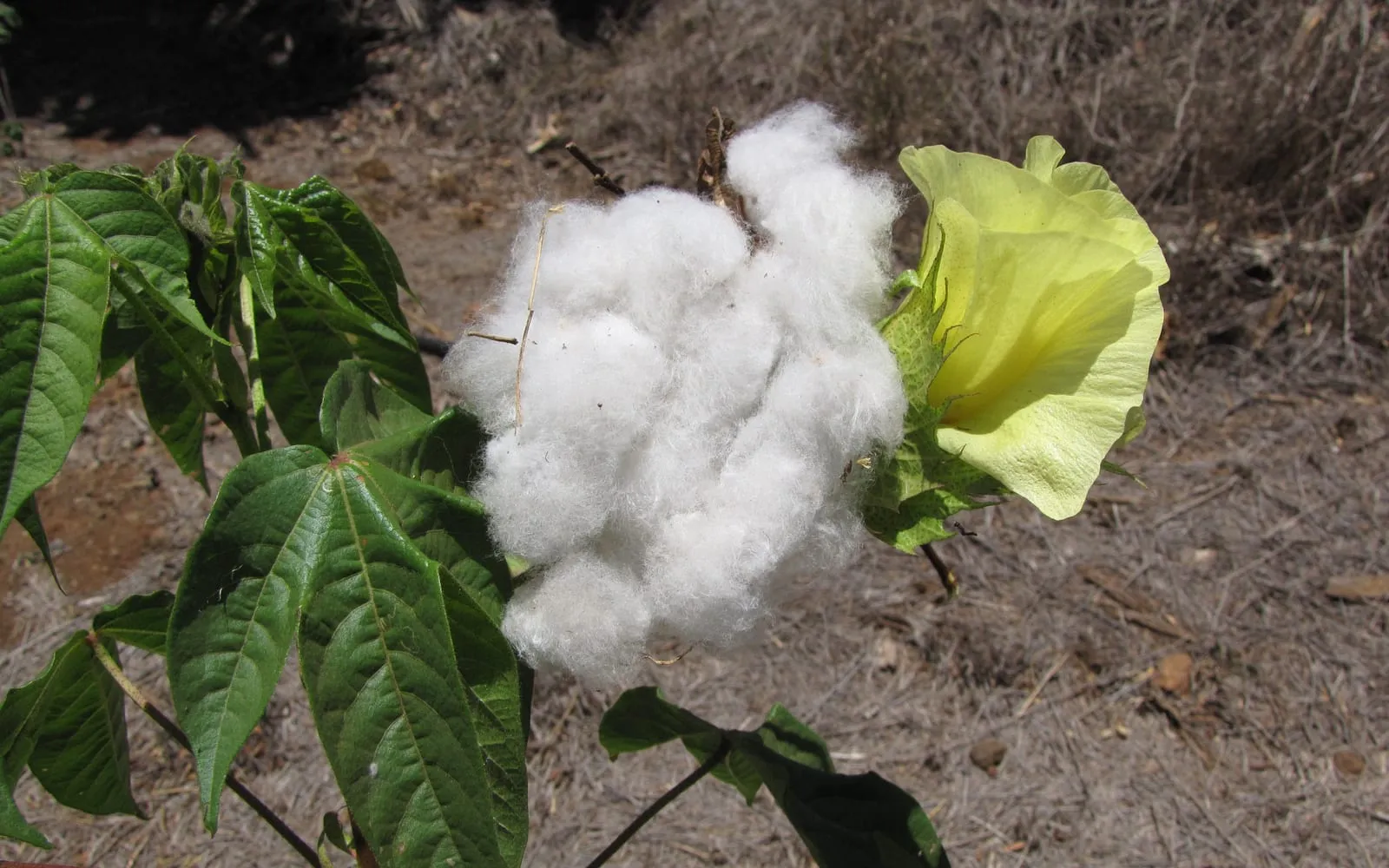
Telling it from upland cotton in a greenhouse is easy. The flower is deep yellow with a purple or maroon blotch at the base of each petal, rather than cream fading to pink.
Appearance and character
An open branching shrub, taller and looser than upland cotton, reaching 1.5 to 3 m as an annual and more as a perennial in the tropics.
Stems are slender and often flushed purple.
Leaves are palmate with three to five lobes cut more deeply than upland cotton’s, darker green, with the lobes narrower and more pointed.
Flowers are the identification. Each is 5 to 8 cm across, deep yellow with a dark purple or maroon blotch at the base of each petal, and they age to a paler yellow rather than to pink.
Bracts around the flower are large, deeply fringed, and persist around the boll.
Bolls are more pointed than upland cotton’s, splitting into three or four segments rather than four or five.
Lint is white to cream, 3.5 cm or longer, silkier and finer to the touch.
Seeds are black and smooth, largely free of the short fuzz that covers upland cotton seed, which is another quick way to separate the two.
Where it is from
Gossypium barbadense was domesticated on the coast of Peru and in north-western South America at least five thousand years ago, and Peruvian coastal sites contain cotton textiles among the oldest anywhere.
Andean cultures spun and wove it long before pottery was common in the region, and naturally coloured brown and tan cottons from that tradition are still grown.
Caribbean cultivation followed, and the species reached the Sea Islands of Georgia and South Carolina by the 1780s, where the long staple strain was developed on plantations worked by enslaved people.
Egypt took it up in the nineteenth century under Muhammad Ali, and Egyptian cotton became the byword for quality it remains.
Egypt, Peru, the United States, India and China grow it now, and it is a small fraction of world cotton production because the plant is slower and less productive than upland cotton.
How it grows
Sow in early April at 22 to 25 deg C, earlier than upland cotton, since the season needed is longer.
Sow 1.5 cm deep in 9 cm pots and grow the seedlings on warm.
Plant into a heated greenhouse or polytunnel border in late May, 60 to 75 cm apart, since the plant is larger and looser than upland cotton.
Give full sun and heat, with 24 to 32 deg C for real growth.
Water steadily through flowering and boll fill.
Feed a balanced feed to start and switch to high potash at flowering.
Pinch the growing tips in late July, earlier than for upland cotton, because the bolls take longer to mature.
Reduce watering from September as the bolls fill.
Harvest by picking the lint from each split boll, and expect fewer bolls than an upland plant would give.
Grow it on as a perennial if you have the heat, since a second year plant starts earlier and can finish more bolls.
Discard the seed safely, since it contains gossypol.
Through the seasons
Early April is the sowing month, and starting later costs the whole crop.
May is growing on under cover, with planting out at the end of the month.
June and July are branching growth and the start of flowering.
Late July is when to pinch the tips, since anything flowering after that will not finish.
August is the main flowering period and the start of boll development.
September and October are boll fill, and the months that need every degree of heat available.
Late October and November are when bolls split, if the greenhouse has held its temperature.
Winter either ends the plant or, in a heated house, becomes a rest before a better second year.
Care difficulty
Difficult, and harder than upland cotton for one reason.
The season is longer. Sea Island cotton needs roughly two months more from sowing to open boll than upland cotton does, which puts it out of reach of any season short of about eight frost-free months.
The plant itself is straightforward and grows readily under glass.
Heat through September and October is what decides whether any boll opens.
Growing it on as a perennial in a heated house is the only reliable route to a crop here.
As an ornamental it is the better of the two cottons, with larger deeper yellow flowers.
Watering
Water twice a week from planting out.
Increase through flowering and early boll development.
Water at the root in the morning.
Reduce from September as the bolls fill.
Stop once the first boll splits, since a dry finish is what opens them.
Keep a second-year plant barely damp through winter.
Warning signs, diseases and pests
Clouds of small white insects are whitefly, which stick the lint together with honeydew.
Fine speckling with webbing is red spider mite.
Curled tips with sticky residue are aphids.
Buds dropping before opening means cold nights or dry roots.
Bolls green and closed in November mean the season was too short, which is the usual outcome outside the subtropics.
Lint that is grey and matted has had honeydew and sooty mould on it.
Wilting with brown staining in a cut stem is verticillium wilt.
A plant that grows tall and flowers late has been fed too much nitrogen.
Boll weevil, a snout weevil that punctures flower buds and bolls, was once the defining pest of American cotton before a decades-long eradication campaign removed it from nearly the entire United States. It survives only in a small area of southern Texas and remains established through Mexico and Central America, and has never established outside the Americas.
Desert locust swarms can strip a cotton field to bare stems within hours during an upsurge, across an invasion area spanning North and West Africa, the Middle East and south-west Asia, which includes the Egyptian and Sudanese cotton belts where this species is grown commercially. It is the most destructive migratory pest on earth, and a hopper band or swarm within that range should be reported to the national locust control authority immediately.
Pink bollworm tunnels inside the boll from the flower stage, fusing petals into a tight rosette and staining the lint yellow or brown. It was eradicated from the continental United States in 2018 after a five-decade campaign, but it remains one of the most damaging cotton pests across Africa, Asia and Latin America. Destroy crop residue after harvest and use certified seed.
Growing environment
A heated greenhouse anywhere the season falls short of about eight frost-free months. A polytunnel will grow the plant and rarely finish a boll.
Full sun.
Minimum 15 deg C, with 24 to 32 deg C for growth, held into October.
Deep rich free-draining soil.
Spacing of 60 to 75 cm.
A long dry warm finish, which is what a heated house is for.
Room for a shrub up to 3 m.
Feeding
Dig in compost before planting.
Feed a balanced liquid feed fortnightly from planting out.
Switch to a high-potash tomato feed at flowering.
Stop nitrogen entirely from midsummer, since late growth is wasted growth on a plant that is already short of time.
Mulch to hold moisture.
Stop feeding at the end of August.
Troubleshooting
What is the difference between this and ordinary cotton? Staple length. Sea Island cotton has lint of 3.5 cm or more against 2 to 3 cm for upland cotton, which spins into finer, stronger, smoother yarn.
Is Egyptian cotton the same plant? Yes. Egyptian, Pima, Supima and Sea Island cotton are all Gossypium barbadense, grown in different places.
How do I tell the two species apart? The flower. Sea Island cotton has a deep yellow flower with a purple blotch at the base of each petal. Upland cotton opens cream and ages to pink. The seeds differ too, being black and smooth rather than fuzzy.
Why is so little of it grown? It yields less, takes longer, and is fussier than upland cotton, so it accounts for only a few per cent of world production despite the premium.
Will it crop where I am? Only in USDA zone 9 and warmer outdoors, or in a heated greenhouse below that, and even then it is difficult. It needs about two months longer than upland cotton from sowing to open boll.
My bolls stayed shut. The season ran out, which is the usual result here. Sow in early April, pinch the tips in late July, and keep the greenhouse warm into October.
Is the seed dangerous? Yes, in the same way as upland cottonseed. It contains gossypol, which is toxic to people, pigs, poultry and dogs. Refined cottonseed oil is safe because processing removes it.
What happened to the Sea Islands industry? The boll weevil arrived and destroyed it in the 1920s. American extra-long staple production moved west to Arizona and became Pima.
Can I keep the plant for a second year? In a heated greenhouse, yes, and it is the best chance of a crop. A second-year plant starts flowering earlier and has time to finish more bolls.
Sea Island Cotton problem guides
Not sure what is wrong? See the common vegetable pests guide.
- Whitefly under glass
- Red spider mite in dry air
- Aphids on soft growth
- Root rot in cold wet compost
- Verticillium wilt
- Boll weevil, eradicated from nearly all of the US but present in Mexico and Central America
- Desert locust, capable of stripping a whole crop across Africa and south-west Asia
- Pink bollworm, eradicated from the US but still a major threat across Africa, Asia and Latin America