
Pest
Spotted lanternfly
Lycorma delicatula
Also called SLF
Grey-winged, red-flashing insects mobbing a trunk in their hundreds, sooty mould growing on the honeydew beneath, and a vineyard that can die within a few years of the first sighting. Spreading fast across the eastern and midwestern United States, a quarantine pest everywhere else, and a hitchhiker that travels in egg masses stuck to almost anything.
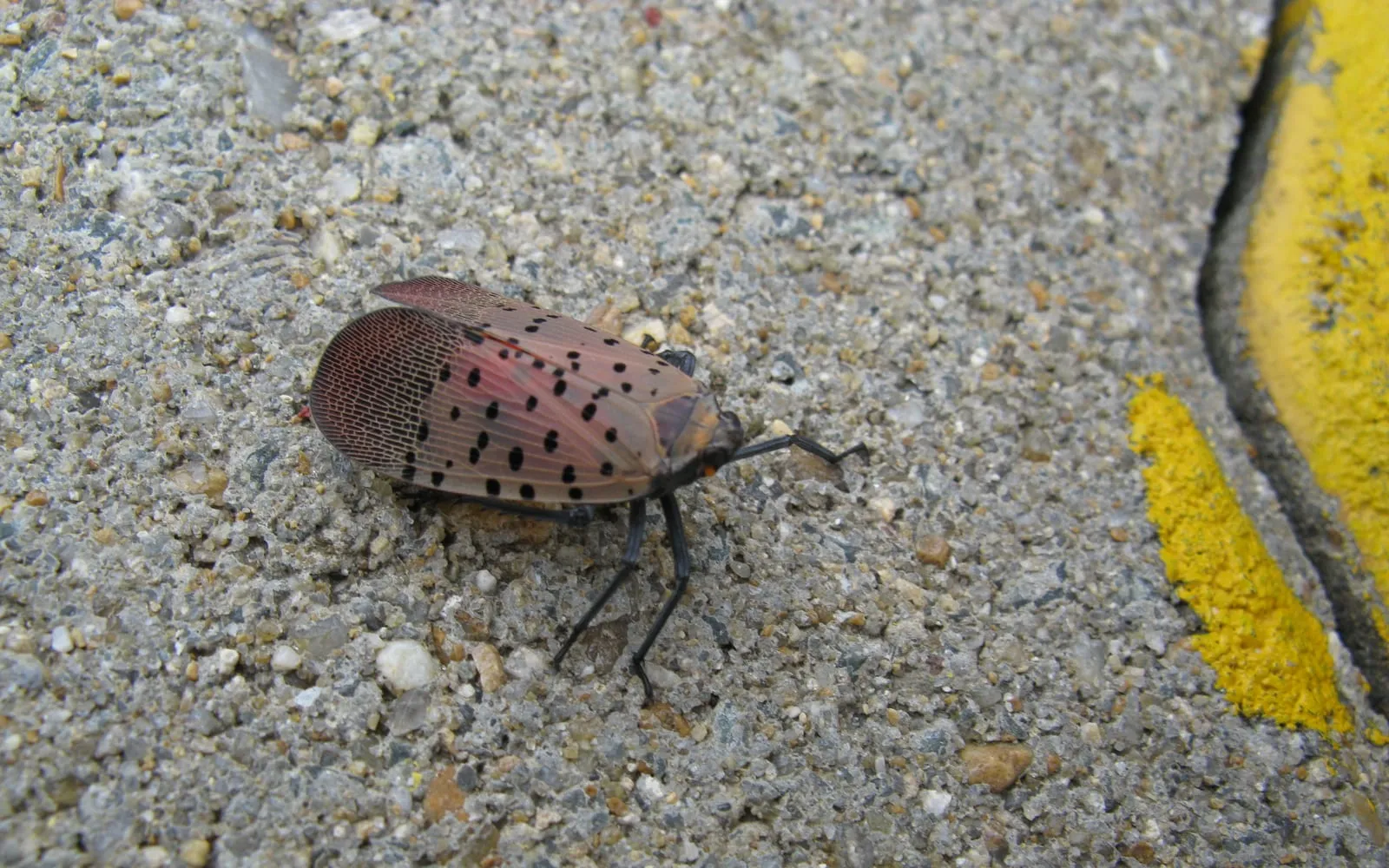
At a glance
- Type
- Pest
- Cause
- Insect
- Severity
- Destroys the crop or display
- Affects
- Herbs and edibles, Garden plants
- Active
- July to October
- Established in
- North America and Asia
What you are seeing
- Grey, black-spotted forewings covering bright red-and-black hindwings, flashed when the insect jumps or is disturbed, on an adult about 2.5 cm long
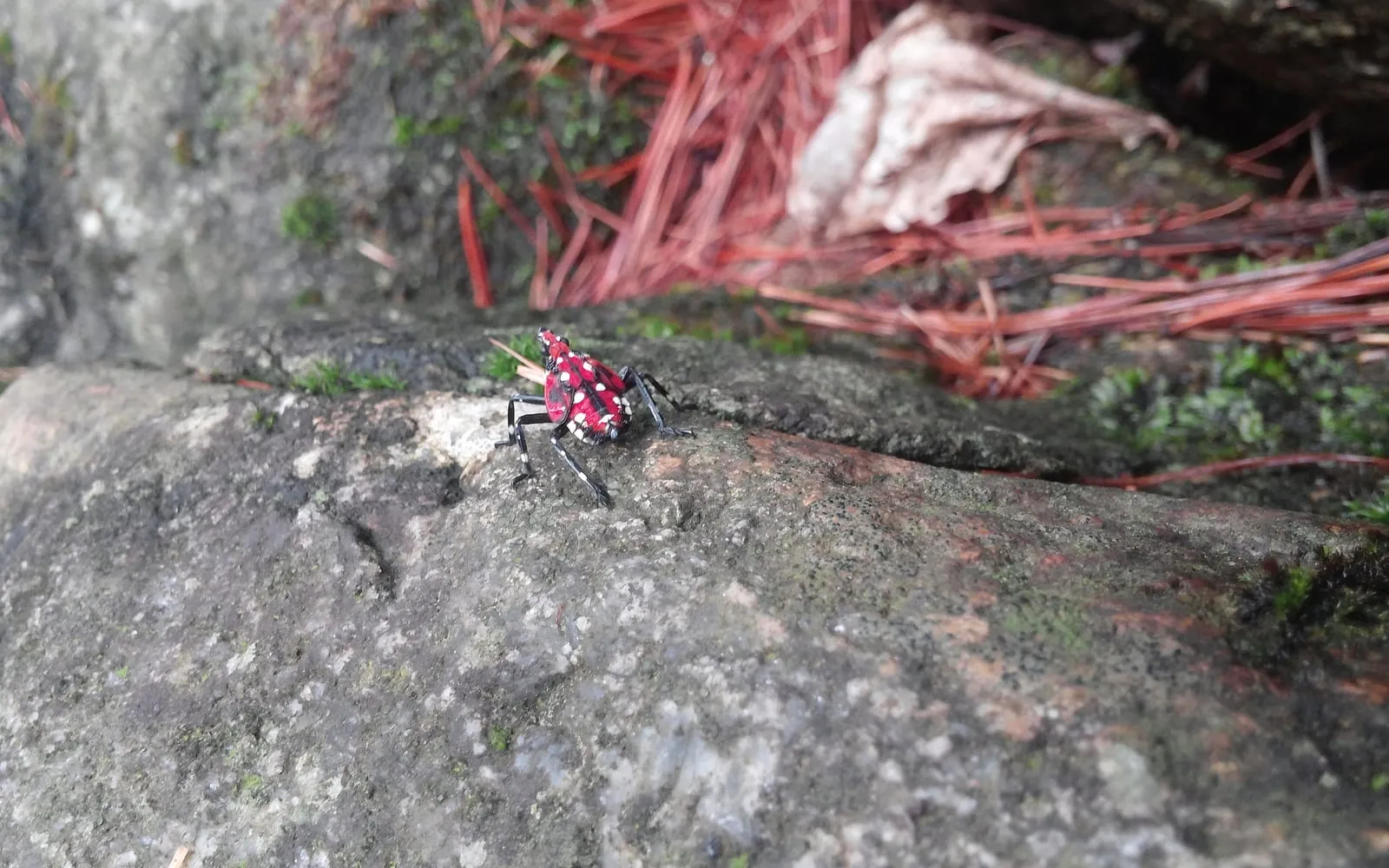
- Nymphs black with white spots, turning red with white spots and black markings before the final moult to the winged adult
- Dozens to hundreds of insects mobbing the trunk and branches of a single tree or vine, especially at dusk
- Sticky honeydew coating the bark, ground and anything parked or sitting beneath an infested plant, with black sooty mould growing on it
- Weeping wounds and streaks of sap running down the trunk where the insects have fed
- Grey-brown egg masses resembling a smear of dried mud or putty, laid on trunks, branches, stones, vehicles and almost any flat hard surface from autumn through winter
- A grapevine declining and dying over several seasons under a sustained heavy infestation
Before you treat anything
The insect does not bite or sting. Fruit from a vine or tree under heavy attack may be reduced in yield or quality but is not made unsafe by the insect's feeding.
What you are looking at
An insect that draws attention to itself: grey forewings marked with black spots cover bright red-and-black hindwings, flashed when it jumps or takes off, on a body about 2.5 cm long. Immature nymphs go through black-with-white- spots stages before turning red with white spots and black markings ahead of the final moult, and at any stage they tend to gather in numbers, sometimes hundreds on a single trunk, especially as dusk falls.
Feeding damage shows less as chewed leaves and more as sap loss and mess. Wounds weep down the bark, and the insects excrete large amounts of sticky honeydew that coats everything below an infested plant, with a black sooty mould growing on top of it. A vineyard under sustained heavy attack can decline and die over a few seasons.
Between autumn and spring, look instead for the egg masses: grey-brown smears about the size of a thumbprint, laid on trunks, branches, stones, vehicles, firewood and almost any other flat hard surface, holding thirty to fifty eggs apiece.
Where it is, and how it gets further
Native to China and already a recognised invasive in South Korea and Japan before it turned up in Pennsylvania in 2014, it has since spread to nineteen US states and the District of Columbia, concentrated in the Mid-Atlantic and expanding outward each year. Within North America, whether this is a live concern still depends heavily on which state you are in.
It has not established in Europe, Australia or New Zealand, and all three treat it as a serious quarantine risk, because the way it spreads makes distance a weak defence. Egg masses laid on a shipping pallet, a vehicle or a piece of outdoor furniture travel wherever that object goes, and long-distance jumps rather than gradual range expansion have driven several of its introductions to new countries and states.
What to do about it
Learn to recognise the egg masses and destroy every one found on trunks, firewood, stone, vehicles or furniture between autumn and spring; this is the single most effective thing a home gardener does.
Band vulnerable trunks with sticky tape or a circle trap through the growing season, and squash nymphs and adults on sight.
Remove tree-of-heaven near a vineyard or orchard, the preferred approach; only keep a few trees as an insecticide-treated trap for the adults where removal is not practical.
Inspect vehicles, firewood and equipment for egg masses and live insects before moving them out of an area where the pest is present.
Outside the established range, report a suspected sighting to the national plant health authority rather than treating it as a garden pest.
What it gets mistaken for
Nothing common produces quite the same combination of mobbing behaviour, honeydew-fed sooty mould and mud-like egg masses. A gall or a mite infestation neither walks nor jumps nor leaves an egg mass resembling a smear of dried putty on bark, which remains the most reliable single sign through the winter months when the insects themselves are not active.
Not established in Europe, Australia and New Zealand
Do not prune, spray or otherwise treat a suspected case. Doing so risks spreading an organism the country has kept out, and it disturbs the evidence needed to identify it. Photograph what you can see, leave the plant alone, and contact your national or state plant health authority. The control advice further down this page is written for regions where this problem is already established.
Native to China, and already an introduced pest in South Korea and Japan before it reached the United States. First found in Pennsylvania in 2014, it has since spread to nineteen states and the District of Columbia, concentrated in the Mid-Atlantic and expanding outward each year, so within North America itself a sighting still depends heavily on where you are. It is not established anywhere in Europe, Australia or New Zealand, all of which treat it as a serious quarantine risk because it lays eggs on almost any hard surface, including vehicles, shipping pallets and outdoor furniture, and travels enormous distances that way rather than by flying.
What to do, in order
The steps below apply where this problem is already established.
Start here
Prevention, and the changes that stop the problem returning. Most of these pages should end at this tier.
- Learn to recognise and destroy egg masses through autumn and winter
- A single grey-brown mass the size of a thumbprint, resembling dried mud or putty, can hold thirty to fifty eggs. Scraping masses off trunks, branches, stones, firewood and outdoor furniture into a container of alcohol or hand sanitiser between autumn and the following spring removes an entire generation before it hatches, and it is the single most effective home control available.
- Remove tree-of-heaven where it grows near the crop
- Ailanthus altissima is the preferred host of the adult stage and is itself an invasive tree across much of the lanternfly's introduced range. Removing it near a vineyard or orchard denies adults their favoured food and is the preferred approach. Only where removal is not practical does keeping a small number of trees as an insecticide-treated trap, drawing feeding adults away from the crop and killing them, become worth the trade-off.
- Check vehicles, firewood and outdoor equipment before moving them out of an infested area
- This is how the pest travels between states and countries. Anyone in or visiting an infested area should inspect for egg masses and adults before moving a vehicle, trailer, firewood or outdoor furniture elsewhere, and scrape off anything found before departing.
Then reach for a barrier
Netting, hand removal and water. Nothing here harms anything except the target.
- Band trunks with sticky tape or circle traps
- Nymphs and adults walk up and down tree trunks repeatedly through the season. A band of sticky tape, or a purpose-made circle trap that funnels climbing insects into a collection bag rather than trapping them on an exposed sticky surface where birds and other wildlife can also be caught, intercepts a useful share of the population on a single tree.
- Squash adults and nymphs on sight where the pest is established
- Direct and unglamorous, and worthwhile given how far a single female's egg mass can travel. Public "stomp on sight" campaigns in several US states reflect how much difference individual action makes against a pest that otherwise spreads largely by hitchhiking.
Then bring in the predators
Encourage what already lives in the garden, and buy predators in where the problem is under glass and nothing will arrive on its own.
- Watch for establishing parasitoids and fungal pathogens
- Two natural enemies from the pest's native range, an egg parasitoid and an entomopathogenic fungus, are under active study as classical biological controls and have shown promise in reducing populations where established naturally. Neither offers an immediate fix.Under research and early field release in parts of the United States; not available for a home gardener to buy or release anywhere at this stage.
Biological controls are live organisms and their sale and release are regulated country by country. An agent sold freely in one place may be unapproved in another, so buy from a licensed supplier where you live and never import or move one yourself.
In pictures
Plants affected
Guides that name it among the problems to watch for. The list is the plants it is characteristic of rather than everything it will feed on.