
Edible
Apricot
Prunus armeniaca
Also known as Common apricot
How to grow apricot, Prunus armeniaca. The earliest blossom of any fruit tree, protecting it from frost, and choosing a cultivar bred for a cool temperate climate.
At a glance
- Difficulty
- Difficult
- Water
- Regular through the growing season, and essential against a wall
- Light
- Full sun against a sheltered south or south-west facing wall
- Temperature
- Hardy as a tree, and the blossom in February and March is destroyed by frost
- Hardiness
- USDA 5-9, RHS H5, hardy to -25 C
- Type
- Deciduous tree, cropping for twenty years or more
- Height
- 3-6 m as a bush, and any size as a trained fan
- Native to
- Central Asia and northern China, and cultivated across Asia for millennia
- Best month
- March in the Northern Hemisphere, September in the Southern Hemisphere
The wood takes hard frost and the blossom does not. Apricot needs only 300 to 900 chill hours, so it wakes at the first mild spell and flowers weeks before the last frost in most temperate gardens, losing the crop to a single cold night. Its natural home is a continental climate with a cold winter that stays cold and then breaks late.
Hardiness zones describe winter cold alone. Summer heat, humidity, rainfall and the length of the growing season decide as much, so treat the range as the outer limit rather than as a recommendation.
Every month named in this guide is for the temperate Northern Hemisphere. If you garden in the Southern Hemisphere, shift each one by six months, so March becomes September. Closer to the equator the wet and dry seasons matter more than the calendar, and the shift stops being a useful guide.
Toxic if eaten
- Safe to eat
- The flesh of the ripe fruit
- Do not eat
- The kernel inside the stone, the leaves and the twigs
- Harm from
- Eating it
- Affects
- People, cats, dogs and horses
Apricot carries the standard cautions of the genus Prunus, and rather more forcefully than most because the kernels have been sold as a health food. The flesh of the fruit is entirely safe. The kernel inside the stone contains amygdalin at high concentration, which releases cyanide when chewed and digested. Bitter apricot kernels sold as a supplement, sometimes marketed as vitamin B17 or laetrile, have caused documented cyanide poisoning, and food safety authorities across Europe advise adults to eat no more than three small kernels a day and children none at all. Do not crack apricot stones for the kernel. The ASPCA lists Prunus armeniaca as toxic to cats, dogs and horses, and a swallowed stone is also an obstruction risk in a dog. Leaves and twigs contain cyanogenic compounds, and wilted foliage releases more cyanide than fresh, so prunings must never be thrown where horses or livestock can reach them. Treat any ingestion of kernels by a person or an animal as a call to a doctor or vet.
Sources: RHS potentially harmful garden plants, ASPCA toxic and non-toxic plants
About
Apricot is a hardy tree with a fatal habit, which is that it flowers in February.
The wood survives a temperate winter without difficulty. The blossom appears earlier than any other fruit tree in the garden, often in the second half of February, several weeks before plum and a month before apple. That puts it squarely into the frost season, and an unprotected apricot loses its crop to a cold night in most years.
It also flowers weeks before pollinating insects are reliably out, so even a frost-free flowering may set nothing without help.
Both problems have the same two answers. Grow it against a warm sheltered wall where it can be reached and covered, and be prepared to fleece it whenever frost is forecast and to hand pollinate with a soft brush on warm afternoons.
Modern cultivars bred for northern conditions have improved the odds substantially. ‘Flavorcot’ and ‘Tomcot’ flower a little later and set more reliably than the old Mediterranean sorts, and they are what to buy.
Apricot is less trouble than peach in one important respect, since it does not get peach leaf curl and needs no rain shelter. It is more prone to unexplained branch dieback, which is the other thing to expect.
Appearance and character
A deciduous tree reaching 3 to 6 m as a bush, and trained flat as a fan against a wall in most temperate gardens.
Leaves are broadly oval to almost round with a pointed tip, 5 to 9 cm long, on a reddish stalk, glossy mid-green and finely toothed. The rounded leaf separates it from the narrow lance-shaped leaf of a peach.
Blossom opens in February and March, before the leaves, 2 to 3 cm across, white to pale pink, borne singly or in pairs on short spurs and on last year’s wood.
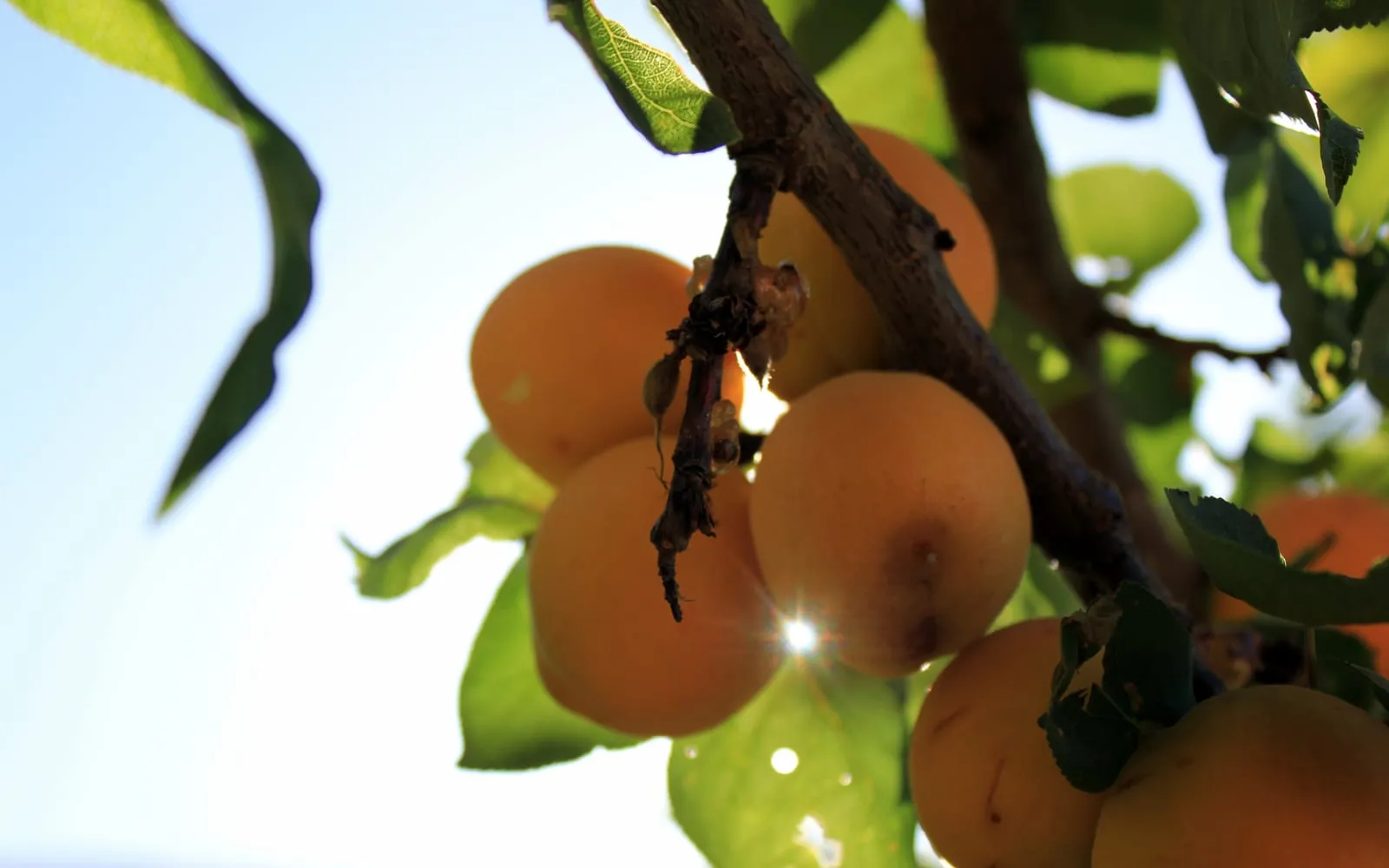
Fruit ripens from late July to August, round to slightly oval, 4 to 6 cm across, in orange to orange-yellow flushed red, with a velvety skin and a smooth flat stone.
Flesh is orange, firm and aromatic when properly ripe, and the difference between a tree-ripened apricot and a shop one is substantial.
Bark is reddish-brown and smooth on young wood, greying and fissured with age.
Apricots are self-fertile, so a single tree crops without a partner, which is a real advantage over most tree fruit.
Rootstocks control size. St Julien A gives a tree of 3 to 4 m and Torinel is more dwarfing and suits a container.
Where it is from
Central Asia and northern China, where the wild relatives grow, and cultivated across Asia for several thousand years.
The species name records a mistaken belief that it came from Armenia, which was a staging post on its westward route rather than its origin.
It reached the Mediterranean in classical times and Britain by the sixteenth century, where Henry VIII’s gardener is credited with introducing it.
The Victorian walled garden was where apricots were grown well in Britain, on south-facing brick walls that stored heat and gave shelter, often with a temporary cover for the blossom.
Turkey is now by far the largest producer, and the Malatya region supplies most of the world’s dried apricots.
The Hunza valley in Pakistan has a long-standing apricot culture, and it is the source of a good deal of folklore about apricot kernels and longevity that does not survive contact with the cyanide content.
Modern breeding for cooler climates, particularly the Canadian and British programmes that produced ‘Tomcot’ and ‘Flavorcot’, is what has made apricots a realistic garden crop in cool maritime climates.
How it grows
Give it the warmest and most sheltered wall on the property, facing south or south-west. Apricot flowers earlier than anything else in the stone fruit, so every degree of stored warmth in the brick buys you a little more of the crop.
Set the tree in autumn or early spring, standing it a good handspan clear of the brickwork and tilting the stem towards the wall so the roots run out into open ground rather than into dry rubble at the footings.
Run wires horizontally at 15 cm spacings and tie each rib of the fan along one.
Lime is the point on which it parts company with the peach. Apricot wants neutral to slightly alkaline ground and sulks on acid soil, so test the plot and add garden lime where the reading is low.
Get the drainage right before planting rather than after. Standing water at the roots kills apricots faster than any cold.
Fleece the tree whenever frost is forecast during flowering, from February onwards. Horticultural fleece over the fan, held clear of the flowers, is what saves the crop. Remove it by day so insects can reach the blossom.
Hand pollinate with a soft artist’s brush every day or two on warm dry afternoons during flowering, transferring pollen between flowers. Apricot is self-fertile, so this works with a single tree.
Thin the fruit when the fruitlets are the size of a hazelnut, to 8 to 10 cm apart, which produces larger and better fruit and reduces branch breakage.
Keep the water up through the summer. Nothing planted against a wall gets much rain, and the strip along the footings stays dry in weather that soaks the rest of the garden.
Mulch each spring with compost or rotted manure.
Prune in spring and summer, never in winter. Silver leaf and bacterial canker both enter through cuts made while the tree is dormant, and both are common enough in Prunus that the timing decides whether a tree survives its own pruning.
Prune lightly. Apricots fruit on short spurs on older wood as well as on last year’s growth, so they need less replacement pruning than peaches. Remove dead, crossing and overcrowded shoots, tie in new growth, and shorten over-long shoots in summer.
Cut out any branch that dies back promptly, cutting into clean healthy wood.
Harvest when the fruit is fully coloured, gives slightly to gentle pressure and comes away with a light twist. Apricots do not ripen well off the tree.
Expect a tree to crop for twenty years or more.
Through the seasons
Winter the tree is dormant and should not be pruned. Check the fleece is ready for February.
Spring flowers in February and March, needing fleecing and hand pollination, and pruning starts once growth begins.
Summer swells and ripens the fruit from late July, and summer pruning and tying in happen now.
Autumn the leaves fall, and this is planting season.
Care difficulty
Difficult, and specifically difficult in February and March.
The tree itself is hardy, self-fertile, long-lived and undemanding once established. It does not get peach leaf curl and needs no rain shelter.
The whole difficulty is the flowering time. Blossom in February needs frost protection in most years and hand pollination in almost all of them, and a gardener who is away for a fortnight at the wrong moment loses the crop.
Unexplained branch dieback is the other characteristic problem and it has no simple cause or cure beyond cutting affected wood out promptly.
Choosing a modern cultivar bred for northern conditions improves the odds considerably.
Watering
Water regularly and generously through the growing season, particularly from fruit set to harvest.
The strip at the foot of a wall gets almost no rain, so a wall-trained apricot needs watering even in a wet summer.
Give a thorough weekly soak in dry weather rather than a daily sprinkle.
Mulch every spring to conserve moisture, keeping it clear of the trunk.
Do not let it stand in wet ground. Apricot dislikes waterlogging more than most fruit trees, and poor drainage contributes to dieback.
Container-grown trees need daily watering in summer.
Warning signs, diseases and pests
Blossom appearing and no fruit setting is frost or a lack of pollination, which is the standard apricot problem. Fleece the tree when frost is forecast and hand pollinate on warm afternoons.
Whole branches dying back suddenly, sometimes in midsummer, with no obvious cause, is a recognised apricot problem often associated with bacterial canker, drought stress or poor drainage. Cut affected branches out promptly into clean wood, prune only in the growing season, and improve drainage.
Bark sunk into a hollow and weeping amber, with the shoots above it dying, is bacterial canker. Take the wood out in July or August, cutting well back into clean tissue, and burn what you remove.
Leaves with a metallic sheen to them, and a dark core showing in the face of a cut branch, is silver leaf. The fungus arrives through pruning cuts, which is why nothing on an apricot is cut while it is dormant.
Rings of buff pustules on a rotting fruit are brown rot. The mummified fruits that hang on through winter are the ones to worry about, since they carry the spores that reach February blossom, so strip them off and remove them.
Gum running from bark that is otherwise sound is gummosis. It signals stress rather than infection, and the cause is usually drought, a wound or water sitting at the roots.
Yellowing between the veins on acid soil is chlorosis. Apricot prefers neutral to slightly alkaline ground, so lime acid soil.
Aphids curling the young shoots in spring are common and rarely need action.
Japanese beetle skeletonises the leaves and brown marmorated stink bug leaves dimpled, corky patches on the fruit. The beetle is well established across the United States and newly arrived in northern Italy and Switzerland; the stink bug is already established across North America and a growing list of European countries. Neither occurs in Australia or New Zealand, where a find is reportable.
Mediterranean fruit fly stings ripening fruit to lay eggs, leaving a pinprick mark that develops into a soft rotting patch with small maggots inside. It is established across the Mediterranean, the Middle East and much of Central and South America. Pick up and destroy fallen fruit, and net or bag fruit as it ripens where the pest is present.
Growing environment
Full sun against the warmest, most sheltered south or south-west facing wall available.
Deep, free-draining, moderately fertile soil, neutral to slightly alkaline. Lime acid ground and improve drainage on clay.
The wood is hardy and the February blossom is not, so frost during flowering is the limitation.
Allow 3.5 to 4.5 m of wall for a fan on St Julien A rootstock.
It suits a south-facing house wall, a walled garden, a lean-to greenhouse, a conservatory or a large container on a dwarfing rootstock.
Grow it in a large container moved into a porch or greenhouse for February and March in a cold garden, which removes the frost problem entirely.
Choose a cultivar bred for northern conditions. ‘Flavorcot’ and ‘Tomcot’ flower slightly later and set more reliably in a cool spring than the older Mediterranean cultivars.
Apricots are self-fertile, so one tree is enough.
Feeding
Feed in early spring with a general balanced fertiliser.
Feed again in early summer with a high-potash feed such as sulphate of potash, which supports fruiting and ripening.
Mulch every spring with compost or well-rotted manure, keeping it clear of the trunk.
Avoid high-nitrogen feeds, which produce soft growth that bacterial canker enters more readily.
Lime acid soil, since apricot prefers neutral to slightly alkaline ground.
Container-grown trees need liquid feeding through the growing season and repotting every two or three years.
Troubleshooting
It blossomed beautifully and set no fruit. Frost, or no pollinating insects flying in February, or both. Fleece the tree when frost is forecast and hand pollinate with a soft brush on warm afternoons.
Do I need two trees? No. Apricots are self-fertile and one tree crops on its own, which is a real advantage over most tree fruit.
Which cultivar should I grow? ‘Flavorcot’ or ‘Tomcot’, both bred for cooler climates and flowering a little later than the old Mediterranean sorts.
A whole branch died back for no reason. A recognised apricot problem, usually connected with bacterial canker, drought stress or poor drainage. Cut it out promptly into clean wood and prune only in the growing season.
When do I prune it? In spring and summer, never in winter. Winter cuts let in silver leaf and bacterial canker. Apricot needs less pruning than peach because it fruits on spurs as well as on new wood.
Does it get peach leaf curl? No. That is one advantage over peach, and no rain shelter is needed.
Can I grow one in a pot? Yes, on Torinel rootstock, which also lets you move it under cover during the February flowering and removes the frost problem.
Can I eat the kernel in the stone? No. Apricot kernels contain amygdalin at high concentration and have caused documented cyanide poisoning when eaten as a supplement. Do not crack the stones.
The leaves are yellow between the veins. Chlorosis on acid soil. Apricot prefers neutral to slightly alkaline ground, so lime it.
Apricot problem guides
Not sure what is wrong? See the common vegetable pests guide.
- Frost destroying the flowers in almost every year without protection
- Bacterial canker and silver leaf entering winter pruning cuts
- Brown rot on ripening fruit
- Japanese beetle across the US, newly arrived in northern Italy and Switzerland
- Brown marmorated stink bug, established across North America and Europe
- Mediterranean fruit fly, established across the Mediterranean, the Middle East and parts of the Americas
- Plum pox, which marks fruit and leaves and cannot be treated