
Disease
Bacterial canker
Pseudomonas syringae
Also called Gummosis, Cherry canker
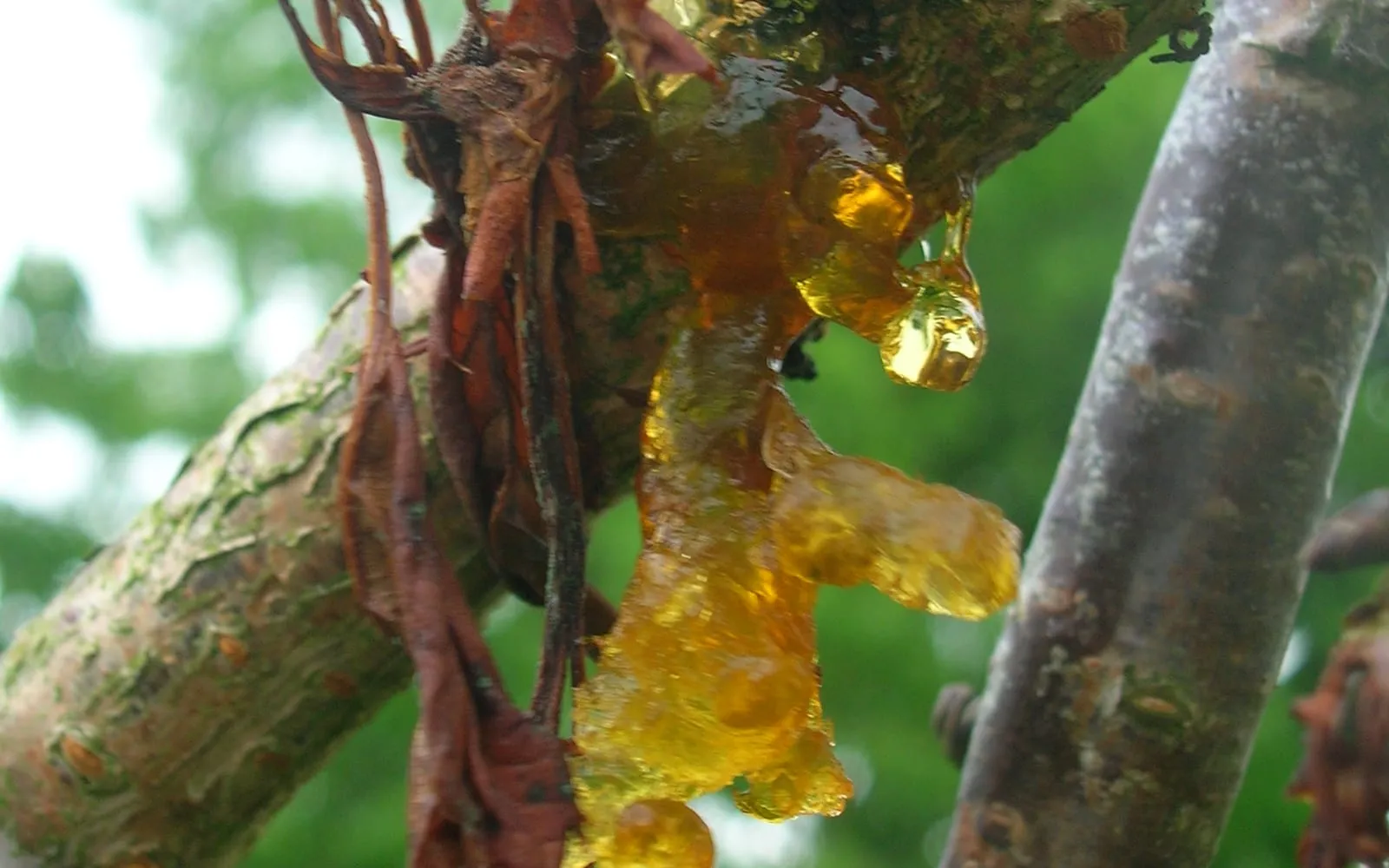
Bacterial canker makes amber gum weep from sunken bark on cherries and plums, with dead buds and shot holes in the leaves. Prune only in dry summer weather and cut back into healthy wood.
At a glance
- Type
- Disease
- Cause
- Bacterium
- Severity
- Can kill the plant
- Affects
- Herbs and edibles, Garden plants
- Active
- All year
- Established in
- Worldwide
What you are seeing
- Sunken, flattened or discoloured patches of bark on a branch or the trunk
- Amber or golden gum oozing from the edge of those patches and running down the bark
- Buds on an affected branch failing to open in spring, or opening and then dying
- Leaves on one branch small, pale and sparse while the rest of the tree flushes normally
- Small round brown spots in the leaves in summer that drop out and leave clean holes
- A whole limb dying in midsummer with the dead leaves staying attached
- Fruit on the affected branch small, sunken or shrivelled
Before you treat anything
The gum is harmless. Fruit from a tree with canker elsewhere is safe to eat. Take care with a tree that has lost large limbs, since dead branches over a path or a seat need removing before they fall.
What you are looking at
A patch of bark on a branch or the trunk goes flat, sunken or discoloured, and thick amber gum wells out along its edge and runs down the wood. Above that point the branch struggles. Buds fail to open in spring, or open and collapse, and the leaves that do appear are small and pale while the rest of the tree looks normal.
By midsummer the affected limb may die outright, with brown leaves hanging on it into the autumn.
The leaves give a second, earlier sign. Small round brown spots appear on foliage in summer, the dead tissue drops out, and the leaf is left punched with clean holes. Shot hole on a cherry or plum, with any gumming anywhere on the tree, points at this.
Gum on its own means very little
Every Prunus gums. A pruning cut, a knock from a mower, a canker, a boring insect, drought or waterlogging will all produce it, because gumming is how the whole family responds to injury of any kind. Gardeners routinely diagnose bacterial canker on gum alone and are often wrong.
What makes it this disease is gum together with dying bark and a branch failing above the point where the gum is. Pare the bark back at the edge of the patch with a sharp knife. Healthy tissue underneath is bright green and moist. Dead brown tissue running under apparently sound bark, spreading well beyond the sunken patch, is the canker.
Prune in summer
Pseudomonas syringae lives on the leaf surfaces of healthy trees all summer doing nothing visible. Populations build through late summer, and the bacteria get into the tree in autumn and winter, through leaf scars as the leaves fall, and through any wound in the bark.
A cherry or plum pruned in December is being offered a fresh wound during the months when infection pressure is at its highest and the tree is dormant and cannot heal. Prune the same tree in June and the wound closes within weeks while the bacterial numbers are low.
That is the reason plums and cherries are pruned in summer, and it is the same reason silver leaf gives. Two serious diseases of the same family, both entering through winter wounds, both prevented by the same habit.
What to do about it
Prune only between June and August, and never in winter.
Cut affected branches out in summer, taking them at least 30 cm below the lowest sign of damage into clean wood, and disinfect the saw between cuts.
Burn or bin the prunings.
Keep the tree unstressed. Mulch, water in a dry summer, feed in spring, and keep grass off the root zone.
Check tree ties every year and keep the strimmer away from the trunk.
Take out a tree that is cankered around the trunk, because it will not recover and it is infecting anything else in the garden.
Copper sprays were once applied in autumn for this and Bordeaux mixture is no longer approved for amateur use in Great Britain, so the pruning calendar is now the whole of the prevention.
What it gets mistaken for
Silver leaf turns the leaves on an affected branch a dull metallic silver, and a cut across a dead branch more than 2.5 cm thick shows a purple-brown stain in the wood. There is no gumming and no sunken bark.
Honey fungus kills from the roots up, with a sheet of white fungal growth under the bark at ground level and black bootlaces in the soil around the base.
Blossom wilt kills the flowers and the short spur behind them in spring, leaving dead flowers attached, and it does not gum or sink the bark of a main branch.
Physical damage gums freely with no dying bark and no branch failure. Look at whether anything above the gum is struggling.
Peach leaf curl and shot hole on peaches both mark the leaves without touching the bark. Shot holes plus gumming on the branch is canker; shot holes alone usually are not.
What to do, in order
Start here
Prevention, and the changes that stop the problem returning. Most of these pages should end at this tier.
- Prune only between June and August
- The bacteria are most active and most abundant in autumn and winter, and a tree pruned then is being given an open wound at exactly the wrong moment. Prune cherries, plums and every other Prunus in summer, when the tree is growing hard, the sap is running and a cut callouses within weeks. This one rule prevents more canker than everything else on this page.
- Keep the tree growing strongly
- Trees under stress get cankered and vigorous ones wall the infection off. Mulch, water through dry summers, feed in spring, and keep grass and weeds off the root area for a metre around the trunk.
- Stop wounding the bark
- A strimmer, a mower, a tie that has cut in, or a stake rubbing all provide the entry point. Check ties every year and loosen them, keep machinery away from the trunk, and use a mulch circle rather than mowing tight to the stem.
- Buy carefully and ask about susceptibility
- Cultivars differ considerably. 'Victoria' plum is notoriously prone. Where cherries or plums keep failing on a site, a nursery growing them for that region will know which stand up locally, and it is worth asking before ordering.
- Plant on ground that drains
- Prunus roots sitting in wet soil produce a stressed tree with poor resistance. Raise the planting position on heavy land rather than setting the tree into a hole that holds water.
Then reach for a barrier
Netting, hand removal and water. Nothing here harms anything except the target.
- Cut affected branches out in summer, well below the damage
- Take the branch back into clean healthy wood at least 30 cm below the lowest sign of the canker, because the bacteria run ahead of anything visible. Do it in June or July. On a branch caught early this can save the tree, and it is the only treatment there is.
- Disinfect the saw between every cut
- The bacteria travel on the blade. Wipe and disinfect between cuts and between trees, and burn or bin the prunings rather than shredding them near the tree.
- Take out a tree cankered on the main trunk
- Once the canker rings the trunk, or has spread into the main framework, nothing will save the tree and it becomes a source of infection for its neighbours. Remove it and replant with something outside the cherry family.
Plants affected
Guides that name it among the problems to watch for. The list is the plants it is characteristic of rather than everything it will feed on.