
Edible
Sandalwood
Santalum album
Also known as Indian Sandalwood, Chandan
Practical guidance for growing sandalwood, Santalum album, including its need for a host plant, slow heartwood development, dry-season triggers, frost sensitivity, and essential oil safety.
At a glance
- Difficulty
- Difficult
- Water
- Regular while young; increasingly drought-tolerant once established
- Light
- Full sun to light shade
- Temperature
- Frost-tender; needs warmth year round
- Hardiness
- USDA 10-12, RHS H1a-H1b, hardy to 5 C
- Type
- Slow-growing, hemi-parasitic evergreen tree
- Height
- 4-9 m, occasionally taller
- Native to
- South Asia
Native to dry deciduous forest and scrubland with a distinct monsoon rainfall pattern, which is also what concentrates the fragrant oil in the heartwood over decades of slow growth. It has no frost tolerance at any age and needs sustained warmth, but a marked dry season does it no harm and may improve the wood it is eventually grown for.
Hardiness zones describe winter cold alone. Summer heat, humidity, rainfall and the length of the growing season decide as much, so treat the range as the outer limit rather than as a recommendation.
Skin irritant
- Safe to eat
- Heartwood, used in small amounts as a flavouring in some traditional South Asian food and drink
- Do not eat
- Concentrated essential oil taken by mouth, and undiluted oil applied to skin
- Harm from
- Eating it and handling it
- Affects
- People
Sandalwood's fragrant heartwood is best known as the source of an essential oil used in perfumery and incense, and the ground wood also appears in small quantities in traditional South Asian food, drink and skincare preparations. The wood itself, used this way, is not a documented poisoning risk. The concentrated essential oil is a different matter: swallowed in quantity it can cause nausea and, in a large enough dose, more serious effects, and applied undiluted to skin it is a recognised irritant and sensitiser for some people. The species is not listed as toxic to pets by the ASPCA, and the practical caution here concerns the oil rather than the growing plant itself.
Sources: RHS potentially harmful garden plants, National Capital Poison Center
About
Sandalwood is a slow-growing tree valued for the fragrant oil stored in its heartwood, developed over decades rather than years. It is a hemi-parasite, tapping into the roots of a neighbouring host plant for part of its water and nutrients, which makes it one of the few trees that needs a companion planted alongside it to grow well.
Commercial and garden specimens alike are started with a host seedling close by from the earliest stage, since a sandalwood grown in isolation, with nothing for its roots to attach to, grows slowly and often poorly.
Appearance and character
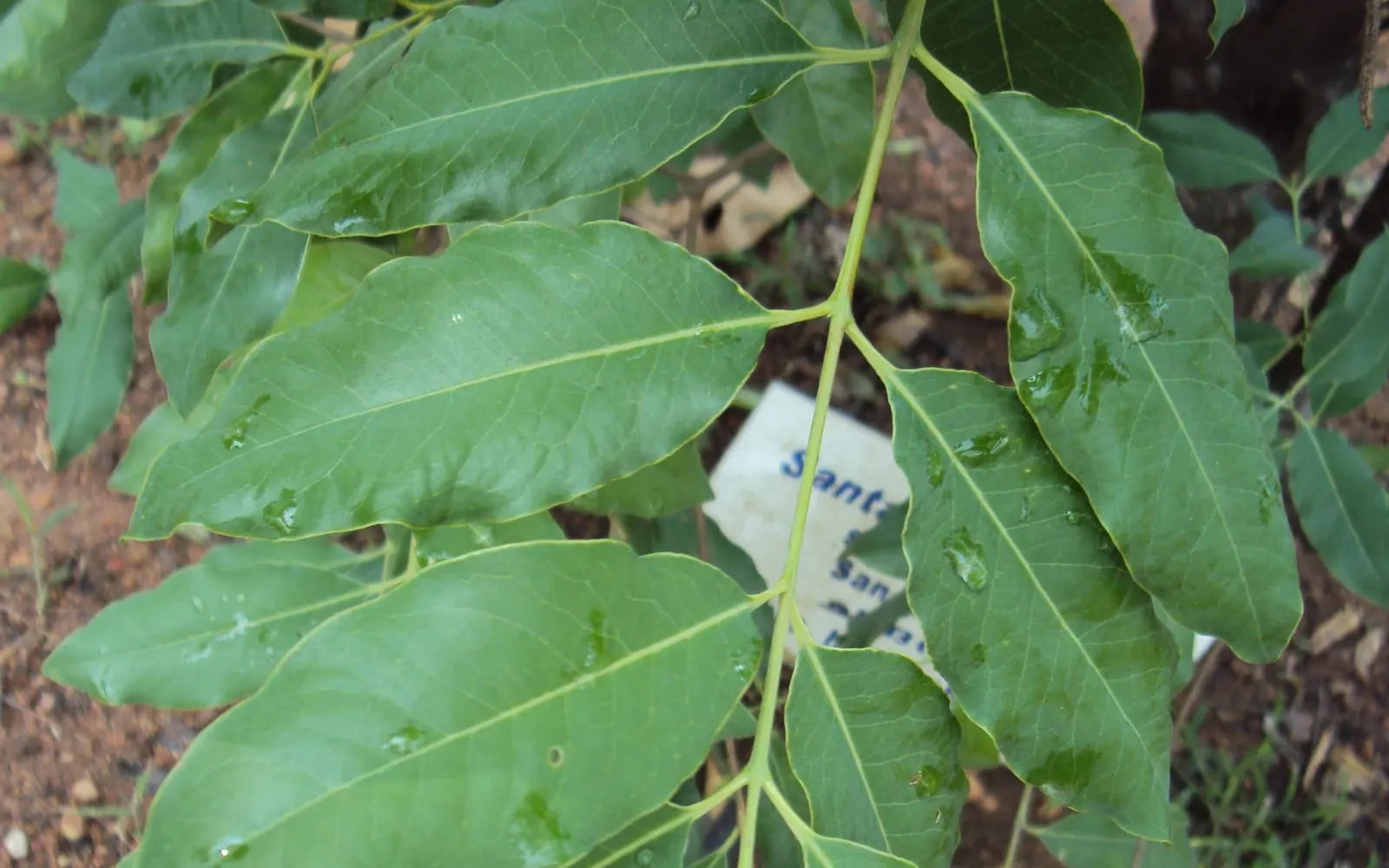
Leaves are smooth, glossy and lance-shaped, held in opposite pairs on slender branches that give a young plant a light, open habit before it thickens with age into a small, rounded tree. The bark on older wood darkens and roughens, eventually cracking into the reddish-brown texture familiar from cut sandalwood timber.
Small, inconspicuous flowers appear in loose clusters, pale at first and deepening to a dull red-purple as they age, followed by small round fruit that ripen through red to black. Neither flower nor fruit is the reason this tree is grown.
The value lies out of sight, in the pale sapwood surrounding a core of dense, yellow-brown heartwood that develops slowly from the centre outward, carrying the concentrated oil the species is famous for. That heartwood takes upward of fifteen to twenty years to develop fully, one of the longest waits of any commonly cultivated tree.
Where it is from
Santalum album is native to South Asia, growing across dry deciduous forest, scrub and open woodland with a pronounced seasonal monsoon climate, alternating a wet growing season with a longer dry period.
The tree’s whole strategy, from its parasitic roots to the slow build-up of oil in its heartwood, fits a landscape where growth cannot be fast and reliable water cannot be assumed every month. Cultivation elsewhere does best when it echoes that rhythm rather than trying to override it with constant irrigation.
How it grows
Plant a young sandalwood alongside a suitable host species from an early stage, since its roots attach to the host’s roots through small structures called haustoria and draw water and some nutrients from them. Many nitrogen-fixing shrubs and trees make workable hosts, and a sandalwood grown with no host at all typically struggles.
Give it well-drained, moderately fertile soil in full sun to light shade, sheltered from any frost at any stage of its life. It tolerates poor, dry ground once established far better than it tolerates waterlogging, since standing water around the roots is one of the fastest ways to lose a young tree.
Prune only lightly, removing dead or crossing wood, since heavy cutting sets back a tree that is already growing slowly toward the size where its heartwood becomes worth anything.
Propagate from fresh seed, sown alongside a host seedling from the start, since seed loses viability quickly once dried and the young tree’s dependence on a host begins almost immediately after germination.
Through the seasons
Spring brings renewed growth in a warm climate, with flowering following on established trees.
Summer is the main growing season, tracking the wetter part of a monsoon climate where the tree is grown in conditions close to its native range.
Autumn slows growth as the dry season, or a temperate autumn in cultivation, sets in, with fruit ripening on flowering trees.
Winter brings the greatest risk in any climate with even a possibility of frost, since this tree has no cold tolerance at any age.
Care difficulty
Difficult. The challenge is less about any single demanding condition and more about providing a living host plant and enough patience for a crop that takes decades to mature. Watering, feeding and general care are comparatively straightforward once a host is established.
Growers outside a naturally warm, seasonally dry climate face the added task of protecting the tree from any frost at all, since even a brief, light freeze that a hardier tropical species might tolerate can kill a sandalwood outright.
Watering
Water regularly while the tree is young and its root system, together with its connection to a host plant, is still developing. Established trees tolerate real drought, reflecting a native climate with a long dry season, and need supplementary water mainly during extended dry spells outside that native rhythm.
Avoid waterlogging at every stage. Standing water around the roots does more damage to this species, and to the host it depends on, than a missed watering ever does.
Warning signs, diseases and pests
Root rot follows soil that stays wet without draining, showing as yellowing leaves and slow decline in both the sandalwood and, often, its host plant at the same time. Improve drainage and reduce watering frequency rather than treating the symptoms alone.
Scale insects attach along stems and leaf undersides as small, immobile bumps, weakening growth and excreting honeydew as they feed. Treat with horticultural oil, or scrape off light infestations by hand.
Mealybug shows as small white, cottony masses in leaf axils and new growth, feeding in much the same way as scale. Treat the same way.
Spider mite thrives in hot, dry air and shows as fine speckling on the leaves with faint webbing in bad cases. Raising humidity around the plant and wiping leaves down helps prevent it.
Growing environment
Full sun to light shade suits a mature tree well; a young plant benefits from some shelter while it establishes its root connection to a host.
Well-drained soil matters more than fertility. Sandalwood tolerates poor, dry ground reasonably well once established. In cultivation, too much water is usually a greater risk than too little.
Sustained warmth, with no frost at any point in the year, is the single condition that overrides all the others, since no amount of good soil or careful watering compensates for cold this tree cannot survive.
Feeding
A light, balanced fertiliser a few times through the growing season is enough for most plants, since a sandalwood draws part of its nutrition from its host and does not need heavy feeding of its own.
Feed the host plant, where it needs feeding, as well as the sandalwood itself, since a struggling host limits how well the sandalwood attached to it can grow.
Troubleshooting
My young tree is growing slowly and looks pale. Check first whether it has a healthy host plant nearby for its roots to attach to. A sandalwood grown without a suitable host, or one whose host has died or declined, typically shows exactly this kind of weak, slow growth.
Can I grow sandalwood without a host plant at all? Not successfully in most cases. It can survive briefly on its own root system as a very young seedling, but long-term healthy growth depends on the parasitic connection to a host, and a permanently hostless tree usually stays stunted.
How do I know when the heartwood is ready to use? Not from looking at the outside. Heartwood development takes fifteen years or more and is generally confirmed by a small core sample or by felling, which is why sandalwood is grown as a long-term investment rather than a crop harvested within a gardener’s usual planning horizon.
A light frost is forecast and my tree is in the ground. Cover it immediately with horticultural fleece down to the soil line, since this species has no frost tolerance at any age and even a brief light freeze can kill it outright. In a climate with any regular frost risk, growing it in a container that can be moved under cover is the safer choice.
Is the sandalwood oil sold in shops the same as the plant’s sap? No. The oil is extracted from the heartwood by distillation, a concentrated product very different from anything a gardener handles while growing the tree, and it carries its own separate safety guidance around ingestion and skin contact.