
Edible
Japanese Plum
Prunus salicina
Also known as Chinese plum, Salicine plum
How to grow Japanese plum, Prunus salicina. Why it flowers three weeks before a European plum, the frost problem that follows, and thinning for size.
At a glance
- Difficulty
- Moderate
- Water
- Weekly through summer while the fruit swells
- Light
- Full sun
- Temperature
- Wood hardy to -20 deg C. Blossom is lost at -2 deg C
- Hardiness
- USDA 5-9, RHS H5, hardy to -20 C
- Type
- Deciduous tree, cropping for 20 to 30 years
- Height
- 3-5 m on a semi-dwarfing rootstock
- Native to
- China
- Best month
- August in the Northern Hemisphere, February in the Southern Hemisphere
Chill runs 300 to 800 hours, low enough to crop where a European plum will not, and the flowers open two to three weeks earlier as a result. That early blossom is the trade. In a climate with late frosts it flowers into them year after year, so it belongs in warm-winter regions rather than cold ones.
Hardiness zones describe winter cold alone. Summer heat, humidity, rainfall and the length of the growing season decide as much, so treat the range as the outer limit rather than as a recommendation.
Every month named in this guide is for the temperate Northern Hemisphere. If you garden in the Southern Hemisphere, shift each one by six months, so August becomes February. Closer to the equator the wet and dry seasons matter more than the calendar, and the shift stops being a useful guide.
Poisonous if eaten
- Safe to eat
- The ripe fruit flesh
- Do not eat
- The kernel inside the stone, and the leaves, twigs and bark
- Harm from
- Eating it
- Affects
- People, cats, dogs and horses
The ripe fruit is food and the rest of the tree is not. Like every Prunus, this tree keeps cyanogenic glycosides in its seeds, leaves, twigs and bark, releasing hydrogen cyanide when they are chewed or digested. A stone swallowed whole passes through intact, so the hazard is cracking stones open to eat the kernel. Those kernels taste of bitter almond, which is the warning, and a handful is enough to poison a child. Do not eat them. For animals the foliage matters more than the fruit, and wilted foliage most of all, because cyanide release rises sharply as the leaf dies. Branches pruned into a paddock have killed horses and cattle, so clear prunings away. A dog swallowing a windfall risks an obstruction from the stone as much as anything chemical. The RHS lists Prunus among plants harmful if eaten and the ASPCA lists the genus as toxic to cats, dogs and horses.
Sources: RHS potentially harmful garden plants, ASPCA toxic and non-toxic plants
About
Japanese plum is the round, juicy, thin-skinned plum of the supermarket shelf, and it is a different species from the European plum that gives us Victoria and damsons. The fruit is larger, softer and more perfumed, and it does not cook down the same way, being best eaten fresh.
The catch in a cool climate is the timing. Japanese plums flower two to three weeks earlier than European ones, often in early March, which puts the blossom squarely in frost season. A tree that crops magnificently in one year can set nothing at all in the next.
Against a warm wall or in a sheltered southern garden it is worth the risk. In a cold or exposed garden a European plum is the sensible choice and this one is a gamble.
Thinning is the other thing that separates a good crop from a disappointing one. The tree sets far more fruit than it can size.
Appearance and character
A spreading deciduous tree, 3 to 5 m on a semi-dwarfing rootstock, with wide-angled branches that make a broad flattish crown.
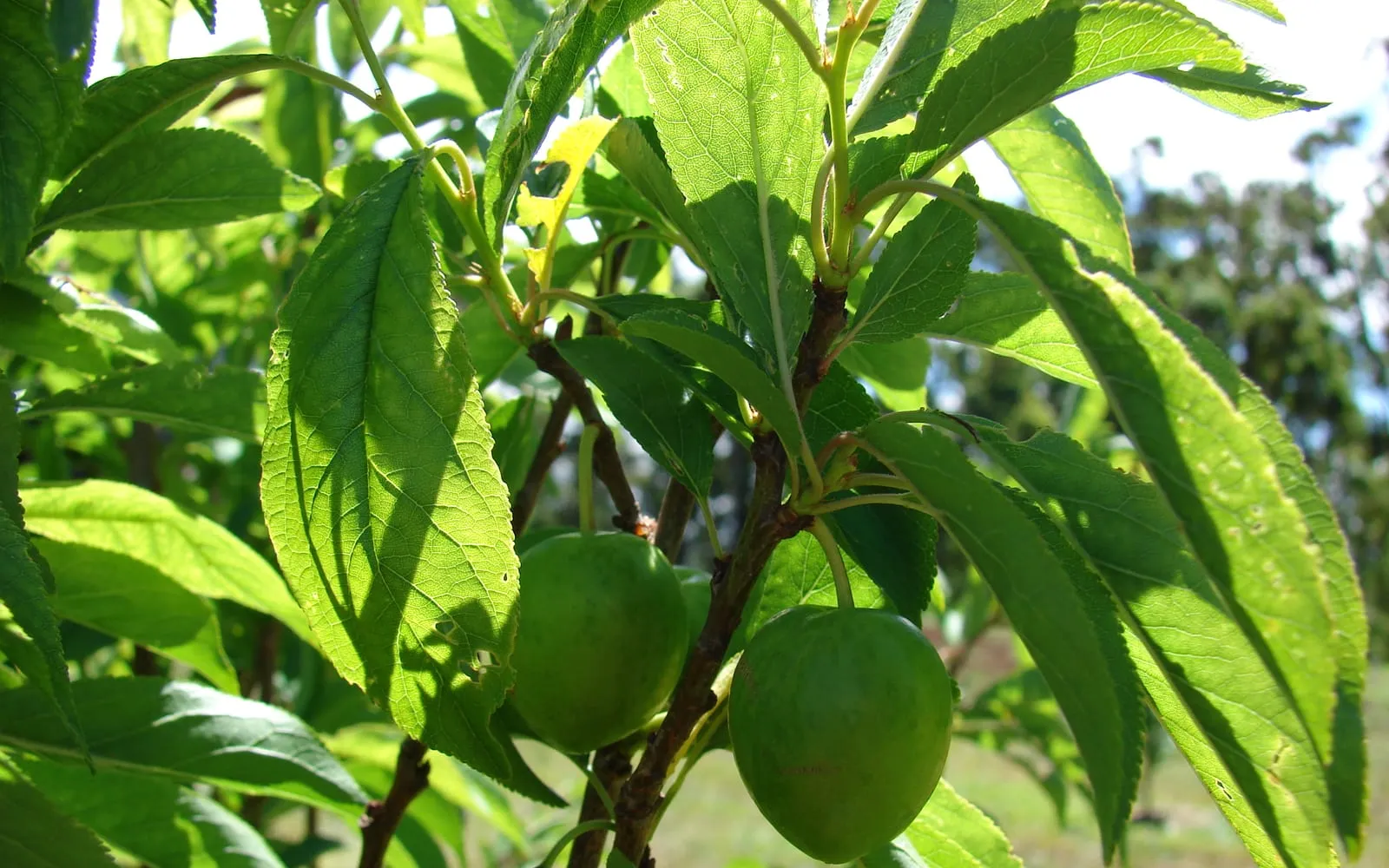
Leaves are oval to lance-shaped with finely toothed edges, glossy and slightly leathery, a brighter green than European plum.
Flowers open before the leaves in early March, white, in clusters of two or three along last year’s wood, and they smother the tree.
Fruit is round to heart-shaped, larger than a European plum, with thin skin in yellow, red or near-black and a distinct point at the tip.
Flesh is very juicy, yellow or red, and usually clings to the stone.
‘Methley’ and ‘Santa Rosa’ are the most widely sold cultivars, and both crop best with a pollination partner nearby.
Where it is from
Despite the name, Prunus salicina is native to China, where it has been grown for well over two thousand years.
It reached Japan several centuries ago and was cultivated there so extensively that Western botanists meeting it in the nineteenth century assumed it was Japanese, which is how the name stuck.
It arrived in the United States in the 1870s, where Luther Burbank crossed it extensively and produced most of the varieties still grown commercially.
Almost every plum sold fresh in a supermarket is a Japanese plum or a hybrid of one, while the plums grown in temperate gardens are mostly European.
It has never been a major garden tree in cool maritime climates, and its early flowering is the reason.
How it grows
Buy a grafted tree on St Julien A for a bush of about 4 m, or Pixy for something smaller.
Plant between November and March in the warmest, most sheltered position you have, in full sun.
Plant two varieties, or one plus a European plum flowering at the same time. Most Japanese plums are self-incompatible or crop far better with a partner.
Space at 4 to 5 m.
Prune in summer only, between May and August. Winter pruning on any plum invites silver leaf and bacterial canker.
Thin the fruit in June, after the natural drop, to about 8 cm apart. The tree sets far more than it can size, and an unthinned branch snaps.
Support heavy branches with props in a good year.
Harvest in August when the fruit softens slightly at the stalk and parts from the spur easily. Japanese plums do not all ripen together, so pick over the tree several times.
Through the seasons
Winter is for planting and for nothing else. Do not prune.
Early March brings blossom, weeks before other plums. Fleece a small tree whenever frost threatens, and accept that a large one cannot be protected.
June is thinning, after the tree has dropped what it intends to drop. Take the fruit to 8 cm apart.
Summer is watering, pruning and propping. Water weekly while the fruit swells and prune in dry weather.
August is harvest, picking over the tree several times as fruit softens.
Care difficulty
Moderate, and the whole difficulty is frost.
Blossom in early March means most years will bring a frost during or just after flowering. Fleece where you can, plant against a warm wall, and choose a sheltered site.
Pollination is the second issue, since most varieties need a partner and the partner has to flower at the same time.
Silver leaf and bacterial canker are the diseases, and both are largely avoidable by pruning in summer rather than winter.
Thinning is essential. Skipping it gives small fruit, broken branches and a tree that crops only every other year.
Beyond that the tree is hardy in wood, tolerant of most soils, and vigorous.
Watering
Water weekly through summer while the fruit swells, around 20 litres for an established tree.
Keep the supply even. Irregular watering splits the thin skins as the fruit approaches ripeness.
Mulch in late winter with compost over the root spread, kept clear of the trunk.
Water a newly planted tree weekly through its first two summers regardless of the crop.
Reduce watering slightly as the fruit colours, which improves flavour, and do not let the tree dry out entirely.
Warning signs, diseases and pests
Frost-blackened blossom in March is the commonest cause of no crop. Nothing can be done after the event.
Silver leaf gives the leaves a silvery sheen and stains the wood purple-brown inside a cut branch. It enters through winter wounds, so prune in summer.
Bacterial canker sinks and darkens patches of bark with amber gum at the margin, killing the branch beyond. Cut well into clean wood in dry summer weather.
Brown rot spreads fast through a ripening crop in a wet August, turning fruit brown and firm with buff rings. Remove affected and mummified fruit.
Aphids curl the young leaves in spring and are usually dealt with by predators.
Wasps open ripe fruit in August and then birds follow them in.
Split fruit means uneven watering.
Branches snapping in July means the crop was not thinned.
Growing environment
Full sun, and the warmest position in the garden.
Deep, fertile, moisture-retentive soil at pH 6 to 7. Plums are hungrier and thirstier than most fruit trees and dislike thin dry ground.
Shelter is the most important single factor, because of the early blossom.
Avoid frost pockets absolutely. Cold air pooling around a tree that flowers in early March will cost the crop most years.
A south or west facing wall suits it well and makes fleecing practical.
Give it room to spread, since the habit is wide rather than tall.
Feeding
Plums are hungry trees and Japanese plums carry heavy crops.
Apply sulphate of potash at 25 g per square metre in February.
Mulch in late winter with well-rotted manure or compost over the root spread, kept off the trunk.
A nitrogen feed in early spring suits a young tree building its frame, and should be eased off once it starts cropping, since soft growth invites canker.
Feed more generously on light sandy ground, where plums exhaust the soil quickly.
Stop feeding by midsummer so the wood ripens before winter.
Troubleshooting
Masses of blossom and no fruit at all. Frost during flowering, or no pollination partner. Japanese plums flower in early March and most need a partner.
The fruit is small. Not thinned. Take the crop to 8 cm apart in June.
A branch snapped off in summer. An unthinned crop. Thin harder and prop heavy branches.
The leaves have a silvery sheen. Silver leaf. Cut out affected branches to clean wood in summer and never prune in winter.
Amber gum is oozing from the trunk. Bacterial canker. Prune in dry summer weather and cut well into healthy wood.
The fruit split just before picking. Uneven watering. Keep the supply steady while the fruit swells.
Can I prune in winter like an apple? No. All plums are pruned between May and August, because winter wounds admit silver leaf and canker.
Do I need two trees? Usually yes. Most Japanese plums crop poorly on their own.
Japanese Plum problem guides
Not sure what is wrong? See the common vegetable pests guide.