
Pest
Plum curculio
Conotrachelus nenuphar
Also called Turk
A distinctive curved scar cut into a young apple, peach, plum or cherry by a snouted weevil playing dead the moment it is disturbed. The North American answer to the maggot-in-the-fruit question that plum moth and codling moth answer everywhere else, and a pest confined to the continent it is named for.
At a glance
- Type
- Pest
- Cause
- Insect
- Severity
- Destroys the crop or display
- Affects
- Herbs and edibles
- Active
- April to July
- Established in
- North America
What you are seeing
- A small, crescent-shaped or D-shaped scar cut into the skin of young fruit, where a female has laid an egg beneath a flap of tissue
- Additional feeding punctures scattered across the fruit surface, smaller and rounder than the egg-laying scar
- Fruit dropping prematurely in late spring and early summer, well before normal fruit drop
- Fruit that stays on the tree developing a lumpy, misshapen scar as it grows around the original wound
- A small white grub feeding inside dropped fruit, working toward the pit or core
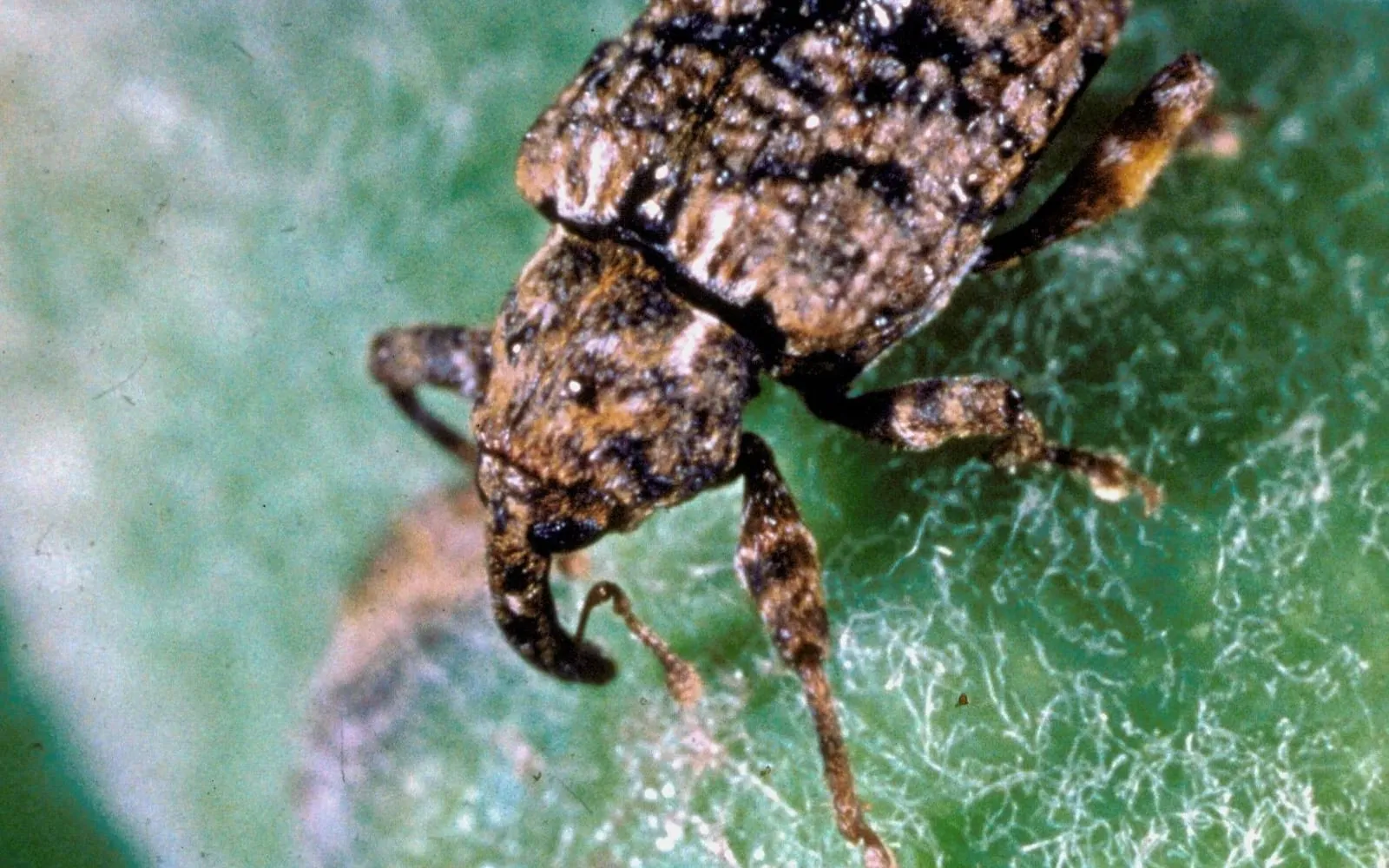
- Adult weevils about 6 mm long, mottled grey-brown with two small humps on the back, that fold their legs and drop to the ground playing dead when the branch is jarred
Before you treat anything
Fruit with a healed-over curculio scar is safe to eat once any grub- affected flesh is cut away; the scar itself is cosmetic.
What you are looking at
A small, distinctly crescent- or D-shaped scar cut into the skin of young apple, peach, plum or cherry fruit, marking where a female has laid an egg beneath a flap of tissue she then cuts partly free. Scattered around it are smaller, rounder feeding punctures from the same weevil. Fruit carrying a scar often drops prematurely, well ahead of the tree’s normal early thinning drop; fruit that stays on the tree develops a lumpy, misshapen patch as it grows around the original wound. Cut open a dropped fruit and there is usually a small white grub inside, working its way toward the pit or core.
The adult responsible is a mottled grey-brown weevil about 6 mm long, with two small humps on its back and a curved snout. Disturb the branch it is sitting on and it responds by folding its legs and dropping to the ground, playing dead rather than flying off, a habit that is both a useful identification clue and the basis of the main non-chemical control against it.
A North American answer to a question asked everywhere
Nearly every fruit-growing region on Earth has some insect that puts a maggot or grub into young stone or pome fruit, and the identity of that insect changes by continent. Plum curculio is North America’s version, native to and confined to the region east of the Rocky Mountains, from southern Canada to the Gulf Coast, with a single isolated population in Utah remaining the only known infestation further west. Where a European or Asian orchard would blame plum moth or codling moth for a maggot in the fruit, a North American one blames this weevil instead, and the crescent- shaped scar on immature fruit is the clearest way to tell it apart from either.
It has never established outside North America.
What to do about it
Jar branches over a sheet in the cool of the early morning through the weeks following petal fall, when adults are least active and most likely to drop rather than fly.
Apply kaolin clay to fruit and foliage from petal fall through the following month or so of egg-laying, as a protective, non-toxic barrier.
Collect and destroy fallen fruit promptly through late spring and early summer rather than leaving it on the ground.
Till the soil beneath host trees in autumn or early spring to disturb overwintering adults.
Apply beneficial nematodes to the soil beneath trees where blueberry or other susceptible plantings have had heavy pressure in previous years.
What it gets mistaken for
Plum moth tunnels inside a fruit that is already colouring toward ripeness, leaving dry crumbly frass around the stone rather than a crescent scar on green immature fruit, and it has never established in North America.
Codling moth leaves a neat round entry hole and tunnels to the core of an apple or pear, and occurs in North America alongside this weevil without being the same pest; the crescent-shaped scar, appearing weeks earlier in the season on much younger fruit, is what separates the two.
What to do, in order
Start here
Prevention, and the changes that stop the problem returning. Most of these pages should end at this tier.
- Clean up fallen fruit through late spring and early summer
- Larvae develop inside dropped fruit and leave it to pupate in the soil beneath the tree. Collecting and destroying fruit that drops early, rather than leaving it on the ground, removes a generation before it completes its cycle and is one of the most effective controls available without spraying.
- Till the soil beneath trees in autumn or early spring
- Overwintering adults shelter in leaf litter and soil debris near the base of host trees and in adjacent hedgerows and woodland edges. Light cultivation disturbs those overwintering sites and exposes adults to weather and predators before the spring egg-laying period begins.
Then reach for a barrier
Netting, hand removal and water. Nothing here harms anything except the target.
- Jar branches over a sheet or tarp in the cool of the morning
- Adults respond to a sudden jolt by folding their legs and dropping, a defence that works against a predator but not against a collecting sheet held ready underneath. Doing this in the cool of early morning, when the beetles are least active and most likely to drop rather than fly off, and repeating it through the weeks after petal fall when females are laying eggs, removes a useful share of the population on a garden scale.
- Apply kaolin clay as a protective barrier during the egg-laying window
- A fine kaolin clay spray applied to fruit and foliage from petal fall through the following four to six weeks makes the surface unattractive for feeding and egg-laying without killing anything outright, and is a standard organic-approved practice in affected regions.
Then bring in the predators
Encourage what already lives in the garden, and buy predators in where the problem is under glass and nothing will arrive on its own.
- Apply entomopathogenic nematodes to the soil beneath trees
- Nematodes such as Steinernema riobrave, watered into moist soil beneath the tree canopy where larvae drop to pupate, have shown strong suppression in trials, particularly in blueberry plantings, and work as a between-season reduction rather than a fix for fruit already scarred.Sold across North America for soil application; not relevant where the pest does not occur.
Biological controls are live organisms and their sale and release are regulated country by country. An agent sold freely in one place may be unapproved in another, so buy from a licensed supplier where you live and never import or move one yourself.
Plants affected
Guides that name it among the problems to watch for. The list is the plants it is characteristic of rather than everything it will feed on.