
Pest
Japanese beetle
Popillia japonica
A shrub or vine with leaves eaten down to a lace of veins, done by a metallic green-and-copper beetle that feeds in mobs and attacks over 300 kinds of plant. Established across most of North America, newly arrived in northern Italy and Switzerland, and a notifiable pest everywhere else in Europe.
At a glance
- Type
- Pest
- Cause
- Insect
- Severity
- Destroys the crop or display
- Affects
- Herbs and edibles, Garden plants
- Active
- June to August
- Established in
- North America and Asia
What you are seeing
- Leaves eaten between the veins into a lace-like skeleton, leaving only the network of veins behind
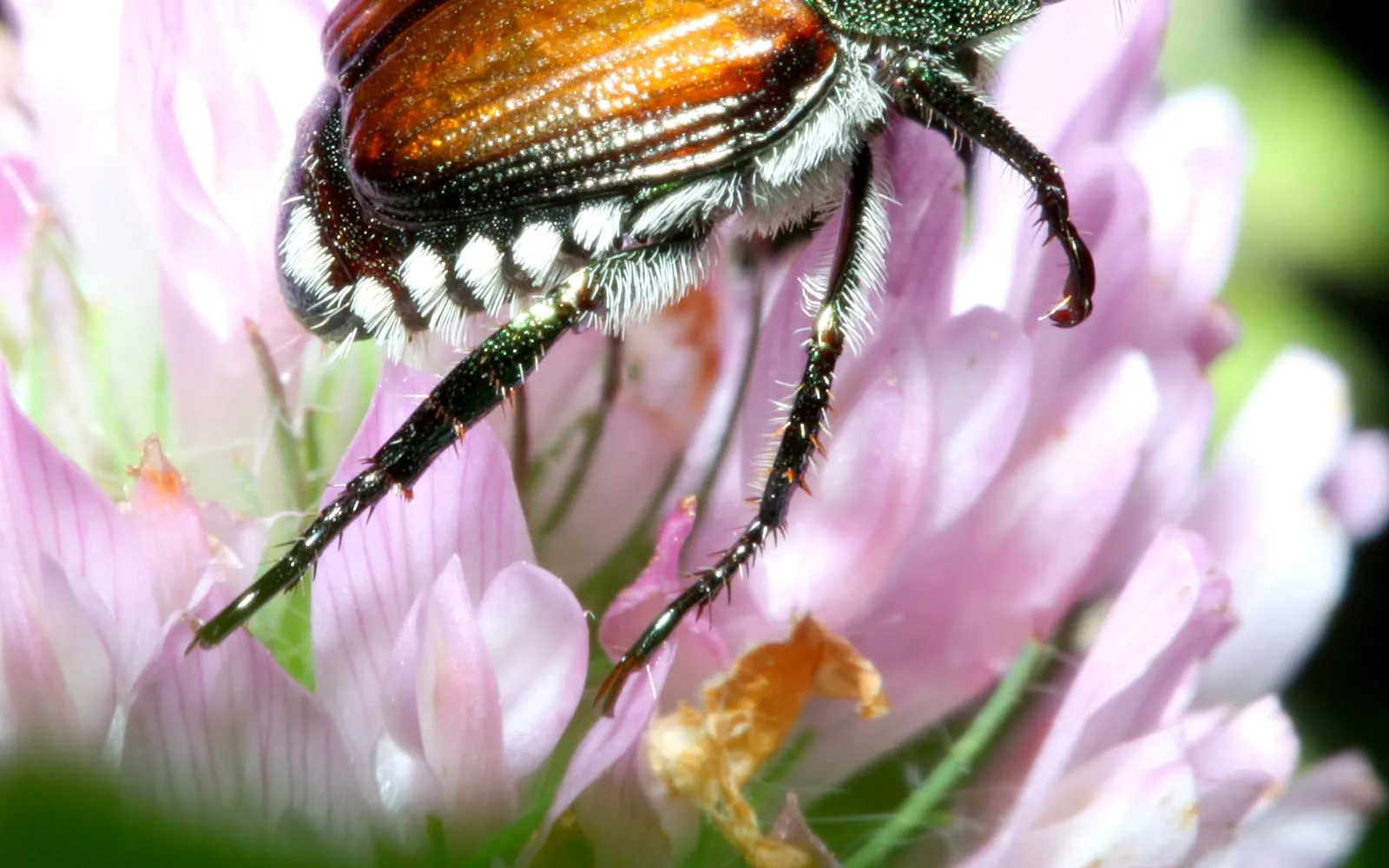
- Beetles 10 to 12 mm long with a metallic green body and coppery-bronze wing cases, feeding in visible groups on the sunniest, uppermost foliage
- Flowers, particularly rose and light-coloured blooms, chewed to shreds or stripped of petals entirely
- Ripening soft fruit and grapes with irregular holes eaten into the flesh
- Patches of brown, dead turf that lift away like a loose carpet, caused by fat white C-shaped grubs feeding on roots underground
- Damage concentrated in the hottest weeks of summer and easing off by early autumn
Before you treat anything
Skeletonised leaves and chewed fruit are unpleasant rather than unsafe. Cut around any damaged fruit flesh and the rest is fine to eat.
What you are looking at
Leaves eaten away between the veins, leaving a lacy skeleton behind rather than ragged holes. The beetles doing it are hard to miss once found: 10 to 12 mm long, with a metallic green body and coppery-bronze wing cases, and they feed in visible clustered groups on the sunniest and uppermost leaves of a plant rather than scattering thinly across it.
Flowers take the same treatment, chewed to shreds or reduced to bare stems, and light-coloured or scented blooms draw the worst of it. Grapes and soft fruit ripening in midsummer get irregular holes eaten straight into the flesh.
Underground, fat white C-shaped grubs feed on grass roots through late summer and autumn, and a lawn with a heavy infestation develops patches of dead turf that peel back like loose carpet, since the roots holding it down have been eaten away.
An old pest with a new front line
This is a well-established, thoroughly studied pest across most of the eastern and central United States and into southern Canada, where it arrived from Japan with nursery stock in the early twentieth century and has been a defining midsummer problem in gardens ever since.
Europe’s situation is different and more urgent. A breeding population was first confirmed in Lombardy, northern Italy, in 2014, almost certainly arriving the same way American populations did a century earlier, and it has since spread into neighbouring Ticino in southern Switzerland. Everywhere else on the continent, including the United Kingdom, remains free of it, and the containment effort treats every new find outside that Italian-Swiss pocket as an emergency, because eradication while numbers are low has worked before and stops working once a population is established and spreading on its own.
Anyone gardening outside northern Italy and southern Switzerland who finds a beetle matching this description should report it rather than treat it, since the response to an isolated find is very different from the response to an established population.
What to do about it
Where the beetle is established, shake plants over soapy water in the cool of the morning through the peak weeks of midsummer, and repeat daily. This is the most effective control available to a home gardener and it also limits the scent cues that draw in further beetles.
Net roses, grapevines and other high-value plants during the flight period rather than relying on a spray programme.
Keep the lawn on the dry side through late summer to discourage egg-laying and grub survival, and consider milky spore or beneficial nematodes as a longer-term, neighbourhood-scale reduction where they are available.
Avoid siting a pheromone trap anywhere near a plant worth protecting; it will draw in more damage than it prevents.
Outside the established range, report a suspected sighting to the national plant health authority and leave the beetle for identification rather than treating it as a garden pest to manage alone.
What it gets mistaken for
A related scarab sold under a similar common name in parts of Europe is a duller green, lacks the coppery wing cases, and feeds alone rather than in the dense working groups that mark Japanese beetle out. A crowd of identical beetles skeletonising the same shrub together, in a place it has established, is the more reliable tell than colour alone.
Leaf miner tunnels stay hidden within the leaf and leave both surfaces intact, nothing like the open lace of a beetle-eaten leaf.
Not established in Europe, Australia and New Zealand
Do not prune, spray or otherwise treat a suspected case. Doing so risks spreading an organism the country has kept out, and it disturbs the evidence needed to identify it. Photograph what you can see, leave the plant alone, and contact your national or state plant health authority. The control advice further down this page is written for regions where this problem is already established.
Native to Japan, where natural predators and its narrower original host range keep it a minor pest. It has been established across most of the eastern and central United States and southern Canada since the early twentieth century, arriving with imported nursery stock, and it is now one of the most damaging generalist pests in North American gardens and farms. Europe is still fighting to keep it out rather than having already lost that fight. A breeding population was confirmed in Lombardy, northern Italy, in 2014 and has since spread into Ticino, southern Switzerland. The rest of the continent, including the United Kingdom, remains free of it and treats a find as notifiable, since eradication is still considered possible outside the infested area. Australia and New Zealand have never had it and run active surveillance at ports of entry.
What to do, in order
The steps below apply where this problem is already established.
Start here
Prevention, and the changes that stop the problem returning. Most of these pages should end at this tier.
- Avoid moving soil, turf or plants from a known infested area
- Grubs travel in the root balls of nursery stock and in turf, which is how the beetle reached Italy and spread from there. Buying plants and turf from certified, inspected sources is the single most useful thing a gardener does to slow its spread into new territory.
- Time watering to discourage grubs in the lawn
- Grubs need moist soil in the weeks after eggs are laid in midsummer, and a lawn kept on the dry side through late July and August is far less attractive to egg-laying females and harder for young grubs to survive in.
- Report a suspected sighting outside the established range
- Anywhere the beetle is not yet established, including all of the United Kingdom and most of continental Europe, a sighting matching this description should go to the national plant health authority rather than be treated at home. Confirmed finds outside Italy and Switzerland have so far been eradicated while numbers were still low, and that only works if they are reported early.
Then reach for a barrier
Netting, hand removal and water. Nothing here harms anything except the target.
- Hand-pick or shake beetles into soapy water in the early morning
- Beetles are sluggish in cool morning air and drop readily when a branch is shaken over a container of soapy water held underneath. Doing this daily through the peak weeks of July keeps a garden-scale planting well ahead of the damage, and it also reduces the scent cues that draw in more beetles, since damaged foliage releases compounds that attract others of the same species.
- Net high-value plants during the flight period
- Fine mesh over roses, grapevines or a favoured fruit bush for the four to six weeks of peak activity in midsummer excludes the beetles entirely from anything that can be practically covered.
- Avoid pheromone traps near the plants you want to protect
- Commercial lure traps draw in far more beetles than they catch, and sited near a vulnerable plant they reliably make its damage worse. Where used at all, place a trap well away from anything you value, as a monitoring tool rather than a control.
Then bring in the predators
Encourage what already lives in the garden, and buy predators in where the problem is under glass and nothing will arrive on its own.
- Apply milky spore disease to the lawn
- Bacillus popilliae infects and kills grubs in the soil and persists for years once established, giving a slow but self-sustaining reduction in the local grub population. It takes several seasons to build up and works best applied across a whole neighbourhood rather than one garden, since grubs and beetles move freely between adjoining properties.Sold across North America as a soil treatment. Not relevant, and not available, where the beetle has not established.
- Apply beneficial nematodes to the lawn in late summer
- Steinernema and Heterorhabditis species applied to moist soil while grubs are small and near the surface, in late summer, give a faster result than milky spore, though a shorter-lived one that needs repeating.Sold across North America; not relevant elsewhere.
Biological controls are live organisms and their sale and release are regulated country by country. An agent sold freely in one place may be unapproved in another, so buy from a licensed supplier where you live and never import or move one yourself.
Plants affected
Guides that name it among the problems to watch for. The list is the plants it is characteristic of rather than everything it will feed on.