
Pest
Plum moth
Grapholita funebrana
Also called Plum fruit moth, Red plum maggot, Damson moth
Plum moth leaves a pink caterpillar curled around the stone and fruit that ripens early. Use pheromone traps from May and separate it from plum sawfly, which damages young fruitlets in June.
At a glance
- Type
- Pest
- Cause
- Insect
- Severity
- Destroys the crop or display
- Affects
- Herbs and edibles
- Active
- June to September
- Established in
- Europe and Asia
What you are seeing
- Plums colouring up and softening two to four weeks before the rest of the crop
- Fruit dropping early, often still hard on one side
- A pinkish-white caterpillar with a brown head curled in the cavity around the stone
- Brown crumbly frass packed into the space the stone sits in
- A small hole in the skin, sometimes with a bead of clear gum around it
- Fruit that looks perfect until it is cut in half
- Worst on damsons and on trees that were not picked over the previous year
Before you treat anything
A plum with a maggot in it is unpleasant rather than dangerous. Cut the fruit in half, discard anything with frass in the cavity, and the sound halves are fine to cook.
What you are looking at
A plum that has coloured early. While the rest of the tree is still green and hard, a scatter of fruit turns purple, softens and falls, two to four weeks ahead of schedule. Picked up and cut open, it has a pinkish-white caterpillar about 12 mm long with a brown head, curled in the hollow around the stone, sitting in a mass of dry brown crumbs.
From the outside there may be nothing at all, or a pinhole in the skin with a bead of clear gum beside it. Most people find this pest at the kitchen counter rather than on the tree.
Damsons suffer worst, then plums and gages. The wild blackthorn in a nearby hedge carries the same moth and is where a new infestation often comes from.
The year the moth has
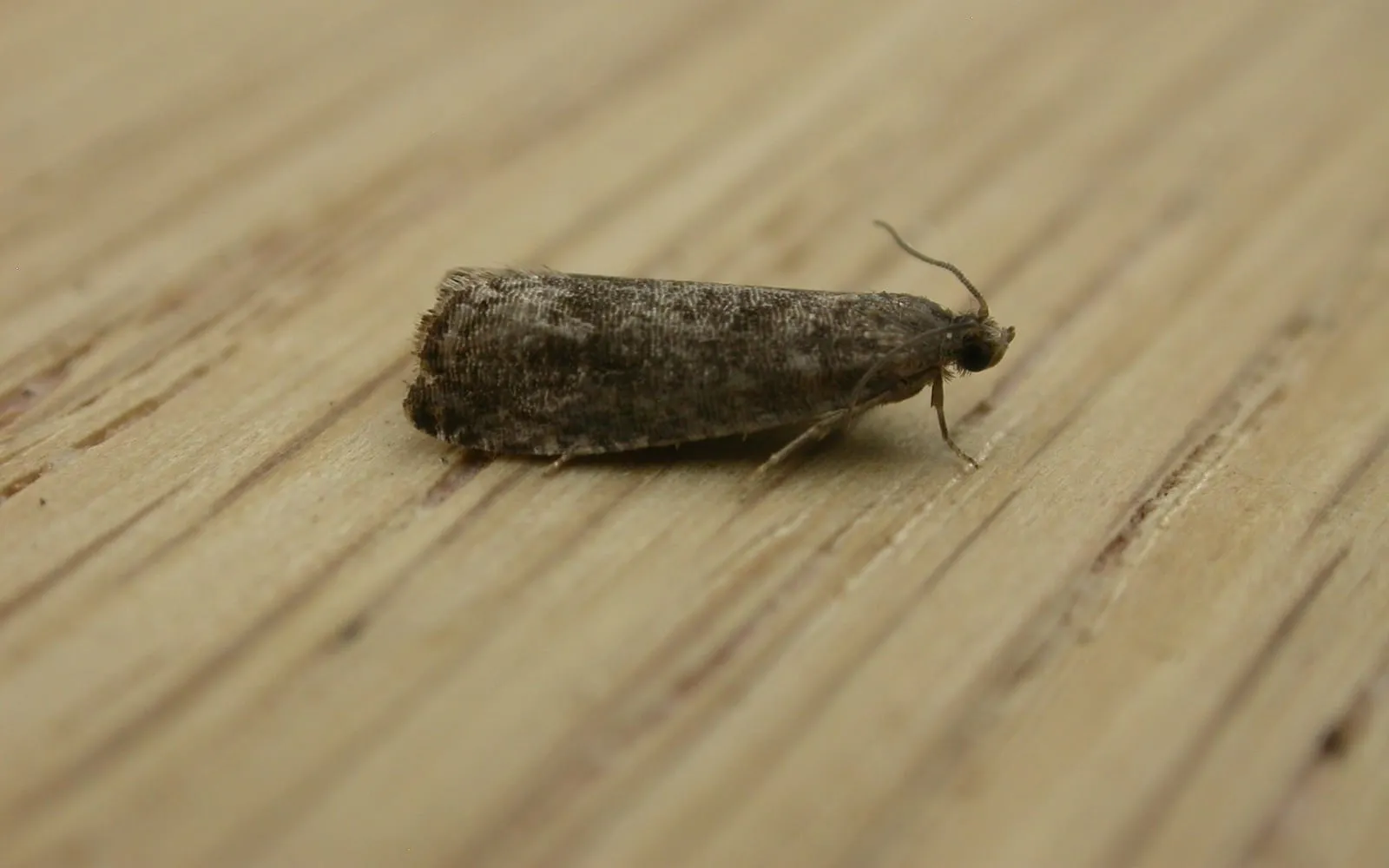
Adults are small and grey-brown, about 15 mm across the wings, and they fly in the evening from late May or early June through to August. They are easy to miss and almost nobody sees them.
A female lays single eggs on developing fruit and on the leaves beside it. The caterpillar hatches, bores in near the stalk, and feeds in the cavity around the stone for three or four weeks. The fruit responds by ripening early and abscising, which suits the moth: it puts the caterpillar on the ground with a food supply, near the trunk where it pupates.
The caterpillar then leaves the fallen fruit, finds a crevice in the bark or the litter, and spins a tough silk cocoon. In a warm year a second, partial generation follows in August and September. The rest overwinter in those cocoons and emerge the following May.
Every part of the control follows from that cycle. The fruit on the ground holds next year’s moths with a fortnight’s head start, and the loose bark on the trunk is where they will spend the winter.
Plum moth or plum sawfly
Both put a grub in a plum and the treatments differ, so the distinction is worth five minutes.
Plum sawfly attacks early. The grub goes into fruitlets in May and June, tunnels to the stone while the fruit is still small and green, and then leaves through a hole several millimetres across. Around that hole is wet black frass with a strong unpleasant smell, and the fruitlet drops in June. One sawfly grub will often ruin three or four fruitlets in succession.
Plum moth attacks late. Its caterpillar goes into a fruit that is already sizing up, stays inside until the fruit falls, and leaves dry brown crumbly frass with no particular smell. One caterpillar stays in one fruit.
June drop with black smelly holes is sawfly, and August fruit with dry frass round the stone is moth. Pheromone traps for plum moth catch no sawflies at all, so a trap that stays empty while the fruitlets are dropping tells you which one you have.
Do the traps work
On a garden tree, yes, and better than they do commercially. A pheromone trap catches male moths, and where there is one tree and one trap, enough of the local males end up on the sticky sheet that many females go unmated. Growers with a block of trees get less benefit from the same trap, because there are always more males arriving, which is why the commercial literature describes traps as monitoring tools and the garden experience is better than that.
Two things stop them working. Hanging the trap in June, after the flight has begun, misses the first and largest wave. And leaving the same sticky base in place all summer means the trap is full and inert by early July.
Nothing sprayed is available or worth pursuing here. The caterpillar spends its whole feeding life inside the fruit, where no product a gardener can buy will reach it, and the window before it bores in is a few days wide and impossible to judge without the trap you would have needed anyway.
What to do about it
Hang a pheromone trap on the tree by the middle of May, and replace the sticky base and the lure through the season as the instructions say.
Gather the fallen fruit twice a week from late June onwards and destroy it.
Thin the crop in June so that fruits do not touch, and pick the whole tree, including the part you need a ladder for.
Tie a band of corrugated cardboard round the trunk in August and burn it in autumn.
Feed the birds near the fruit trees over winter and leave the bark alone.
Cut and use the sound halves of maggoty fruit rather than throwing the lot.
What it gets mistaken for
Plum sawfly damage comes earlier, smells, and leaves a wide exit hole with wet black frass.
Codling moth does the same job on apples and pears and never touches plums.
Pear midge attacks pears alone, and its fruitlets turn black, swell oddly at the base and drop in May, with many small white maggots inside one fruit rather than a single caterpillar.
Nut weevil puts a single grub in a hazelnut or a filbert kernel and leaves a neat round exit hole in the shell.
Brown rot works from the outside in, spreading a soft brown patch over the surface with concentric rings of buff pustules, often on fruit a bird or a wasp opened first.
Wasps and earwigs found inside a plum in August are enlarging damage that something else began.
Not established in North America, Australia and New Zealand
Do not prune, spray or otherwise treat a suspected case. Doing so risks spreading an organism the country has kept out, and it disturbs the evidence needed to identify it. Photograph what you can see, leave the plant alone, and contact your national or state plant health authority. The control advice further down this page is written for regions where this problem is already established.
Grapholita funebrana is European and Asian and has never established in North America, where Canada, Mexico and the United States all list it as a quarantine pest. Australia and New Zealand are free of it too. A maggot in a plum therefore has a different culprit depending on the continent, and in North America the usual suspect is plum curculio.
What to do, in order
The steps below apply where this problem is already established.
Start here
Prevention, and the changes that stop the problem returning. Most of these pages should end at this tier.
- Pick up and destroy every fallen plum
- A dropped fruit still has the caterpillar in it, and it will leave within a few days to spin a cocoon in the bark or the litter and start next year's generation. Gathering the early drops twice a week through July and August is the most useful half-hour in the plum year. Bin them, or drown them in a bucket of water for a fortnight before composting.
- Thin the crop and pick the tree clean
- A plum tree left half-picked because the top was out of reach carries the population through to next season. Thinning in June also spaces the fruit so that fewer touch, since a caterpillar will cross from one plum to another where two are pressed together.
- Expect bad years to follow good ones
- Numbers build across seasons when the fallen fruit is left, and they collapse when it is not. A tree that had heavy maggot damage last August will have it again unless something changed on the ground, and the ground is where the change has to happen.
- Leave the bark rough and the birds welcome
- The caterpillars overwinter in cocoons under loose bark and in crevices on the trunk. Tits work over that bark all winter and take a good share of them, so a feeder near the fruit trees from November onwards is worth more than it looks. Do not scrub or paint the trunk.
Then reach for a barrier
Netting, hand removal and water. Nothing here harms anything except the target.
- Hang a pheromone trap from mid-May
- A delta trap baited with the female's scent catches male moths on a sticky sheet. Hang one at about head height on the south side of the tree before the middle of May and check it weekly. On a single garden tree the trap catches enough males to cut the damage on its own; in an orchard it is better used to tell you when the flight has started.
- Use the trap to time everything else
- The first moths on the sheet mean eggs are being laid within a week or two. That is when to start thinning, gathering drops and paying attention, rather than working from a date in a book. Flight timing moves by two or three weeks between a cold spring and a warm one.
- Replace the sticky base and the lure as the packet says
- A sheet covered in moths and dust catches nothing more, and the lure stops giving off scent after six to eight weeks. A trap left unserviced from May to September is doing nothing for most of the summer, which is the commonest way this control gets a poor reputation.
- Put a band of corrugated cardboard round the trunk in August
- The caterpillars leaving late fruit look for a crevice to spin up in, and a band of cardboard tied round the trunk gives them an obvious one. Take it off in the autumn and burn it. This catches a fraction rather than most of them, so treat it as a supplement to clearing the drops.
Plants affected
Guides that name it among the problems to watch for. The list is the plants it is characteristic of rather than everything it will feed on.