
Disease
Silver leaf
Chondrostereum purpureum
Also called Silverleaf, Plum silver leaf
Silver leaf turns leaves on one branch of a plum dull silver and stains dead wood purple. Confirm it with a cut through affected wood, and prune plums in June to reduce infection risk.
At a glance
- Type
- Disease
- Cause
- Fungus
- Severity
- Can kill the plant
- Affects
- Herbs and edibles, Garden plants
- Active
- All year
- Established in
- Europe, North America, Asia, Australia, New Zealand and Central and South America
What you are seeing
- Leaves on one branch taking on a dull metallic silver sheen while the rest of the tree stays green
- The silvering spreading to further branches over the following seasons
- Affected branches dying back, with the leaves browning from the margins
- A purple-brown stain running through the wood when a dead branch over 2.5 cm thick is cut across
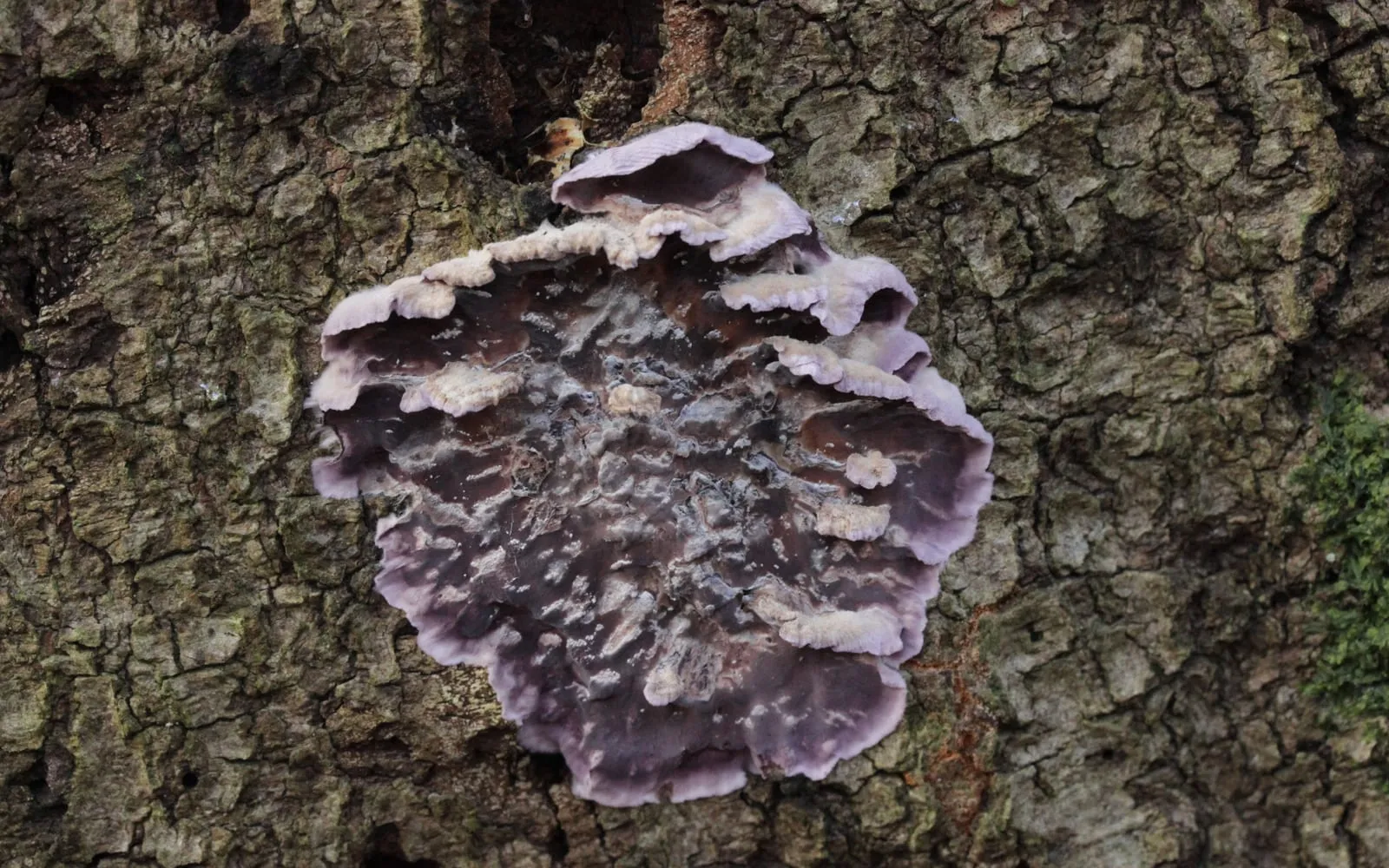
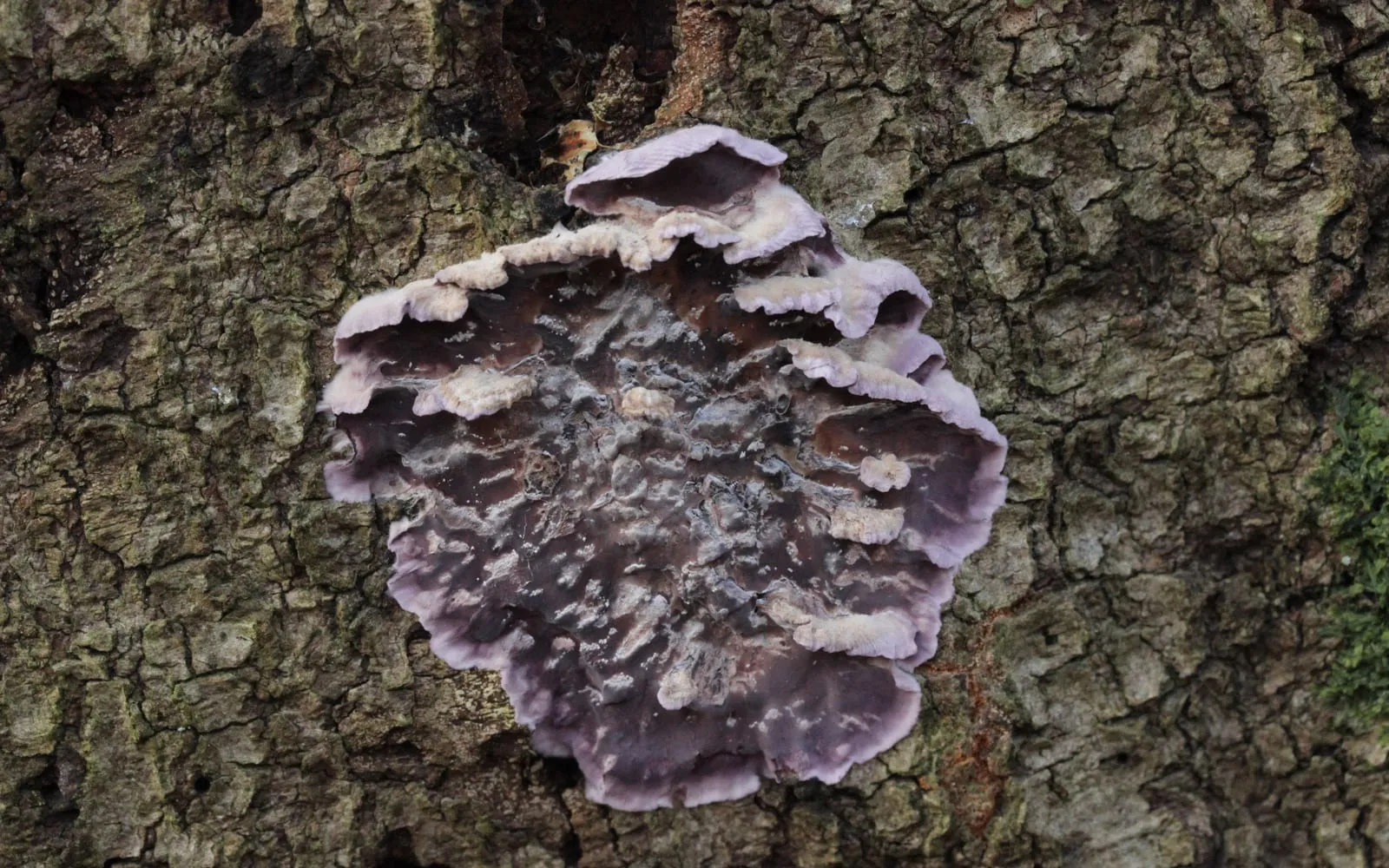
- Small overlapping brackets on dead wood, woolly and buff above and purple beneath
- A tree that has been pruned in autumn or winter within the last two years
Before you treat anything
Fruit from a tree with silver leaf is safe to eat. Dead branches shed without warning, so take out any that overhang a path or a seat rather than waiting to see whether the tree recovers.
What you are looking at
The leaves on one branch of a plum take on a dull metallic sheen, as though someone had breathed on them. The rest of the tree looks normal. Over the following season the silvering appears on more branches, the affected ones die back with their leaves browning from the edges, and the tree loses a limb at a time.
The silvering is an optical effect rather than a coating. A toxin produced by the fungus separates the upper skin of the leaf from the tissue beneath it, leaving a thin layer of air that reflects light. It cannot be wiped or washed off, which is worth trying because a sooty or dusty deposit can be.
One cut confirms it
Silvering on its own is not enough. Drought, starvation and root damage all produce what growers call false silver leaf, where the whole tree silvers at once rather than a branch at a time, and it corrects itself when the underlying problem is fixed.
The test is in the wood. Cut across a dead or dying branch more than about 2.5 cm thick and look at the cut face. Silver leaf leaves a distinct purple-brown stain running through the wood, often as an irregular ring or a patch rather than a neat circle. Clean pale wood under silvered leaves means the tree has something else wrong with it.
Brackets are the third sign and the latest one. Small overlapping fruiting bodies, woolly and buff on top and lilac to purple underneath, appear on dead wood once the branch has been dead for a while. They shed spores through autumn and winter.
Which is why plums are pruned in June
The spores land on fresh wounds in the bark and germinate there. Autumn and winter are when they are in the air, and they are also when a dormant tree seals a cut most slowly.
Prune a plum in December and you have made a large, slow-healing wound in the middle of the spore season. Prune the same tree in June and the wound is callousing within weeks while there is little to infect it. That is the whole of the reason for the rule, and it is not a piece of orchard folklore.
The same timing prevents bacterial canker, which enters the same trees through the same winter wounds. Two diseases, one habit.
What can be saved
A tree with the fungus confined to one limb can be saved. Cut that branch back in summer, following the stain in the wood, taking progressively shorter branches until the cut face is clean, and then a further 15 cm. Trees held this way for a decade are common.
A tree where the stain has reached the trunk will not recover. The fungus is in the framework, further branches will silver each year, and the tree becomes a spore source for every other plum nearby. Taking it out is the right call, and replanting with a pear, an apple on the far side of the garden, or something outside the cherry family altogether avoids repeating it.
What to do about it
Prune between June and August and never in autumn or winter.
Cut a silvered branch out in summer, following the stain into clean wood.
Burn or bin the wood rather than stacking it.
Leave the cut unpainted.
Clear dead wood, old stumps and log piles from around the fruit trees.
Keep the tree fed, mulched and watered so it can hold the line.
Take out a tree that has silvered all over.
What it gets mistaken for
False silver leaf silvers the whole tree at once from drought, starvation or root trouble, and the wood underneath is clean. It recovers when the tree is fed and watered.
Bacterial canker sinks and kills patches of bark and weeps amber gum, with the damage visible from outside.
Honey fungus works up from the roots, with white fungal sheets under the bark at ground level and black bootlaces in the surrounding soil.
Powdery mildew coats the leaf surface in a white bloom that rubs off between finger and thumb.
Aphid honeydew and the sooty mould that grows on it leave a sticky black or grey film that washes off with water. Silver leaf cannot be washed away.
What to do, in order
Start here
Prevention, and the changes that stop the problem returning. Most of these pages should end at this tier.
- Prune plums and cherries only between June and August
- The fungus releases its spores in autumn and winter, and it gets in through fresh pruning wounds. Summer pruning puts the cuts into the months with the fewest spores in the air and the fastest healing, and it prevents this disease and bacterial canker at the same time. Nothing else on this page comes close to it for effect.
- Take out dead wood from the whole garden
- The brackets grow on dead wood of many kinds, not just on fruit trees. A stump left after felling, a pile of logs, a dead branch in a hedge or an old poplar can all be producing spores. Clearing standing dead wood near a plum is worth doing before it fruits.
- Keep the tree growing well
- A vigorous tree walls off the infection and can hold it in one limb for years, and a starved one loses branch after branch. Mulch, feed in spring, water through a drought, and keep grass away from the trunk.
- Make small cuts rather than large ones
- A wound the size of a pencil closes in weeks and a wound the size of a saucer takes years. Formative pruning done annually, taking out small wood as it grows, avoids ever needing the cut that lets this in.
Then reach for a barrier
Netting, hand removal and water. Nothing here harms anything except the target.
- Cut affected branches back into clean wood in summer
- Follow the purple stain in the wood by cutting progressively back towards the trunk until a cut face shows clean, then take a further 15 cm beyond that. Do it in June or July. Caught in one limb, this can save the tree, and it is the only treatment there is.
- Burn or bin what you cut out
- Infected wood left on a heap grows brackets and reinfects the garden. Do not shred it and do not stack it for firewood next to the trees it came from.
- Leave the wound unpainted
- Sealing compounds were once standard and are no longer recommended. They trap moisture against the cut and slow the tree's own defence. A clean cut just outside the branch collar, made in summer, does better on its own.
- Remove a tree that is silvering all over
- Once the fungus is in the trunk the tree will decline whatever is done, and it will produce brackets and spores in the meantime. Take it out and replant with something outside the cherry family.
In pictures
Plants affected
Guides that name it among the problems to watch for. The list is the plants it is characteristic of rather than everything it will feed on.