
Disease
Plum pox
Potyvirus plumpoxi
Also called Sharka, Plum pox virus, PPV, Sharka disease
Pale rings and blotches on plum, apricot and peach fruit, with the fruit dropping early and tasting of nothing. Aphids spread it in seconds, so spraying them does not help, and in several countries a suspected case has to be reported.
At a glance
- Type
- Disease
- Cause
- Virus
- Severity
- Destroys the crop or display
- Affects
- Garden plants, Herbs and edibles
- Active
- April to August
- Established in
- Europe, Asia, Africa and Central and South America
What you are seeing
- Pale green or yellow rings, blotches and bands on the leaves, clearest in spring
- Rings, lines and dark blotches on the skin of the fruit
- Fruit deformed and lumpy with sunken discoloured areas in the flesh
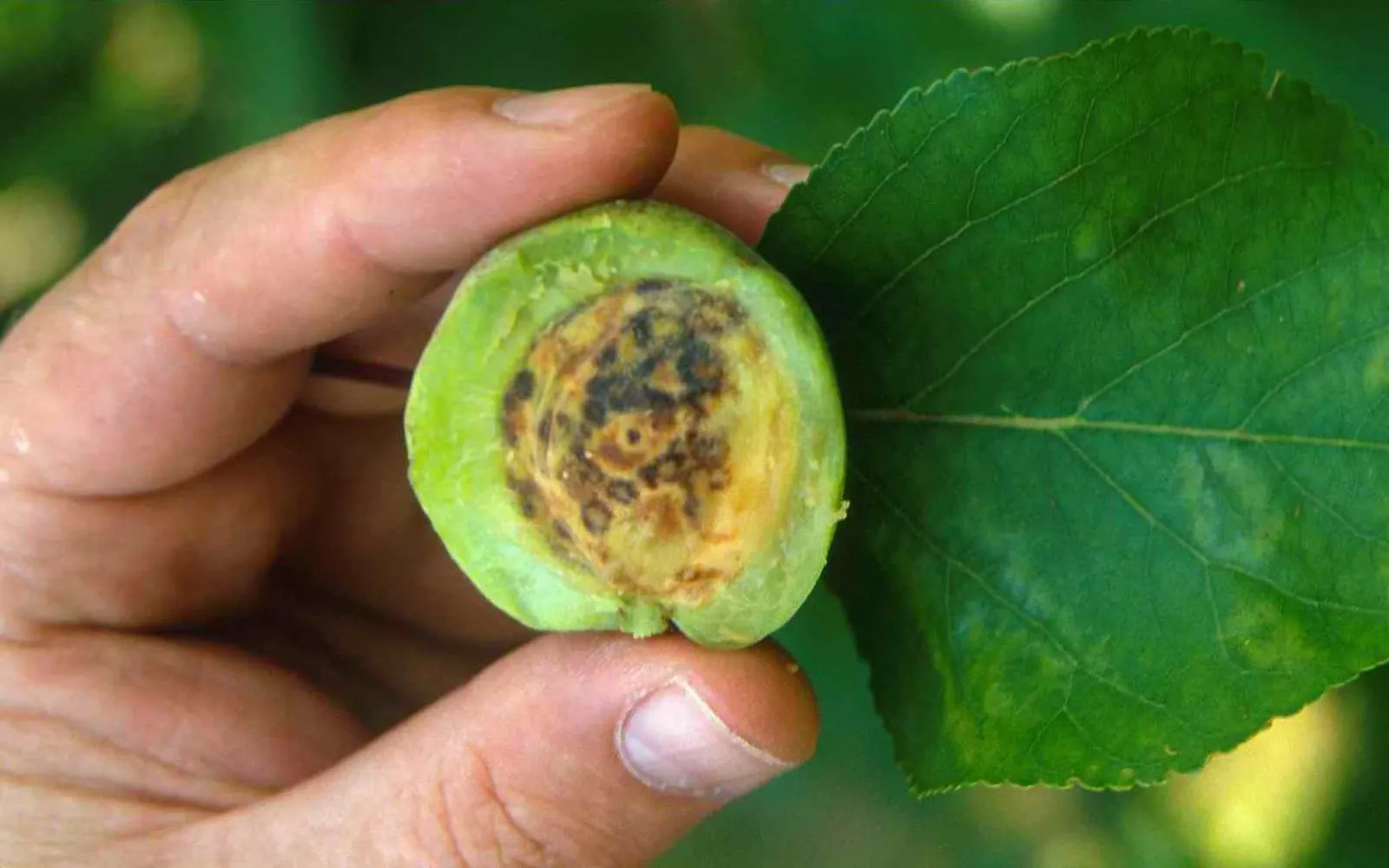
- Rings or pale blotches on the stone itself in plums and apricots
- Fruit dropping weeks before it should, and tasting flat or bitter when it does not
- Pale rings on the petals of an apricot or peach blossom
- Symptoms strong on some branches and absent on others in the same tree
- The tree itself growing on normally for years while the crop is worthless
Before you treat anything
Fruit from an infected tree is safe to eat and generally not worth eating, since it drops early and tastes flat. Where the virus is not established, moving fruit or plant material off the property may be restricted, so check before carrying anything away.
What you are looking at
Rings on the fruit. Pale circles, arcs and lines in the skin of a plum, an apricot or a peach, sometimes with the flesh beneath them sunken and discoloured. The fruit is lumpy rather than round, drops weeks early, and tastes of very little when it does not.
Cut a plum or an apricot open and look at the stone. Rings and pale blotches on the stone itself are made by nothing else, and they settle the identification.
On the leaves the marks are pale green or yellow rings, bands along the veins and irregular blotches. They show best in spring and early summer on a cool morning with the light behind the leaf, and they fade as the summer heats up, so a tree inspected in August can look clean.
Often one part of the tree is marked and the rest is not. The tree itself keeps growing and may live for years, which is why the disease is measured in ruined crops rather than dead trees.
Report it first in three parts of the world
The virus is absent from North America, Australia and New Zealand, and all three regulate it. North America had it and got rid of it. Plum pox was found in Pennsylvania in 1999, and after two decades of survey and tree removal the United States was declared free of it in 2019, with Canada running a parallel campaign.
Two decades of work stand behind that, so a suspected finding in those countries goes to the national plant health authority or the state agriculture department before anything else happens.
Leave the tree standing while they respond. Do not take cuttings, do not move fruit or plant material off the property, and do not dig it up. A tracing programme has to find out where the tree came from and what else came with it, and a tree already on the bonfire cannot answer that.
Everything below applies where the virus is established and no reporting duty exists.
Seconds on the mouthparts
More than twenty aphid species carry plum pox, and they do it in a way that closes off the obvious control.
The virus attaches to the aphid’s mouthparts rather than travelling through its body. An aphid probing a leaf to taste it picks the virus up within seconds, and it can pass it on to the next leaf it probes just as quickly. It holds the virus for a few hours at most.
An insecticide cannot work against that. By the time the aphid has taken enough of anything to die, it has probed several leaves and infected them. Worse, a sublethal dose makes aphids restless and moving aphids probe more plants than settled ones do, so spraying can raise the spread rather than lower it.
This is the opposite of how barley yellow dwarf behaves, where the aphid must feed for hours and carries the virus for life, and it is why two diseases both described as aphid-borne need entirely different advice.
Grafting moves it further than any aphid
Aphids move the virus from tree to tree within a neighbourhood. What moves it between countries is people carrying plant material.
The virus is present throughout an infected tree, so budwood, grafts, suckers and rootstock all carry it, and a graft transmits it with certainty rather than chance. Every long-distance jump this virus has made has been on nursery stock, and the Pennsylvania outbreak is thought to have arrived that way.
Certification schemes exist because of this. A tested tree from a certified nursery is the whole of the prevention available to a gardener, and an unlabelled tree from a plant fair or an online seller is the route the virus uses.
Blackthorn and wild plum matter for the same reason at a local scale. They carry the virus quietly in the hedge and reinfect the orchard each year, so where the disease is established the scrub is part of the problem.
What to do about it
Report it and leave the tree alone if you are in North America, Australia or New Zealand.
Cut a few fruit open and look at the stone, since the rings there are diagnostic.
Inspect in spring in cool weather with the light behind the leaf, because the symptoms fade in summer heat.
Buy only certified trees, and treat an unlabelled tree as a risk to every plum in the neighbourhood.
Never take budwood, grafts or suckers from a tree you suspect.
Remove and destroy an infected tree where the virus is established, roots and suckers included.
Clear blackthorn and abandoned plums near an orchard.
Ask a local certified nursery which tolerant cultivars they carry.
Do not spray the aphids and expect it to help.
What it gets mistaken for
Mosaic viruses mottle the leaf without forming rings and leave the stone unmarked.
Bacterial canker kills shoots, oozes gum and shot-holes the leaves.
Fruit splitting tears the skin open after heavy rain.
Brown rot spreads a growing brown patch studded with buff pustules.
Manganese and iron shortages yellow the leaf between the veins across the whole tree.
Aphids on the shoots are the carrier rather than the cause of the marks.
Not established in North America, Australia and New Zealand
Do not prune, spray or otherwise treat a suspected case. Doing so risks spreading an organism the country has kept out, and it disturbs the evidence needed to identify it. Photograph what you can see, leave the plant alone, and contact your national or state plant health authority. The control advice further down this page is written for regions where this problem is already established.
First described in Bulgaria in 1917 and now across most of Europe, western and central Asia, North Africa and parts of South America. North America had it and no longer does. The virus was found in Pennsylvania in 1999, prompted a long eradication programme, and the United States has been declared free of it since 2019, with Canada running its own campaign. Australia and New Zealand have never had it and treat it as a high-priority exotic. Report a suspected case to the national plant health authority rather than dealing with the tree yourself.
What to do, in order
The steps below apply where this problem is already established.
Nothing available to a gardener will cure this once a plant has it. The steps below are about limiting the spread and deciding what to plant in its place.
Start here
Prevention, and the changes that stop the problem returning. Most of these pages should end at this tier.
- Report it before you touch it where you are in North America, Australia or New Zealand
- These are the places the virus is not established, and a suspected finding is a legal matter rather than a gardening one. Contact the national plant health authority or the state agriculture department, leave the tree standing, and do not move fruit, cuttings or plant material off the property. Removing the tree yourself destroys the evidence a tracing programme depends on.
- Buy certified trees, and buy nothing else
- Grafting and budding move this virus further and faster than every aphid put together, and certification schemes exist for that reason. A tree from a certified nursery has been tested. A tree from a plant fair, a neighbour's sucker or an unlabelled online seller has not, and this is where the virus travels between countries.
- Never propagate from a tree you suspect
- The virus is in every part of an infected tree, so budwood, grafts, suckers and rootstocks all carry it. Anything taken from a symptomatic tree spreads it to a clean one with certainty rather than probability.
- Remove blackthorn and wild plum near an orchard
- Blackthorn, wild plum and abandoned garden trees carry the virus without anyone noticing and keep a local infection going indefinitely. Where the virus is established locally, the scrub in the hedge matters more than anything done to the trees themselves.
- Grow a resistant cultivar where the virus is established
- Resistance and useful tolerance exist in some apricot and plum cultivars, and availability varies enormously by country. Ask the certified nursery what is offered locally rather than ordering a name from abroad, which is the route the virus takes.
- Look in spring and look at the stone
- Leaf symptoms are clearest in cool weather in spring and early summer and fade in high summer heat, so an inspection in August can miss an infected tree entirely. Rings on the stone of a plum or apricot are the sign nothing else makes, and cutting a few fruit open is worth more than a long look at the leaves.
Then reach for a barrier
Netting, hand removal and water. Nothing here harms anything except the target.
- Remove and destroy an infected tree where the virus is established
- In a region where the virus is present and no reporting duty applies, the tree has to come out, roots and suckers included, and be burned or taken away rather than chipped on site. Nothing cures it and the tree is a source for every orchard within aphid range. Replant with a certified tree of a tolerant cultivar.
- Do not rely on spraying the aphids
- This virus is transmitted in seconds. An aphid picks it up on its mouthparts while probing a leaf, carries it for a few hours at most, and infects the next plant it probes. An insecticide cannot kill the insect before the transmission has already happened, and a treated aphid that moves on rather than settling can spread it further than an untreated one would.
Plants affected
Guides that name it among the problems to watch for. The list is the plants it is characteristic of rather than everything it will feed on.