
Pest
Brown marmorated stink bug
Halyomorpha halys
Also called BMSB
Fruit dimpled and scarred where a shield-shaped bug fed through the skin, and an unpleasant smell if you crush one indoors. Established across North America, Europe and parts of South America, an active biosecurity target in Australia and New Zealand, and a pest of an extraordinarily wide range of crops.
At a glance
- Type
- Pest
- Cause
- Insect
- Severity
- Destroys the crop or display
- Affects
- Herbs and edibles, Garden plants
- Active
- June to September
- Established in
- North America, Europe, Asia and Central and South America
What you are seeing
- Small dimpled or sunken patches on the skin of apples, pears, peaches and other fruit, with corky, discoloured flesh directly beneath
- Cat-facing, a puckered scarring pattern on the fruit surface where repeated feeding punctures have distorted growth
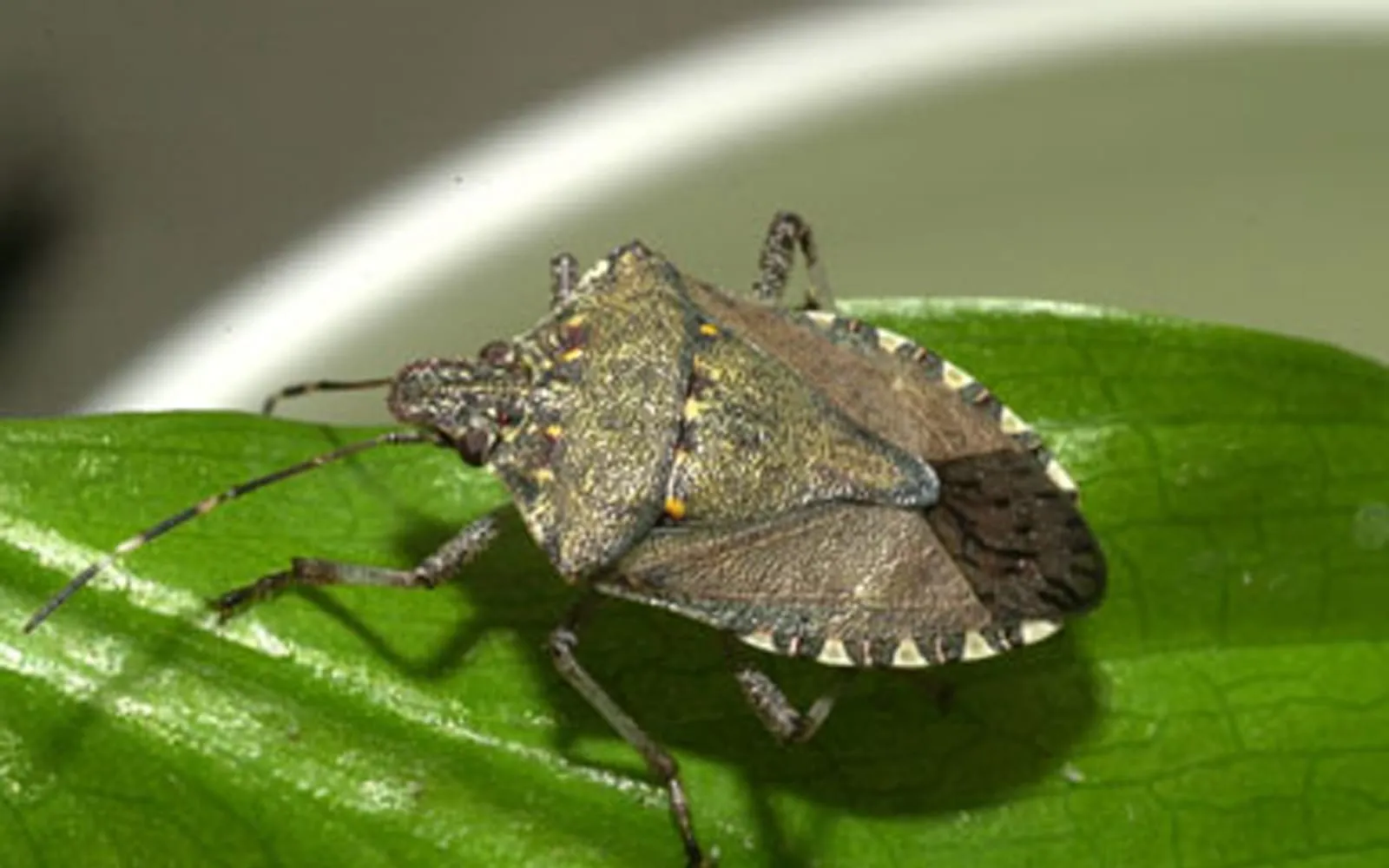
- Shield-shaped bugs 12 to 17 mm long, mottled brown, with alternating pale bands on the antennae and the edge of the abdomen visible beyond the wings
- A strong, unpleasant smell released when a bug is crushed or disturbed, the origin of the common name
- Large numbers of adults gathering on sunlit walls and entering buildings in autumn looking for a place to overwinter
- Damage scattered through a fruit crop with no single obvious source, since the bugs feed briefly and move on
Before you treat anything
The smell is unpleasant rather than harmful, and the bug does not bite or sting. Cut around dimpled or corky patches on fruit and the rest is fine to eat.
What you are looking at
Fruit with small dimpled or sunken patches on the skin and corky, discoloured flesh directly underneath, sometimes distorted into a puckered scarring pattern known as cat-facing where repeated feeding has warped the growth around each puncture. The damage is scattered rather than concentrated, because the insect responsible feeds briefly in one spot and moves on.
The insect itself is a shield-shaped bug 12 to 17 mm long, mottled brown all over, with alternating pale and dark bands running along the antennae and along the exposed edge of the abdomen. Crushed or handled roughly, it releases a strong, unpleasant smell, which is where the name comes from and which most people encounter first indoors in autumn, when large numbers move into buildings looking for somewhere to spend the winter.
An extraordinarily wide host range
Few pests match this one for the sheer number of plants it will feed on. Documented hosts run past 170 species across dozens of unrelated plant families, including most tree fruit, many vegetables, soft fruit, field crops such as maize and soya bean, and a long list of ornamentals. That breadth is part of what makes it so difficult to manage: a population can build up on a wild or ornamental host with nobody watching, then move into an orchard or vegetable garden nearby once that host is exhausted.
Where it has spread, and where it is being kept out
Native to East Asia, it turned up in Pennsylvania in the mid-1990s, almost certainly arriving in shipping cargo, and is now established across most of the United States and into Canada. Europe followed the same pattern from the early 2010s and the bug now occurs across a growing list of countries there. It has also been found in parts of South America.
Australia and New Zealand have kept it out so far, and both treat this as a genuine achievement worth defending rather than a formality. Shipping containers arriving from countries where the bug is established go through seasonal treatment requirements timed to the Northern Hemisphere’s autumn movement into buildings, which is when hitchhiking risk is highest. A single bug found outside a known interception, in either country, is reportable rather than something to deal with alone.
What to do about it
Net high-value fruit trees and vegetable plantings with mesh fine enough to exclude adults, put up before the main summer movement into the crop.
Seal gaps around doors, windows and vents before early autumn, when adults begin looking for overwintering sites, and vacuum up any found indoors rather than crushing them.
Use pheromone traps to track when the pest is moving into a crop, understanding that they monitor better than they control.
Where the pest is not yet established, check vehicles, luggage and imported goods arriving from a country where it occurs, and report a suspected find rather than dealing with it as a garden pest.
What it gets mistaken for
Capsid bugs are smaller, green and soft-bodied, and leave small ragged holes that expand as the leaf grows rather than the dimpled, corky patches this species leaves on fruit.
Earwigs enlarge damage something else has already started, working from an existing wound outward, and release no smell when disturbed.
Not established in Australia and New Zealand
Do not prune, spray or otherwise treat a suspected case. Doing so risks spreading an organism the country has kept out, and it disturbs the evidence needed to identify it. Photograph what you can see, leave the plant alone, and contact your national or state plant health authority. The control advice further down this page is written for regions where this problem is already established.
Native to East Asia. First confirmed outside that range in Pennsylvania in the mid-1990s, it is now established across most of the United States and southern Canada and across a growing list of European countries, having reached the continent inside shipping and travellers' luggage the same way it reached North America. It has also turned up in parts of South America. Australia and New Zealand have never had a breeding population and both run seasonal import controls on shipping containers from countries where the bug is established, because a single fertilised female arriving in the wrong container has been enough to trigger a biosecurity response. A find in either country outside a known interception is reportable.
What to do, in order
The steps below apply where this problem is already established.
Start here
Prevention, and the changes that stop the problem returning. Most of these pages should end at this tier.
- Check imported goods, luggage and vehicles for hitchhiking bugs before travel between regions
- This species spreads by hitchhiking in vehicles, luggage, packaging and shipping containers far more often than by flying long distances. Where it is not yet established, including Australia and New Zealand, check anything arriving from a country where it occurs. Report any bug found rather than releasing it, squashing it or discarding it.
- Manage field margins and windbreaks where the pest is established
- Adults move into orchards and field crops from wooded edges and hedgerows as the season progresses. Where practical, monitoring those margins gives earlier warning than waiting for damage to show up inside the crop.
Then reach for a barrier
Netting, hand removal and water. Nothing here harms anything except the target.
- Exclude with fine mesh netting on high-value plants
- Netting fine enough to stop the adults, put up before the main summer movement into the crop, protects fruit trees and vegetable plantings too small or too valuable to treat any other way.
- Seal gaps around doors, windows and vents before autumn
- Adults seek out buildings to overwinter in from early autumn, entering through the smallest gaps and gathering in large numbers on sun-warmed walls beforehand. Sealing likely entry points ahead of that movement is more effective than dealing with bugs already inside, which should be vacuumed up rather than crushed, since crushing releases the smell indoors.
- Use pheromone-baited traps to monitor arrival and build-up
- Aggregation pheromone traps give useful warning of when the pest is moving into a crop and are the standard way commercial growers time other interventions, though on their own they remove too few bugs to control a heavy population.
Then bring in the predators
Encourage what already lives in the garden, and buy predators in where the problem is under glass and nothing will arrive on its own.
- Support parasitic wasps where they are established
- Where present, this and related native parasitoids reduce egg survival meaningfully over several seasons, though neither offers the fast reduction a grower needs in a single bad year.Trissolcus japonicus, a small parasitic wasp that attacks the eggs, has established naturally in parts of North America and Europe following accidental introduction and is under active study as a classical biological control. It is not something a home gardener buys or releases; its spread happens on its own where conditions suit it.
Biological controls are live organisms and their sale and release are regulated country by country. An agent sold freely in one place may be unapproved in another, so buy from a licensed supplier where you live and never import or move one yourself.
Plants affected
Guides that name it among the problems to watch for. The list is the plants it is characteristic of rather than everything it will feed on.