
Edible
Nectarine
Prunus persica var. nucipersica
Also known as Smooth peach, Prunus persica nectarina
How to grow nectarine, Prunus persica var. nucipersica. The fuzzless peach, why it is harder to grow than a peach, and keeping rain off it from January.
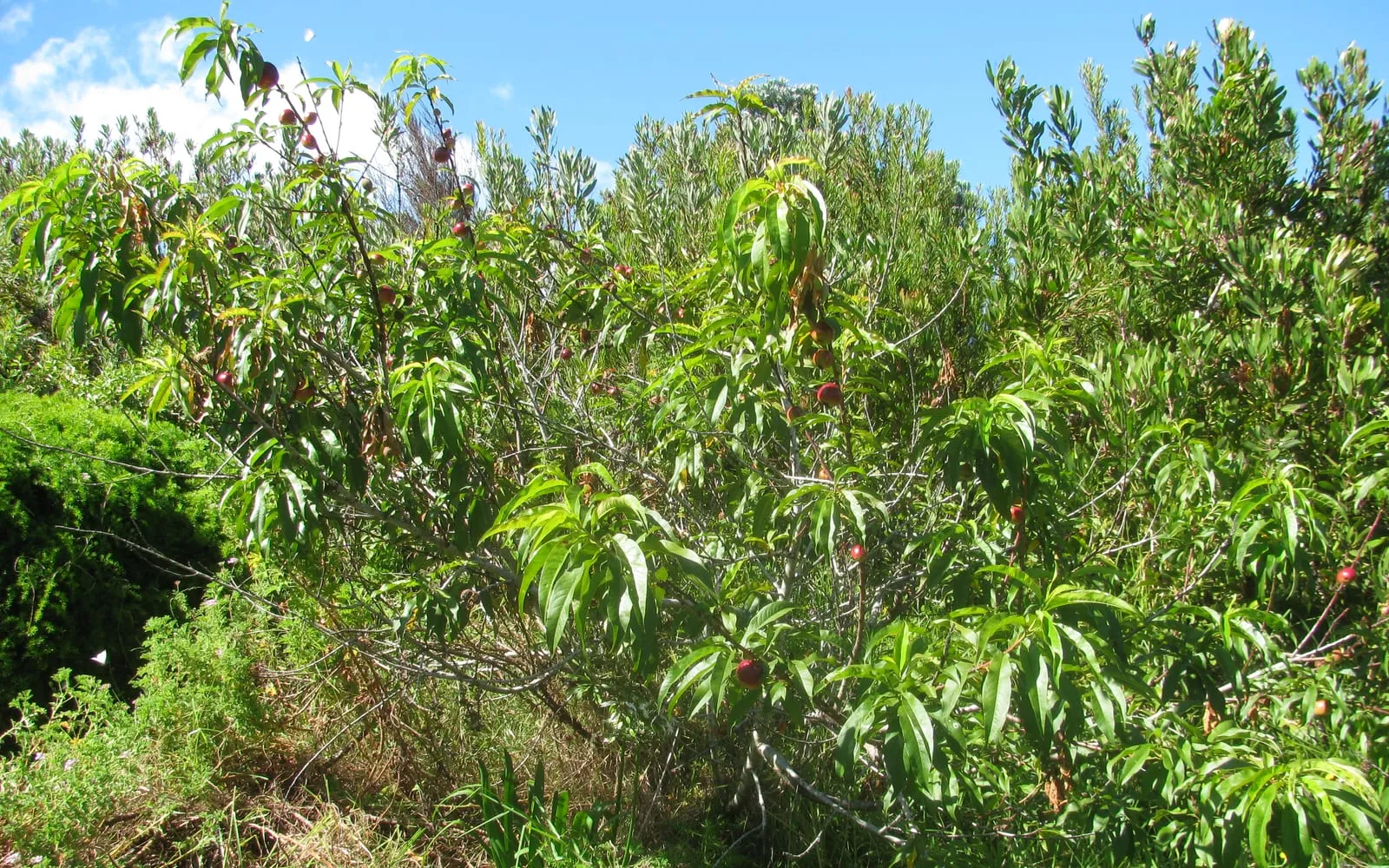
At a glance
- Difficulty
- Difficult
- Water
- Twice weekly in summer once the fruit is swelling
- Light
- Full sun. A sheltered south-facing wall in a cool climate
- Temperature
- Wood hardy to -15 deg C. Blossom is lost at -2 deg C
- Hardiness
- USDA 5-9, RHS H5, hardy to -20 C
- Type
- Deciduous tree, cropping well for about 15 years
- Height
- 3-5 m free-standing, 2 m as a fan
- Native to
- China
- Best month
- August in the Northern Hemisphere, February in the Southern Hemisphere
A smooth-skinned peach with the same chill requirements and one extra weakness, since the skin has no fuzz to shed water and splits or rots in a wet ripening season. Dry summers are close to a condition of growing it well outdoors.
Hardiness zones describe winter cold alone. Summer heat, humidity, rainfall and the length of the growing season decide as much, so treat the range as the outer limit rather than as a recommendation.
Every month named in this guide is for the temperate Northern Hemisphere. If you garden in the Southern Hemisphere, shift each one by six months, so August becomes February. Closer to the equator the wet and dry seasons matter more than the calendar, and the shift stops being a useful guide.
Poisonous if eaten
- Safe to eat
- The ripe fruit flesh
- Do not eat
- The kernel inside the stone, and the leaves, twigs and bark
- Harm from
- Eating it
- Affects
- People, cats, dogs and horses
The ripe flesh is food and the rest of the tree is not. Like every Prunus, nectarine keeps cyanogenic glycosides in its seeds, leaves, twigs and bark, which release hydrogen cyanide when chewed or digested. Swallowing a stone whole does nothing, because the hard shell passes through intact, and the hazard is deliberately cracking stones to eat the kernel inside. Those kernels taste of bitter almond for the same reason bitter almonds do, and a handful is enough to cause serious poisoning in a child. Do not eat them and do not use them as a flavouring. For animals the greater danger is foliage rather than fruit, and wilted foliage most of all, since cyanide release rises sharply as a leaf dies. Prunings thrown into a paddock have killed horses and cattle, so clear them. Dogs eating a windfall are at risk from the stone as an obstruction as much as from its chemistry. The RHS lists Prunus among plants harmful if eaten, and the ASPCA lists it as toxic to cats, dogs and horses.
Sources: RHS potentially harmful garden plants, ASPCA toxic and non-toxic plants
About
A nectarine is a peach without the fuzz. One recessive gene removes the skin hairs, and everything else about the tree is the same, so a peach stone can grow a nectarine and a nectarine stone can grow a peach.
That bare skin is why it is the harder of the two to grow. Fuzz sheds water and deters some insects, and without it the fruit bruises more easily, splits more readily in wet weather and is far more prone to brown rot. Nectarine also seems to suffer peach leaf curl more severely.
The reward is a better fruit. A ripe nectarine has more perfume and more acidity than a peach and it is one of the best things a sunny wall can produce.
Everything depends on getting a rain shelter over it from January, which is the single measure that decides whether the year works.
Appearance and character
A small deciduous tree, 3 to 5 m as a bush, and normally grown as a fan on wires at about 2 m where the ripening season is wet, since the wall gives the fuzzless skin the shelter it needs.
Leaves are long, narrow and finely toothed, glossy mid-green, folded along the midrib.
Flowers open on bare wood in March, before the leaves, deep pink and 2 to 3 cm across, borne singly along last year’s shoots.
Fruit has smooth skin flushed crimson over yellow or white, and it is usually a little smaller than a peach of the same variety.
Flesh is yellow or white depending on variety, and clings to or parts from the stone depending on whether it is a clingstone or freestone type.
‘Lord Napier’ is the standard early white-fleshed variety for a sunny wall. ‘Fantasia’ and ‘Pineapple’ are reliable yellow-fleshed choices, and all three are self-fertile.
Where it is from
The peach and therefore the nectarine originates in China, where peaches have been cultivated for at least four thousand years and appear throughout Chinese art and mythology as symbols of immortality.
The species travelled west along the Silk Road, reaching Persia early enough that Europeans assumed it came from there, which is how it acquired the name persica.
Nectarines arise as sports from peach trees and as seedlings, and they have been recorded independently many times because the mutation is a simple one. English references to them date from the sixteenth century.
Britain has grown them under glass and against walls in walled gardens since the seventeenth century, and the Victorian peach house was a standard feature of a large garden.
Commercially they are grown where summers are warm and dry, which is what the fruit wants and a maritime climate does not offer.
How it grows
Buy a maiden or partly trained fan on St Julien A rootstock, which gives a tree of manageable size.
Plant between November and March against a south or south-west wall, 20 cm out from the brickwork, with the roots angled away from the base.
Space at 4 m of wall for a fan.
Train as a fan on wires spaced 15 cm apart. The flat form gets warmth from the wall, keeps the fruit in the sun and makes covering practical.
Cover from January to mid May with a rain shelter, a clear polythene lean-to open at both ends. This keeps leaf curl spores from landing in rain on swelling buds and is the most important job of the year.
Hand pollinate through March with a soft brush, working the flowers on mild days. Few insects fly reliably that early.
Thin the fruit twice. Take them to about 10 cm apart when they reach hazelnut size, then thin again to 20 cm at walnut size. An unthinned tree gives small fruit and exhausts itself.
Prune in summer, never in winter. Nectarine fruits on wood made the previous summer, so cut out the shoots that have just fruited and tie in replacements after harvest.
Harvest in August when the flesh gives slightly at the shoulder and the fruit parts from the spur with a gentle lift.
Through the seasons
January is when the rain shelter goes up, before the buds swell. This one job prevents peach leaf curl.
March brings blossom. Hand pollinate on mild days and fleece against frost.
Late spring is thinning. Take the crop down in two stages and be harder than feels comfortable.
Summer is watering, feeding and summer pruning. Keep the tree evenly moist, because irregular water splits stones and cracks fruit.
August is harvest. Take the shelter down after leaf fall in autumn, then prune out the fruited wood and tie in the replacements.
Care difficulty
Difficult, and harder than a peach in the same position.
Peach leaf curl is the defining problem. Spores land in rain on the swelling buds in late winter and the leaves emerge thick, blistered and red before falling. Nectarine suffers it worse than peach. A rain shelter from January to May is the only reliable prevention.
March blossom means frost risk and almost no pollinating insects, so fleece and a paintbrush are both needed.
The bare skin brings its own troubles. Brown rot enters easily, fruit splits after rain onto dry soil, and bruising in handling shows immediately.
Fruit thinning is essential and most people do not do enough of it.
Summer pruning is not optional either. Winter cuts on stone fruit invite bacterial canker and silver leaf.
Watering
Water twice weekly through summer once the fruit begins to swell, and keep it even. Irregular watering is what splits stones and cracks skins.
A wall-trained tree needs far more water than its position suggests, because the wall shelters the root run from rain all year round.
Water at the base and keep the foliage dry, since wet leaves spread leaf curl and brown rot.
Mulch in late winter with compost over the root run, clear of the trunk.
Ease off slightly as the fruit approaches ripeness, which concentrates the flavour, and do not let the tree dry out completely.
Water through autumn if the season is dry, since the tree is forming next year’s flower buds.
Warning signs, diseases and pests
Peach leaf curl blisters and reddens the leaves in spring and defoliates the tree. Shelter from rain between January and May, pick off affected leaves, and clear fallen ones. A tree stripped in spring produces a second flush of clean leaves and loses that year’s crop.
Brown rot turns fruit brown and firm with buff rings of pustules, spreading fast in a wet August. Remove and destroy affected and mummified fruit.
Frost-blackened blossom in March is a lost crop. Fleece on cold nights.
Split stones and cracked fruit come from uneven watering during swelling.
Red spider mite bronzes and fine-webs the leaves in the dry air beside a wall. Damping down the wall and the ground helps.
Bacterial canker sinks bark and oozes amber gum, killing branches. Prune only in summer, in dry weather.
Silver leaf gives leaves a silvery sheen and a purple stain inside cut wood. It also enters winter pruning wounds.
Aphids curl the shoot tips in spring and predators usually deal with them.
Growing environment
Full sun against a south or south-west facing wall. Nectarine needs more heat than peach to ripen properly.
Deep, fertile, free-draining soil at pH 6.5 to 7. Improve the border at the foot of a wall before planting, since it is usually poor, dry and full of rubble.
Shelter is essential, both for the March blossom and for the fruit, which bruises on the branch in wind.
Avoid frost pockets. A tree flowering in March cannot afford cold air pooling around it.
The wall itself matters. Brick holds and releases heat better than a fence, and a pale wall reflects more light onto the fruit.
Under glass is easier again, and a cold greenhouse or lean-to removes the leaf curl problem entirely along with most of the frost risk.
Feeding
Nectarine is a hungry tree carrying a heavy crop on a small frame.
Apply sulphate of potash at 25 g per square metre in February. Potash drives flowering and fruit quality and firms the wood against canker.
Mulch in late winter with well-rotted manure or compost over the root run, kept clear of the trunk.
Feed fortnightly with a high-potash liquid feed, a tomato feed serves, from when the fruit sets until it begins to ripen.
Avoid high-nitrogen feeds. Soft growth attracts aphids, invites canker and delays ripening.
A wall border dries and exhausts faster than open ground, so a wall-trained tree needs feeding more consistently than a free-standing one would.
Troubleshooting
Thick red puckered leaves in spring. Peach leaf curl. Put a rain shelter over the tree from January to mid May. Once the leaves are out it is too late for that year.
Blossom went brown and dropped. Frost in March. Fleece the tree on cold nights.
Lots of blossom, no fruit. Poor pollination. Hand pollinate with a soft brush on mild days through March.
The fruit split at the stone. Uneven watering while the fruit was swelling. Water twice a week and keep it steady.
Brown fruit with rings of buff dots. Brown rot. Remove every affected and mummified fruit and improve airflow.
Gum oozing from a branch. Bacterial canker. Prune only in dry summer weather and cut into clean wood.
Small fruit despite a heavy set. Not thinned enough. Take them to 20 cm apart, which always feels brutal and always pays.
Should I prune in winter? No. Stone fruit is pruned in summer, because winter wounds admit silver leaf and bacterial canker.
Nectarine problem guides
Not sure what is wrong? See the common vegetable pests guide.