
Pest
Mediterranean fruit fly
Ceratitis capitata
Also called Medfly
A small, boldly patterned fly that punctures ripening fruit to lay eggs, leaving a pinprick sting mark that develops into a soft, rotting patch as maggots tunnel through the flesh. One of the most economically damaging fruit pests on earth, attacking more than 300 different fruits and vegetables across a still-expanding range.
At a glance
- Type
- Pest
- Cause
- Insect
- Severity
- Destroys the crop or display
- Affects
- Herbs and edibles
- Active
- June to October
- Established in
- Africa, Europe, Asia, Central and South America, Australia and Pacific Islands
What you are seeing
- A small, dark, pinprick sting mark on the skin of ripening or nearly ripe fruit, where a female has punctured the surface to lay eggs
- A soft, discoloured, sunken patch developing around the sting over the following days as the fruit begins to rot from within
- Small white to cream-coloured maggots tunnelling through the flesh, found when an affected fruit is cut open
- Premature fruit drop, sometimes the first sign noticed, as damaged fruit falls before it would otherwise be ready
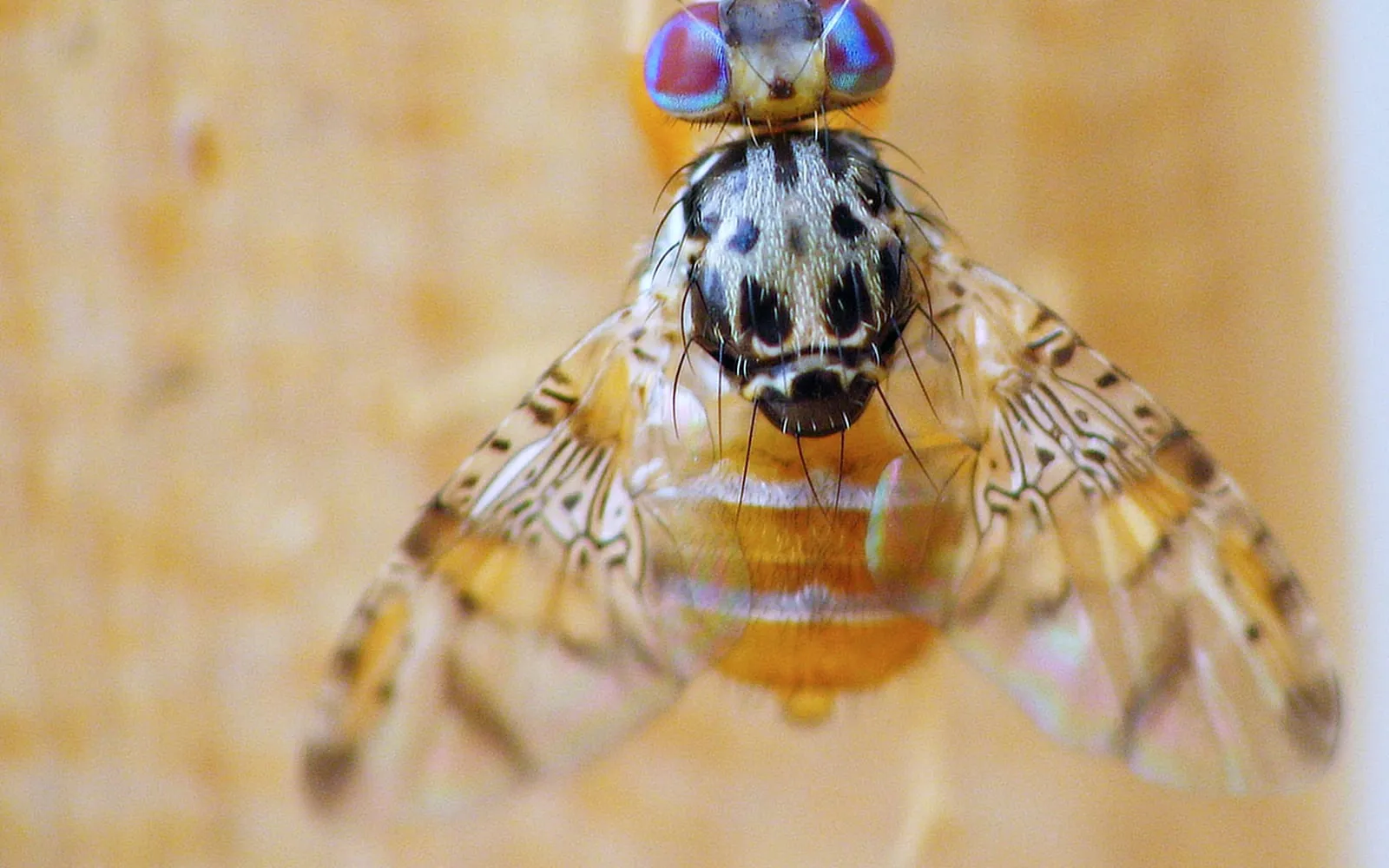
- Adult flies about 4 to 5 mm long, with a boldly mottled yellow, brown and black body and clear wings marked with distinctive dark and yellow bands, seen resting on fruit or foliage
What you are looking at
A small, dark pinprick mark on the skin of ripening fruit, where a female has punctured the surface to lay eggs beneath. Over the following days a soft, discoloured, sunken patch develops around the sting as the fruit begins to rot from the inside, and cutting an affected fruit open usually turns up small white to cream maggots tunnelling through the flesh. Sometimes the first sign noticed is fruit falling before it would otherwise be ready, already carrying damage that is not obvious from outside.
The adult responsible is a small, striking fly, only 4 to 5 mm long but boldly patterned in mottled yellow, brown and black, with clear wings marked in distinctive dark and yellow bands, quite unlike the plainer reddish-brown appearance of many other fruit flies.
One of the world’s most damaging and adaptable fruit pests
Native to sub-Saharan Africa, this fly has become one of the most widely distributed fruit pests on earth, attacking more than 300 different kinds of fruit and vegetable and established across the Mediterranean basin, the Middle East, much of Central and South America, Hawaii and the south-west corner of Western Australia. In Australia it once occupied the eastern mainland too, before Queensland fruit fly, a more mobile and prolific competitor, displaced it there over the twentieth century, leaving Western Australia as its last Australian foothold.
It has repeatedly turned up in California, Florida and Texas, arriving in infested fruit carried by travellers or through the post, and every one of those incursions has triggered an eradication campaign, including large- scale sterile male releases, rather than being accepted as a permanent establishment. That pattern, an adaptable pest capable of breeding in a huge range of hosts, arriving repeatedly and being fought back each time, is likely to continue wherever fruit moves between regions faster than quarantine can screen it. New Zealand has never had it and treats a sighting as an immediate biosecurity matter.
What to do about it
Never move homegrown or backyard fruit out of a quarantine area, since this is one of the main ways the pest has spread and re-established after eradication campaigns.
Pick up and destroy fallen and infested fruit promptly, before larvae inside can complete their development in the soil beneath the tree.
Bag individual fruit or net a whole tree as it ripens where the pest is established locally, and use protein bait or pheromone traps to monitor for a rising population.
Support any area-wide sterile insect release programme running locally as the primary defence. Reserve a registered protein bait spray applied to foliage rather than fruit for a genuine outbreak that bagging, sanitation and trapping have not brought under control on their own.
Report a suspected sighting or damaged fruit outside the pest’s confirmed range, including mainland North America and New Zealand, to the national plant health or biosecurity authority immediately.
What it gets mistaken for
Queensland fruit fly has a plainer reddish-brown body and clear, unbanded wings, quite different from this species’ bold mottled pattern. The two occupy largely separate ground in Australia, Queensland fruit fly across the east and this species confined to the south-west of Western Australia, so a sighting in the wrong region for either is worth reporting on that basis alone.
Not established in North America and New Zealand
Do not prune, spray or otherwise treat a suspected case. Doing so risks spreading an organism the country has kept out, and it disturbs the evidence needed to identify it. Photograph what you can see, leave the plant alone, and contact your national or state plant health authority. The control advice further down this page is written for regions where this problem is already established.
Native to sub-Saharan Africa, and now one of the most widely distributed fruit flies on earth, established across the Mediterranean basin, the Middle East, much of Central and South America, Hawaii and the south-west corner of Western Australia, where it has persisted since long before Queensland fruit fly displaced it from the Australian mainland's east coast. It has repeatedly turned up in California, Florida and Texas, and every detection there has triggered an eradication response rather than being accepted as an establishment, so it is not considered present in mainland North America despite the recurring incursions. New Zealand has never had it and treats a sighting as an immediate biosecurity matter.
What to do, in order
The steps below apply where this problem is already established.
Start here
Prevention, and the changes that stop the problem returning. Most of these pages should end at this tier.
- Never move homegrown or backyard fruit out of a quarantine area
- Fruit carried by travellers and in the post is one of the main ways this pest has spread to new regions and re-established after eradication campaigns, and observing local quarantine restrictions on moving fruit is one of the most effective things an individual can do to stop it spreading further.
- Pick up and destroy fallen and infested fruit promptly
- Removing infested fruit before larvae can complete their development in the soil beneath the tree breaks the life cycle locally and is one of the most effective non-chemical measures available to a home grower in an affected area.
- Report a suspected find outside the confirmed established range
- Because eradication is far more achievable while an incursion is small and localised, a suspected sighting or fruit showing sting marks anywhere outside the pest's confirmed range, including mainland North America and New Zealand, should be reported to the national plant health or biosecurity authority immediately.
Then reach for a barrier
Netting, hand removal and water. Nothing here harms anything except the target.
- Bag or net fruit as it ripens
- Individually bagging fruit, or covering a whole tree in fine mesh before fruit ripens, physically prevents females from reaching the surface to lay eggs and is effective on a garden scale where the pest is established.
- Monitor with protein bait or pheromone traps
- Traps baited with a protein lure or the species' pheromone are the standard way of detecting a rising population and timing any further response, used both in home gardens and, at a larger scale, by government surveillance programmes.
Then bring in the predators
Encourage what already lives in the garden, and buy predators in where the problem is under glass and nothing will arrive on its own.
- Support sterile insect technique programmes where deployed
- Releasing large numbers of sterilised male flies to mate unproductively with wild females has been a mainstay of eradication and containment campaigns against this species for decades and has repeatedly cleared incursions from areas outside its established range.Run by government agricultural agencies as part of area-wide eradication or suppression campaigns, including long-running programmes in Western Australia and California; not something an individual grower arranges independently.
Biological controls are live organisms and their sale and release are regulated country by country. An agent sold freely in one place may be unapproved in another, so buy from a licensed supplier where you live and never import or move one yourself.
Plants affected
Guides that name it among the problems to watch for. The list is the plants it is characteristic of rather than everything it will feed on.