
Pest
Codling moth
Cydia pomonella
Also called Apple worm
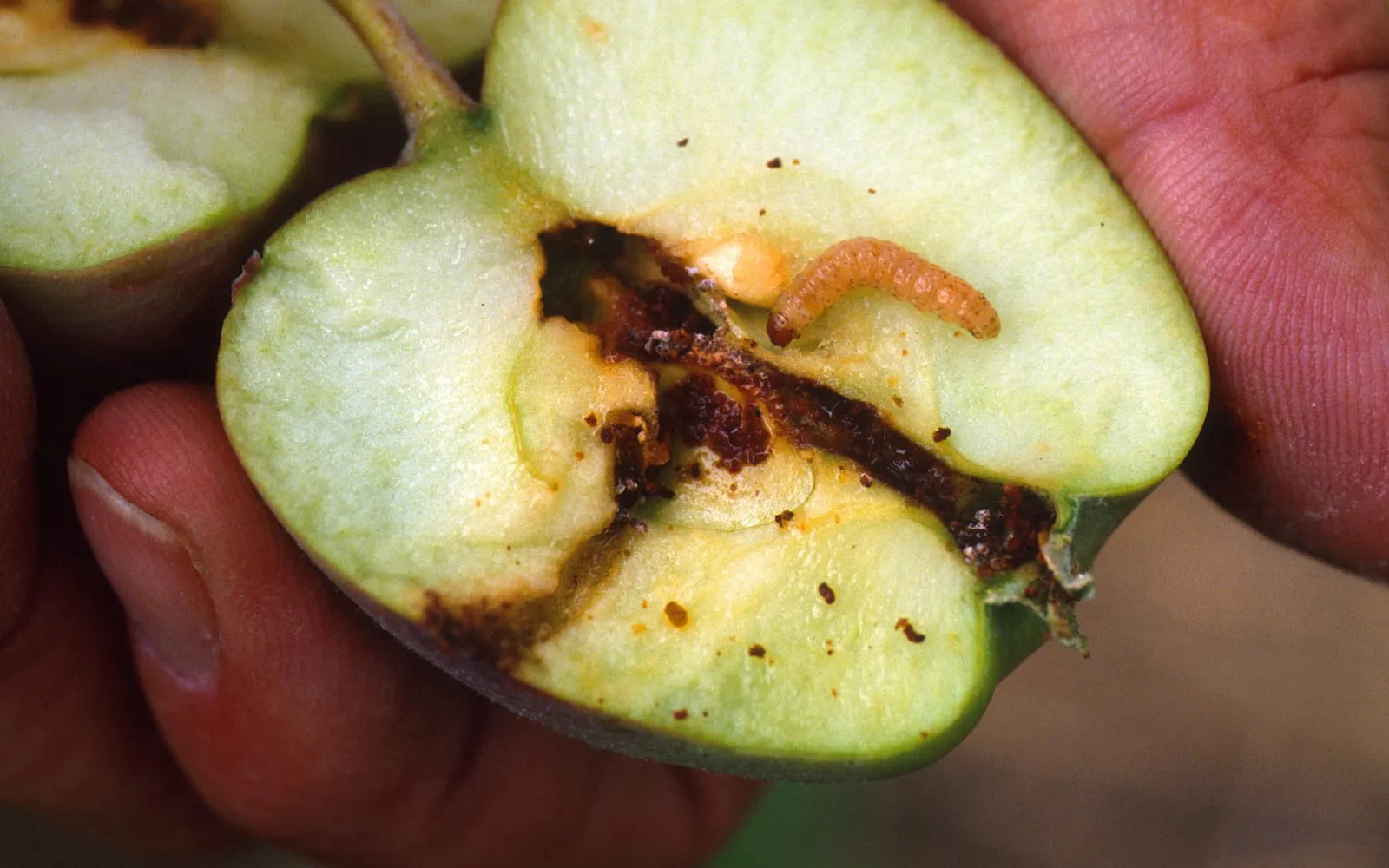
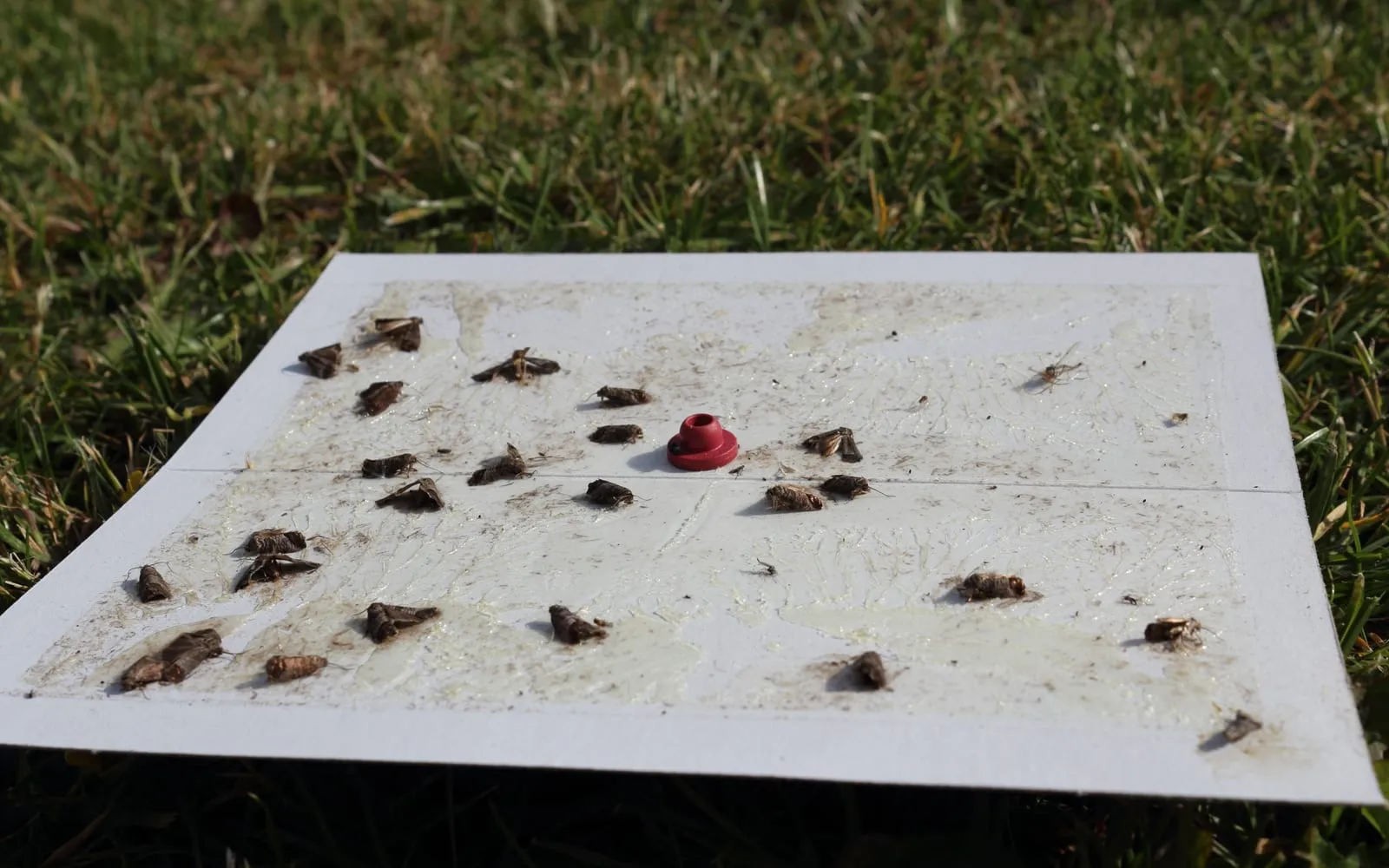
Codling moth leaves a tunnel to the apple core packed with wet brown frass. Pheromone traps show when moths are flying, and cardboard bands catch larvae as they leave the fruit.
At a glance
- Type
- Pest
- Cause
- Insect
- Severity
- Destroys the crop or display
- Affects
- Herbs and edibles
- Active
- June to September
- Established in
- Worldwide
What you are seeing
- A hole in the side or the eye end of a ripe apple, plugged with wet brown crumbs
- A tunnel running to the core, with the pips eaten and the cavity packed with frass
- A pinkish-white caterpillar with a brown head inside the fruit
- Fruit ripening and colouring early on the tree, then dropping
- Damage found at picking on fruit that looked sound from a distance
- Small grey-brown moths with a coppery patch at the wing tip, flying at dusk from June
Before you treat anything
A tunnelled apple is safe to eat once the damaged core is cut out. Compost or bin fruit that has started to rot around the entry hole.
What you are looking at
An apple picked in September has a small round hole in the side or at the eye end, sealed with a plug of wet brown crumbs. Cut it open and a tunnel runs to the core, the pips have been eaten, and the cavity is packed with dry frass. A pinkish-white caterpillar with a brown head may still be in there, up to about 2 cm long.
Some affected fruit colours and ripens ahead of the rest of the tree and falls early. Check early windfalls at the end of August rather than assuming they are finished fruit.
Pears get it less often and walnuts get it too, with the larva going into the developing kernel.
Codling moth or apple sawfly
Both put a maggot in an apple and the treatments differ, so the distinction is worth five seconds.
Apple sawfly attacks in May and June, when the fruitlets are small. Its larva often tunnels just under the skin first, leaving a winding ribbon-like scar that corks over and stays on the apple all season as a brown band. When it goes into the core the frass is wet, dark and smells strongly. Most sawfly-damaged fruitlets drop in the June drop.
Codling moth comes later. Eggs are laid from June onwards on fruit and leaves, and the caterpillar bores in and heads straight for the core. The entry hole is neat and round, the frass is dry and crumbly, and the fruit stays on the tree to be picked with the damage inside it.
A ribbon scar on the skin of a picked apple is sawfly. A frass-plugged hole is codling.
One generation, and where it spends the winter
Adults fly at dusk from late May or June through July, a grey-brown moth about 10 mm long with a bronze-coppery patch at the tip of each forewing. Britain gets one generation in most years and a partial second after a hot summer.
Eggs hatch within a fortnight and the caterpillar enters the fruit. It feeds for three to five weeks, leaves through a tunnel of its own making, and crawls down the branches to find a crevice. There it spins a tough silk cocoon, under a flap of loose bark, in a crack, behind a tree tie, or in a fruit crate stored in the shed. It sits there through the winter as a full-grown larva and pupates in spring.
That life cycle explains the controls. Collect windfalls before the larva leaves. Use a cardboard band as the crevice it is looking for. Spray nematodes into real bark crevices in autumn, and let tits work the bark all winter.
What to do about it
Tie a corrugated cardboard band around the trunk in July and burn it in late autumn.
Collect windfalls twice a week from August and bin the damaged ones.
Hang a pheromone trap from late May, and read it as a calendar unless your tree stands well away from other apples.
Spray nematodes over the trunk and main branches on a mild damp evening in early autumn.
Scrape loose bark and wash out the fruit crates in winter.
Put up a nest box.
Then accept that some fruit will be lost, because a garden apple tree in Britain has never produced a clean crop without a spray programme, and a clean crop is not what most people are growing one for.
What it gets mistaken for
Apple sawfly leaves a ribbon scar and wet smelly frass, and drops most of its fruitlets in June.
Brown rot turns the flesh brown and firm and grows rings of buff-coloured pustules on the skin. It commonly starts at a codling moth hole, so the two are found together.
Bitter pit shows as small sunken brown spots scattered under the skin with no tunnel and no insect, and it is a calcium transport problem rather than a pest.
Wasps enlarge existing wounds into open ragged craters and eat the flesh from outside. They rarely break intact skin.
Apple scab leaves black scabby blotches on the surface that crack the skin, with sound flesh beneath.
What to do, in order
Start here
Prevention, and the changes that stop the problem returning. Most of these pages should end at this tier.
- Pick up and destroy every fallen and damaged apple
- Larvae leave a fallen fruit within days and go looking for somewhere to spin up. Collecting windfalls twice a week from August, and binning the maggoty ones rather than composting them, takes a generation out of the orchard. Fruit fed to hens or bagged for household waste is out of circulation.
- Scrape loose bark and clear crevices in winter
- Full-grown larvae spend the winter in cocoons under flaking bark, in splits and cracks, behind tree ties and in stored fruit crates. A stiff brush over the trunk and main limbs in December, and a wash of the crates, removes a share of them.
- Thin the crop and pick promptly
- Fruit touching in a cluster gives a caterpillar a sheltered place to enter. Thinning to single fruits opens those points up, and picking on time keeps apples off the tree during the weeks when the larvae are leaving them.
- Accept a level of damage on a garden tree
- A mature apple tree carries several hundred fruit and losing a portion of them to this is normal in Britain and always has been. Aim to keep the numbers down rather than to eliminate the moth, which no garden measure will do.
Then reach for a barrier
Netting, hand removal and water. Nothing here harms anything except the target.
- Band the trunk with corrugated cardboard in July
- A band of corrugated cardboard 10 cm wide tied around the trunk, ridges against the bark, is exactly the crevice a full-grown larva is looking for. Put it on in July, take it off in late autumn, and burn or bin it with the cocoons in it. On a single garden tree this is the most productive twenty minutes of the year.
- Hang a pheromone trap from late May
- The trap releases the female's scent and catches males on a sticky sheet. On an isolated tree, with a trap in place from before the flight starts, enough males are removed to reduce the number of fertile eggs laid. In a garden surrounded by other apple trees it works better as a record of when the moths are flying than as a control. Replace the lure each season.
- Bag individual fruits
- Where a few perfect apples matter more than a full crop, a paper or fine mesh bag slipped over each fruitlet in June and left until picking keeps everything out. Laborious on a tree, straightforward on a cordon.
Then bring in the predators
Encourage what already lives in the garden, and buy predators in where the problem is under glass and nothing will arrive on its own.
- Spray Steinernema carpocapsae nematodes onto the bark in autumn
- These nematodes hunt in crevices and find the overwintering cocoons. Apply to the trunk and main branches in September or October on a mild damp evening, wetting the bark thoroughly, and keep it out of direct sun. It reduces the number of moths emerging the following spring rather than protecting this year's fruit.Widely sold across Europe and North America. Australia and New Zealand permit far fewer species, because releasing an entomopathogenic nematode that is not already approved is prohibited there. Check what is registered locally rather than ordering from overseas.
- Put up a bird box and leave the birds to the bark
- Blue tits and great tits work over the trunk and branches through the winter and take overwintering larvae out of the crevices. Orchards with nest boxes carry measurably less damage. Nothing else about this is cheaper.
Biological controls are live organisms and their sale and release are regulated country by country. An agent sold freely in one place may be unapproved in another, so buy from a licensed supplier where you live and never import or move one yourself.
In pictures
Plants affected
Guides that name it among the problems to watch for. The list is the plants it is characteristic of rather than everything it will feed on.