
Pest
Woolly aphid
Eriosoma lanigerum
Also called American blight, Woolly apple aphid
Woolly aphid forms tufts of white wax in bark cracks on apple, cotoneaster and pyracantha, with lumpy swellings beneath. Brush colonies off, protect predators and watch for canker entering the galls.
At a glance
- Type
- Pest
- Cause
- Insect
- Severity
- Weakens the plant
- Affects
- Garden plants, Herbs and edibles
- Active
- April to September
- Established in
- Worldwide
What you are seeing
- Tufts of white waxy wool packed into bark cracks, pruning wounds and branch joints
- Purple-brown aphids under the wool when a patch is rubbed away
- Soft lumpy swellings developing in the bark where the colonies have fed
- Those swellings cracking open in winter and staying as knobbly galls
- Colonies spreading onto new shoots and the undersides of leaves in summer
- Sticky honeydew and black sooty mould below the colonies
- Wool appearing in the same places every year, worst on young trees
Before you treat anything
Harmless to handle. Fruit from an affected tree is fine, and where sooty mould has grown on the honeydew, wash it before use.
What you are looking at
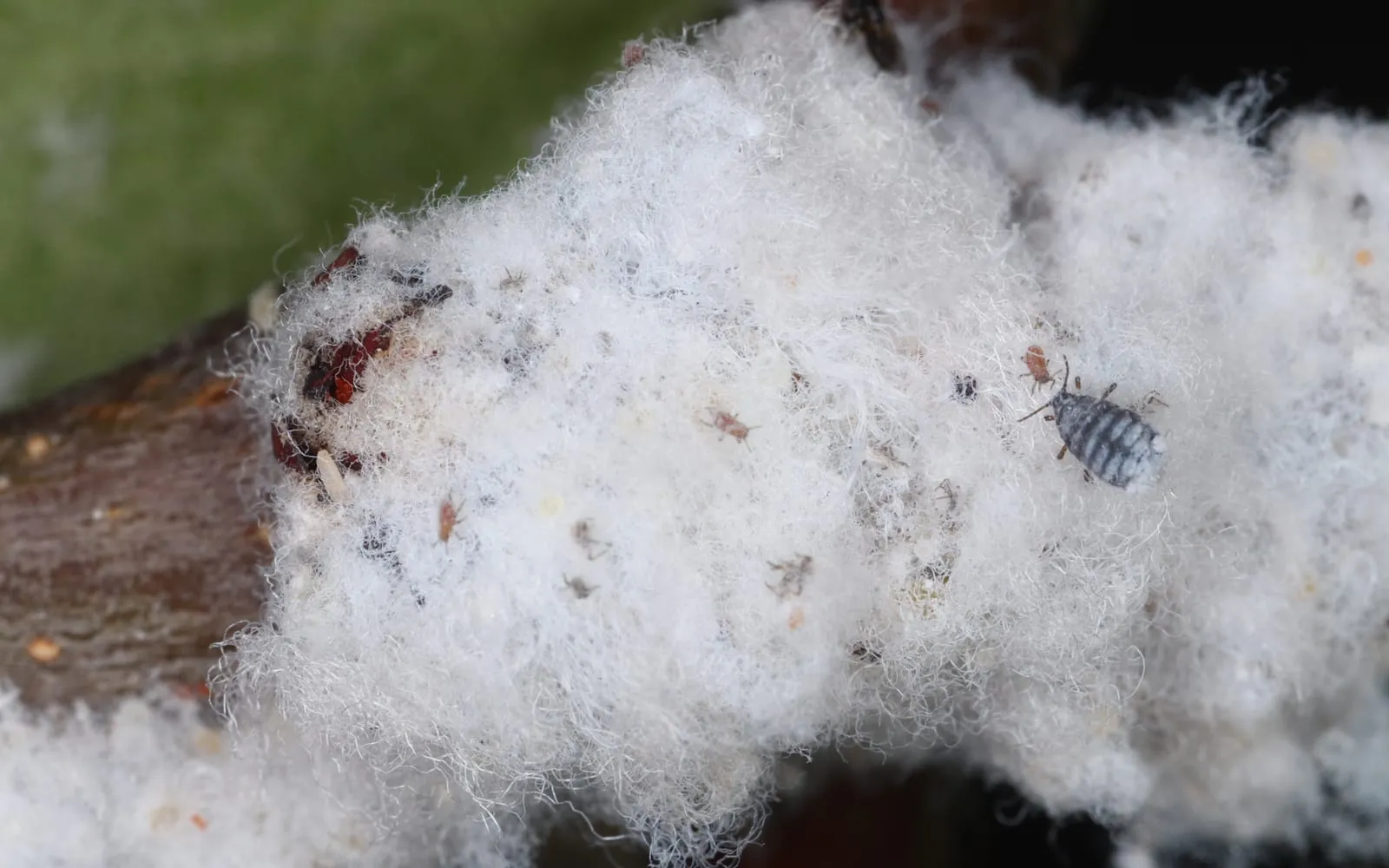
Tufts of what looks like cotton wool packed into the cracks of the bark on an apple, a cotoneaster or a pyracantha. They sit in branch joints, around old pruning cuts and along the edges of canker wounds, and they appear from about May onwards.
Rub a patch away with a finger. Underneath are soft purple-brown aphids, and they smear reddish when squashed, which is a surprise the first time.
The wool is wax, extruded from the insects’ bodies as a covering. It sheds water and it discourages predators, and it is the reason a hose turned on a colony achieves so little.
The swellings matter more than the wool
Feeding by these aphids makes the bark and the wood underneath it swell into soft lumpy galls. Over a winter those galls crack, and the cracks stay.
That is the real cost of the insect. Cracked galls give canker a way in, they disfigure a young tree, and on a maiden or a cordon with only a few metres of branch to its name, a heavy infestation checks growth noticeably.
On a mature apple tree it is a different question. A big tree carries colonies every summer, has done for decades, and crops perfectly well. Nobody needs to do anything about it.
The distinction between those two cases is worth making before reaching for a brush.
A wasp brought over for the job
Aphelinus mali is a tiny parasitic wasp introduced to Britain in the 1920s specifically to control woolly aphid, and it is now established across much of the country.
It lays into the aphids, and the ones it has finished with turn into small black mummies sitting among the white wool. Finding those is good news, and it usually means the colony will collapse of its own accord by midsummer.
Earwigs do the other half of the job. They hunt the bark at night, they take woolly aphid in quantity, and they are one of the more useful animals in an apple tree. Anything sprayed at the aphid kills both the wasp and the earwigs and leaves the aphid to rebuild, which is why no spray appears on this page.
What to do about it
Look at the tree and decide whether it needs anything. A mature apple usually does not.
On a young tree, a cordon or a wall-trained pyracantha, scrub the colonies off with a stiff brush and warm soapy water, working into the cracks, and repeat in a few weeks.
Cut out wood that has galled and cracked, in summer, and take it away.
Prune lightly rather than hard, and feed at the stated rate, so the tree is not producing the soft growth colonies build on.
Check branch joints on anything new before you plant it.
Look for black mummies in the wool before deciding the problem is out of hand.
What it gets mistaken for
Mealybug produces very similar white wax and lives indoors and under glass, in leaf joints and on stems rather than in tree bark.
Scale insects sit as immobile shells that pop off under a thumbnail, and some of them carry a white waxy covering that reads as wool at a glance.
Cushion scale and other soft scales produce white waxy egg masses on evergreen shrubs, usually along the leaf veins rather than in the bark.
Apple canker produces sunken, cracked and flaking bark with rings of dead tissue, often at the same spots, and the two are commonly found together because one lets the other in.
Lichen and moss on old bark are grey-green, flat and firmly attached, and they harm nothing at all.
What to do, in order
Start here
Prevention, and the changes that stop the problem returning. Most of these pages should end at this tier.
- Go easy on nitrogen and hard pruning
- Soft sappy regrowth after a heavy winter pruning, or after a generous feed, is what a colony builds up on fastest. A tree pruned lightly and fed at the stated rate carries far less.
- Watch young trees more closely than old ones
- A mature apple shrugs this off. A newly planted tree, a cordon or a young cotoneaster has proportionally far more of its bark colonised, so the galling matters and the check to growth is real.
- Keep the bark sound
- Colonies start in cracks, old pruning cuts, canker margins and rubbing wounds. Pruning cleanly to a collar, checking ties, and dealing with canker all remove the places they overwinter.
- Check what you buy
- Woolly aphid travels on nursery stock, tucked into the crotch of a young tree where nobody looks. Run a thumb through the branch joints of anything new before planting it.
Then reach for a barrier
Netting, hand removal and water. Nothing here harms anything except the target.
- Scrub the colonies off with a stiff brush and soapy water
- The wax repels water, so a hose alone does very little. A stiff brush, an old washing-up brush or a nail brush, worked into the cracks with warm soapy water, removes both the wool and the aphids under it. On a cordon or a young tree, ten minutes twice in the summer keeps on top of it.
- Prune out badly galled wood
- Where the feeding has produced knobbly swellings that have cracked open, cut those pieces out in summer and take them away. The cracks are both a shelter for the aphids and a way in for canker.
- Leave the rest of it alone
- On an established tree, a few colonies in the bark are a normal feature of growing apples in Britain and they do no measurable harm to the crop. The wool is more alarming than the insect.
Then bring in the predators
Encourage what already lives in the garden, and buy predators in where the problem is under glass and nothing will arrive on its own.
- Leave the parasitic wasp to work
- Aphelinus mali was introduced to Britain a century ago specifically for this pest and is now widely established. It lays into the aphids and leaves behind small black mummies among the wool, which is a sign to look for and a reason not to spray. Populations often collapse in midsummer once it gets going.
- Keep the earwigs
- Earwigs are among the most effective predators of woolly aphid on apple, working the bark at night, and they are killed by the same sprays. An apple tree is the one place in the garden where earwigs are unambiguously worth having.
Biological controls are live organisms and their sale and release are regulated country by country. An agent sold freely in one place may be unapproved in another, so buy from a licensed supplier where you live and never import or move one yourself.
Plants affected
Guides that name it among the problems to watch for. The list is the plants it is characteristic of rather than everything it will feed on.