
Edible
Crab apple
Malus sylvestris
Also known as European crab apple, Wild apple, Scrab
How to grow crab apple, Malus sylvestris. Britain's only native apple, the pollination it gives an orchard, and turning sour fruit into jelly.
At a glance
- Difficulty
- Easy
- Water
- First two summers only, then none
- Light
- Full sun to light shade
- Temperature
- Fully hardy, well below -20 deg C
- Hardiness
- USDA 3-8, RHS H7, hardy to -35 C
- Type
- Deciduous tree, living a century or more
- Height
- 6-10 m, occasionally more in woodland
- Native to
- Britain, Europe, Western Asia
- Best month
- September and October in the Northern Hemisphere, March and April in the Southern Hemisphere
It takes cold that would kill a cultivated apple and asks the same 600 to 1000 chill hours to flower properly, so the mild-winter problem applies here too. Its long overlapping flowering period is why growers plant one to pollinate an orchard.
Hardiness zones describe winter cold alone. Summer heat, humidity, rainfall and the length of the growing season decide as much, so treat the range as the outer limit rather than as a recommendation.
Every month named in this guide is for the temperate Northern Hemisphere. If you garden in the Southern Hemisphere, shift each one by six months, so September becomes March. Closer to the equator the wet and dry seasons matter more than the calendar, and the shift stops being a useful guide.
Not known to be toxic
- Safe to eat
- The fruit, cooked
- Do not eat
- The pips, in large chewed quantity
The flesh is food. The pips contain amygdalin, which releases hydrogen cyanide when the seed coat is broken by chewing, and the same compound occurs in apple and pear seed. Swallowing a few pips whole does nothing, because an intact seed passes through undigested. The quantity needed to cause harm runs to a large cupful of thoroughly chewed seed, so treat this as a reason not to feed cores to a dog rather than as a hazard to the person eating the fruit. Discard the core when juicing in quantity, since a juicer breaks every seed at once. Leaves and wood carry the same compound at low levels and no part of the tree is a grazing risk in a garden.
Sources: RHS potentially harmful garden plants, ASPCA toxic and non-toxic plants
About
This is the wild apple of European hedgerows and the only apple native to Britain. Every orchard apple belongs to Malus domestica, which came out of the mountains of Kazakhstan by way of the Silk Road, so the crab in your hedge is a different species from the tree in your orchard.
The fruit is small, hard and sour enough to make your jaw ache. It also carries more pectin than any cultivated apple, which is why crab apple jelly sets without help while a modern dessert apple needs added pectin to do the same job.
Gardeners plant it for three reasons. It flowers profusely and for a long time, it pollinates almost every other apple in the neighbourhood, and it feeds birds well into winter.
As a garden tree it asks for nothing. Plant it, stake it for three years, and it will still be there when the house changes hands twice.
Appearance and character
A rounded tree with a dense low crown, often carrying short thorny spurs on the older wood. The thorns are one way to tell a true wild crab from a seedling of a cultivated apple.
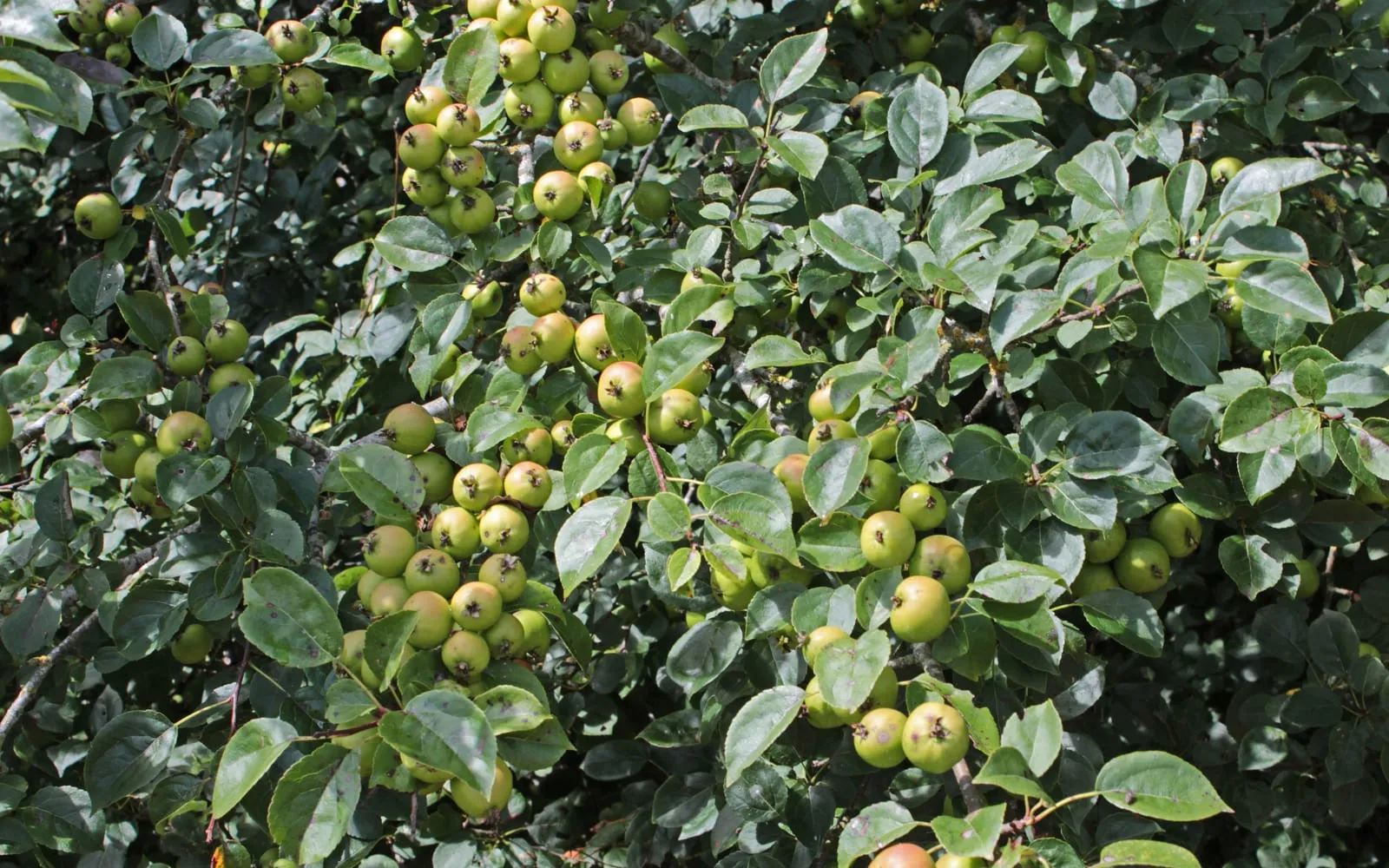
Leaves are oval, 3 to 6 cm, with toothed edges. They are smooth and nearly hairless underneath when mature, where a domestic apple leaf stays downy.
Blossom in late April and May is white flushed with deep pink in bud, opening to five petals around a boss of yellow stamens. A tree in full flower is as good as any ornamental cherry.
Fruit is 2 to 4 cm across, yellow-green ripening to a flushed red on the sunny side, held on a long thin stalk. It hangs on after leaf fall and turns translucent after frost.
Bark is grey-brown, cracking into small square plates on an old trunk.
Where it is from
Malus sylvestris grows wild across Europe from Spain to the Caucasus, and Britain lies within its native range.
It belongs to woodland edge, ancient hedgerow and scrub, where it grows scattered as single trees rather than in stands.
The wild population is under quiet pressure from its own relatives. Crab apples cross readily with domestic apples growing nearby, so many hedgerow trees are hybrids and true M. sylvestris is scarcer than the number of crab apples suggests.
The fruit fed people long before orchards existed. Charred crab apple remains turn up on British archaeological sites from the Neolithic onwards, usually halved and dried.
Verjuice, the sour juice pressed from crab apples, served as the kitchen acid in medieval England in the role lemon juice plays now.
How it grows
Buy a bare-root tree in winter, either the true species from a native-tree nursery or a named ornamental such as ‘John Downie’ for larger fruit and better jelly.
Plant between November and March into a hole no deeper than the roots, firmed well and staked low against wind rock.
Site it anywhere with reasonable light. The tree fruits best in full sun and copes with light shade better than a dessert apple.
Protect the trunk from rabbits and deer with a spiral guard or a mesh sleeve for the first five years. Bark stripped in a hard winter can ring and kill a young tree.
Prune very little. Take out dead, damaged and crossing wood in winter and leave the rest alone, because the natural shape is the tree’s chief ornament.
Expect blossom within three years and useful quantities of fruit from about year five.
Through the seasons
Winter is when the tree shows its frame, and it is the season for planting, for any pruning and for checking guards after storms.
Blossom opens in late April and holds for two to three weeks, longer than most apples, which is part of what makes it so useful as a pollinator.
Through summer the tree looks after itself. Scab may mark the leaves in a wet year without doing lasting harm.
Fruit colours through September and is ready from late September into October. Pick for jelly while the fruit is firm, since the pectin level falls as it softens.
After leaf fall the crop hangs on bare branches and slowly turns to bird food. Fieldfares and redwings arriving from Scandinavia in November will strip a tree in a fortnight.
Frost sweetens what is left, which is when badgers and foxes take the windfalls.
Care difficulty
Easy, and about as close to a plant-and-forget tree as any fruiting species gets.
It is native, so the climate suits it without help, and it grows on soil that would defeat a dessert apple.
Disease turns up and does little. Scab spots the leaves and marks the fruit in a wet summer, and since the fruit is destined for a jelly pan the marks matter less than they would on an eating apple.
The one real threat is fireblight, which can kill a branch or a young tree in a warm wet spring.
No spraying, no thinning, no feeding, and only enough pruning to keep the shape sound.
Watering
Water weekly through the first two summers, giving 20 litres at a time rather than a daily splash.
After the third year an open-ground tree needs no watering at all in a temperate climate. The root system reaches well beyond the canopy and finds moisture through most droughts.
A tree in its first summer is the exception, and a dry May and June kills more newly planted trees than any pest.
Mulch the root area in spring with compost or bark, leaving a gap around the trunk, which conserves more water than watering does.
Standing water is more dangerous than drought. Crab apple tolerates heavy clay but not ground that lies wet all winter.
Warning signs, diseases and pests
Olive-brown blotches on leaves, black scabby patches on fruit. Apple scab. Cosmetic on a tree grown for jelly. Clear fallen leaves in autumn to reduce next year’s spores.
Shoot tips blackened and bent into a crook, leaves hanging dead. Fireblight. Cut 60 cm into healthy wood, burn the prunings and sterilise tools between cuts.
White fluffy wool in bark cracks and around old pruning wounds. Woolly aphid. Scrub off what you can reach with a stiff brush. An established tree tolerates it.
White powdery coating on new shoots in a dry spring. Powdery mildew. Prune out affected tips in winter.
Honey-coloured toadstools at the base, white sheets under the bark. Honey fungus, which is fatal. Remove the stump and as much root as you can and do not replant an apple in the same ground.
Bark stripped in a ring near ground level. Rabbits or deer. A tree ringed all the way round will die, so guards go on at planting rather than after damage.
Leaves eaten to a lace of veins by metallic green beetles. Japanese beetle, well established across the United States and newly arrived in northern Italy and Switzerland. Shake beetles into soapy water in the morning, and report a sighting elsewhere in Europe rather than treat it.
Fruit rotting from inside with only a faint surface dimple. Apple maggot fly, a North America-only fly whose original host is wild hawthorn. Hang sticky red sphere traps from mid-June and clear fallen fruit twice weekly.
Growing environment
Full sun gives the heaviest blossom and fruit, though the tree grows perfectly well in the dappled light of a woodland edge.
Soil is close to irrelevant. It grows on clay, chalk, sand and loam, and at any pH from 5.5 to 8.
Exposure is tolerated better than by most fruit trees, which is why crab apple survives in hedgerows on windy ground where a dessert apple would not.
Give it room. A mature tree spreads 6 to 8 m, and a tree planted tight against a boundary will need cutting back into a shape it does not want to hold.
It suits a wildlife planting better than a formal garden. Blossom feeds early bees, the fruit feeds thrushes and finches, and the dense low crown gives nesting cover.
Feeding
An established crab apple in open ground needs no fertiliser. It evolved on poor hedgerow soil and does badly on rich feeding.
Nitrogen in particular produces soft sappy growth that fireblight enters easily, which turns a feed into a liability.
Mulch with garden compost every second spring if you want to do something. Spread it over the root area on damp ground and keep it off the bark.
A tree on very thin chalk may show yellowing between the leaf veins, which is iron shortage rather than hunger. Chelated iron corrects it.
Leave the fallen leaves where they land, unless scab was bad, since they return more to the soil than any bagged fertiliser.
Troubleshooting
Plenty of blossom, almost no fruit. Frost during flowering, or too few pollinating insects out in a cold wet spring. A crab apple is self-sterile and needs another apple nearby, though in most places one is within range.
Fruit dropping in June. The tree’s own thinning, and normal. It sheds what it cannot carry.
Jelly that will not set. Fruit picked too ripe. Pectin is highest while the fruit is still firm and starts falling once it softens on the tree.
Branch dying back with sunken dark bark at the base. Canker. Cut out the affected wood in dry weather and burn it.
Growth slowing on an old tree, small pale leaves. Congestion. Thin the crown in winter to let light in, and mulch.
Suckers coming from the base. Growth from the rootstock on a grafted tree. Pull them off at the point of origin rather than cutting, which only makes them branch.
Crab apple problem guides
- Apple scab on leaves and fruit
- Fireblight in a warm wet spring
- Woolly aphid on older bark
- Powdery mildew on shoot tips
- Codling moth in the fruit
- Honey fungus on a stressed old tree
- Deer browsing young trees, and rabbits ringing the bark in winter
- Japanese beetle across the US, newly arrived in northern Italy and Switzerland
- Apple maggot fly, a North America-only fly distinct from codling moth