
Edible
Quince
Cydonia oblonga
Also known as Common quince, Cotogna
How to grow quince, Cydonia oblonga. Why the fruit will not ripen enough to eat raw in a cool summer, leaving it on the tree until November, and quince leaf blight.
At a glance
- Difficulty
- Moderate
- Water
- Weekly in dry spells for the first three years, rarely after that
- Light
- Full sun, and it fruits poorly in shade
- Temperature
- Fully hardy to about -20 deg C. The late blossom usually escapes frost
- Hardiness
- USDA 5-9, RHS H5, hardy to -20 C
- Type
- Deciduous tree, long-lived
- Height
- 4-6 m in cool climates, occasionally 8 m
- Native to
- Western Asia, The Caucasus
- Best month
- October in the Northern Hemisphere, April in the Southern Hemisphere
Flowering comes late enough to sit clear of spring frost, so the limit is at the other end of the year. Quince needs a long warm autumn to develop its scent and turn from green to gold, and in a cool summer the fruit stays hard and smells of nothing. It fruits alone without a partner.
Hardiness zones describe winter cold alone. Summer heat, humidity, rainfall and the length of the growing season decide as much, so treat the range as the outer limit rather than as a recommendation.
Every month named in this guide is for the temperate Northern Hemisphere. If you garden in the Southern Hemisphere, shift each one by six months, so October becomes April. Closer to the equator the wet and dry seasons matter more than the calendar, and the shift stops being a useful guide.
Edible, with limits
- Safe to eat
- The ripe fruit, cooked
- Do not eat
- The pips, and the leaves and bark
- Harm from
- Eating it
- Affects
- People, cats and dogs
The fruit is food and the pips are not. Quince belongs to the Rosaceae and, like apple, cherry and plum, it keeps cyanogenic glycosides in its seeds, leaves and bark. Chewing or digesting them releases small amounts of hydrogen cyanide. Pips swallowed whole pass through intact and the quantity in a few crushed pips is far below a harmful dose for an adult, so the realistic concern is a child or a dog eating a quantity of crushed seed, and the sensible precaution is to core the fruit and compost the pips rather than to worry about the odd one. Neither the RHS nor the ASPCA singles out Cydonia oblonga, which reflects how rarely anyone is harmed by it. Raw quince flesh is safe and merely unpleasant, being hard, astringent and dry enough that almost nobody gets far enough to matter. Cooking destroys the astringency and does nothing to the pips, so remove them. Wilted foliage is the classic Rosaceae hazard to grazing animals, since cyanide release rises as the leaves die, and a branch pruned into a paddock is worth clearing.
Sources: RHS potentially harmful garden plants, ASPCA toxic and non-toxic plants
About
Quince is the fruit that pays you back only after it has been cooked. Raw, it is hard enough to blunt a knife and so astringent that a bite dries the whole mouth. Cooked, it turns from cream to deep coral and gives you jelly, membrillo and the one ingredient that makes an apple pie taste of more than apples.
The tree is easy to grow and easy to disappoint yourself with. Two things decide whether you get useful fruit where summers are cool. The first is patience in autumn, because quinces need to hang on the tree until the skin loses its down and turns properly gold, which is often the first week of November. The second is quince leaf blight, which strips the leaves by August in a wet summer and leaves the fruit to sit on a bare tree with nothing left to ripen it.
Blossom comes late, in May, so frost rarely touches it. That alone makes quince more reliable than almond, apricot or peach in a cold garden.
Appearance and character
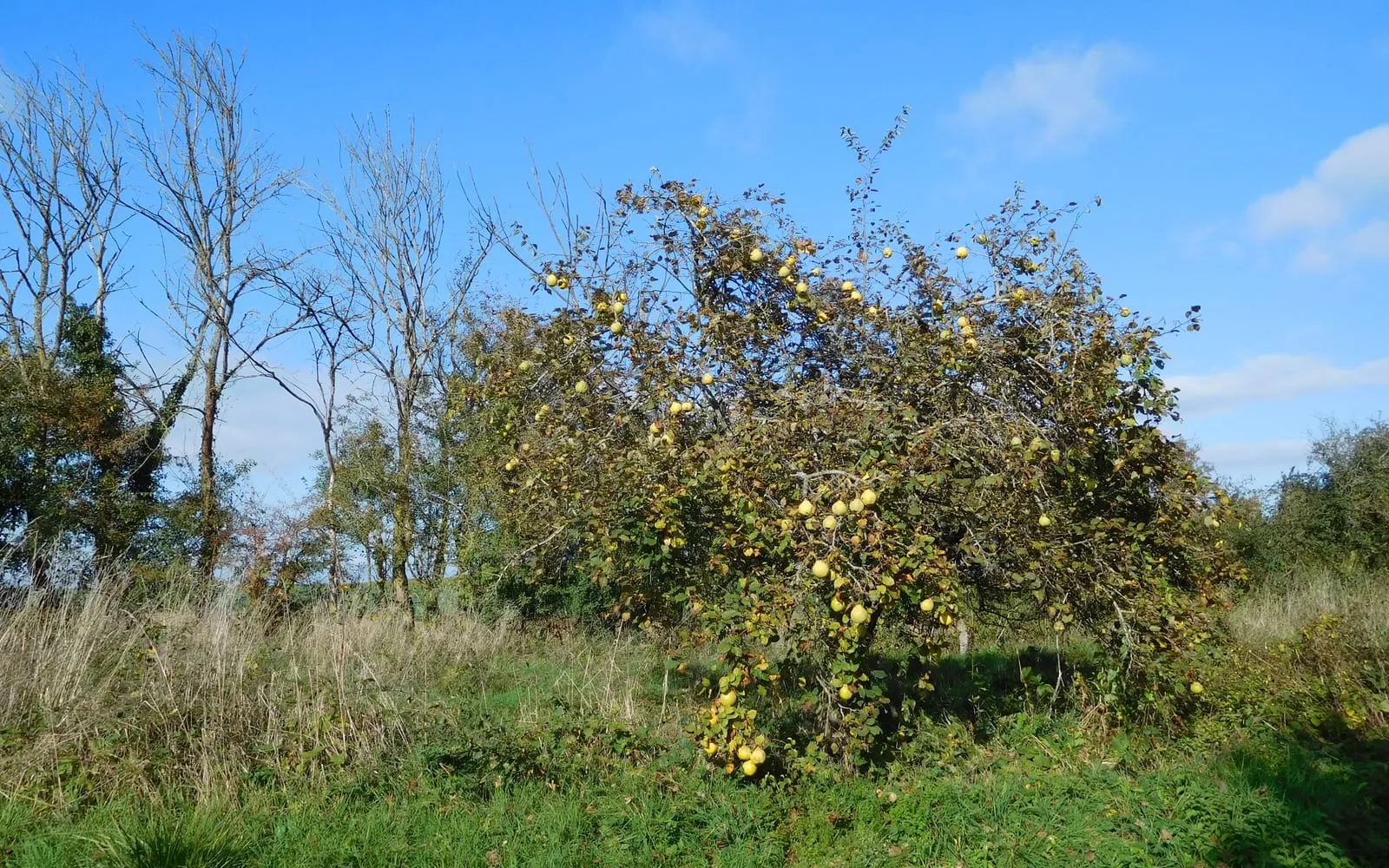
A small tree with a crooked, twiggy, rather shrubby crown, usually 4 to 6 m here and wider than it is tall in old age.
Leaves are oval, dark green above and thickly white-felted beneath, so the whole tree flashes pale when wind turns them.
Flowers are solitary, 5 cm across, pale pink fading to white, opening in May after the leaves. They are large for the size of the tree and worth the space on their own.
Fruit is golden yellow, downy when young, and either apple-shaped or pear-shaped depending on the variety. ‘Vranja’ and ‘Meech’s Prolific’ are pear-shaped; ‘Champion’ is rounder.
The scent is the thing nobody expects. One ripe quince perfumes a room, and a bowl of them will taint butter, milk and any other fruit stored nearby, so keep them on their own.
Flesh is hard, cream-coloured and turns pink to deep red when cooked slowly, which is a chemical change in the tannins rather than anything added.
Where it is from
Quince is native to the Caucasus and northern Iran, and it has been cultivated across western Asia for at least four thousand years.
It reached the Mediterranean early and mattered there. Several of the golden apples of Greek myth are probably quinces, and the fruit was sacred to Aphrodite, which is why it turns up at Greek weddings.
The Romans brought it north and the Normans brought it to Britain, where it was a standard kitchen-garden tree for centuries before apples and pears crowded it out.
Marmalade is a quince word. The Portuguese for quince is marmelo, and marmelada was quince paste long before anyone made it with oranges. Membrillo in Spain and cotognata in Italy are the same preparation.
The tree is also the standard dwarfing rootstock for pears, which is why a grafted pear tree often carries a quince root beneath it.
How it grows
Buy a two or three year old grafted tree. Quince on its own roots suckers badly and takes far longer to fruit.
Plant between November and March into deep, moisture-retentive ground in full sun. Quince tolerates heavier and wetter soil than most fruit trees and dislikes thin chalk.
Space at 4 to 5 m. One tree is enough, since every commercial variety is self-fertile.
Stake for the first three years and keep a metre of clear ground around the trunk. Grass competing at the base costs a young quince more growth than it costs an apple.
Prune lightly and in winter only. Quince carries its fruit on the tips of the previous summer’s growth, so shortening every shoot removes the crop. Take out dead, crossing and crowded wood and stop there.
Expect the first fruit in the third or fourth year, and a useful crop from about the sixth.
Pick in late October or early November, when the down has rubbed off and the skin has gone from green-gold to full gold. Handle them gently, because they bruise far more easily than their hardness suggests.
Through the seasons
Winter is for planting and for what little pruning the tree needs. Mulch in February with compost and a dressing of sulphate of potash.
Spring brings the leaves and then, in May, the blossom. Nothing needs doing. The late flowering is the tree’s own frost insurance.
Summer is when quince leaf blight shows, from June onwards in a wet year. Watch the leaves, and water young trees weekly in a dry spell.
Autumn is the long wait. The fruit will look ripe in September and will not be. Leave it on the tree into November unless a hard frost is forecast, since frost on the fruit ruins its keeping.
After picking, store in a single layer somewhere cool, dark and airy, well away from other fruit. They keep for two or three months and the scent deepens.
Care difficulty
Moderate, and almost all of the difficulty is disease rather than culture.
Quince leaf blight is the problem that spoils quince growing in a damp climate. It shows as small red-brown spots that spread until the leaf blackens and drops, and a bad year strips the tree by August. Rake up and burn every fallen leaf, prune for an open airy crown, and avoid overhead watering.
Fireblight kills shoots back from the tip, leaving blackened leaves hanging on as though scorched. Cut well below the damage into clean wood and disinfect the saw between cuts.
Ripening is the other difficulty and it is a matter of nerve. A quince picked in September never develops its scent.
Beyond that the tree asks very little. It is hardy, self-fertile, tolerant of heavy ground and untroubled by the pruning regime an apple demands.
Watering
Water a newly planted tree weekly through its first three summers, around 20 litres at a time, delivered as one soak rather than a daily sprinkle.
An established quince rarely needs watering in a temperate climate. Its roots go wide and it naturally grows on damp ground.
Water in a long summer drought if the tree is carrying a crop, because quince drops fruit under stress and the fruit that stays is small and woody.
Mulch each February with 8 cm of compost over the root spread, kept clear of the trunk. That does more for moisture than any watering can.
Avoid wetting the foliage. Quince leaf blight spreads in splash, so water at the base.
Warning signs, diseases and pests
Quince leaf blight is the main disease and the one to plan around. Red-brown spots merge into black patches, the leaf yellows and falls, and by late summer the tree can be bare. Clear the fallen leaves, thin the crown for airflow, and choose a resistant variety such as ‘Serbian Gold’ where the problem is chronic.
Fireblight blackens and kills young shoots from the tip down, and the dead leaves stay attached. Prune 30 cm below the visible damage into healthy wood.
Brown rot turns fruit to a firm brown mass with rings of buff pustules. Remove every mummified fruit from the tree over winter, since those are where next year’s infection sits.
Codling moth tunnels the core, exactly as it does in apples. Pheromone traps from May reduce it.
Powdery mildew whitens young shoot tips in a dry spring and rarely matters on an established tree.
Fruit dropping in July is normal thinning. Fruit dropping in September usually means drought.
Small hard fruit that never colours means the tree was picked too early or shaded too much.
Plum curculio cuts a crescent-shaped scar into young green fruit and is confined to North America east of the Rocky Mountains. Jar branches over a sheet in the cool morning after petal fall to catch adults, which play dead and drop when disturbed.
Growing environment
Full sun. Quince fruits poorly in shade and the fruit will not colour without direct light.
Deep, moisture-retentive soil suits it best, and it is one of the few fruit trees that is content on heavy clay. It dislikes shallow chalk, where it goes chlorotic.
Slightly acid to neutral, around pH 6 to 7. On alkaline ground expect yellowing between the leaf veins.
Shelter matters more for the fruit than the tree. Quinces bruise on the branch in wind, and a bruised quince rots in store.
A sunny wall is worth using at the cool edge of its range, where a fan-trained tree ripens fruit that a free-standing one will not.
Do not plant in a frost pocket even though the blossom is late, since cold air sitting around the tree in autumn stops the fruit finishing.
Feeding
Quince is not a hungry tree and overfeeding it causes more harm than underfeeding.
Mulch in late winter with well-rotted compost or manure spread over the root spread and kept off the trunk.
Add sulphate of potash at 20 g per square metre in February. Potash firms the wood and improves fruiting, and it helps a tree recovering from leaf blight.
Avoid high-nitrogen feeds. Soft sappy growth is what fireblight and mildew enter through, and a well-fed quince makes shoots instead of fruit.
On chalk, treat yellowing between the veins with chelated iron and sequestered manganese, applied as a foliar feed in spring.
Nothing further is needed once the tree is established on reasonable ground.
Troubleshooting
The leaves went black and fell off in July. Quince leaf blight. Rake up and destroy every fallen leaf, open the crown, and water at the base rather than over the tree.
Shoots died back with the dead leaves still hanging on. Fireblight. Cut 30 cm below the damage into clean wood and disinfect between cuts.
The fruit is hard and has no scent. Picked too early. Leave them on the tree until the down rubs off and the skin is fully gold, often into November.
The fruit rotted in store. Either bruised at picking or picked after a hard frost. Handle them like eggs and get them in before a heavy freeze.
Everything in the fruit bowl tastes of quince. That is quince behaving normally. Store them on their own, away from butter and milk.
The tree grows well and never fruits. Too much nitrogen, too much shade, or winter pruning that removed the shoot tips where the fruit is carried.
Can I eat them raw? Not the varieties grown in cool climates. Some cultivars from Turkey, Iran and the Caucasus soften enough to eat raw where summers are hot, and the northern sorts never do. Cooking is the point of the fruit rather than a compromise.
Do I need two trees? No. Almost every quince cultivar is self-fertile.
Quince problem guides
Not sure what is wrong? See the common vegetable pests guide.