
Edible
Bilimbi
Averrhoa bilimbi
Also known as Cucumber tree, Tree sorrel, Belimbing asam, Irumban puli
How to grow bilimbi, Averrhoa bilimbi. The sour cousin of the starfruit that grows straight out of the trunk, its place in a Kerala kitchen, and the kidney damage its juice has caused.
At a glance
- Difficulty
- Moderate
- Water
- Twice a week in growth, less in winter
- Light
- Full sun to light shade
- Temperature
- Minimum 10 deg C. Less cold tolerant than starfruit
- Humidity
- High
- Hardiness
- USDA 10-12, RHS H1b, hardy to 10 C
- Type
- Tender evergreen tree
- Height
- 5-10 m in the open, 1.5-2 m in a pot
- Native to
- the Moluccas, South East Asia
- Best month
- June and July in the Northern Hemisphere, December and January in the Southern Hemisphere
Wet tropical Asia. It fruits on the trunk and older branches almost continuously in warm wet conditions, and stops in cool or dry weather. No frost tolerance at all.
Hardiness zones describe winter cold alone. Summer heat, humidity, rainfall and the length of the growing season decide as much, so treat the range as the outer limit rather than as a recommendation.
Every month named in this guide is for the temperate Northern Hemisphere. If you garden in the Southern Hemisphere, shift each one by six months, so June becomes December. Closer to the equator the wet and dry seasons matter more than the calendar, and the shift stops being a useful guide.
Poisonous if eaten
- Safe to eat
- The fruit in small culinary amounts, cooked or pickled
- Do not eat
- Concentrated juice, and any large quantity, because of the oxalate load
- Harm from
- Eating it
- Affects
- People
Bilimbi carries one of the highest oxalate concentrations of any commonly eaten fruit, and concentrated bilimbi juice has caused acute oxalate nephropathy: crystals form in the kidney tubules and cause acute kidney injury, sometimes needing dialysis. Case series from Kerala, Sri Lanka and Indonesia describe people drinking a glass or two of undiluted juice, often on an empty stomach and often as a folk remedy for high blood pressure or diabetes, and presenting days later with kidney failure. Dehydration makes it worse. The fruit used as a souring agent in cooking, a few pieces in a curry, has been eaten in the region for centuries without this happening. The rule that follows is straightforward. Cook with it in small amounts and never drink the juice neat. Anyone with existing kidney disease should avoid it altogether, as they should its relative the starfruit.
Sources: National Kidney Foundation on starfruit, RHS potentially harmful garden plants
About
Bilimbi is the starfruit’s sour relative, and the two are unmistakable side by side. Where a carambola is ridged and waxy and yellow, a bilimbi is smooth, green and shaped like a small cucumber, which is where its English name comes from.
The fruit is far too acid to eat raw. It goes into curries, pickles, chutneys and relishes across Kerala, Sri Lanka, Indonesia and the Philippines, doing the job that tamarind or lime does elsewhere.
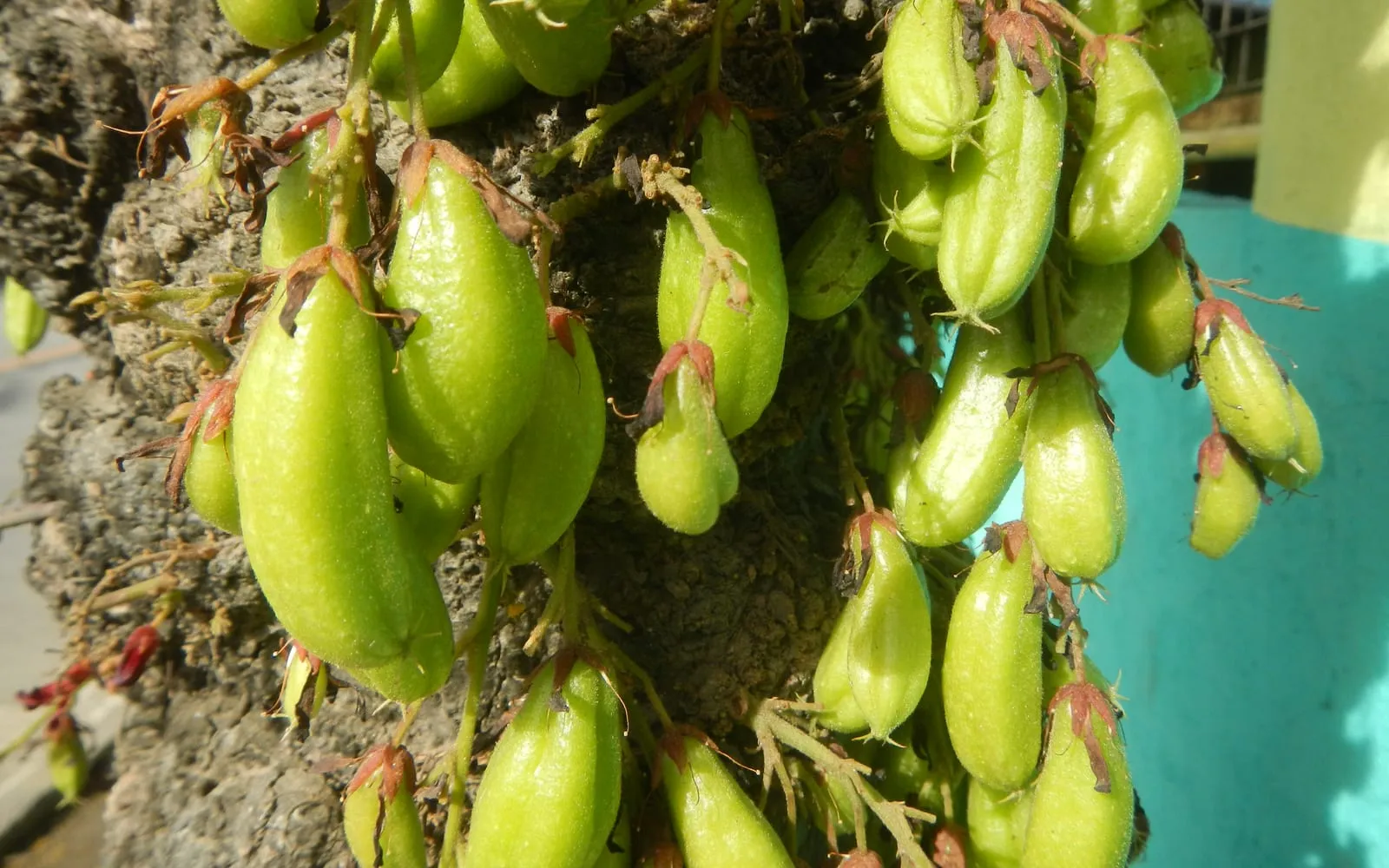
The tree fruits on its trunk. Clusters of fruit hang straight off the main stem and the older branches, so a laden bilimbi looks as though the fruit has been tied on.
Appearance and character
An upright evergreen tree, 5 to 10 m, with a short trunk dividing into a few erect branches and a rather sparse crown.
Leaves are pinnate, 30 to 60 cm long, with 11 to 37 oblong leaflets, and they cluster at the branch ends. They fold at night as starfruit leaves do.
Flowers grow directly on the trunk and older branches, in hanging clusters, small and deep red to purple with a heavy fragrance.
Fruit hangs in the same place, in dense bunches straight off the wood. Each is 4 to 10 cm, cylindrical with five faint ridges, and it stays green or turns pale yellow-green when ripe.
Texture is crisp and juicy, the skin is thin and glossy, and the flesh is very pale.
The taste is extremely sour, sharper than a lemon, with a clean acidity and little sweetness at any stage.
A few flat brown seeds sit in the centre.
Where it is from
Bilimbi is thought to be native to the Moluccas in Indonesia, and it has been cultivated across South East Asia for so long that its wild range is unclear.
It reached South Asia early and became embedded in Kerala and Sri Lankan cooking, where it is irumban puli and bilin respectively, used in fish curries and pickles.
The Philippines uses it as kamias, in sinigang and in relishes, and Indonesia uses it as belimbing wuluh.
The Portuguese and Spanish carried it to the Americas, and it is grown in a small way in the Caribbean and Central America.
It has never become a commercial export crop, because the fruit is too acid for fresh eating and too perishable to ship, so it remains a garden and market tree across its range.
Temperate markets see it very rarely fresh, and occasionally as a pickle in South Asian groceries.
How it grows
Sow seed from a ripe fruit, which germinates readily and loses viability quickly.
Sow at 22 to 28 deg C in free-draining compost. Germination takes two to four weeks.
Buy a grafted or air-layered plant if fruit is the aim, since seedlings take five to seven years and vary.
Grow in full sun or light shade at a minimum of 10 deg C, and above 15 deg C for growth.
Keep humidity high, since bilimbi is less tolerant of dry air than starfruit.
Water twice a week in growth and less in winter.
Use slightly acid compost and rainwater.
Feed monthly from April to September.
Prune sparingly. The tree is naturally upright and the fruit comes on the trunk and older wood, so hard pruning removes the fruiting sites.
Expect fruit on a grafted plant in three or four years under glass.
Through the seasons
Winter is a cool rest above 10 deg C, watered lightly and unfed. Some leaf drop is normal.
Spring brings a growth flush and flowers on the trunk and older branches.
Early summer is fruit set.
Midsummer is fruit swell and the first harvest.
Late summer brings further flowering, since bilimbi fruits over a long season in warm conditions.
Autumn is when to stop feeding and reduce watering as light falls.
Care difficulty
Moderate, and similar to starfruit with a little less cold tolerance and a little more need for humidity.
Minimum 10 deg C is the floor and 15 deg C is needed for growth.
High humidity matters more than for starfruit, and dry heated air brings leaf drop.
Iron shortage on hard water is the standard complaint.
Fruit comes in three or four years from a grafted plant.
Pruning needs restraint, because the fruit is borne on the trunk and older branches and cutting them removes the crop.
The safety question is the one to understand before planting. The fruit is a cooking ingredient in small amounts and the juice is dangerous neat.
Watering
Water twice a week in growth, keeping the compost evenly damp.
Reduce in winter without letting it dry out completely.
Drain fully.
Keep humidity high with misting and grouping.
Use rainwater in a hard water area.
Water steadily through fruiting, since a bilimbi in crop is demanding.
Mulch the pot surface in summer.
Warning signs, diseases and pests
Yellowing between green veins is iron shortage from hard water or alkaline compost.
Leaf drop follows cold, drought or a move, and the plant refoliates if the roots are sound.
Brown crisp leaf edges mean dry air.
Leaflets folding at night is normal.
Brown limpets on the trunk and branches are scale, which this species collects readily because the bark is smooth.
Fine webbing under the leaves is spider mite.
Wilting in damp compost is root rot.
No fruit on a mature plant that flowers is usually a pollination problem under glass. Hand-pollinate with a soft brush.
Fruit dropping green is irregular watering.
Growing environment
A frost-free greenhouse or conservatory. It can stand outside in a warm summer.
Minimum 10 deg C, with 20 to 30 deg C for growth.
Full sun to light shade.
High humidity.
Free-draining rich slightly acid compost.
pH from 5.5 to 6.5.
Rainwater in a hard water area.
A pot of 35 to 45 cm for a fruiting plant.
Feeding
Feed monthly from April to September with a balanced liquid feed containing iron.
Add sequestered iron at the first yellowing between the veins.
Stop feeding at the end of September.
Give nothing through winter.
Top-dress or repot each spring.
Avoid heavy nitrogen.
Keep feeding steady through the long fruiting season.
Troubleshooting
Can I drink bilimbi juice? Not neat. Concentrated bilimbi juice has caused acute kidney injury from oxalate crystals, with case series from Kerala, Sri Lanka and Indonesia describing people who drank a glass or two as a folk remedy and needed dialysis days later. Use the fruit in cooking in small amounts.
How is it different from a starfruit? Same genus, different fruit. Bilimbi is smooth, green and cucumber-shaped, borne in clusters on the trunk, and far more sour. Starfruit is ridged, waxy, yellow, and eaten raw.
Why is the fruit growing on the trunk? Cauliflory, which several tropical trees show. Flowers and fruit are borne on the trunk and older branches rather than on new growth, which is why hard pruning removes the crop.
Can I eat one raw? You can and you will not want to. It is sharper than a lemon with almost no sweetness.
What is it used for? Souring curries, pickles, chutneys and relishes across Kerala, Sri Lanka, Indonesia and the Philippines.
The tree dropped all its leaves. Cold, drought or a move. It refoliates if the roots are healthy.
It flowers and sets no fruit. Under glass there are no pollinators. Hand-pollinate the trunk flowers with a soft brush.
Is it safe for someone with kidney disease? No. Anyone with kidney disease should avoid bilimbi and starfruit alike.
Bilimbi problem guides
Not sure what is wrong? See the common vegetable pests guide.