
Disorder
Sunscald and frost cracks
Also called Southwest injury, Winter sunscald, Bark split, Frost crack, Frost rib
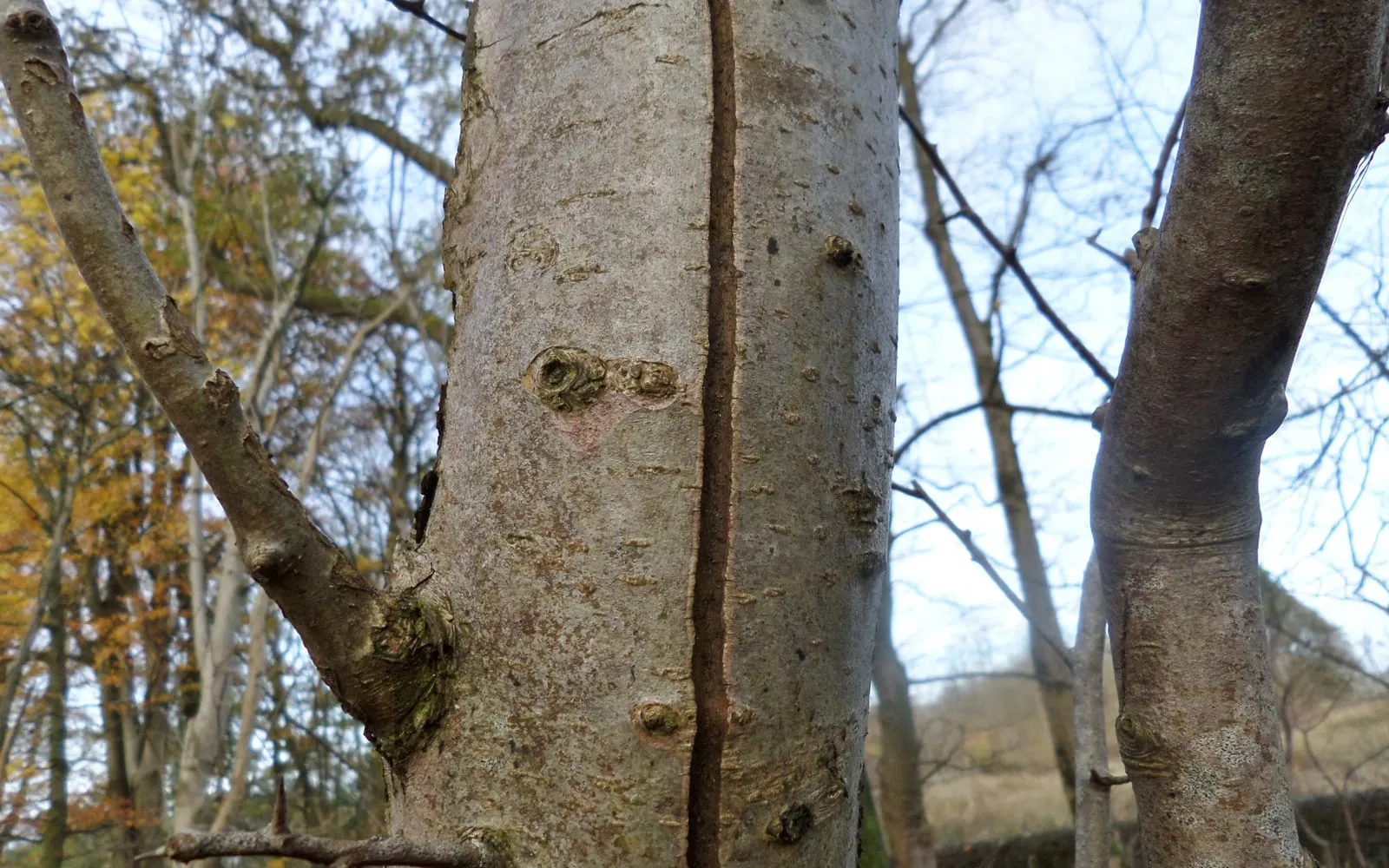
Sunken dead bark on the side facing the low winter sun, and long vertical splits that open with a bang on a cold night. Both come from winter sun rather than winter cold, and both are prevented rather than treated.
At a glance
- Type
- Disorder
- Cause
- Growing conditions
- Severity
- Destroys the crop or display
- Affects
- Garden plants, Herbs and edibles
- Active
- November to March
What you are seeing
- A sunken, discoloured patch of bark on the side of the trunk that faces the afternoon winter sun
- Bark cracking and peeling away from that patch in spring, exposing dead wood
- A long vertical split running up the trunk, sometimes a metre or more
- A raised ridge of callus along an old split, thickening year after year
- Damage on young, smooth-barked trees while the rough-barked ones beside them are clean
- A tree that leafed out normally and then wilted on one side in early summer
- Sap or frass at the edge of a split where borers have moved in
- Splitting worst on a trunk recently exposed by pruning or by the loss of a neighbouring tree
Before you treat anything
A long vertical split in the trunk of a large or mature tree can indicate a structural fault rather than a cosmetic one, particularly where the crack is wide, wet inside or accompanied by bracket fungi. Have it assessed by a qualified arborist before working under it or leaving it standing near a building, a path or a boundary.
What you are looking at
Two injuries that turn up on the same trees for the same underlying reason, and that most people meet in spring rather than in the winter that caused them.
The first is a patch of bark on the trunk that has gone sunken and dull, often running a metre or more up the stem and confined to one side. Through spring it dries, cracks and starts lifting at the edges, and by summer it has fallen away to leave bare wood. If the patch runs most of the way round, the branches above it wilt in the first hot spell.
The second is a split. A clean vertical crack up the trunk, sometimes short and sometimes several metres, occasionally opening with a report loud enough to hear from indoors on a very cold night. Old ones close over into a raised ridge of callus running up the stem, and reopen in the same place winter after winter.
Both fall on young trees with thin smooth bark far more than on old rough-barked ones, and both fall on freshly planted and recently pruned trees hardest of all.
Winter sun, not winter cold
The patch is on the side of the trunk that catches the low afternoon sun in winter. In the northern hemisphere that is the south-west, which is why North American growers call it southwest injury. South of the equator it is the north-west. Either way it is the side that gets the last and warmest light of a short day.
On a clear, still, freezing day, dark bark facing that sun absorbs enough heat to sit ten or even twenty degrees above the air temperature. The living cambium beneath it warms with it, comes out of dormancy over a few hours, and loses the cold hardiness it had built up through the autumn.
Then the sun goes behind a cloud, or behind the horizon, and the temperature of that strip of bark collapses back to the air temperature within minutes. The tissue is caught deacclimated and it freezes. Ice forms inside the cells, the cells burst, and a strip of cambium dies.
So the damage needs a bright winter rather than a severe one. A grey cold winter does far less of this than a sunny cold one, so the injury bites harder in continental climates with clear winter skies than in cloudy maritime ones at the same latitude.
Why the trunk splits
A frost crack starts from a different mechanism and often on the same side.
Wood shrinks as it cools, and the outer wood of a trunk cools faster than the core. On a night when the temperature falls sharply, the outside is contracting around an inside that has not caught up, and the tension builds until the wood fails along a radial line. That is the crack, and the bang.
The failure almost always starts at a weak point. Old pruning wounds, branch stubs, dead knots and last year’s sunscald are where they begin. A crack that has opened once is a permanent weakness, so the same trunk splits in the same place each hard winter and lays down a thicker rib of callus each summer trying to close it.
Trees carrying a frost rib often live for decades with it. The risk is what gets in through the wound, since decay fungi and wood-boring beetles both use it, and a rib on a large tree near a building is worth having someone qualified look at.
The trunk that was shaded until last year
A separate case catches people out in summer rather than winter. Bark that has grown up shaded, whether by the tree’s own lower branches, by a neighbouring tree or by a hedge, has never developed the thickness and pigmentation that exposed bark has.
Take that shelter away in one go, by felling the neighbour or pruning the tree up into a clean stem, and the newly exposed bark scalds in the first hot bright spell. The damage looks the same and arrives in July.
Fruit takes the equivalent injury. Apples, tomatoes and peppers suddenly exposed by heavy summer pruning or by a collapsed plant develop pale, papery, sunken patches on the side that faces the sun. That is the same failure in thinner tissue, and the answer is the same: do not strip the cover off in one go.
What to do about it
Leave the lower branches on a young tree for its first few years.
Wrap or shade the trunk of a newly planted thin-barked tree through winter, or paint it white, and take the wrap off in early spring.
Plant in spring on a cold site and water into the autumn.
Stop feeding by midsummer so the wood hardens before the cold.
Take a shelter belt down over several seasons rather than in one winter.
Mulch the root area and keep the mulch clear of the bark.
Pare loose dead bark back to firm tissue with a clean knife and shape a smooth vertical ellipse, and use no wound sealant.
Leave frost cracks alone and keep the tree well watered and mulched.
Check the wound margins each spring for borer holes and bracket fungi, and have a large split assessed.
What it gets mistaken for
Apple canker sinks the bark in rings around a wound or a bud and carries small red or white fruiting bodies through the winter.
Bacterial canker on cherry and plum runs amber gum out of the dead margin.
Coral spot dots dead wood with pink cushions, and it moves into sunscald damage rather than causing it.
Rabbit, deer and vole damage strips bark in a band at a fixed height, right round the stem, with tooth marks or shredded fibres.
Strimmer damage sits at ground level, is ragged, and goes round rather than up.
Lightning strips a narrow spiral of bark from the crown to the ground and usually splits the wood behind it.
What to do, in order
Start here
Prevention, and the changes that stop the problem returning. Most of these pages should end at this tier.
- Leave the lower branches on a young tree
- Every branch on the trunk shades a piece of it, and a young tree carrying its lower limbs rarely scalds. Pruning a nursery tree up to a clean stem for the look of it removes that shade at the age the bark is thinnest. Keep the low growth for the first four or five years and take it off in stages once the bark has thickened.
- Plant in spring on a cold site, and water it into the autumn
- A tree that goes in during spring has a full season of root growth before its first winter, which is worth more on a cold exposed site than the extra establishment time an autumn planting is supposed to give. Water through any dry spell in autumn as well, since a hydrated trunk resists both injuries better than a dry one.
- Stop feeding in late summer
- Nitrogen applied late pushes soft growth that has not hardened off by the time the cold arrives, and it delays the whole tree going properly dormant. Feed in spring and leave it alone from midsummer.
- Prune in the dormant season, and not into late autumn
- A cut made as the tree is shutting down heals slowly and gives cold injury a place to start. Winter pruning on apples and stone fruit follows its own timing rules for disease, and where you have a choice, late winter beats early winter for this.
- Thin a shelter belt gradually rather than felling it
- Bark that has grown up in shade has never had to cope with direct sun and scalds badly when suddenly exposed. Where a tree or a hedge that has been sheltering a trunk has to come out, take it down over two or three seasons and give the bark underneath time to adapt.
- Mulch the root area and keep the mulch off the trunk
- A mulched root zone holds moisture and moderates soil temperature through the winter, which supports the tree through the injury. Piling mulch against the bark does the opposite, holding damp against the stem and giving voles a covered run to feed in.
Then reach for a barrier
Netting, hand removal and water. Nothing here harms anything except the target.
- Wrap or shade the trunk through winter, and take it off in spring
- A white plastic tree guard, a spiral wrap or a board propped on the sunny side all work by keeping the winter sun off the bark. White reflects best, and commercial orchards paint young trunks with white latex paint thinned half and half with water. Remove any wrap in early spring without fail, because left on through the summer it holds damp, harbours insects and can strangle the stem as it thickens.
- Trace a damaged patch rather than sealing it
- Once you can see where the live bark ends, pare the loose dead bark away with a sharp clean knife back to firmly attached tissue, shaping the margin into a smooth ellipse with the long axis vertical. That lets the tree callus over the edge cleanly. Do not paint the wound with sealant of any kind, which seals moisture and decay in rather than out.
- Leave a frost crack alone
- There is nothing to be gained by cutting into a split, bolting it or filling it. The tree closes what it can from the edges and reopens the same crack in later winters, building the raised rib that marks an old one. Keep the tree in good health and let it deal with it.
- Watch the wound for borers and decay
- Dead bark is the entry point for wood-boring beetles and for decay fungi, and both are far more dangerous than the original injury. Look over the margins each spring for fresh holes, frass or bracket fungi, and get a large trunk assessed if any appear.
Plants affected
Guides that name it among the problems to watch for. The list is the plants it is characteristic of rather than everything it will feed on.