
Edible
Sweet Crabapple
Malus coronaria
Also known as American Crabapple, Wild Crabapple
How to grow sweet crabapple, Malus coronaria. Why it needs a real winter chill to flower well, the root suckers that build it into a thicket if left unchecked, and cooking the tart fruit into jelly, sauce or cider rather than eating it raw.
At a glance
- Difficulty
- Moderate
- Water
- Regularly while establishing; drought-tolerant once mature
- Light
- Full sun for the best flowering and fruit set
- Temperature
- Fully hardy; needs real winter cold to flower well
- Hardiness
- USDA 4-8, RHS H6, hardy to -34 C
- Type
- Deciduous tree, often forming thickets by root sucker
- Height
- 5-9 m
- Native to
- eastern North America
A tree of the cold continental interior of eastern North America, it needs a proper winter chill to flower and fruit reliably and takes extreme cold without any protection at all. Its limits sit at the warm end rather than the cold one: without enough winter cold to satisfy its chill requirement, flowering becomes sparse and erratic even where summer heat would otherwise suit it.
Hardiness zones describe winter cold alone. Summer heat, humidity, rainfall and the length of the growing season decide as much, so treat the range as the outer limit rather than as a recommendation.
Edible, with limits
- Safe to eat
- Ripe fruit flesh, usually cooked into jelly, sauce or cider
- Do not eat
- Seeds, and leaves and stems in quantity
- Harm from
- Eating it
- Affects
- People, dogs, cats and horses
Sweet crabapple carries the same cyanogenic compounds found in the seeds, leaves and stems of cultivated apples and most of their close relatives, released when that plant material is crushed or chewed rather than swallowed whole. The ASPCA lists apple as toxic to dogs, cats and horses on this basis, generally causing mild gastrointestinal upset rather than serious harm at the scale a person or a pet would normally encounter it. The fruit's flesh itself is the edible part. Gardeners grow the tree for its strongly tart fruit, which is better cooked into jelly, sauce or cider than eaten raw, and a handful of accidentally swallowed whole seeds is not a cause for alarm, since the compound is released only when a seed is chewed or crushed.
Sources: ASPCA (Apple, Malus species), RHS potentially harmful garden plants
About
Sweet crabapple grows wild across the woodlands, old fields and fencerows of eastern North America, prized above all for a spring blossom so fragrant it gives the tree its common name, a scent carrying well beyond the tree itself on a still spring day. Its small, hard, sour fruit is a genuine cooking crop, turned into jelly, sauce and cider rather than eaten out of hand.
It is also one of the most valuable early-season trees for pollinators in its native range, its blossom opening while few other nectar sources are available, and it hosts the larvae of a considerable number of moth and butterfly species besides.
Appearance and character
The tree grows with a broad, rounded crown on a short trunk, often branching low and, where conditions allow root suckers to establish, forming a loose thicket of several trunks rather than staying a single clean specimen.
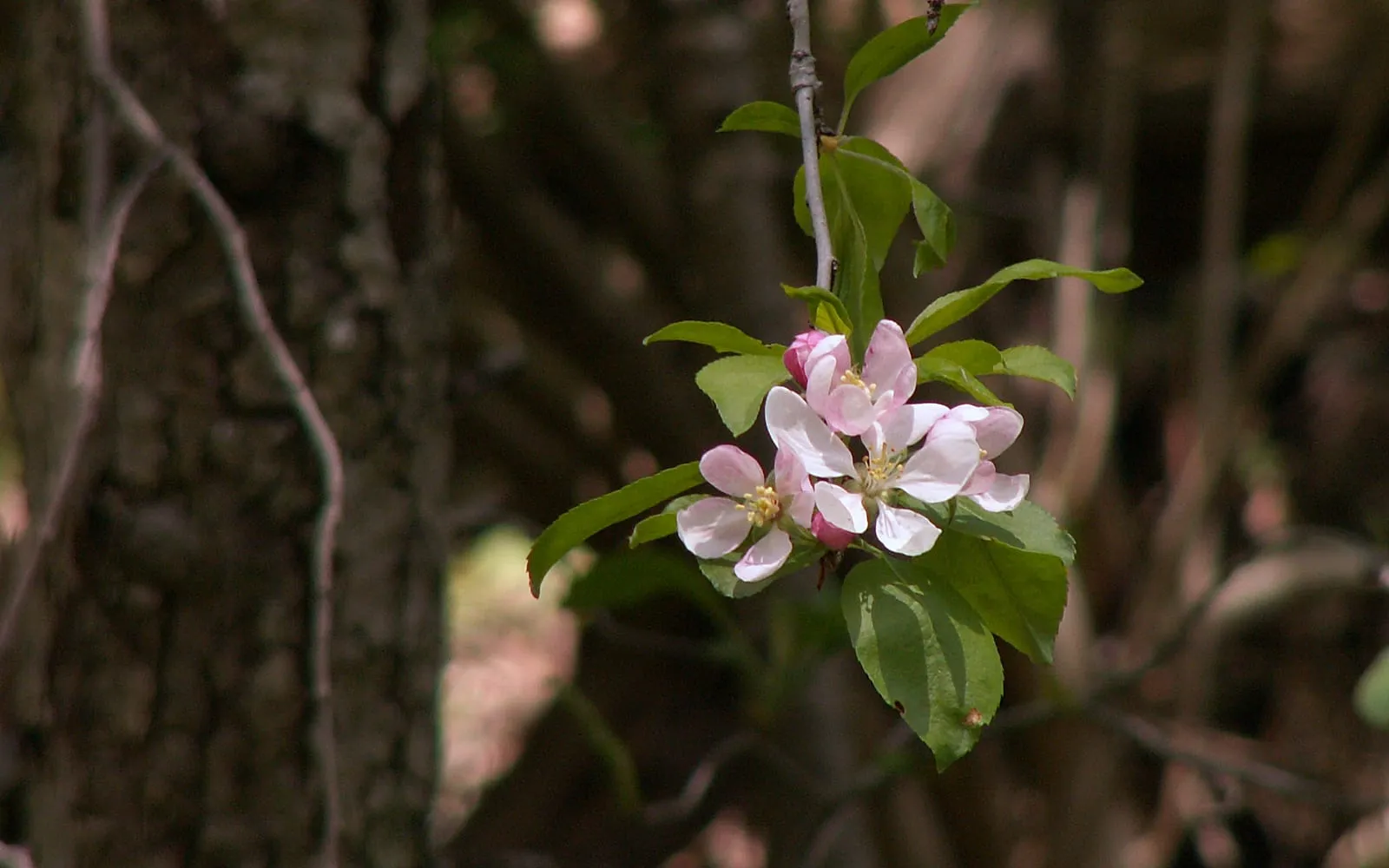
Leaves are oval to broadly lance-shaped, toothed and sometimes lobed on vigorous young shoots, turning a modest yellow before falling in autumn. Flowers open in mid to late spring, five-petalled, pale pink fading to white, and carry a strong, sweet fragrance that is the tree’s single most distinctive feature.
Fruit follows through summer, small, hard, greenish-yellow and intensely tart even at full ripeness, rarely more than 2 to 3 cm across and nothing like the size or sweetness of a cultivated eating apple. It hangs on slender stalks and persists on the tree well into autumn if not harvested or taken by wildlife first.
Where it is from
Malus coronaria is native across the eastern half of North America, from southern Ontario and New York south into Alabama and west to Missouri, growing typically in open woodland, along forest edges, in old fields and in fencerows rather than in dense, closed forest.
Its native range experiences cold, snowy winters and warm, humid summers across most of that area, a firmly continental climate the tree is well adapted to. That cold winter is not incidental to how it grows: like many temperate fruit trees, it needs a sustained period of winter chill to break dormancy properly and flower well the following spring, and a tree grown somewhere too mild to provide that chill flowers sparsely and irregularly regardless of how warm and sunny its summer is.
How it grows
Plant in moist, well-drained soil in full sun, since flowering and fruit set are both noticeably better in open positions than in any significant shade.
It tolerates a wide range of soil types without much special amendment, and adapts reasonably well to poorer or heavier ground than a cultivated eating apple typically prefers.
Allow room for root suckers if a thicket habit is acceptable, since the species readily sends up new shoots from its roots, particularly where the original stem has been damaged or where growing conditions are favourable. Where a single clean tree is wanted instead, remove suckers as they appear rather than letting them establish.
Propagate from seed, which needs a period of cold stratification to germinate reliably, or by grafting onto compatible rootstock for a more predictable, uniform result. Growth is moderate, and a young tree typically begins flowering within its first several years.
Through the seasons
Spring brings the tree’s main display, fragrant pink and white blossom opening over one to two weeks and drawing bees and other pollinators in numbers.
Summer develops the small, hard fruit, and is also the main season for the fungal diseases common to the wider apple family in humid weather.
Autumn ripens the fruit to its final tart flavour, ready for picking for jelly or cider, with leaves colouring modestly before falling.
Winter is fully dormant, and the tree’s considerable cold hardiness means no protection is needed even in the coldest parts of its range.
Care difficulty
Moderate. Sweet crabapple is not a demanding tree in terms of soil, water or feeding, but like most members of the apple family it is susceptible to a range of common fungal and bacterial diseases in humid summer weather, and a degree of routine monitoring keeps minor problems from becoming serious ones.
Its thicket-forming habit is a further point of active management for anyone wanting a single, well-shaped tree rather than a spreading clump, since suckers need removing as they appear rather than being left to establish.
Watering
Water regularly through the first two growing seasons while the tree establishes a proper root system, then reduce to occasional deep watering during any extended dry spell once it is settled.
An established tree tolerates a normal range of rainfall in its native climate without special attention, and is considerably more drought-tolerant than many cultivated fruit trees, though a dry spell during fruit development can still reduce the size and quality of that year’s crop.
Warning signs, diseases and pests
Apple scab causes dark, scabby lesions on leaves and fruit, worse in wet spring weather, and can lead to early leaf drop in a bad year. Clearing fallen leaves in autumn, which harbour the fungus over winter, is the most effective single step to reduce it the following spring.
Fireblight blackens blossom and young shoots as if scorched, spreading rapidly in warm, wet weather during flowering. Prune out affected growth well below the visible damage, sterilising tools between cuts to avoid spreading the bacteria further.
Apple canker produces sunken, discoloured lesions on branches and the trunk, sometimes girdling and killing a branch entirely. Prune out affected wood back to healthy tissue and improve drainage, since canker takes hold more readily in wet, poorly drained ground.
Rust shows as bright orange spots on the upper leaf surface, often linked to a nearby juniper or cedar that hosts the other stage of the fungus’s life cycle. Removing that alternate host nearby, where practical, reduces the pressure considerably.
Japanese beetle skeletonises leaves in summer in parts of the tree’s range where the beetle is established, feeding in groups and leaving foliage looking lace-like. Handpicking into soapy water controls a light infestation well.
Growing environment
Full sun gives the best flowering and the most reliable fruit set. A tree grown in significant shade flowers more sparsely and produces a noticeably smaller crop.
Moist, well-drained soil suits it best, though it adapts to a fairly wide range of soil types without serious difficulty, from sandy ground to heavier loam.
Good airflow around the canopy matters more for this tree than for many, since several of its common diseases take hold more readily in still, humid air around crowded branches. Avoid planting too close to other trees or structures that would restrict circulation.
A reliably cold winter, meeting the tree’s chill requirement, is essential for reliable flowering. This is not a tree suited to a mild, frost-free climate, however warm and sunny its summers might otherwise be.
Feeding
Feed with a balanced fertiliser or well-rotted compost once in early spring, which is enough for most trees growing in reasonable garden soil.
Avoid heavy or repeated feeding, particularly with high-nitrogen fertiliser, which pushes lush leafy growth more prone to fireblight and other diseases, at some cost to flowering and fruit.
A mulch of compost around the root zone in spring, kept clear of the trunk, supplies most of the additional fertility a mature tree needs beyond that single feed.
Troubleshooting
My tree flowers beautifully but the fruit is inedible off the tree. That is expected. Sweet crabapple fruit is intensely tart even at full ripeness and is grown for cooking into jelly, sauce or cider rather than for eating fresh. Pick it once fully coloured and treat it as a cooking ingredient from the start.
The leaves developed dark scabby patches in early summer. Almost certainly apple scab, worse in a wet spring. Clear fallen leaves in autumn to reduce the fungus overwintering nearby, and improve airflow around the canopy if the tree is crowded.
Suckers keep coming up around the base of the tree. Normal for this species, which spreads readily by root sucker. Remove them as soon as they appear if you want a single clean trunk, or allow them to establish if a thicket habit suits the space.
It has never flowered well despite years of good care. Check whether the site provides enough winter cold. This tree needs a real, sustained chill to break dormancy properly, and one grown at the mild edge of its range, or in an unusually warm winter, can flower sparsely regardless of how well it is otherwise looked after.
Blossom and young shoots blackened suddenly in spring. Likely fireblight, especially following warm, wet weather during flowering. Prune out affected wood promptly, well below the visible damage, and sterilise tools between cuts to avoid spreading the bacteria to healthy growth.