
Edible
Bread Wheat
Triticum aestivum
Also known as Common wheat, Bread wheat
How to grow wheat, Triticum aestivum. The three genomes behind a risen loaf, how to tell an ear of wheat from barley in a field, and why the plant got shorter in the 1960s.
At a glance
- Difficulty
- Moderate
- Water
- Rain-fed, and a garden patch wants water through a dry May and June
- Light
- Full sun
- Temperature
- Grows from about 4 deg C, ripens best above 20
- Hardiness
- USDA 3-9, RHS H6, hardy to -25 C
- Type
- Hardy annual grass, autumn or spring sown
- Height
- 70-100 cm in modern varieties, 140 cm in old ones
- Native to
- south-eastern Turkey, the southern Caspian
- Best month
- October and August in the Northern Hemisphere, April and February in the Southern Hemisphere
Winter and spring wheat are the same species doing two different jobs. Winter wheat needs four to eight weeks below about 5 C before it will make an ear, so it is sown in autumn and yields more, and spring wheat needs no such cold and is sown where winters are too hard for a crop to survive standing. That split decides the sowing date at every latitude. Rain at flowering carries fusarium head blight and rain at ripening sprouts the grain in the ear, so the timing of rain matters far more than the total.
Hardiness zones describe winter cold alone. Summer heat, humidity, rainfall and the length of the growing season decide as much, so treat the range as the outer limit rather than as a recommendation.
Every month named in this guide is for the temperate Northern Hemisphere. If you garden in the Southern Hemisphere, shift each one by six months, so October becomes April. Closer to the equator the wet and dry seasons matter more than the calendar, and the shift stops being a useful guide.
Edible, with limits
- Safe to eat
- The grain, milled or whole
- Do not eat
- Ergot bodies in the ear, and any grain that is mouldy or pink
- Harm from
- Eating it
- Affects
- People
Wheat is food, and it is on the list of 14 allergens British food businesses must declare, under cereals containing gluten. Coeliac disease is an autoimmune response to gluten that damages the lining of the small intestine, affects about one person in a hundred, and is managed by removing wheat, barley and rye from the diet for life rather than by moderating them. Wheat allergy is a separate condition and can be immediate and severe. Two field hazards reach the grain. Ergot is a fungus that replaces a grain with a hard black body carrying alkaloids that constrict blood vessels, and mass poisoning from ergot in rye and wheat flour is on the historical record as St Anthony's fire. Fusarium head blight infects the ear during a wet flowering and leaves deoxynivalenol behind, which causes vomiting. Commercial grain is screened for both. Grain from a garden patch is not, so throw out any ear carrying black bodies and any grain that is pink, shrivelled or musty.
Sources: Coeliac UK on the gluten-free diet, Food Standards Agency on the 14 named allergens, Food Standards Agency on mycotoxins
About
Wheat covers more farmland than any other crop, around 220 million hectares of it, and Britain grows about 1.7 million of those. In a field it is an unglamorous grass with a stiff upright head on each stem. That head holds thirty to fifty grains in paired rows on a tough central axis, and the toughness is the domestication: a wild wheat shatters at the touch to scatter its seed, while this one holds on until a combine beats it out.
Bread wheat carries three complete sets of chromosomes where most plants carry one. A tetraploid wheat of the emmer line crossed with a scruffy wild grass called Aegilops tauschii near the southern Caspian around eight thousand years ago, and the resulting hexaploid drew proteins from all three ancestors. The set that came in from that wild grass supplies the glutenin that lets bread dough hold gas and rise. Einkorn and emmer both contain gluten, and neither of them will give you a tall loaf.
The plant a British farmer grows today is short on purpose. Old varieties stood 1.4 m tall and fell flat in summer storms with the grain still in the ear. Dwarfing genes from a Japanese variety called Norin 10 went into breeding programmes after 1945, put the plant’s energy into grain rather than straw, and took 40 cm off its height. British wheat yields tripled between 1945 and 1990, and the plant you see from a train window is the result.
Appearance and character
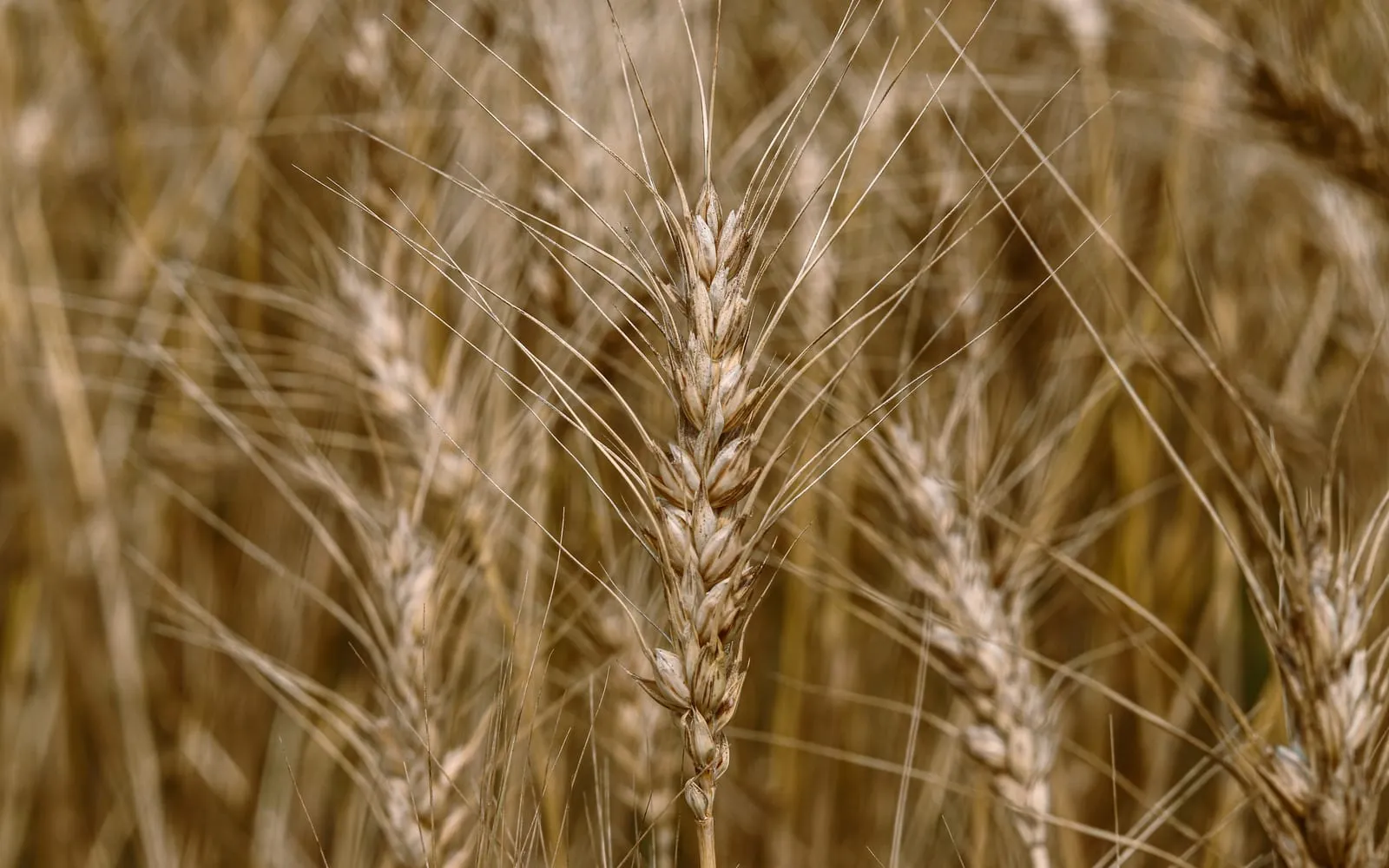
The head is a spike, meaning each spikelet sits straight on the central stem with no stalk between. Look down on a ripe ear from above and you see two rows. Look at the same ear side on and you see four, because each spikelet stacks two to four grains. Most British varieties carry short awns or none at all, and the ear stands upright through the summer, leaning a little as the grain fills.
Separating the three cereals in a temperate field takes a moment. Barley wears awns as long as the ear itself and bows its head as it ripens, so a barley field in July looks brushed in one direction. Oats hold their grain in an open branching panicle, which reads as a loose spray rather than a head. Wheat sits between the two, compact and upright.
Before the ear appears, the identification is at the base of the leaf. Two small flaps called auricles clasp the stem where the leaf blade leaves it, and their shape is diagnostic. Wheat’s auricles are short and carry fine hairs, barley’s are large, smooth and overlap right around the stem, and rye’s are short and blunt. A hand lens settles which crop a green field holds in February.
Where it is from
The wheat line begins in the Fertile Crescent, in a band running from the Jordan valley through southern Turkey into western Iran. Einkorn was domesticated in the Karacadag hills of south-eastern Turkey, emmer somewhere close by, and both are among the eight founder crops that agriculture in western Eurasia was built on.
Bread wheat has no wild form anywhere, because it did not exist until farmers had already been growing emmer for two thousand years. The hybrid with Aegilops tauschii happened in cultivation, probably more than once, somewhere between northern Iran and the Caspian. A plant that cannot be found in the wild is a plant made by farming.
From there it went everywhere that would take it. Wheat reached Britain with Neolithic farmers around 4000 BC, and grains of emmer and einkorn turn up in excavations from that period. Bread wheat took over slowly, and Britain has grown it as the dominant cereal only since the medieval period.
How it grows
A wheat seed germinates within a week of sowing in warm soil and puts up a single shoot. Over the following weeks it tillers, producing side shoots from the base, so one sown grain becomes three to six stems. Autumn-sown wheat spends the winter as a flat rosette of tillers doing very little above ground while its roots go down over a metre.
Spring brings stem extension. The growing point rises up inside the sheath of leaves, the internodes lengthen one after another, and the ear travels upward inside the flag leaf until the sheath swells around it, which farmers call booting. The ear then pushes clear over about a week.
Wheat pollinates itself, and it does so mostly before the flowers open, which is why breeding wheat is slow work with tweezers. Grain fill takes six weeks. The plant moves sugar out of the leaves and stem into the developing grains, the whole crop turns from blue-green to gold from the bottom up, and the grain hardens from milk to dough to a state where a thumbnail leaves no mark.
Most winter varieties need a cold period before they will flower at all. Sow one in April and it tillers all summer and never produces an ear, which is a mistake worth avoiding in a garden patch. Spring varieties carry no such requirement and yield less.
Through the seasons
British winter wheat goes in from late September to early November, ideally into a firm dry seedbed. It emerges in a fortnight, tillers through the autumn, and sits out the winter. Growth restarts in late February or March with the first nitrogen.
April and May are stem extension, when the crop puts on most of its height and the fungicide programme runs. The ear emerges in late May or early June and flowers within a week of that. From flowering to harvest is roughly two months.
Harvest is August in most of Britain, later in the north and in a poor summer. The crop is cut when the grain is below about 15 per cent moisture, which in a wet year means waiting for a dry window and watching the ears for sprouting. Spring wheat compresses all of this into March to September and produces a lighter crop.
Care difficulty
A garden bed of wheat is easy to grow and hard to do anything with. Broadcast seed on cleared ground in October, rake it in, keep the pigeons off, and you will have ears by July with no further attention. The work comes afterwards, because threshing and winnowing a few square metres by hand takes an afternoon and produces about a kilo of grain.
A field crop is a different proposition, and the difficulty sits in the decisions rather than the labour. Nitrogen timing sets both yield and protein, fungicide timing has to anticipate a disease that is not yet visible, and both are judged against a forecast. Getting either wrong costs more than getting the sowing wrong.
Set your expectations by the reason you are growing it. As a thing to look at and to learn from, wheat rewards a small patch. As a source of flour, a household eating a large loaf a week would need something like 200 square metres and a way of milling what came off it.
Watering
Wheat in Britain is rain-fed, and irrigating it is rare enough to be notable. The plant roots deeply and pulls water from well below the surface, which is what carries it through a dry spell that flattens a shallow-rooted vegetable bed.
A garden patch behaves the same way once it is established. Water it through germination if October is dry, and then leave it alone until May. The period that responds to watering is flowering and the three weeks after, when the grains are filling. Drought then produces small pinched grains and a poor sample.
Waterlogging does more damage than drought. Wheat on heavy clay that lies wet through the winter turns yellow, loses tillers and grows shallow roots that let it down in June. Choose the drained end of the plot rather than the low corner.
Warning signs, diseases and pests
Septoria leaf blotch costs British wheat more than any other disease. It shows as brown oval blotches with small black dots inside them, always starting on the lowest leaves and moving up the plant in rain splash. What matters to yield is whether it reaches the top two leaves before the grain has filled, so the ear can look clean while the crop is already lost.
Yellow rust appears as bright orange-yellow pustules in neat stripes running along the leaf veins, and it moves fast in a mild damp spring. Brown rust scatters its pustules randomly and prefers warmer weather later in the season. Both rub off on a finger, which separates them from septoria.
Fusarium head blight bleaches individual spikelets white while the rest of the ear stays green, sometimes with a pink tinge at the base of a grain. It infects during flowering in wet weather and leaves mycotoxins in the grain, so an affected garden crop is not worth eating. Ergot is unmistakable when it comes, replacing a grain with a hard purple-black body up to 2 cm long that sticks out of the ear.
Take-all is a root disease that shows above ground as scattered patches of stunted plants that ripen white and early, with blackened roots when you pull one. It builds up when wheat follows wheat, and rotating the patch is the whole of the answer. Slugs hollow out sown seed in a wet autumn, aphids bring barley yellow dwarf virus into autumn crops and leave stunted yellow-red patches behind, and pigeons will graze a garden square flat in a week if you let them.
Desert locust swarms can strip a wheat field to bare stems within hours during an upsurge, across an invasion area spanning North and West Africa, the Middle East and south-west Asia. It is the most destructive migratory pest on earth and not a risk for wheat grown outside that range, but a hopper band or swarm anywhere within it should be reported to the national locust control authority immediately.
Growing environment
Full sun, and a lot of it. Wheat evolved in open country and will not tolerate shade from a hedge or a wall for more than part of the day. A shaded strip along a fence produces tall thin stems that fall over.
Soil is where the crop is won in Britain. Wheat wants depth more than richness, because the roots go down over a metre and the water they find there is what carries the grain fill. Deep loams and drained clays grow the best wheat, and thin chalk and dry sand grow the worst. Aim for a pH between 6 and 7, and lime an acid plot the autumn before sowing rather than at sowing.
The plant is hardy to around minus 20 deg C once it has hardened off through the autumn, which is why it can be sown in September and left. A crop sown late and caught by hard frost while still soft is the one that suffers. Ripening wants warmth and dryness, and a wet August is the reason a British harvest can be poor in a year when the growing season was good.
Feeding
Nitrogen drives yield in wheat more than any other input, and the timing is as important as the amount. A winter crop gets nothing in the autumn, since the plant needs little and anything applied leaches out over the winter. The first dose goes on as growth restarts in February or March. The main one follows at stem extension in April.
Protein content follows a later application. Milling wheat for breadmaking is bought on a protein specification, typically 13 per cent, and a dose applied at or just after ear emergence lifts protein without adding much yield. Feed wheat skips it. For a garden patch, one handful of a balanced granular feed per square metre in March covers everything.
Phosphate and potash matter less because most soils hold enough of both, though a plot that has grown vegetables hard for years may be short of potash. Wheat on a very acid soil takes up manganese poorly and shows it as pale mottled leaves with a floppy kink, which lime fixes over a season rather than a week.
Troubleshooting
Can I grow wheat in a garden? Yes, and a bed of it is a good thing to look at. Broadcast the seed thickly on cleared soil in October, rake it in, and net it against pigeons. Expect roughly a kilo of grain from four square metres.
Where do I get seed? Farm seed is sold in tonnes and is usually treated with fungicide. Heritage grain suppliers sell einkorn, emmer, spelt and old bread wheat varieties in packet quantities, and wholefood shops sell wheat berries that will often germinate.
My wheat never produced an ear. You sowed a winter variety in the spring. It needs several weeks of cold to switch to flowering, so without a winter it tillers and stays green. Sow winter types in October, or buy a spring variety.
How do I thresh it by hand? Cut the stems, dry them under cover for a fortnight, then beat the ears inside a pillowcase or rub them between your palms. Winnow the result by pouring it between two buckets in a light breeze, which carries the chaff away and drops the grain.
Is spelt easier on the digestion than wheat? No, and the belief is dangerous for anyone with coeliac disease. Spelt is a hexaploid wheat and contains gluten. Neither it nor einkorn, emmer, kamut nor any heritage wheat is safe on a gluten-free diet.
What is the black thing in my ear of wheat? Ergot, most likely, a fungus that replaces a grain with a hard dark body. Do not eat grain from an ear carrying one, and pull the affected heads out and burn them rather than composting them.
Why is my wheat flat on the ground? Lodging, which is a storm hitting a crop that is too tall and too soft. It follows heavy nitrogen, thick sowing and an old tall variety. The grain will usually still fill, but it will be harder to cut and more likely to sprout in the ear.
Can I use my wheat to make bread? If you can mill it. Whole grains need a grain mill or a strong blender, and the wholemeal flour that results makes a denser loaf than shop flour because it carries the bran and the germ.
Bread Wheat problem guides
Not sure what is wrong? See the common vegetable pests guide.
- Septoria leaf blotch, the disease that costs British wheat the most
- Yellow rust and brown rust in warm damp springs
- Powdery mildew on thick lush crops
- Aphids carrying barley yellow dwarf virus into autumn-sown crops
- Slugs hollowing the seed before it germinates
- Pigeons grazing a small patch flat
- Fusarium head blight after a wet flowering, which leaves mycotoxins in the grain
- Ergot, a black fungal body replacing a grain in the ear
- Desert locust, capable of stripping a whole crop across Africa and south-west Asia