
Edible
Emmer Wheat
Triticum dicoccum
Also known as Farro, Farro medio, Hulled wheat
How to grow emmer, Triticum dicoccum. One of the eight founder crops, the wheat that fed Egypt and Rome, and the ancestor standing behind every plate of pasta.
At a glance
- Difficulty
- Moderate
- Water
- Rain-fed. Water only during a dry grain fill
- Light
- Full sun
- Temperature
- Hardy, and tolerant of heat at ripening
- Hardiness
- USDA 4-8, RHS H6, hardy to -25 C
- Type
- Hardy annual grass, autumn or spring sown
- Height
- 100-140 cm
- Native to
- south-eastern Turkey, the Levant
- Best month
- October and August in the Northern Hemisphere, April and February in the Southern Hemisphere
One of the eight founder crops of agriculture, and hulled like spelt, so it needs dehulling before milling. It tolerates poor thin soil and unreliable rain, which is what carried it across the dry Near East, and it is more resistant to fusarium and rusts than modern wheat. Autumn-sown crops need winter cold to ear, and spring sowing works where winters are too hard.
Hardiness zones describe winter cold alone. Summer heat, humidity, rainfall and the length of the growing season decide as much, so treat the range as the outer limit rather than as a recommendation.
Every month named in this guide is for the temperate Northern Hemisphere. If you garden in the Southern Hemisphere, shift each one by six months, so October becomes April. Closer to the equator the wet and dry seasons matter more than the calendar, and the shift stops being a useful guide.
Edible, with limits
- Safe to eat
- The grain, once dehulled
- Do not eat
- Ergot bodies in the ear
- Harm from
- Eating it
- Affects
- People
Emmer is a wheat and contains gluten, so it falls under the cereals containing gluten heading in the 14 named allergens and is not safe for anyone with coeliac disease. Farro is emmer, and a restaurant farro salad is a wheat dish. The claim that ancient grains are tolerable to people who react to modern wheat circulates widely and Coeliac UK rejects it. Emmer's gluten proteins differ from bread wheat's in proportion rather than in kind, and the immune response in coeliac disease is to sequences all of them carry. Ergot applies as it does to every cereal, so inspect a home-grown ear and discard any carrying a hard dark body.
Sources: Coeliac UK on the gluten-free diet, Food Standards Agency on the 14 named allergens
About
Emmer is the wheat that fed the ancient world. It was domesticated in the Fertile Crescent alongside einkorn around ten thousand years ago, spread across the Near East, Egypt, Greece and Rome, and remained the dominant wheat of the Mediterranean for several thousand years before free-threshing wheats displaced it. Egyptian bread and Egyptian beer were both made from it.
Its place in the family tree is more consequential than its place in history. Emmer is tetraploid, and every tetraploid wheat grown today descends from it. A mutation that loosened the glumes turned it into durum. A cross with a wild goat grass, adding a third genome, turned it into bread wheat. Without emmer there is no pasta and no risen bread.
It survives as a crop in pockets, chiefly in Italy where it is sold as farro, in Ethiopia, and in a small revival among European growers who want a cereal for poor ground. Britain grew it in the Neolithic and Bronze Age, and grains from that period turn up regularly on excavations.
Appearance and character
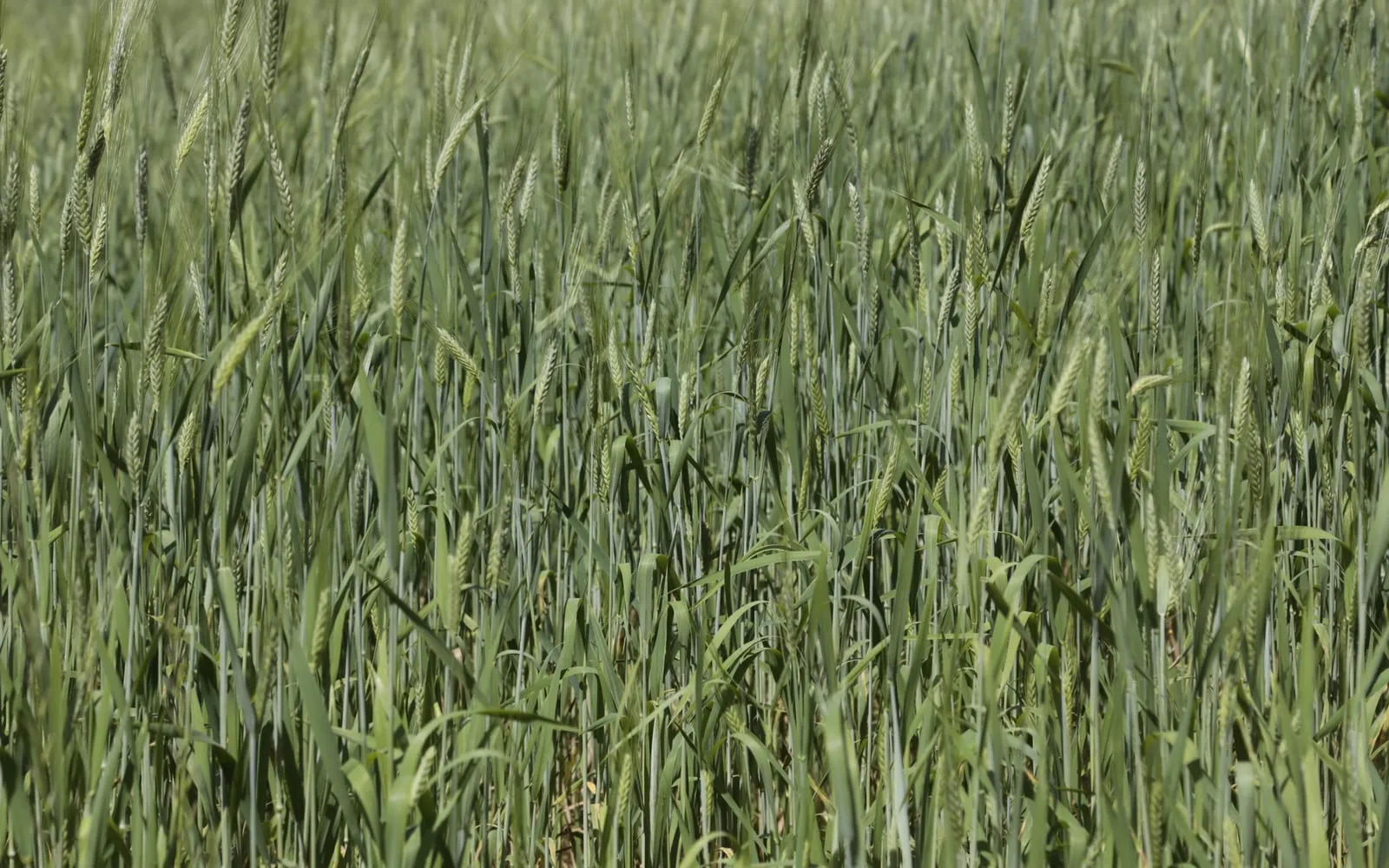
The ear is flattened and strictly two-ranked, so it looks like a comb from one side and a narrow blade from the other. Long stiff awns run up from it in a parallel bundle. Each spikelet holds two grains, sometimes only one, and the name of the plant in several languages refers to that pairing.
The ear is brittle by design. Under threshing it breaks into individual spikelets rather than releasing grain, and each spikelet has to be dehulled afterwards. The wild ancestor took this further and shattered on the plant to scatter its seed. Domestication toughened the axis just enough to hold the spikelets until harvest.
The grain inside is long, flat-sided and pointed, with a deep crease. It cooks to a firm chewy bead that holds its shape, which is why Italian cooking uses farro in salads and soups where a softer grain would collapse.
Where it is from
Wild emmer still grows in the hills of Israel, Syria, Lebanon and south-eastern Turkey, in open oak woodland and on stony slopes, and it can be found there today. Domestication happened somewhere in that arc around 9000 BC, and the genetic evidence points to the Karacadag region of southern Turkey, the same area that produced domesticated einkorn.
From there emmer travelled with farming. It reached Egypt early and stayed as the national grain for millennia, reached Greece and Italy in the Bronze Age, and arrived in Britain with the first farmers around 4000 BC. Roman writers treat it as an old-fashioned grain even while acknowledging its ritual importance.
The retreat was gradual. Free-threshing wheats needed no dehulling, and once milling became centralised the labour saving decided the question. Emmer held on longest in mountainous regions with poor soil and small mills, which is exactly where it is still grown.
How it grows
Emmer grows as a tall, slightly untidy winter or spring cereal. Autumn sowing gives the larger crop, and the plant tillers freely through the winter without much prompting.
Stem extension in spring takes it well over a metre, and the crop leans and weaves rather than standing in a rigid block. The ear emerges in early summer, flowers by self-pollination within days, and fills over six weeks. Ripening happens from the base of the plant upward and finishes in late summer.
Sowing is done as spikelets, since that is what threshing produces. Each unit carries two grains, so a sown patch comes up in pairs and looks thicker than the seed rate suggests. It needs no thinning.
Through the seasons
Sow in October for the best crop, or in March if the autumn slipped away. The seedbed needs no refinement, and emmer establishes on rough ground that would give a modern wheat trouble.
The plant sits low through the winter and starts moving in March. April and May are the growing months, when it goes from ankle height to shoulder height, and the ear appears in late May or June.
Harvest is August. Cut, dry under cover for a fortnight, then dehull. Small quantities come out by rolling the spikelets firmly under a board or a rolling pin and winnowing between two buckets in a breeze, and the process takes longer than the growing did.
Care difficulty
Emmer is one of the easiest cereals to grow and one of the most awkward to eat. It establishes on poor ground, needs no feeding, resists several diseases that trouble modern wheat, and stands up to weather that thins a crop out. Nothing about the growing is demanding.
The hull is the difficulty, as it is with spelt and einkorn. A grain that will not thresh free needs a dehuller, and no domestic appliance does the job. Expect to spend more time processing a small crop than growing it.
Lodging is the other thing to plan for. The plant is tall and the straw is not stiff, so a plot that was manured last year will produce a crop that lies flat after the first summer storm. Grow it hungry.
Watering
Emmer is a dryland cereal with a deep and searching root system, which is what let it feed farming societies in places with unreliable rain. In a temperate climate it needs no watering in an ordinary year.
The one period that repays attention is grain fill, the three weeks after flowering. A drought then produces small grains that are mostly hull, and a single deep soak at that point makes a visible difference to what you get out of the dehulling.
Standing water is the real enemy. Emmer on a plot that lies wet through the winter loses tillers and roots shallowly, and no amount of spring attention recovers it.
Warning signs, diseases and pests
Emmer carries broad resistance to several rust races, which is why wheat breeders keep returning to wild emmer for genes. A patch grown next to a rusting bread wheat crop will often stay clean, though it is not immune and orange pustules on the leaves mean the same thing here as anywhere.
Septoria finds it in a wet spring, showing as brown oval blotches speckled with black dots on the lower leaves. The plant’s height puts the top leaves well clear of splash, so the damage tends to stay low.
Lodging is the commonest failure and it follows from feeding. A flattened crop ripens unevenly, holds moisture and starts to sprout in the ear after rain. Ergot appears occasionally, replacing a grain with a hard black body, and any ear carrying one should be pulled and burned.
Birds are the practical problem on a garden scale. A few square metres of ripe emmer is a conspicuous meal, and pigeons will strip it in days. Net it from ear emergence.
Growing environment
Full sun on an open site, with some shelter from the prevailing wind if the plot allows it. Emmer will tolerate light shade and responds by growing taller and leaning further.
Soil can be poor, thin, stony or acid, and emmer will still produce. This is the plant’s defining agricultural quality and the reason it survived in mountain farming long after the lowlands had abandoned it. A pH anywhere from 5.5 to 8 is acceptable.
Cold holds no fear for it. Autumn-sown emmer survives hard temperate winters without protection. What it dislikes is a rich, sheltered, well-watered bed, which produces a magnificent crop that falls over in June.
Feeding
Feed emmer nothing, or very close to nothing. The plant evolved on poor ground and responds to nitrogen by growing taller rather than by setting more grain, which ends in lodging.
If the plot is exhausted, a single light dressing of a balanced granular feed in March is enough. Skip it entirely on ground that grew a manured crop the previous year.
The same logic applies to the compost heap. Emmer straw is long and tough and composts slowly, so chop it before adding it, and consider keeping it as a mulch instead.
Troubleshooting
Is emmer the same as farro? It is farro medio, the middle one of three Italian hulled wheats. Farro grande is spelt and farro piccolo is einkorn, so a bag labelled only farro could be any of them and they cook at different speeds.
Is emmer safe for coeliacs? No. Emmer is a wheat and contains gluten. The belief that ancient grains are gentler is common and unsupported, and Coeliac UK advises against all of them.
How do I dehull it? Roll the dried spikelets under firm pressure with a rolling pin on a hard board, then winnow the mixture by pouring it between two buckets in a light breeze. The hulls fly and the grain drops. It is slow and there is no domestic machine for it.
Why is my emmer crop lying flat? It was fed, or it was grown on ground with residual fertility. Emmer is tall and its straw is soft, and rich soil takes it over in the first storm. Grow the next one on poorer ground.
What does it taste like? Nutty and firm, with grains that stay separate after cooking. It takes about 30 to 40 minutes to cook whole, longer than pearled barley and shorter than whole spelt.
Can I mill it into flour? Yes, once it is dehulled. Emmer flour makes a dense flavoursome loaf that will not rise like bread flour, because the gluten lacks the strength that bread wheat’s third genome supplies.
Where do I buy seed? Heritage grain suppliers sell it in packet quantities. Italian farro from a delicatessen is sometimes pearled, which removes the outer layers and stops it germinating, so check that the grain is whole before sowing.
Emmer Wheat problem guides
Not sure what is wrong? See the common vegetable pests guide.