
Edible
Rye
Secale cereale
Also known as Grazing rye, Winter rye, Cereal rye
How to grow rye, Secale cereale. Sowing, poor soils, ergot risk, harvesting grain and using rye as a green manure.
At a glance
- Difficulty
- Easy
- Water
- Rain-fed. A garden patch needs nothing after germination
- Light
- Full sun
- Temperature
- The hardiest cereal, surviving to minus 30 deg C
- Hardiness
- USDA 3-8, RHS H7, hardy to -30 C
- Type
- Hardy annual grass, autumn sown
- Height
- 120-200 cm
- Native to
- eastern Turkey, the Caucasus
- Best month
- September and August in the Northern Hemisphere, March and February in the Southern Hemisphere
It is the hardiest cereal there is, surviving to around -30 C under snow, and it crops on thin acid sand that starves wheat. The root system is the deepest of any cereal, which is where the drought tolerance comes from. Ergot is the risk that matters, a fungus replacing grain with a dark toxic sclerotium, and it is worse in a wet flowering because rye is wind-pollinated and cross-pollinating with a longer open floret than wheat.
Hardiness zones describe winter cold alone. Summer heat, humidity, rainfall and the length of the growing season decide as much, so treat the range as the outer limit rather than as a recommendation.
Every month named in this guide is for the temperate Northern Hemisphere. If you garden in the Southern Hemisphere, shift each one by six months, so September becomes March. Closer to the equator the wet and dry seasons matter more than the calendar, and the shift stops being a useful guide.
Toxic if eaten
- Safe to eat
- The grain, milled or whole
- Do not eat
- Ergot bodies in the ear, which are severely poisonous
- Harm from
- Eating it
- Affects
- People and horses
Rye contains secalin, a gluten protein, so it appears under cereals containing gluten in the 14 named allergens and is unsafe for anyone with coeliac disease. The more serious hazard is ergot, and rye is the crop the historic poisonings came from. Claviceps purpurea infects an open rye flower and replaces the grain with a hard purple-black body carrying alkaloids that constrict blood vessels and act on the nervous system. Milling those bodies into flour caused mass poisoning across medieval and early modern Europe, recorded as St Anthony's fire, with gangrene of the extremities in one form and convulsions and hallucinations in the other. Rye is more exposed than wheat or barley because it is cross-pollinated, so its flowers stand open for the spores to enter. Commercial grain is screened and cleaned. A garden crop is not, so inspect every ear before threshing and discard any carrying a dark body. Ergot poisoning also affects grazing livestock and horses on infected pasture grasses.
Sources: Coeliac UK on the gluten-free diet, Food Standards Agency on the 14 named allergens, Food Standards Agency on mycotoxins
About
Rye is the cereal of last resort, and it made northern Europe possible. It produces a crop on acid sand that would starve wheat, survives winters down to around minus 30 deg C, and roots deeper than any other cereal, reaching two metres in loose soil. The great rye belt runs from Poland through Belarus and into Russia, across exactly the light cold ground that suits nothing else.
The bread that comes from it is dense, dark and sour. Rye flour carries gluten proteins but very little of the elastic structure wheat gluten forms, and it holds a large quantity of pentosans that make the dough sticky rather than stretchy. Rye bread is therefore usually fermented with a sourdough culture, and the acidity is doing structural work rather than adding flavour alone.
Most gardeners in cool climates meet rye without eating it. Grazing rye is the standard autumn green manure, sown after a crop comes out to hold nitrogen through the winter, break up compaction with its roots, and smother weeds. It is dug in or cut down in spring, and it does that job better than anything else you can buy in a packet.
Appearance and character
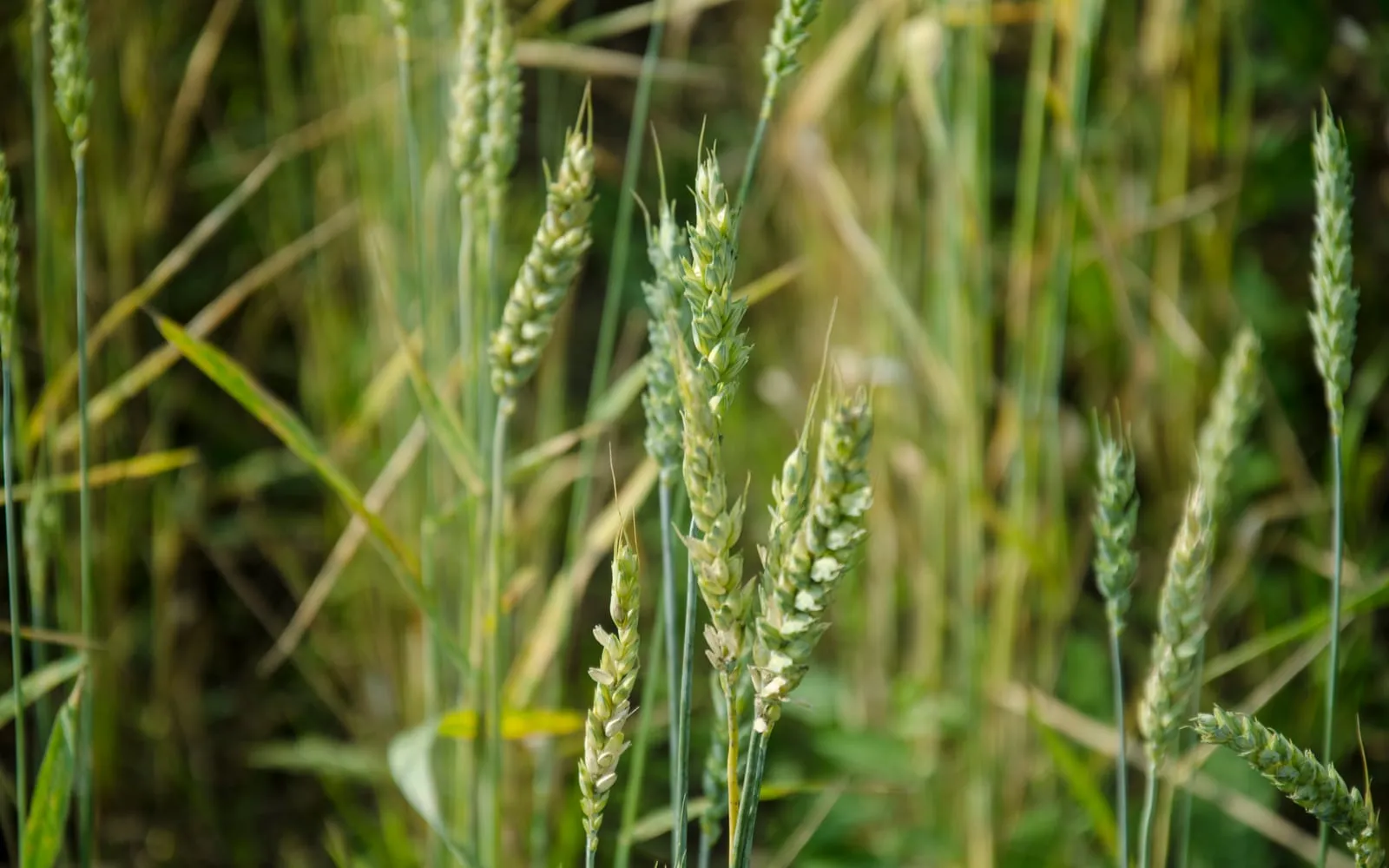
Rye stands taller than any other cereal in a temperate field, often reaching well over 1.5 m, with slender stems and a distinctly blue-grey cast to the foliage. Seedlings frequently show purple pigment in the leaves through cold weather.
The ear is long, narrow and flattened, with the spikelets in two ranks and awns that are rough to a downward-stroking finger. Each spikelet carries two grains. As the grain fills the ear nods over, though less dramatically than barley’s.
The grain is long, greenish-grey to brown, and more slender than wheat, with a deep crease. Rye is the only common cereal that is wind-pollinated and self-incompatible, so a crop flowers in a visible cloud of pollen and no plant sets seed with its own.
Where it is from
Rye’s wild relatives grow in eastern Turkey, Armenia and the Caucasus, and the domestication story follows the pattern oats did. Wild rye travelled north with wheat and barley as a weed of those fields, doing progressively better as the climate got colder and the soil got poorer, until farmers gave up weeding it and started sowing it.
That switch happened in Europe in the Bronze and Iron Ages. Rye becomes common in central and northern European archaeology from around 1000 BC and dominant in the medieval period across the North European Plain, Scandinavia and Russia.
Britain grew rye widely on light sandy soils, particularly in the Breckland of Norfolk and Suffolk, and much less as fertiliser and drainage made those soils capable of carrying wheat. It remains a common cover crop and a small speciality grain crop.
How it grows
Autumn-sown rye germinates fast, even in cold soil, and grows away when other cereals have stopped. That autumn vigour is what makes it a good green manure, since a September sowing produces a dense mat of growth before the winter.
Over the winter it stays green and continues rooting. Spring growth is early and rapid, and the crop is often at knee height before wheat has properly started. Stem extension carries it well above head height in a good year.
Flowering is where rye differs from every other cereal here. The anthers hang out of the open flower and shed pollen to the wind, and the plant cannot fertilise itself, so a lone plant sets almost no seed. Grain fill takes six weeks, and the crop is ready in late July or August.
Through the seasons
Sow in September or early October for either purpose. As a green manure, scatter seed thickly on cleared ground and rake it in. As a grain crop, sow more thinly and give the plants room.
The crop covers the ground through the autumn, sits green through the winter, and starts extending in March. It flowers in late May or June, in a visible haze of pollen on a still afternoon.
For grain, harvest in late July or August and do not wait, since rye grain has little dormancy and starts to sprout in the ear after rain on a ripe crop. For green manure, cut it down and dig it in during March or April, before it gets tall enough to be difficult.
Care difficulty
Rye is the easiest cereal to grow badly and get away with. It germinates in cold soil, tolerates acidity to pH 5 and below, produces on sand, and asks for nothing. Sow it and forget it.
Two things need thought. Its height makes lodging likely on any soil with fertility in it, so grow the grain crop hungry. And ergot needs a real inspection at harvest, because rye’s open flowering makes it the most exposed crop there is.
As a green manure the difficulty is at the other end. A rye cover left until May is a metre and a half of tough fibrous growth that is hard to dig in and slow to break down, and it releases compounds that suppress germination of small seeds for several weeks. Cut it early, and wait a month between digging it in and sowing carrots or lettuce.
Watering
Rye needs no watering in a temperate climate at any stage. Its root system is the deepest of the cereals, reaching two metres in light soil, and one classic study measured several hundred kilometres of root and root hair on a single plant.
Water a garden sowing once if the ground is bone dry in September, purely to get even emergence. Nothing after that.
Wet ground is tolerated better than by wheat or barley, though rye still prefers free drainage. Its natural home is light sandy soil that dries out, which is exactly the ground its rooting suits it to.
Warning signs, diseases and pests
Look along a ripening ear for a hard, purple-black, slightly curved body 1 to 2 cm long standing where a grain should be. That is ergot, and it is unmistakable once seen. Pull those ears, burn them, and do not mill grain from a crop where several turned up.
Brown rust is the common leaf disease, appearing as small orange-brown pustules scattered across the leaf that rub off on a finger. Rye tolerates a fair amount of it before yield suffers.
Sprouting in the ear shows as short white roots emerging from the grain in a standing crop after rain. Rye has the least grain dormancy of the cereals, so it happens quickly and cannot be undone.
Aphids bring barley yellow dwarf virus into autumn sowings, and the following spring shows stunted plants with yellow-red leaf tips in scattered patches. Slugs take sown seed in a wet autumn, and pigeons will graze a small patch flat.
Growing environment
Full sun and an open site. Rye is untroubled by exposure, and its main weakness in a sheltered fertile spot is that it grows too well and falls over.
Soil is where the crop earns its keep. Rye produces on poor, dry, sandy and acid ground down to about pH 4.5, which is well below where barley gives up and below where wheat is worth sowing. Give it the worst corner of the plot and it will still perform.
Cold is not a constraint anywhere a cereal is grown. Rye survives to around minus 30 deg C under snow, which is why the crop belt runs across Russia and why Scandinavian farming depended on it.
Feeding
Feed rye nothing. A tall plant on fed ground goes over in the first summer storm, and the extra nitrogen buys height rather than grain.
As a green manure the question does not arise, since the whole purpose is to capture nitrogen that would otherwise leach away over the winter and give it back when the crop is dug in.
If the plot is worn out and you want a grain crop, a light dressing of a balanced granular feed in March is defensible. On anything that grew a manured crop in the last two years, apply nothing at all.
Troubleshooting
Is rye the same as ryegrass? No, and the names cause endless confusion. Cereal rye is Secale cereale, an annual grain crop. Ryegrass is Lolium, a pasture and lawn grass. A packet labelled grazing rye is the cereal; one labelled Italian ryegrass is not.
Why is rye bread always sourdough? Rye flour has gluten proteins but forms almost no elastic gluten network, and its pentosans make the dough sticky. Acid from a sourdough culture restrains the enzymes that would otherwise break the starch down, and it is what gives a rye loaf structure.
What is the black thing sticking out of my rye ear? Ergot, and rye gets it more than any other cereal because its flowers stand open to the wind. Pull the ear, burn it, and do not eat grain from a crop where you found several.
When should I dig in a rye green manure? March or early April, when it is knee height at most. Left later it becomes tough and fibrous and hard to incorporate, and it releases compounds that suppress small seeds. Wait about a month after digging in before sowing carrots, lettuce or anything else fine.
Can I let my green manure rye go to grain? Yes, though grazing rye varieties are selected for forage rather than for grain quality, so the crop will be very tall and the yield modest.
Will one plant set seed? Barely. Rye is self-incompatible and wind pollinated, so it needs a stand of plants flowering together. A single plant in a border will produce almost nothing.
How hardy is it? Hardier than any other cereal. It survives to around minus 30 deg C with snow cover, and a temperate winter presents it with no difficulty at all.
Rye problem guides
Not sure what is wrong? See the common vegetable pests guide.