
Edible
Rice
Oryza sativa
Also known as Asian rice, Paddy rice, Padi
How to grow rice, Oryza sativa. Why the fields are flooded when the plant does not need it, the difference between indica and japonica, and the arsenic question.
At a glance
- Difficulty
- Moderate
- Water
- Kept flooded from transplanting until three weeks before harvest
- Light
- Full sun
- Temperature
- 25-30 deg C, with nothing below 15 at any stage
- Humidity
- High, and standing water at the root through most of the season
- Hardiness
- USDA 9-11, RHS H2, hardy to 10 C
- Type
- Annual grass, treated as an annual everywhere it is grown
- Height
- 60-150 cm depending on type
- Native to
- the Yangtze valley, the eastern Himalaya
It needs four to six months above 20 C and stops growing below about 15 C, so the season length rather than the flooding is what limits it. Standing water is a weed control method rather than a requirement, and upland rice is grown rain-fed without a paddy across much of Africa and south-east Asia. Cold water at the panicle initiation stage causes sterility, which is why cool nights matter more than cool days.
Hardiness zones describe winter cold alone. Summer heat, humidity, rainfall and the length of the growing season decide as much, so treat the range as the outer limit rather than as a recommendation.
Edible, with limits
- Safe to eat
- The grain, milled or whole
- Do not eat
- None in the plant itself
- Harm from
- Eating it
- Affects
- People
Rice is not toxic and contains no gluten, which makes it the staple grain for people with coeliac disease. Two food safety points matter anyway. Rice takes up inorganic arsenic from soil and water more readily than other cereals, because flooded paddy conditions make arsenic available to the roots, and the Food Standards Agency advises that children under five should not be given rice drinks as a milk substitute for that reason. Brown rice carries more than white, since the arsenic concentrates in the bran. Cooking rice in plenty of water and draining it removes a substantial part. The second point concerns cooked rice left warm. Bacillus cereus spores survive cooking, germinate in rice held at room temperature, and produce a toxin that reheating does not destroy, which causes vomiting a few hours later. Cool cooked rice quickly, refrigerate it within an hour, and eat it within a day.
Sources: Food Standards Agency on arsenic in rice, NHS on food poisoning
About
Rice feeds more people than any other crop, supplying a substantial share of the calories eaten by more than three billion of them. Around 90 per cent is grown and eaten in Asia, and about 165 million hectares are under it worldwide.
The flooding is the part most people get wrong. Rice does not need standing water to grow, and upland rice is cultivated without it across west Africa and south east Asia. Farmers flood paddy fields because water controls weeds, suppresses many soil pests, buffers temperature and releases nutrients from the soil. The plant tolerates the flood rather than requiring it, and it does so through aerenchyma, air channels running down the stem that pipe oxygen from the leaves to roots sitting in airless mud.
Two subspecies split the crop. Indica rices are long-grained, cook dry and separate, and dominate in south Asia and the tropics. Japonica rices are short or medium grained, cook sticky, and dominate in Japan, Korea, northern China and the Mediterranean. Sushi rice, risotto rice and paella rice are all japonica.
Appearance and character
Rice is a tufted grass with long narrow leaves and a distinctly rough feel to the leaf margin, which will cut a careless hand. It tillers heavily from the base, and a single transplanted seedling produces twenty or more stems.
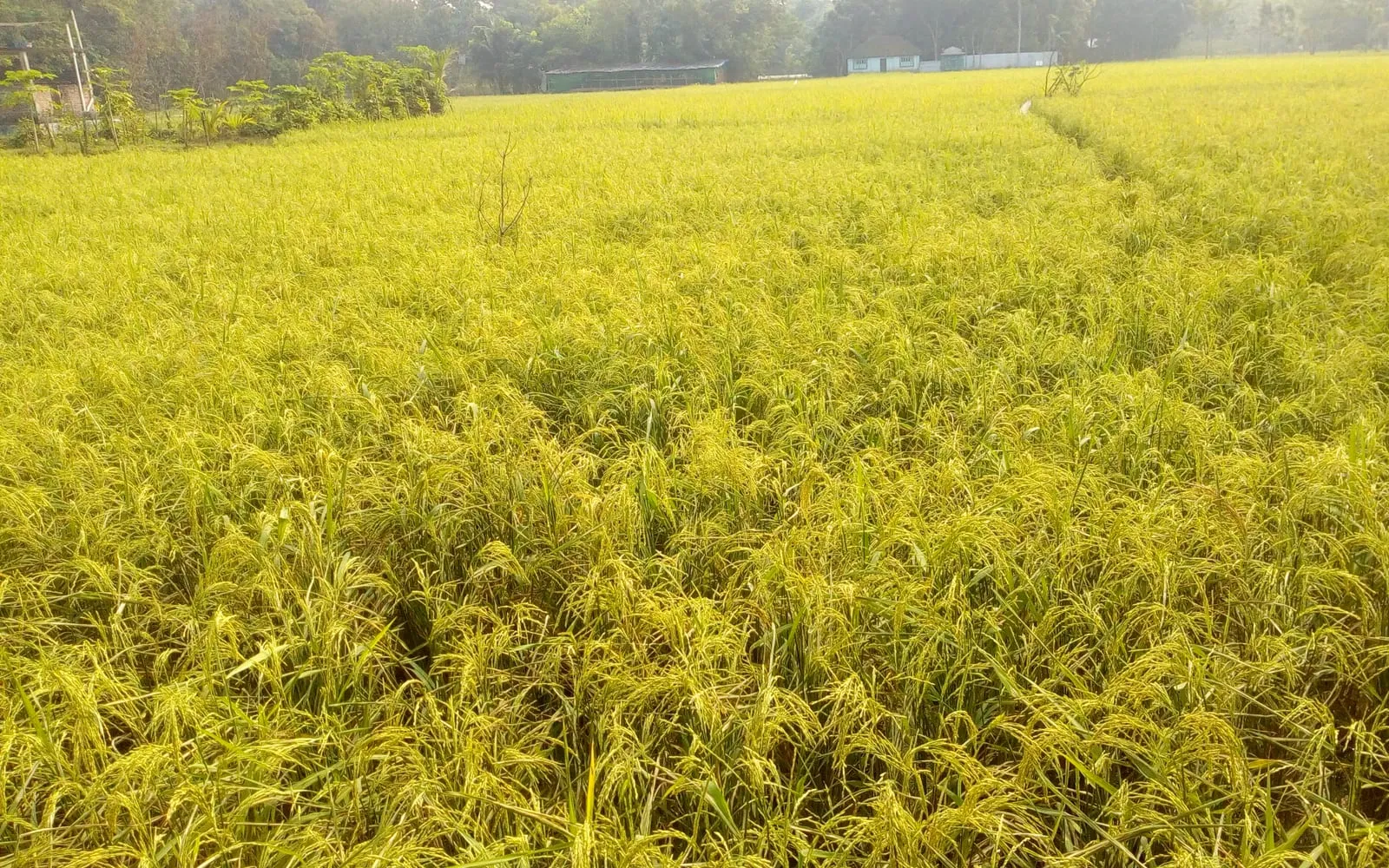
The head is a panicle, branched and arching, with the grains hanging along the branches rather than sitting on a spike. As the grain fills the whole panicle bends over into a curve, which is the shape on every rice advertisement ever printed.
Each grain sits inside a tough hull, and removing that hull gives brown rice. Milling further removes the bran and germ and gives white rice. The hull is siliceous and abrasive, which is why rice needs a dedicated huller and why rice husk is used as an industrial abrasive.
Where it is from
Asian rice was domesticated in the Yangtze valley of southern China. Archaeology at sites such as Shangshan and Kuahuqiao places rice cultivation there from around 8000 BC, with fully domesticated forms by about 6000 BC, from the wild species Oryza rufipogon.
The two subspecies diverged early and then exchanged genes repeatedly. Japonica appears to be the original domestication, and indica arose when domestication genes from japonica crossed into local wild populations in south Asia. That mixed ancestry is why the two behave so differently in a kitchen and so similarly in a field.
From China rice spread across south east Asia and into India, west into Persia and the Mediterranean by the Islamic agricultural expansion, and to the Americas in the colonial period. Spain and Italy have grown it since the medieval period, and the Po valley remains Europe’s main rice region.
How it grows
Rice is usually raised in a seedbed and transplanted into a puddled field at three to five weeks old, which gives it a head start on weeds. Direct seeding into flooded or dry ground is also common and now dominates in mechanised systems.
After transplanting the crop tillers for several weeks, then moves into reproductive growth as the panicle forms inside the stem. Panicle initiation is the point at which the yield is largely decided, and it is the stage most sensitive to cold and to nitrogen shortage.
The panicle emerges, flowers within days, and fills over four to five weeks. Rice pollinates itself. The field is drained two or three weeks before harvest so that the ground firms up and the grain dries evenly.
Through the seasons
Outside the subtropics rice is a curiosity rather than a crop, and it needs a greenhouse or a conservatory. Sow indoors in April in warmth, prick out into a container with no drainage hole, and keep 5 cm of water over the compost from May.
The plant grows through the summer under glass, tillering steadily. Keep the temperature above 20 deg C and the water topped up. A panicle appears in August in a good year.
Harvest in October if the grain has hardened. In a poor summer it will not, and the plant is worth growing for the look of it rather than for the two tablespoons of rice you might get. Outdoors in the ground it will not crop here at all.
Care difficulty
As a field crop in the tropics, rice is demanding of water management and labour and undemanding of everything else. As a container plant in a cool climate it is demanding of heat and easy in every other respect.
Warmth is the whole difficulty. Rice stops growing below 15 deg C and is damaged by cold water at the roots, so an unheated greenhouse in a cool summer gives a plant that survives and never flowers. A conservatory or a heated greenhouse changes the answer.
The water is straightforward once the container is right. Use a pot or tub with no drainage, fill it with heavy loam-based compost rather than a peat-free multipurpose that will float, and keep a few centimetres of water standing on top all season.
Watering
Keep the water standing. From the point the seedlings are established until three weeks before harvest, rice in a container wants 5 to 10 cm of water over the soil surface at all times.
Use rainwater if you have it. Tap water is fine unless it is very hard, which will leave deposits and gradually raise the pH of the compost.
Drain the container about three weeks before you expect to harvest. The plant finishes ripening on stored moisture, the grain dries more evenly, and the whole thing becomes easier to handle.
Warning signs, diseases and pests
Rice blast is the most damaging disease of the crop worldwide, caused by a fungus that produces grey-centred diamond-shaped lesions on the leaves and can rot the neck of the panicle so the head dies while still green. It needs humidity and moderate temperatures, and a crowded greenhouse supplies both.
Sheath blight shows as irregular greenish-grey lesions with brown margins on the leaf sheaths at the waterline, spreading upward in dense stands. Thin the planting and improve airflow.
A patch of plants collapsing into scorched brown within days, with dense clusters of small brown insects at the base of the stems near the waterline, is brown planthopper, the most destructive insect pest of rice across Asia. It is not a risk for rice grown outside that region, but it is worth recognising given how much damage it does where the crop is grown commercially.
Algae will colonise standing water in a greenhouse within weeks, and duckweed arrives from anywhere. Neither harms an established plant, though a thick mat over the surface makes it hard to see the water level.
Birds strip a ripening panicle faster than any other stage of the crop is lost anywhere. If a container is standing outside in September, net it.
Fall armyworm feeds hidden in the whorl of young plants and can kill a seedling outright. It has spread across Africa since 2016, Asia since 2018 and Australia since 2020 and is now a major threat to rice across much of that range, though it has not established in Europe or New Zealand.
Growing environment
Full sun, high humidity and sustained warmth. Rice wants 25 to 30 deg C and declines below 20, and cold nights during panicle formation cause sterile florets that never fill.
Soil should be a heavy loam that holds water and does not float. Paddy soils are clays with a compacted layer beneath that stops water draining away, and a container with no drainage hole reproduces that arrangement well enough.
The pH range is wide, from about 5 to 7.5, and flooding pushes soil pH toward neutral on its own. Waterlogged soil goes anaerobic and smells of sulphur, which is normal for a paddy and would be a disaster for anything else you grow.
Feeding
Rice is a hungry crop for nitrogen, and commercial growers split the dose across the season. A container crop wants a balanced liquid feed every fortnight from the point growth takes off until the panicle emerges.
Stop feeding once the grain starts to fill. Late nitrogen produces soft growth and taller stems that fall over, and in a field it delays ripening.
Rice paddies have a nitrogen advantage no other cereal has, because cyanobacteria and the water fern Azolla fix nitrogen in the standing water. Asian rice systems have used Azolla deliberately for centuries, and it will appear on a container’s water surface unprompted if you keep any nearby.
Troubleshooting
Will rice crop where I am? It needs four to six months above 20 deg C, which USDA zone 9 and warmer supplies. Below that it is a greenhouse exercise rather than a crop, since a cool summer will not fill a panicle.
Why are rice fields flooded? For weed control, pest suppression, temperature buffering and nutrient release, rather than because the plant needs it. Rice tolerates flooding through air channels in its stems that carry oxygen to the roots. Upland rice is grown without standing water.
What is the difference between brown and white rice? Milling. Brown rice has had only the hull removed. White rice has had the bran and germ abraded away too, which removes fibre, oil and much of the vitamin content, and greatly extends storage life because the oil in the bran is what goes rancid.
Is arsenic in rice a real concern? It is a real and regulated one. Rice takes up inorganic arsenic more readily than other cereals because flooding makes it available, and the Food Standards Agency advises against rice drinks for children under five. Cooking rice in plenty of water and draining it removes a useful proportion.
Why should I not reheat rice? Bacillus cereus spores survive cooking and germinate in rice left standing warm, producing a toxin that reheating does not destroy. Cool cooked rice fast, refrigerate within an hour, and use it within a day.
Which rice is sticky and which is not? Japonica rices are short or medium grained and cook sticky, and they cover sushi, risotto and paella. Indica rices are long grained and cook dry and separate, and they cover basmati and most long-grain rice.
Can I sow rice from a packet in the supermarket? Only if it is whole brown rice, and even then most of it has been dried or heat treated and will not germinate. Buy seed rice or paddy rice with the hull still on.
What is wild rice? A different genus entirely, Zizania, native to North America and harvested from shallow lakes. It is not a form of Oryza sativa.
Rice problem guides
Not sure what is wrong? See the common vegetable pests guide.
- Rice blast, the most damaging disease of the crop worldwide
- Brown planthopper, the most destructive insect pest of rice across Asia
- Aphids under glass on a container crop
- Algae and duckweed colonising the standing water
- Red spider mite if the crop is grown under glass and allowed to dry
- Fall armyworm, established across Africa, Asia and Australia since 2016