
Pest
Desert locust
Schistocerca gregaria
Also called Locust
A grasshopper that spends most of its life alone and harmless, until crowding triggers a change in colour, behaviour and biology that turns it into a swarming, migratory pest able to strip a field bare within hours. The most destructive migratory pest on earth, threatening the livelihoods of tens of millions of people across Africa, the Middle East and South Asia.
At a glance
- Type
- Pest
- Cause
- Insect
- Severity
- Destroys the crop or display
- Affects
- Herbs and edibles, Garden plants
- Active
- All year
- Established in
- Africa and Asia
What you are seeing
- Vegetation and crops stripped down to bare stems within hours of a swarm arriving, across an area that can run to hundreds of square kilometres
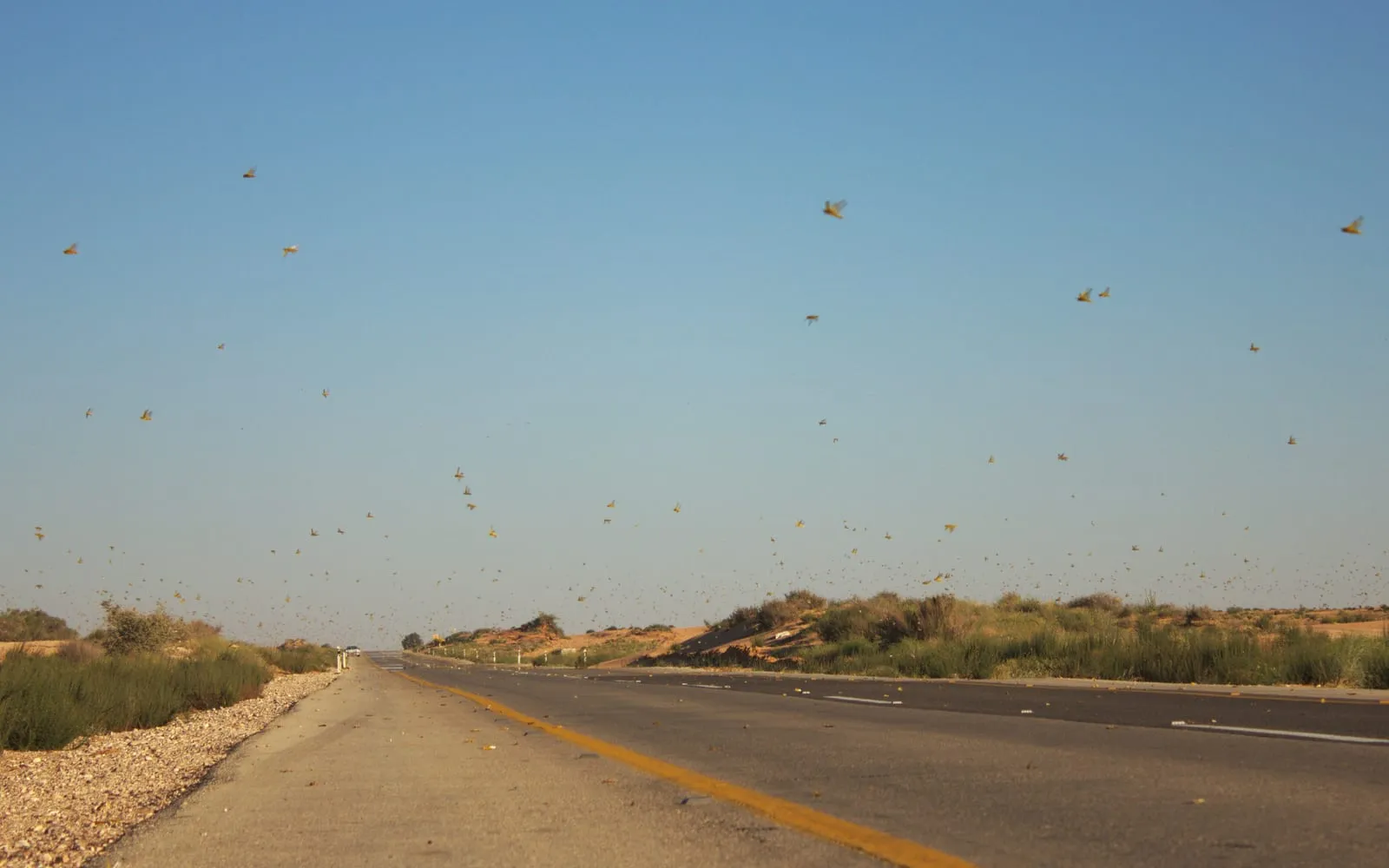
- Dense, low, moving clouds of flying locusts, sometimes visible from a considerable distance and audible as a mass
- Solitary-phase locusts, pale brown and well camouflaged, present in low numbers in normal seasons and easily overlooked
- Gregarious-phase adults, yellow with black markings once mature, and pink to grey-brown hopper nymphs in dense marching bands ahead of a developing swarm
- Bands of wingless hopper nymphs moving and feeding together on the ground before adults take flight, often the first visible sign of a developing outbreak
- Crop loss that can reach total, since a swarm eats through practically any green vegetation in its path rather than favouring particular plants
What you are looking at
Vegetation and crops stripped down to bare stems across an area that can run to hundreds of square kilometres, following the arrival of a dense, low, moving cloud of flying insects, sometimes visible from a considerable distance and audible as a mass before it is seen. A single adult eats roughly its own weight in a day, and a swarm can hold tens of millions of individuals per square kilometre, so the scale of loss bears little resemblance to ordinary grasshopper damage.
What crowding does to this insect is what makes it exceptional. For most of the time it lives as a solitary insect, pale brown, well camouflaged and easily overlooked, doing no more damage than any other grasshopper. When conditions concentrate enough individuals together, typically after rain breaks a drought and vegetation flushes across a breeding area, a genuine change in colour, behaviour and biology follows. Nymphs turn pink to grey-brown and march together in dense bands across the ground before they can fly, and adults mature into a yellow-and-black gregarious form that forms and travels in swarms. The marching hopper bands are usually the first visible sign a local outbreak is developing, well before any swarm takes to the air.
The most destructive migratory pest on earth
At its full extent the invasion area covers around 29 million square kilometres across North and West Africa, the Arabian Peninsula, the Middle East and south-west Asia as far as the Indian subcontinent, and during a major upsurge the areas affected can reach a fifth of the world’s land surface and threaten the livelihoods of more than 60 of the world’s poorest countries. Southern Europe, including the Iberian Peninsula, the Canary Islands and Madeira, sits at the extreme margin of the historical range and has recorded rare incursions, though it is not part of the area affected in a typical year, and the pest has never established in the Americas, Australia, New Zealand or the wider Pacific.
Because outbreaks develop from remote breeding areas that can span several countries at once, the Food and Agriculture Organization has run a continuous early warning system, the Desert Locust Information Service, since 1978, tracking breeding conditions worldwide and issuing forecasts up to six weeks ahead. That lead time, combined with organised survey and control operations reaching a hopper band before it can fly, is what has kept most seasons from developing into a full plague.
What to do about it
Report a hopper band or a swarm to the national locust control unit or FAO immediately, since early detection is what lets a developing outbreak be controlled while it is still localised.
Cooperate with organised survey and control operations in an affected area, since effective control happens at a regional and national scale rather than field by field.
On a small local outbreak, trenches or physical barriers can trap and allow the destruction of a still-flightless hopper band, though this does not scale to a widespread plague.
Support fungal biopesticide campaigns run by national and regional locust control organisations as the preferred response once a swarm has formed. Coordinated chemical spraying by trained control units remains a last resort reserved for a plague at a scale biopesticide alone cannot contain, and it stays a decision for those organisations rather than something an individual grower undertakes.
What to do, in order
Start here
Prevention, and the changes that stop the problem returning. Most of these pages should end at this tier.
- Report hopper bands or swarms to the national locust control unit or FAO immediately
- Every affected country maintains a national locust control organisation that reports into the Food and Agriculture Organization's Desert Locust Information Service, which has run a continuous early warning system since 1978, tracking breeding conditions and issuing forecasts up to six weeks ahead. Reporting a sighting promptly, rather than waiting to see whether it develops further, is what lets control teams reach a hopper band while it is still small and localised rather than after it has become a flying swarm.
- Support and cooperate with organised survey and control operations
- Because this pest breeds and moves across enormous, often remote areas spanning many countries, effective control happens at the level of coordinated regional and national campaigns rather than individual fields, and cooperating with survey teams and control operations already under way is the most effective thing an individual grower can do once an outbreak is under way.
Then reach for a barrier
Netting, hand removal and water. Nothing here harms anything except the target.
- Dig trenches or use physical barriers against marching hopper bands
- Before hopper nymphs develop wings, they move across the ground in dense marching bands rather than flying, and trenches or barriers that trap and allow the destruction of a band in one place remain a locally useful tactic in a small-scale outbreak, though it does not scale to a widespread plague.
Then bring in the predators
Encourage what already lives in the garden, and buy predators in where the problem is under glass and nothing will arrive on its own.
- Support use of biopesticides based on Metarhizium acridum where deployed by control programmes
- This fungal biopesticide, developed specifically for locusts and grasshoppers, kills the target insects without the broader environmental and human health impact of the chemical insecticides historically used at scale against this pest, and is an increasing part of coordinated control campaigns.Used at scale by national and regional locust control organisations rather than something bought or applied by an individual grower; it has protected the food security of millions of people in several African campaigns.
Biological controls are live organisms and their sale and release are regulated country by country. An agent sold freely in one place may be unapproved in another, so buy from a licensed supplier where you live and never import or move one yourself.
Plants affected
Guides that name it among the problems to watch for. The list is the plants it is characteristic of rather than everything it will feed on.