
Edible
Einkorn
Triticum monococcum
Also known as Small spelt, Farro piccolo, One-grained wheat
How to grow einkorn, Triticum monococcum. The oldest wheat, one grain to a spikelet, and the crop found in the stomach of a five-thousand-year-old man.
At a glance
- Difficulty
- Moderate
- Water
- Rain-fed, and drought tolerant beyond any other wheat
- Light
- Full sun
- Temperature
- Very hardy, and content on cold exposed sites
- Hardiness
- USDA 4-8, RHS H6, hardy to -25 C
- Type
- Hardy annual grass, autumn or spring sown
- Height
- 70-110 cm
- Native to
- south-eastern Turkey
- Best month
- October and August in the Northern Hemisphere, April and February in the Southern Hemisphere
The driest-adapted and the most primitive of the wheats, with a single grain per spikelet, which is what the name records. It grows on the poorest and driest ground of any wheat and yields accordingly. It is hulled, so it needs dehulling, and its gluten behaves differently enough that it makes a dense loaf rather than an airy one.
Hardiness zones describe winter cold alone. Summer heat, humidity, rainfall and the length of the growing season decide as much, so treat the range as the outer limit rather than as a recommendation.
Every month named in this guide is for the temperate Northern Hemisphere. If you garden in the Southern Hemisphere, shift each one by six months, so October becomes April. Closer to the equator the wet and dry seasons matter more than the calendar, and the shift stops being a useful guide.
Edible, with limits
- Safe to eat
- The grain, once dehulled
- Do not eat
- Ergot bodies in the ear
- Harm from
- Eating it
- Affects
- People
Einkorn is a wheat and contains gluten, so it is covered by the cereals containing gluten heading in the 14 named allergens and is unsafe for anyone with coeliac disease. It is the grain most often put forward as the exception, on the grounds that its diploid genome lacks the D genome that carries some of the most immunogenic gluten sequences. Einkorn does still carry sequences that provoke the coeliac response, feeding studies have found reactivity, and Coeliac UK advises against it along with every other wheat. Ergot applies as it does across the cereals. Anyone testing their own tolerance should do it with a clinician rather than with a loaf.
Sources: Coeliac UK on the gluten-free diet, Food Standards Agency on the 14 named allergens
About
Einkorn is the oldest of the wheats and the simplest. Its name in German means one grain, and that is the description: each spikelet along the ear holds a single grain rather than the two or three its relatives carry. It is diploid, with one set of seven chromosome pairs where bread wheat has three, which makes it the closest thing in a modern field to what a wild wheat looks like.
It was among the first plants farmed anywhere. Domesticated einkorn appears in the Karacadag hills of south-eastern Turkey around 8500 BC, and wild einkorn still grows on those slopes. Otzi, the man who died in an Alpine pass around 3300 BC and froze into a glacier, had einkorn in his stomach and einkorn chaff in his clothing.
As a crop it is a poor performer by any modern measure. It yields a fraction of what bread wheat does, keeps its grain in a hull that has to be removed mechanically, and makes flour that will not rise properly. It survives because it grows where nothing else will and because the grain is good to eat.
Appearance and character
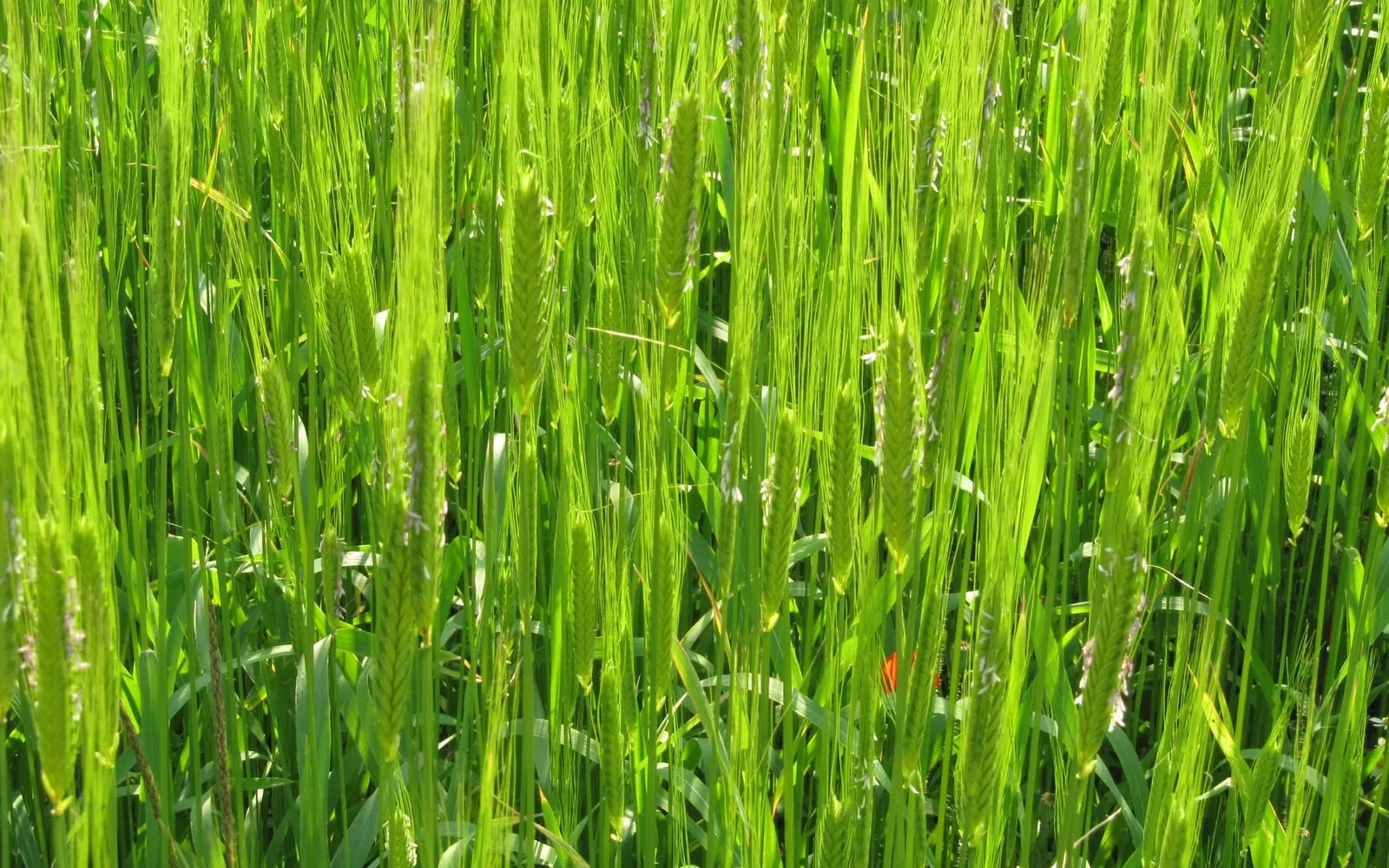
The ear is narrow, flattened and strongly two-ranked, with the spikelets overlapping in a single plane so the whole head looks like a slim comb. Awns splay outward rather than standing parallel, which gives a ripe field a soft untidy appearance. Compared with an emmer ear it is noticeably smaller and thinner.
Each spikelet contains one plump grain, occasionally two in the middle of the ear. The grain is small, flattened from the sides and pointed at both ends, with a deep golden colour and an unusually large germ for its size. That large germ is where the flavour and much of the nutrition sits.
The plant is slender all through. Fine leaves, thin stems, a modest tuft at the base. Growing beside a modern wheat it looks like something half wild, which is close to the truth.
Where it is from
Wild einkorn, Triticum boeoticum, grows on stony hillsides across Turkey, Iran, Iraq and the Balkans. Genetic work in the 1990s traced domesticated einkorn to a specific cluster of wild populations in the Karacadag mountains of south-eastern Turkey, which is about as precise a birthplace as any crop can claim.
From there it spread west with agriculture, reaching the Balkans, central Europe and eventually Britain. It was one of the eight founder crops, alongside emmer, barley, lentil, pea, chickpea, bitter vetch and flax, and every one of those is covered somewhere in this collection.
Einkorn began retreating as soon as emmer and free-threshing wheats offered higher yields, and by the Roman period it was a marginal crop. It held on in mountain agriculture in Turkey, the Balkans, southern France and Italy, and a handful of European farmers still grow it commercially.
How it grows
Einkorn behaves like a small, tough, unhurried winter cereal. It germinates readily, tillers freely, and sits through the winter without damage on sites that would injure a modern crop.
Spring growth is slower than a modern wheat’s and the plant stays shorter. The ear emerges in early summer, self-pollinates almost immediately, and fills over about six weeks. The crop then ripens to pale straw, ears still upright.
Threshing breaks the ear into spikelets rather than freeing the grain, so sowing is done with whole spikelets and the harvest arrives in the same form. Because each spikelet holds only one grain, the arithmetic is simpler than with emmer or spelt: one unit sown, one plant.
Through the seasons
Sow in October into cleared ground, or in March for a smaller crop. Einkorn establishes on rough seedbeds and does not need the ground worked fine.
It stays low and unremarkable through the winter, greening up in March and extending gently through April and May. The ear appears in late May or June and the crop is in full flower shortly after.
Harvest in August when the ears have gone pale and a grain resists a thumbnail. Cut, dry under cover for a fortnight, then dehull. As with emmer and spelt, this last step takes longer than everything before it.
Care difficulty
Nothing about growing einkorn is demanding. It is the most stress-tolerant wheat there is, handling drought, cold, thin soil and neglect better than any of its relatives, and it carries strong resistance to the rusts. Sow it and leave it.
What it asks in return is patience at the end. The hull is tight, the grains are small, and a square metre yields perhaps 150 grams of clean grain after processing. Anyone growing it for flour should plan the area accordingly and expect a slow afternoon at the winnowing.
Rich ground is the one way to fail with it. Einkorn on a fed bed grows soft and tall and lodges, producing a flattened crop that is hard to cut and slow to dry.
Watering
Einkorn is the driest-adapted of the wheats and needs no watering in a temperate climate at any point in its life. Its root system is fine and extensive, and it holds on through droughts that stall a modern crop.
If a garden patch is sown in a dry autumn, water it once to get germination started and then stop. After that the plant will find what it needs, including during grain fill.
Waterlogging is the failure mode to design against. Einkorn on a wet plot yellows and thins over the winter. Put it on the driest ground you have, which is convenient, since it will grow there and most vegetables will not.
Warning signs, diseases and pests
Einkorn’s rust resistance is one of the reasons wheat breeders still work with it. A patch will frequently stand clean beside a bread wheat crop carrying yellow rust, and the resistance genes have been transferred into modern varieties more than once.
Powdery mildew is the disease most likely to show, as a white dusty growth on the lower leaves in a still humid spring. It rarely amounts to much on a plant this open and this small.
Lodging is the practical problem. The stems are fine and a fed or sheltered crop will lie down. A flattened stand ripens unevenly and holds moisture, which invites sprouting in the ear if the weather turns.
Ergot appears occasionally, as a hard dark body where a grain should be. Pull those ears and burn them. Birds are the main pest on a garden scale, and a few square metres of ripe einkorn is worth netting from the moment the ears show colour.
Growing environment
Full sun and an exposed site suit einkorn better than shelter does, since shelter encourages the soft growth that ends in lodging. This is a crop for the windy corner of a plot.
The soil should be poor. Einkorn was farmed for millennia on stony mountain ground, and thin, dry, low-fertility soil produces the sturdiest crop. It tolerates acidity down to about pH 5.5 and alkalinity to 8.
Cold is irrelevant to it. Autumn-sown einkorn survives hard winters unprotected, and mountain agriculture in Turkey and the Balkans relied on that. Heat at ripening suits it, and a hot dry August produces the cleanest sample.
Feeding
Do not feed einkorn. The plant does not convert extra nitrogen into extra grain, and what it does with it instead is grow taller and softer until it falls over.
On exhausted ground a single light dressing of a balanced feed in early spring is defensible. On anything that has grown a manured crop within two years, apply nothing at all.
Einkorn is a useful crop for the poor end of a rotation for this reason. Put it where the fertility has run out and the potatoes did badly, and it will produce where the alternative is a bare patch.
Troubleshooting
Is einkorn gluten-free? No. It contains gluten and is unsafe for anyone with coeliac disease. It lacks the D genome that carries some of the most reactive sequences, which is where the claim comes from, but it still carries sequences that provoke the coeliac response.
Why is it so expensive? Low yield and hulled grain. An einkorn crop produces a fraction of what bread wheat does per hectare, and the dehulling adds a processing step that most cereal plants are not built for.
Can I make bread with it? You can make a loaf, and it will be dense and flat. Einkorn gluten is weak and its dough is sticky and slack, so it suits flatbreads, pancakes and enriched doughs better than a tall sandwich loaf. Use less water than a bread wheat recipe calls for.
What is farro piccolo? Einkorn, the smallest of the three Italian hulled wheats. Farro medio is emmer and farro grande is spelt.
How much will a small patch yield? Around 150 grams of cleaned grain per square metre, and less if birds find it. Four square metres is a demonstration rather than a food supply.
Was einkorn found on the Iceman? Yes. Einkorn grains were in Otzi’s digestive tract and einkorn chaff in his clothing and equipment, which puts the crop in the Alps around 3300 BC.
Why do the awns stick out sideways? Einkorn spikelets sit in two ranks and the awns splay from them rather than running parallel, which is a reliable field mark against emmer, whose awns stand in a tight bundle.
Einkorn problem guides
Not sure what is wrong? See the common vegetable pests guide.