
Disease
Barley yellow dwarf
Barley yellow dwarf virus
Also called BYDV, Barley yellow dwarf virus, Red leaf of oats, Yellow dwarf
Circular patches of stunted cereal, yellow in barley and wheat, red in oats. Aphids brought it in the autumn, and the sowing date decides how much of it you get.
At a glance
- Type
- Disease
- Cause
- Virus
- Severity
- Destroys the crop or display
- Affects
- Garden plants, Herbs and edibles
- Active
- October to June
- Established in
- Europe, North America, Central and South America, Africa, Asia, Australia and New Zealand
What you are seeing
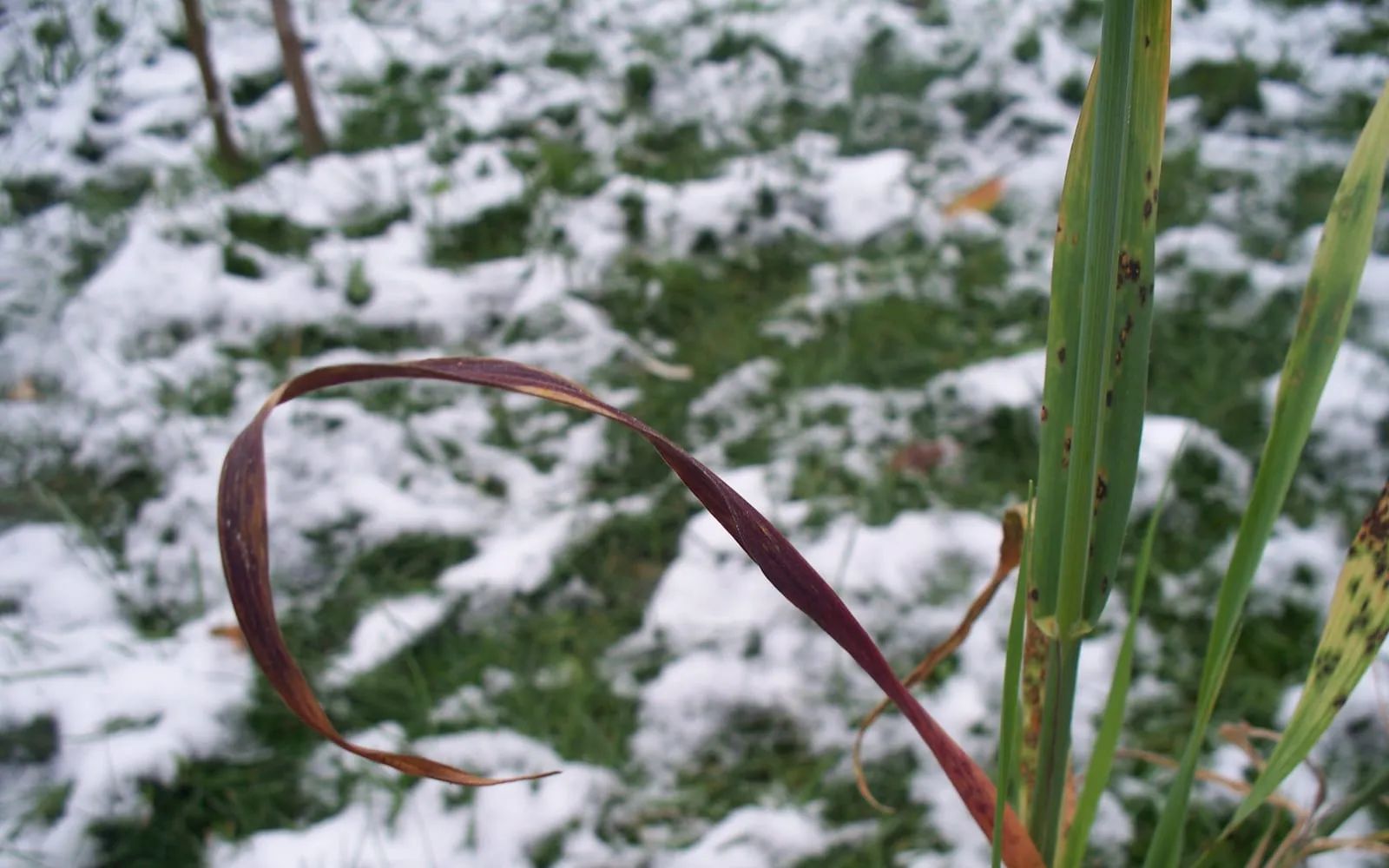
- Roughly circular patches of stunted crop, brightest at the centre and fading outward
- Leaf tips and margins turning bright yellow in barley and wheat, working down from the tip
- Leaves of oats turning red, purple or bronze rather than yellow
- Plants noticeably shorter than the crop around them, with stiff upright leaves
- Heads small, poorly filled or absent, and tillering reduced
- Older leaves affected first while the newest leaf stays greener
- Patches appearing in early spring in a crop that looked well in autumn
- Worst along headlands, next to grassy margins and in early-sown fields
Before you treat anything
Grain from an infected crop is safe. The loss is yield and grain size rather than anything that affects the food.
What you are looking at
Roughly circular patches in a cereal crop where the plants are shorter than everything around them and a different colour. The patch is most intense at the centre and fades outward into healthy crop, so the edges are gradual rather than sharp.
In barley and wheat the colour is a bright, almost golden yellow, starting at the leaf tip and along the margins and working down. In oats it is red, purple or bronze instead, which is why the disease was called red leaf in oats for years before anyone connected the two.
The oldest leaves go first and the newest leaf stays greener. The plants are stiff and upright, tiller poorly, and carry small heads that fill badly or fail to emerge.
Patches show up in early spring on a crop that looked perfectly well in November. The outer rounds of a field and the ground next to grassy margins are usually the worst of it.
Infected in October, visible in April
Aphids carry the virus and they do it in a particular way. A cereal aphid feeding on infected grass or a volunteer picks the virus up, and after a short period it can transmit for the rest of its life. Bird cherry-oat aphid and grain aphid are the two that matter in most regions.
Autumn is when the damage is done. A crop that emerges in September or early October is standing there as the last aphid flights of the year come off the grass, and every plant infected in those few weeks is a plant that will be stunted next spring. Infection after the turn of the year costs far less, because the plant has already built most of what it is going to build.
So the disease you see in April was settled in October, and by the time the patches are visible nothing can be done about that crop. The whole of the control sits before and around drilling.
Why the sowing date carries the advice
Aphid activity falls off steeply with temperature. Delaying an autumn sowing by two or three weeks moves the crop’s emergence past the bulk of the flight, and it routinely halves the infection without costing anything but patience.
The other half is the green bridge. Volunteer cereals and grass weeds standing between harvest and drilling keep the aphids fed and the virus circulating through the gap, and they deliver both straight into the new crop when it comes up alongside. Clearing that growth several weeks before drilling breaks the chain.
How much the sowing date is worth depends on the winter. Where it turns cold enough to stop aphid flight, the exposure window is short and moving the drill date closes most of it. Where winters stay mild the aphids remain active and keep spreading the virus through the season, so a later sowing helps less and the tolerant varieties carry more of the weight.
What to do about it
Sow later in the autumn where the winter is cold enough for that to matter.
Cultivate off the volunteers and grass weeds at least five weeks before drilling.
Choose a variety carrying Bdv2 in wheat or Ryd2 and Ryd3 in barley on land with a history.
Inspect for aphids in the weeks after emergence rather than waiting for the patches.
Expect the headlands and the ground beside grass to be worst.
Keep the beetle banks and rough margins that feed the aphid predators.
Judge the crop in spring and plan the next sowing, since nothing rescues the current one.
What it gets mistaken for
Nitrogen shortage yellows the oldest leaves across the whole field and corrects when you feed.
Waterlogging follows the low ground and the wheelings.
Rust raises pustules that rub off onto your fingers.
Cereal cyst nematode stunts patches too, and the roots show excessive branching and small white cysts.
Aphids visible on the crop are the carrier rather than the cause of the loss.
Frost and wind scorch the leaf tips across a whole exposed area following the wind.
What to do, in order
Nothing available to a gardener will cure this once a plant has it. The steps below are about limiting the spread and deciding what to plant in its place.
Start here
Prevention, and the changes that stop the problem returning. Most of these pages should end at this tier.
- Sow later in the autumn
- This is the single most effective thing available and it costs nothing. Aphid flights fall away sharply as temperatures drop, so a crop that emerges after the main flight has finished misses most of the infection. Delaying an autumn sowing by two or three weeks routinely halves the damage, and where a field has a history it is worth more than any other measure here.
- Destroy the green bridge before you drill
- Volunteer cereals and grass weeds between one crop and the next keep both the virus and the aphids alive through the gap. Cultivate or otherwise remove that growth at least five weeks before drilling, so nothing green carries the aphids straight into the new crop.
- Grow a tolerant or resistant variety where you have had it
- Varieties carrying the Bdv2 gene in wheat and the Ryd2 and Ryd3 genes in barley are available and are the answer on land with a history of it. Tolerance means the crop yields despite being infected rather than escaping infection, so a tolerant variety still shows some symptoms.
- Expect it worst on the headlands and beside grass
- Aphids arrive from grassy margins, hedge bottoms and permanent pasture, so the outer rounds of a field take the heaviest infection. Knowing that makes the crop easier to assess in spring, and it explains a pattern that otherwise looks arbitrary.
- Read the winter rather than the calendar
- Where winter is mild enough that aphids stay active, infection carries on all winter and a late sowing gains less. Where the first hard frost stops them, the exposure window is short and the sowing date does nearly all the work. Which of those a grower is in decides how much the advice above is worth.
Then reach for a barrier
Netting, hand removal and water. Nothing here harms anything except the target.
- Walk the crop in autumn rather than waiting for spring
- The patches show in spring and the infection happened in October. By the time it is visible nothing can be done about that crop, so the useful inspection is for aphids on the young plants in the weeks after emergence, which tells you what next spring will look like.
Then bring in the predators
Encourage what already lives in the garden, and buy predators in where the problem is under glass and nothing will arrive on its own.
- Leave the aphid predators the field margins support
- Ground beetles, rove beetles, hoverfly larvae, lacewings and parasitic wasps all take cereal aphids in the autumn, and the beetle banks and rough margins that support them are the reason infection often stops at the outer rounds rather than crossing the field.
Biological controls are live organisms and their sale and release are regulated country by country. An agent sold freely in one place may be unapproved in another, so buy from a licensed supplier where you live and never import or move one yourself.
Plants affected
Guides that name it among the problems to watch for. The list is the plants it is characteristic of rather than everything it will feed on.