
Edible
Spelt
Triticum spelta
Also known as Dinkel, Farro grande, Hulled wheat
How to grow spelt, Triticum spelta. The hulled wheat that keeps its jacket on, why it needs a mill before it needs an oven, and the health claim that is not true.
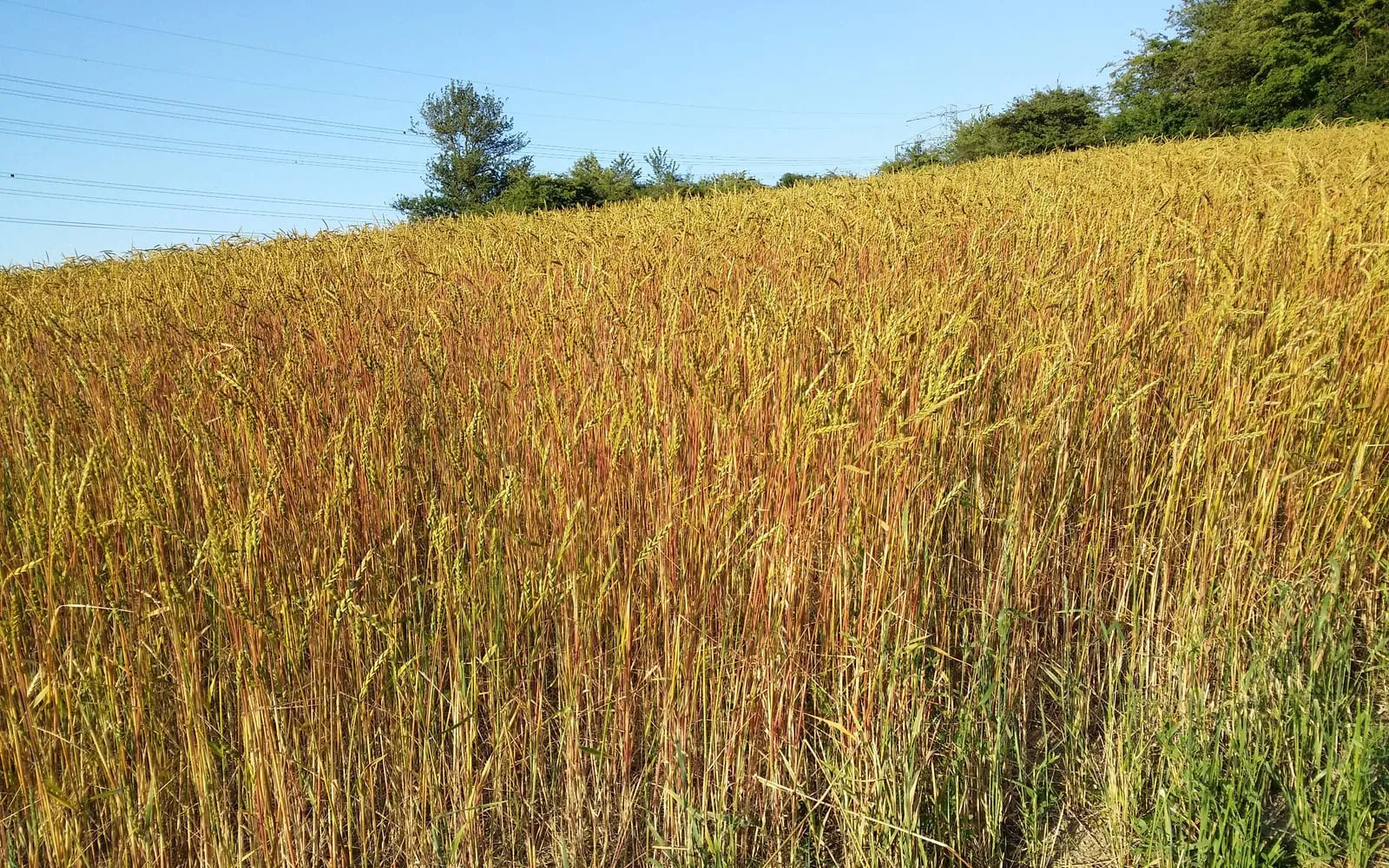
At a glance
- Difficulty
- Moderate
- Water
- Rain-fed. A garden patch needs water only in a dry June
- Light
- Full sun
- Temperature
- Hardy to minus 20 deg C once established
- Hardiness
- USDA 4-8, RHS H6, hardy to -25 C
- Type
- Hardy annual grass, usually autumn sown
- Height
- 120-150 cm
- Native to
- the Near East, central Europe
- Best month
- October and August in the Northern Hemisphere, April and February in the Southern Hemisphere
It is a hulled wheat, so the grain stays inside a tough glume through threshing and needs a second dehulling step, which is the reason it lost out to bread wheat and the reason it stores so well. It tolerates cold, wet and poor soil better than modern wheat and yields considerably less. Almost all of it is autumn sown and it needs the same winter cold as winter wheat before it will ear.
Hardiness zones describe winter cold alone. Summer heat, humidity, rainfall and the length of the growing season decide as much, so treat the range as the outer limit rather than as a recommendation.
Every month named in this guide is for the temperate Northern Hemisphere. If you garden in the Southern Hemisphere, shift each one by six months, so October becomes April. Closer to the equator the wet and dry seasons matter more than the calendar, and the shift stops being a useful guide.
Edible, with limits
- Safe to eat
- The grain, once the hull has been removed
- Do not eat
- Ergot bodies in the ear
- Harm from
- Eating it
- Affects
- People
Spelt is a hexaploid wheat and contains gluten. It is covered by the same allergen declaration as bread wheat, under cereals containing gluten, and it is not safe for anyone with coeliac disease. The belief that spelt is tolerable to people who react to wheat is common in health food shops and has no support in the evidence, and Coeliac UK names it explicitly among the grains to avoid. Some people report that spelt bread sits more easily, which may come from the long slow fermentation spelt doughs usually get rather than from the grain. Anyone with a diagnosis should treat spelt as wheat. The field hazards are the same as wheat's, with ergot the one to inspect a home-grown ear for.
Sources: Coeliac UK on the gluten-free diet, Food Standards Agency on the 14 named allergens
About
Spelt is bread wheat’s hulled cousin, carrying the same three genomes in a different arrangement and refusing to let go of its grain. Thresh a spelt ear and it breaks into spikelets rather than releasing loose grain, each grain still wrapped in the tough glumes it grew in. Getting the food out takes a second machine, a dehuller, and that single difference explains why the plant went out of fashion and why it costs more in a shop.
The plant itself is tall, lean and tough. It stands half a metre higher than a modern bread wheat, roots into poor ground that would starve one, and shrugs off cold that would thin a crop out. Farmers in the Swabian Alb and in Switzerland kept growing it through centuries when the lowlands had moved on, because on thin upland soil it produced where the improved varieties did not.
British bakers rediscovered it in the 1990s, and it is now grown here in small quantities and sold at a premium. The flour has a nutty flavour and a gluten that is strong but fragile, which means a spelt dough comes together fast and then collapses if you keep working it.
Appearance and character
The ear is the giveaway. Where bread wheat packs its spikelets into a dense four-sided head, spelt spaces them out along the axis so the ear looks narrow, flattened and slightly loose, with the spikelets angled outward like the teeth of a comb. It is longer than a bread wheat ear and noticeably thinner.
Each spikelet holds two grains, occasionally three, and holds them hard. The axis is brittle and breaks at the joints under threshing, so what comes off a spelt crop is a pile of spikelets rather than a pile of grain. The grain inside is long, narrow and pointed at one end, redder than bread wheat and with a deep crease.
The straw is long, hollow and springy, which is why spelt straw was the preferred thatching and mattress filling in the regions that grew it. It is also why a heavily fed crop goes over in a June storm. Awns are usually present and short, though awnless forms exist.
Where it is from
Spelt’s origin is argued over. It appears in the archaeological record in two places that do not connect neatly, in the Near East around 5000 BC and in central Europe from the Bronze Age, and the European material may represent a second independent hybridisation between emmer and bread wheat rather than a migration.
Whatever the route, central Europe is where it became a staple. Spelt was the principal bread grain of southern Germany, Switzerland and Austria through the medieval period, and it is the grain Hildegard of Bingen wrote about approvingly in the twelfth century, which is a large part of why German health food culture adopted it so enthusiastically.
Britain grew it in the Iron Age and then largely stopped. Spelt grains turn up in British excavations from that period and rarely afterwards, and the modern British crop dates from a deliberate revival by a handful of growers from the late 1980s.
How it grows
Spelt grows like a tall winter wheat with a longer fuse. Autumn-sown seed germinates and tillers through the winter, and because the plant is less responsive to nitrogen it puts on tillers more slowly and finishes with fewer of them.
Stem extension carries it well past head height for anything sown next to it. The ear emerges in early summer, flowers within a few days, and fills over about six weeks. Ripening runs a little later than bread wheat in the same field.
The plant is sown as whole spikelets rather than as naked grain, which changes the arithmetic. A spikelet contains two grains and lands as one unit, so seed rates are quoted in spikelets and a sown patch comes up in pairs. This is normal and needs no thinning.
Through the seasons
Sow in October into ground that has been cleared rather than finely prepared, since spelt is forgiving about seedbeds. It emerges within a fortnight and tillers into the winter, staying green through all but the hardest weather.
Growth restarts in March. The crop extends through April and May, comes into ear in late May or June, and stands taller than anything else on the plot for the rest of the summer.
Harvest is August, usually a week or so after bread wheat. Cut it, dry it under cover, and then face the hulls. Small quantities can be rubbed out by hand or run through a hand grain mill set wide, though the classic method is to roll the spikelets under a board with steady pressure and then winnow.
Care difficulty
The growing part is easier than bread wheat. Spelt tolerates poorer soil, needs less nitrogen, resists yellow rust better than most modern varieties, and survives winters that thin a wheat crop out. A gardener who wants a cereal patch with minimal fuss should choose this one.
The processing part is harder, and it is the whole of the difficulty. A crop that will not release its grain needs a dehuller, and there is no domestic appliance for it. Small quantities come out with patience and a rolling pin; larger ones need equipment you would have to build or borrow.
Lodging is the other thing to plan for. The plant is tall and the straw is springy rather than stiff, so a fed crop in an exposed spot will end up flat. Feed lightly and site it where a hedge takes the worst of the wind.
Watering
Spelt is grown rain-fed and needs no help in an ordinary year. Its root system is deeper and more exploratory than a modern wheat’s, which is exactly why it held on in upland districts with thin soil.
If you water at all, water during grain fill. The three weeks after flowering set the size of the grain, and drought then gives you a thin sample that is mostly hull. Before that the plant will find what it needs.
Wet ground in winter is the condition to avoid, as with any cereal. Spelt tolerates it better than bread wheat but still loses tillers and roots shallowly where water lies.
Warning signs, diseases and pests
Spelt’s disease profile is a large part of its appeal, since it carries useful resistance to yellow rust and to some races of the other rusts. A spelt patch next to a rusting wheat crop often stays clean.
Septoria still finds it in a wet spring, showing as brown blotches speckled with black dots on the lower leaves and working upward. The plant’s height helps here, since the top leaves are further from the splash.
Lodging is the failure that costs you the crop. A flattened stand ripens unevenly, sits wet, and starts sprouting in the ear after rain. Once it is down there is nothing to do but cut it early and dry it fast.
Ergot appears in spelt as in every cereal, replacing a grain with a hard dark body that protrudes from the spikelet. Inspect a home-grown crop before you eat it and discard any ear that carries one. Aphids bring barley yellow dwarf virus into autumn-sown crops and leave stunted red-tinged patches in the spring.
Growing environment
Full sun, and shelter if you can find it, which is a combination that takes some thought on an open plot. The plant will grow in more shade than bread wheat tolerates and will grow taller and lodge sooner for it.
Soil requirements are light. Spelt performs on thin, stony, acid and generally unimproved ground where a modern wheat would produce nothing worth cutting. That tolerance is historical rather than magical, since it was selected for centuries by farmers who had no better ground to offer it. A pH from 5.5 to 7.5 suits it.
Cold is not a problem. Spelt survives to around minus 20 deg C once hardened, and Alpine agriculture relied on that. What it dislikes is a warm wet winter followed by a warm wet spring, which grows a soft tall crop that goes over in the first storm.
Feeding
Feed spelt about half of what you would give bread wheat, and expect a lighter crop for it. The plant converts extra nitrogen into height rather than grain, so generosity here buys you lodging.
One application in March, as growth restarts, covers a garden patch. Use a balanced granular feed at a light rate rather than a straight nitrogen, since the crop is not chasing a milling protein specification.
Manure the plot the autumn before rather than the spring of sowing. Fresh nitrogen going into a tall cereal in May is the reliable way to flatten it.
Troubleshooting
Is spelt safe for coeliacs? No. Spelt is a wheat and contains gluten. Coeliac UK names it among the grains to avoid, and the health food shop claim that it is somehow different has no evidence behind it.
Why does spelt flour behave oddly in bread? Its gluten is strong but fragile. A spelt dough comes together quickly and then breaks down if you keep kneading, so mix it less, prove it a little shorter, and expect a slacker dough than the same recipe in bread flour.
How do I get the hulls off? In small quantities, roll the spikelets under firm pressure with a rolling pin on a board, then winnow by pouring the result between buckets in a breeze. There is no domestic machine for it, and this is the single reason home-grown spelt is more trouble than home-grown wheat.
Can I sow the spelt from a health food shop? Sometimes. If it is sold as whole grain with the hull already removed, it may still germinate, though it will have been dried hard. Sowing rate is a guess; sow thickly and thin nothing.
Is farro the same as spelt? Partly. Italian farro covers three hulled wheats, and spelt is farro grande. Farro medio is emmer and farro piccolo is einkorn, which is why a bag labelled farro may cook in twenty minutes or in an hour.
My spelt is flat after a storm. Lodging, and it is the plant’s habit. Cut it and dry it under cover rather than leaving it down, because a flattened crop sprouts in the ear within days of rain.
How tall does it get? Around 1.5 m in good ground, which is roughly a third taller than a modern bread wheat. Plan for it when you decide what to plant behind it.
Spelt problem guides
Not sure what is wrong? See the common vegetable pests guide.