
Disorder
Green potatoes
Also called Greening, Solanine in potatoes, Light greening, Glycoalkaloids
Light turns a tuber green and raises its solanine at the same time. The green is harmless and the alkaloid is not, boiling destroys neither, and a bitter taste is the warning to stop eating.
At a glance
- Type
- Disorder
- Cause
- Growing conditions
- Severity
- Destroys the crop or display
- Affects
- Herbs and edibles
- Active
- July to March
What you are seeing
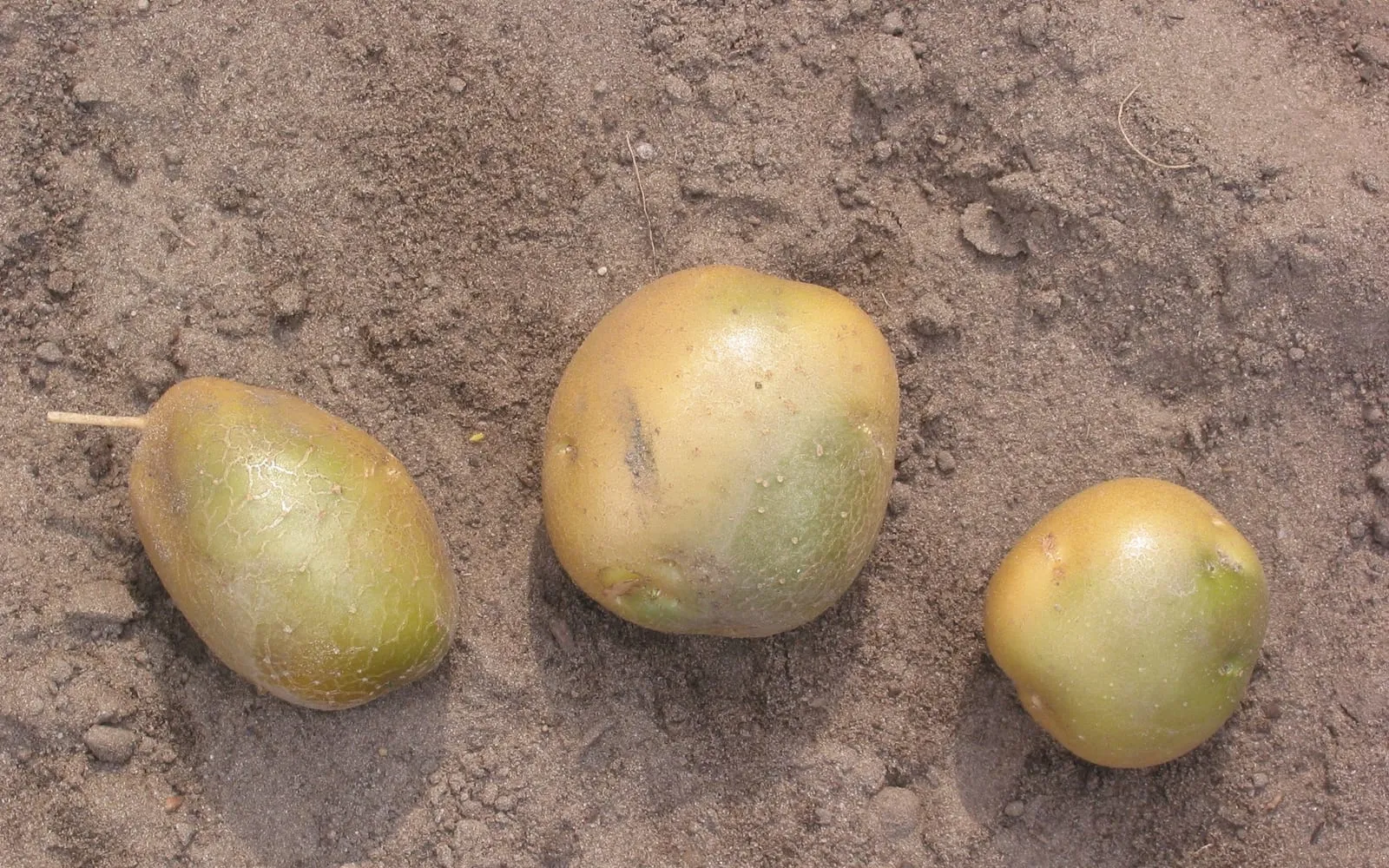
- A green tinge under the skin, strongest on the side that faced the light
- Green reaching into the flesh once the tuber is peeled
- A bitter taste, followed by a burning or scratching feeling at the back of the throat
- Sprouts at the eyes, stubby and green in the light or long and pale in the dark
- Tubers sitting near the soil surface at lifting, already green on the upper side
- Greening on potatoes bought loose from a lit display or in a clear plastic bag
Before you treat anything
Solanine and chaconine are not destroyed by boiling, steaming, baking or microwaving, because the inside of a potato never gets hot enough. Cooking removes the risk from a great many things and this is not one of them. Do not eat a potato that tastes bitter, do not feed green peelings to pets or livestock, and never eat seed potatoes, which are often treated before sale.
What you are looking at
A potato with a green cast under the skin, usually strongest down one side. Peel it and the green goes into the flesh, fading from a definite colour at the surface to nothing a few millimetres in. It is firm, it does not smell, and nothing has rotted.
The tuber either sat too near the surface while it was growing, or sat in the light after it was lifted. A bag on a kitchen worktop does it in a few days, and so does a lit supermarket shelf, a windowsill and a shed with an uncovered window.
What the green means
Chlorophyll is the green, and eating chlorophyll does you no harm at all. A potato exposed to light behaves like any other plant organ and starts building it, which is why the colour appears.
The same light triggers a second response, and that one is the problem. The tuber raises its production of two glycoalkaloids, solanine and chaconine, which are the plant’s chemical defence against being eaten. They sit mainly in the skin and the few millimetres below it, and they concentrate hard in the eyes and in any sprouts.
The two responses happen together and they are separate processes. So the green works as a reasonably good warning light rather than as a measurement. A tuber can be greener than another and less alkaloid, and a badly bruised or heavily sprouted potato can carry a high level with no green on it at all.
A sound potato holds well under 20 mg of glycoalkaloid per 100 g of flesh, which is also the figure treated as the upper limit for food. Bitterness becomes noticeable somewhere around 14 mg, and a burning sensation at the back of the throat around 22. Your tongue is therefore a more reliable instrument than your eyes, and it warns you before the level gets dangerous.
Symptoms of a serious dose start with stomach pain, vomiting and diarrhoea a few hours after the meal, with headache and drowsiness. A well-documented case at a south London school in 1979 put seventy-eight boys in bed and several in hospital, and the potatoes involved had been left over in store from the previous term.
Why cooking does not deal with it
Glycoalkaloids hold together until around 170 degrees C. The inside of a potato sits at 100 degrees C at the most when you boil, steam, bake or microwave it, because the water in it cannot get any hotter until it has all gone. So the alkaloid comes out of the pan at close to the level it went in.
Deep frying gets the outside above the threshold and does not touch the middle. Peeling helps a great deal, because most of the alkaloid is in the outer layer, and peeling is the reason a lightly greened potato pared thickly is usually fine.
The taste survives cooking as well. Butter, salt and gravy will not hide it.
Chitting, and why green seed potatoes are fine
Anyone who has chitted seed potatoes on a windowsill has produced deliberately greened tubers with short green sprouts, and that is the intended result. A greened seed potato is tougher, keeps better and resists rot in cold spring soil, and the alkaloid does not concern anyone because nobody is eating it.
Do not eat seed potatoes. Besides the greening, most are treated before sale with substances approved for planting stock and not for food.
Green tomatoes contain a different alkaloid, tomatine, which is far less toxic to people than solanine, and green tomato chutney has been made safely for centuries. The rule about green potatoes does not carry across to the rest of the family.
What to do about it
Plant deep and keep earthing up through the season, containers included.
Fork the row over twice at lifting and pick up the strays.
Dry the crop in a shed rather than on the lawn, and cover anything that has to sit out in daylight.
Store in paper or hessian in the dark, cool and with air moving, and get supermarket bags out of the plastic and into a cupboard.
Handle gently, since bruises raise the alkaloid on their own.
Sort the sack every few weeks and rub off any sprouts.
Peel a lightly greened potato thickly and cut out every eye, and bin anything where the green reaches the middle.
Taste a piece, and throw the batch away if it is bitter.
What it gets mistaken for
Common scab raises rough corky patches on the surface with white sound flesh underneath, and it is a blemish rather than a hazard.
Blight sinks dark patches into the tuber that turn rusty brown and soft inside, and it smells strongly.
Blackleg rots the tuber from the stem end into a foul soft mass.
Frost damage in store turns potatoes grey and glassy, then wet and sweet as they thaw.
Hollow heart leaves a clean brown-edged cavity in the centre of a very large tuber after a growth check, and the flesh around it is white and safe.
What to do, in order
Start here
Prevention, and the changes that stop the problem returning. Most of these pages should end at this tier.
- Earth up, and go back and do it again
- Tubers form above the seed potato and work their way towards the surface as they swell, so a ridge that was deep enough in June is often not deep enough in August. Draw soil up over the row whenever a tuber or a pale patch of soil shows, and take the ridge higher than feels necessary. Growing in bags and containers needs the same treatment, which is what topping up the compost is for.
- Plant deep enough to start with
- Seed potatoes 12 to 15 cm below the surface give the crop somewhere to form without pushing into the light. Shallow planting is the commonest reason a first crop comes up half green.
- Search the ground after lifting
- Strays left in the soil are the ones that green, sprout and carry blight through to next year. Fork the row over a second time a few days later, when the missed tubers have settled to the surface.
- Store in the dark, and treat any light as too much
- Greening starts within a day or two of exposure and it happens under electric light as readily as sunlight. Paper or hessian sacks in a dark shed or cupboard are the standard, and a clear polythene bag is the worst container available. Decant a supermarket bag into a dark cupboard as soon as you get it home.
- Keep the store cool and ventilated
- Warmth drives sprouting, and sprouting raises glycoalkaloids alongside the greening. A cool shed or garage at around 7 to 10 degrees C, dry and with air moving, holds a crop for months. Below about 4 degrees C the starch converts to sugar, which makes potatoes taste sweet and brown heavily when fried, so a fridge is a poor place for anything destined for a roasting tin.
- Handle them gently
- Bruising, cuts and spade damage all raise glycoalkaloid levels in the tissue around the wound, quite separately from any light. Lift with a fork well away from the stem, tip potatoes rather than dropping them, and put the damaged ones aside to eat first.
- Check the sack every few weeks
- Sort through a stored crop monthly, take out anything sprouting, green or rotting, and rub the sprouts off the rest. One forgotten sack at the back of a shed is how most people meet this.
Then reach for a barrier
Netting, hand removal and water. Nothing here harms anything except the target.
- Cover a crop that has to sit in the light
- Potatoes drying off after lifting, or waiting in a trug while you finish the row, green quickly on a bright day. Throw a sack or a sheet of black polythene over them, and dry the crop in a shed rather than on the lawn.
- Cut the green away generously, or throw it out
- Where a tuber has a light green blush on one side, peel it thickly, taking off the skin and several millimetres of flesh beneath, and cut out every eye and sprout. Where the green has reached the middle, or where more than a small part of the potato is affected, bin it. The flesh is not worth the trouble of judging.
- Taste one piece, and stop at bitterness
- Bitterness arrives at roughly the level where the alkaloid starts to matter, and a burning or scratching feeling at the back of the throat arrives a little above it. Both are useful warnings and neither should be argued with. Spit it out, throw the batch away, and do not try to cook the taste out.
Plants affected
Guides that name it among the problems to watch for. The list is the plants it is characteristic of rather than everything it will feed on.