
Edible
Wonderberry
Solanum retroflexum
Also known as Sunberry, Garden huckleberry, Msoba
How to grow wonderberry, Solanum retroflexum. Telling ripe berries from unripe, the Burbank controversy of 1909, and why only fully black fruit is worth picking.
At a glance
- Difficulty
- Easy
- Water
- Weekly. It is drought-tolerant once established
- Light
- Full sun to light shade
- Temperature
- 18-26 deg C. Killed by frost
- Hardiness
- USDA 9-11, RHS H2, hardy to 2 C
- Type
- Tender annual
- Height
- 45-90 cm
- Native to
- Southern Africa
- Best month
- May in the Northern Hemisphere, November in the Southern Hemisphere
Fast enough from seed to crop as a summer annual in almost any climate with three frost-free months, which is how it is grown outside the tropics. Frost ends it. It seeds itself readily and is treated as a weed in parts of Australia and southern Africa.
Hardiness zones describe winter cold alone. Summer heat, humidity, rainfall and the length of the growing season decide as much, so treat the range as the outer limit rather than as a recommendation.
Every month named in this guide is for the temperate Northern Hemisphere. If you garden in the Southern Hemisphere, shift each one by six months, so May becomes November. Closer to the equator the wet and dry seasons matter more than the calendar, and the shift stops being a useful guide.
Toxic if eaten
- Safe to eat
- The fully ripe black berries, cooked
- Harm from
- Eating it
- Affects
- People, cats and dogs
The ripe wonderberry is eaten as a cooked fruit across southern Africa, where it is a traditional crop under the name msoba, and it is safe when fully ripe. Unripe green berries are not. Solanum retroflexum belongs to the black nightshade group, and green fruit and the foliage contain solanine and related glycoalkaloids at levels that cause vomiting, abdominal pain and drowsiness. The RHS lists Solanum species among plants harmful if eaten and the ASPCA lists the genus as toxic to cats and dogs. The rule is absolute and simple. Pick only berries that are fully black-purple, dull rather than shiny, and that come away from the stalk at a touch. Discard anything green, and never eat a mixed handful, since a cluster ripens unevenly. Most sources advise cooking rather than eating them raw, which is the traditional preparation and reduces the residual glycoalkaloids further. The plant is easily confused with black nightshade, Solanum nigrum, which grows wild across Europe and North America, has a similar history of being eaten ripe in some regions, and is best left alone.
Sources: RHS potentially harmful garden plants, ASPCA toxic and non-toxic plants
About
The wonderberry is a small black-fruited annual from southern Africa that crops heavily in a cool summer with almost no attention. The berries are cooked into jam, pies and cordials rather than eaten raw, and the flavour is somewhere between a blueberry and a blackcurrant with a slight savoury edge.
It arrived in Europe and America through one of horticulture’s more entertaining rows. Luther Burbank released it in 1909 as a new creation of his own breeding, priced it high, and was promptly accused by a rival seedsman of having renamed an ordinary and mildly toxic wild nightshade. The dispute ran in the American gardening press for years. Burbank was closer to right than his critics allowed, though the plant was not the novelty he claimed.
The safety rule that came out of that argument still stands. Only fully ripe black berries, and cooked.
Appearance and character
A bushy branching annual, 45 to 90 cm tall, with soft angular green stems.
Leaves are small, oval to diamond-shaped, mid-green, smooth and thin, held alternately.
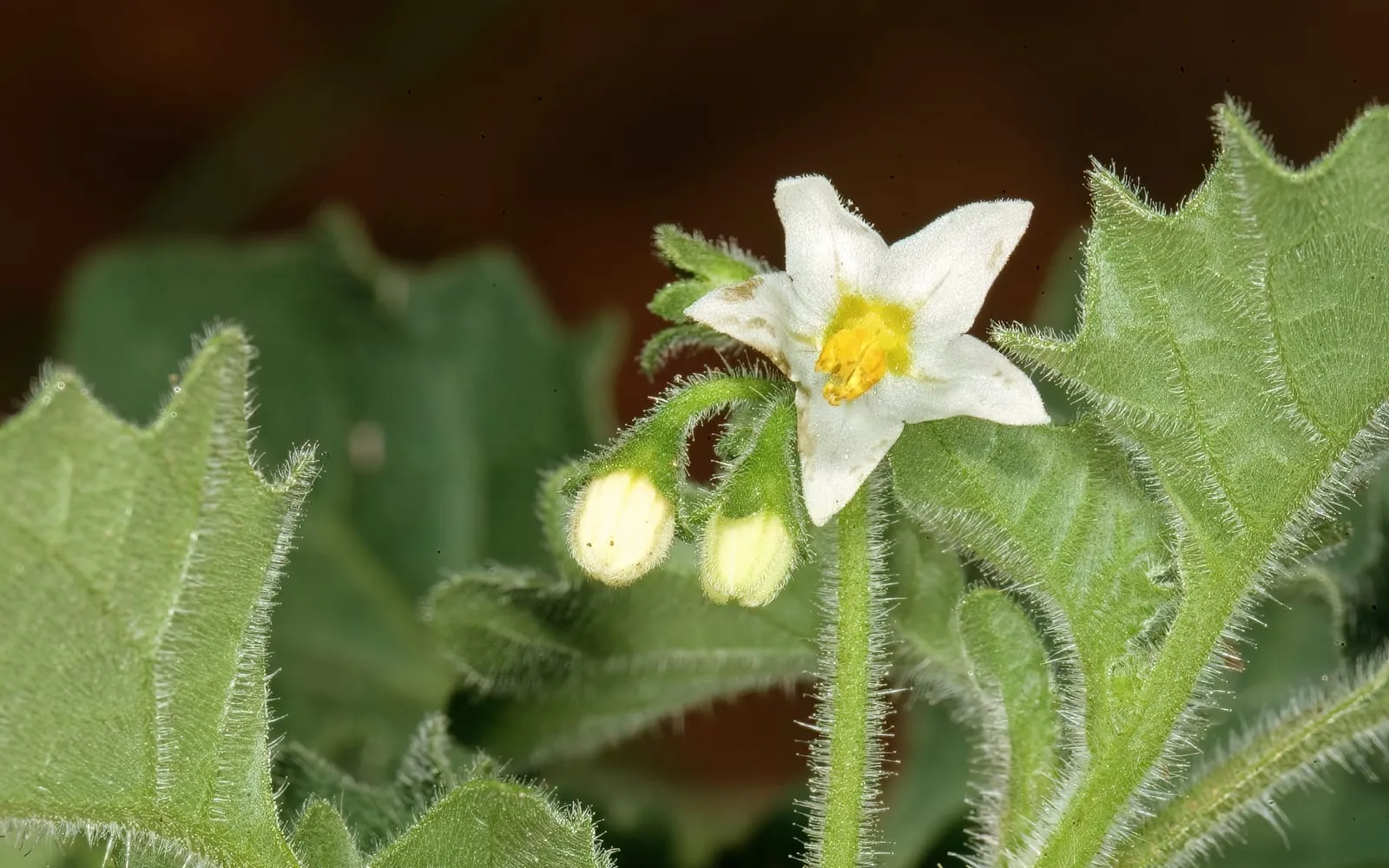
Flowers are small, white and star-shaped with a yellow anther cone, in nodding clusters of five to ten, and they look exactly like a potato flower in miniature.
Berries follow in clusters, each 8 to 12 mm across, ripening from green through dull purple to matt black-purple.
A ripe berry is dull rather than glossy, slightly soft, and detaches from the stalk at a touch. A green or shiny berry is not ready.
Flavour cooked is mild and slightly earthy, closer to a blackcurrant than a blueberry, and it needs sugar and an acid such as lemon to be interesting.
Where it is from
Solanum retroflexum is native to southern Africa, where it grows on disturbed ground and has long been gathered and cultivated. In South Africa it is msoba or nastergal, and both leaves and ripe berries are eaten.
Luther Burbank obtained seed and released the plant in 1909 as the wonderberry or sunberry, claiming it as a cross of his own making between Solanum guineense and a wild American nightshade.
The seedsman Charles Dawson bought and grew it, declared it to be the common weed black nightshade under a new name, and offered a public reward to anybody who could tell them apart. The row was covered widely enough to damage Burbank’s reputation.
Modern taxonomy places the plant as Solanum retroflexum, a distinct southern African species within the black nightshade complex, so it was neither Burbank’s invention nor plain Solanum nigrum.
Garden huckleberry, sold under the same names, is usually Solanum scabrum, a close relative with larger berries handled identically.
How it grows
Sow indoors in March or April at 18 to 20 deg C, exactly as for tomatoes. Germination takes seven to fourteen days.
Prick out into 9 cm pots and grow on. Plant out after the last frost in late May or early June, at 60 cm apart.
The plant needs no staking in most gardens and benefits from it in an exposed one.
Pinch out the growing tip at 30 cm to make it branch, which increases the number of fruiting clusters.
Pick from August, taking whole clusters only when every berry in them is matt black. Clusters ripen unevenly, so go over the plants every few days.
Pull the plants after the first frost, and collect any fallen berries, because this species self-seeds freely and the volunteers are hard to distinguish from wild black nightshade.
Through the seasons
Early spring is sowing, indoors in March or April at 18 to 20 deg C.
Late spring grows the plants on and hardens them off from mid-May.
Early summer is planting out, after the last frost, at 60 cm apart. Pinch out at 30 cm.
Summer is growth and flowering. Water weekly and resist feeding. The plant crops better on moderate ground than on rich.
Autumn is the harvest, from August until the first frost. Pick over every few days, taking only fully black berries. Clear the plants and fallen fruit afterwards.
Care difficulty
Easy, and one of the least demanding fruiting crops here.
Judging ripeness is the only thing that requires care, and it matters because unripe berries make people ill. Matt black, slightly soft, detaching at a touch.
Self-seeding is the practical nuisance. Dropped berries produce seedlings that look much like wild black nightshade, which is a confusion worth avoiding in a garden where children pick things.
Slugs take young plants and lose interest afterwards.
Blight can affect it in a wet summer and rarely does much damage.
The plant needs no pruning, no support in most gardens, and very little feeding.
Watering
Water weekly, around 12 litres per square metre in dry weather.
Wonderberry is drought-tolerant once established and over-watering gives a large leafy plant with fewer berries.
Water at the base rather than over the foliage, which reduces blight risk.
Mulch after planting to hold moisture and keep the lower fruit clean.
Reduce watering in September as the crop finishes.
Container growing works in a pot of 25 litres or more, watered every two or three days in summer.
Warning signs, diseases and pests
Slugs graze young transplants. Protect them for the first fortnight.
Aphids cluster on the growing tips and spread virus. Wash them off.
Whitefly build up under cover. Ventilate and use Encarsia wasps under glass.
Blight browns the leaves and spoils fruit in a wet August. Water at the base, space the plants and remove affected material.
Self-sown seedlings the following spring look much like wild black nightshade and are the main reason to clear fallen fruit.
Unevenly ripening clusters are normal rather than a fault, and they are the reason to pick over the plants every few days rather than stripping them.
An enormous leafy plant with few berries means the ground was too rich or the plant was fed nitrogen.
Growing environment
Full sun to light shade. It crops usefully in less sun than a tomato needs.
Free-draining, moderately fertile soil. Rich ground gives leaf rather than fruit.
Neutral to slightly acid, pH 6 to 7.
Space at 60 cm each way.
No support needed in a sheltered garden, and a cane in an exposed one.
Rotate with tomatoes, potatoes, aubergines and peppers on three years, since all are Solanaceae and share blight and several viruses.
Feeding
Dig compost into the bed before planting and leave it at that.
Avoid nitrogen entirely. It gives a large leafy plant and reduces the crop, and it is the commonest mistake with this plant.
A high-potash feed once fruit has set is worthwhile only on poor ground.
Never use fresh manure.
Container plants take a fortnightly tomato feed from six weeks after planting.
Troubleshooting
The berries made us feel unwell. They were not fully ripe. Only matt black, slightly soft berries that detach at a touch are safe, and green fruit contains solanine. Cook them rather than eating them raw.
A cluster ripens unevenly. Normal. Pick over the plants every few days and take only the berries that are fully black.
The berries taste of very little. They need cooking with sugar and an acid such as lemon. Raw they are dull, and the plant is grown for jam and cordial rather than for eating out of hand.
A huge leafy plant with few berries. Too much nitrogen or too rich a soil. Grow it hard.
Seedlings coming up everywhere the next spring. Dropped berries. Clear fallen fruit at the end of the season, since the seedlings look much like wild black nightshade.
Brown patches on the leaves in a wet August. Blight. Water at the base, space the plants and remove affected growth.
Is this the same as black nightshade? No, though it is in the same group. Wonderberry is Solanum retroflexum, a southern African species. Black nightshade, Solanum nigrum, is a common weed across Europe and North America and is best left alone.
Is garden huckleberry the same plant? Usually not. Garden huckleberry is generally Solanum scabrum, a close relative with larger berries, grown and handled in the same way and subject to the same ripeness rule.
Wonderberry problem guides
Not sure what is wrong? See the common vegetable pests guide.