
Disease
Potato scab
Streptomyces scabiei
Also called Common scab, Potato common scab
Common scab makes corky marks on potato skins that go no deeper than the peel. Keep soil evenly moist while tubers form, and separate it from powdery scab, which favours wetter ground.
At a glance
- Type
- Disease
- Cause
- Bacterium
- Severity
- Cosmetic
- Affects
- Herbs and edibles
- Active
- June to September
- Established in
- Worldwide
What you are seeing
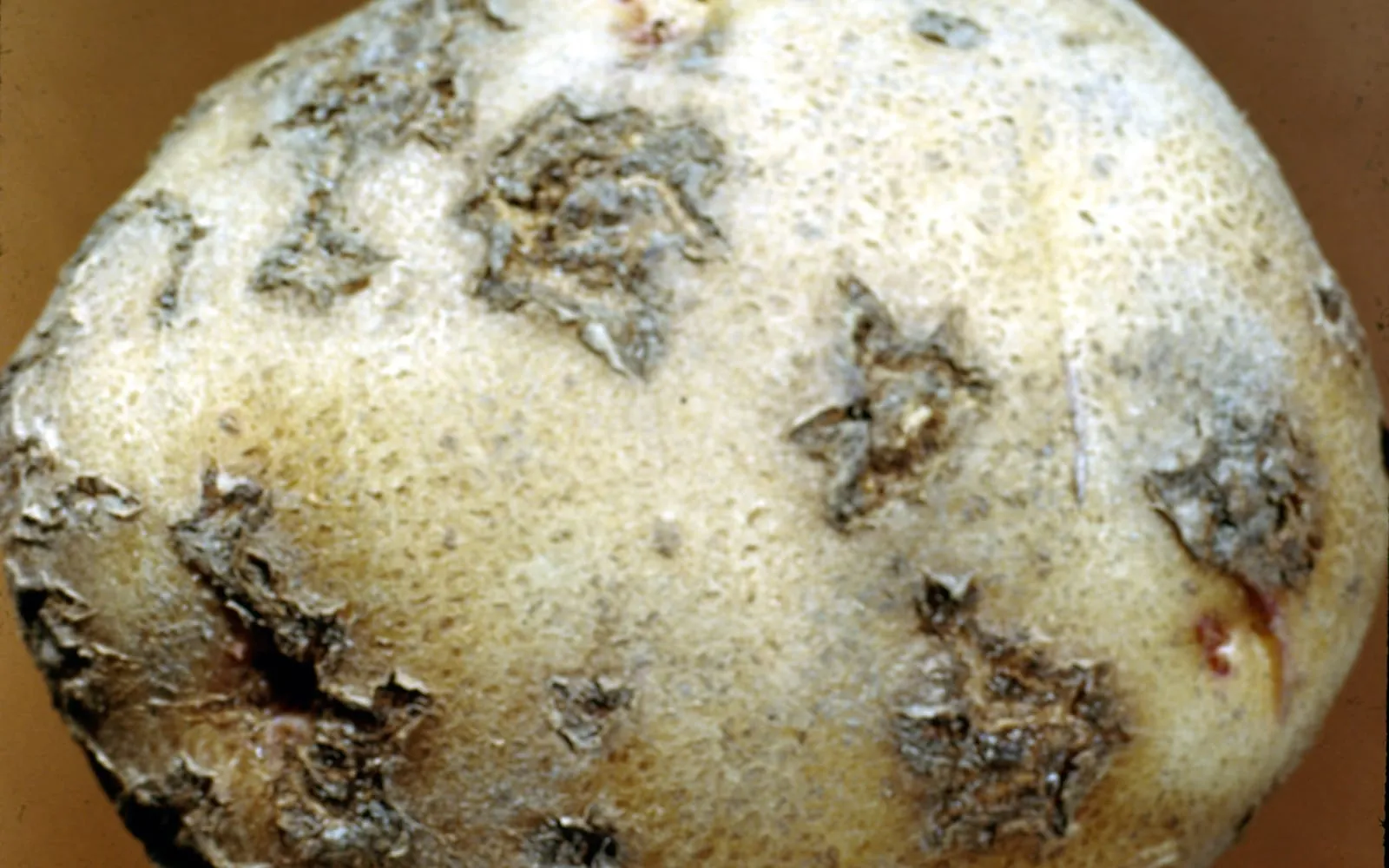
- Raised corky patches on the tuber skin, ragged-edged and often star-shaped
- Scabs sitting on the surface, with sound white flesh directly beneath them
- Sunken pitted scabs on badly affected tubers, a few millimetres deep at most
- Worst on light sandy soils and in a dry summer
- Worse where the ground was limed or manured before planting
- Beetroot, radish and swede scabbing in the same bed in the same season
- The crop otherwise a normal size and yield
Before you treat anything
Scabbed potatoes are safe to eat once peeled. As with all potatoes, discard any that have gone green or are sprouting heavily, since those carry solanine, which scab has nothing to do with.
What you are looking at
Raised corky patches on the skin of a lifted potato, brown and rough, with ragged edges that often make a rough star shape. On a badly affected tuber the scabs sink into shallow pits, and even then they go only a few millimetres deep.
Scrape one off with a thumbnail. The flesh underneath is white, firm and perfectly sound.
The crop is otherwise normal. The plants grew well, the yield is what it should be, and the potatoes keep and cook as usual once peeled.
Beetroot, radish, swede and carrots grown in the same bed can show the same thing, since the organism is not fussy about which root it roughens.
A watering problem in a disguise
The organism responsible is a soil-dwelling actinomycete, a bacterium that grows in threads like a fungus, and it is a normal resident of almost every garden soil. Its presence is not the variable.
What decides whether you get scab is moisture during one specific window. A tuber can only be infected while its skin is still forming, which is roughly the four to six weeks after the tubers reach marble size, around the time the plants flower. Skin that has set is not penetrable.
If the soil dries out during those weeks, the organism gets in and the crop scabs. If the soil stays moist, it does not.
That is why the same cultivar on the same plot is clean one year and scabbed the next, and why the answer is a watering can rather than a treatment. It is also why scab is worst on light sandy soils, which dry out fastest, and in the sort of dry British June that people otherwise enjoy.
Soil pH is the second lever. The organism does better as soil becomes more alkaline, which is why liming a bed before potatoes reliably produces a scabby crop. Anyone who limed for clubroot needs to keep the potatoes out of that ground.
Powdery scab is the opposite
There is a second scab on potatoes, and its conditions run the other way, so mixing them up leads to precisely the wrong action.
Powdery scab produces raised pimples that burst open to release a brown powder, leaving a rimmed crater rather than a corky patch. It is caused by an unrelated organism, and it is a disease of wet, cold, heavy soil.
Watering hard through tuber formation prevents common scab and encourages powdery scab. On a heavy wet plot with a history of powdery scab, improve the drainage instead and pick a different cultivar.
Common scab on a light dry soil is far and away the one most British gardeners have.
What to do about it
Water thoroughly and consistently from the point the tubers reach marble size, right through the following month. This matters more than everything else here combined.
Mulch the ridges after earthing up to hold that moisture in.
Keep lime off the ground that will grow potatoes.
Use well-rotted compost rather than fresh manure, and dig it in the autumn before.
Choose a resistant cultivar for a light soil.
Build the organic matter up in a sandy plot over several seasons.
Peel the crop you have and eat it, because there is nothing wrong with it.
What it gets mistaken for
Powdery scab makes pimples that burst and release brown powder, and it comes from wet cold soil rather than dry.
Blackleg blackens and softens the stem base and rots the tuber through to the centre, wet and smelling strongly.
Slug damage bores clean round holes into a tuber and hollows out cavities inside it, and the entry holes are smooth-edged.
Wireworm leaves narrow round tunnels a couple of millimetres across driven straight through the flesh.
Skin spot and black scurf both mark the skin as well. Black scurf leaves flat black flecks that look like soil but will not wash off, and neither affects the flesh underneath any more than common scab does.
Apple scab shares the name and nothing else. It is a fungus, on apples and pears.
What to do, in order
Start here
Prevention, and the changes that stop the problem returning. Most of these pages should end at this tier.
- Water heavily while the tubers are forming
- This is the whole answer. The organism can only get in through the very young skin of a tuber, over a window of about four to six weeks starting as the tubers reach marble size, which is roughly when the plants come into flower. Keep the soil consistently moist right through that window and the crop comes up clean. Let it dry out for a week and it scabs.
- Do not lime before potatoes
- The organism thrives as soil becomes more alkaline and is held back below about pH 5.5. Lime applied for the brassicas earlier in the rotation is a common cause of a scabby potato crop, which is why the clubroot page says to keep lime away from the ground that will grow potatoes.
- Use well-rotted compost rather than fresh manure
- Fresh strawy manure dug in before planting makes scab noticeably worse, partly by drying the soil around the tubers. Well-rotted organic matter dug in the previous autumn does the opposite, holding moisture through the critical weeks.
- Grow a resistant cultivar on light soil
- 'Arran Pilot', 'Nadine', 'Golden Wonder' and 'Pentland Crown' resist it well. 'Maris Piper', 'King Edward' and 'Desiree' scab readily. On a thin sandy plot, that choice matters more than anything you do during the season.
- Build up the organic matter in a light soil
- A sandy soil that drains within hours is the one that produces scabby potatoes every year. Compost, leafmould and green manures raise the water-holding capacity and reduce it over several seasons.
- Rotate, and expect modest returns
- The organism is a normal inhabitant of most garden soil, so rotation thins the pressure rather than removing it. Watering does more.
Then reach for a barrier
Netting, hand removal and water. Nothing here harms anything except the target.
- Peel the potatoes and eat them
- Scab is skin deep. Pare it off and the potato underneath is perfectly sound, and it cooks and stores exactly as it should. A crop written off for this reason has been wasted.
- Mulch the ridges to hold moisture in
- Grass clippings, straw or compost over the ridges after earthing up keeps the soil around the developing tubers damp for longer between waterings.
Plants affected
Guides that name it among the problems to watch for. The list is the plants it is characteristic of rather than everything it will feed on.
Common on UK allotments
This is one of the pests and diseases allotment growers meet most often. See it alongside the other common problems on the allotment guide.
Common allotment pests and diseases