
Edible
Ethiopian Eggplant
Solanum aethiopicum
Also known as Scarlet eggplant, Gilo, Nakati, Bitter tomato, Mock tomato
How to grow the Ethiopian eggplant, Solanum aethiopicum. A scarlet aubergine that looks like a tomato, the leaves eaten as a green, and the bitterness that is the point rather than a fault.
At a glance
- Difficulty
- Moderate
- Water
- Twice a week, more once fruiting
- Light
- Full sun
- Temperature
- 22-30 deg C, with nothing below 12
- Humidity
- Moderate
- Hardiness
- USDA 10-11, RHS H1b, hardy to 5 C
- Type
- Tender perennial grown as an annual
- Height
- 0.6-1.5 m
- Native to
- West and Central Africa
- Best month
- April and August in the Northern Hemisphere, October and February in the Southern Hemisphere
Heat and humidity suit it better than they suit common aubergine, and it carries resistance to the bacterial wilt and nematodes that limit Solanum melongena in the wet tropics. Nothing below 12 deg C. It is used as a grafting rootstock for aubergine for exactly that reason.
Hardiness zones describe winter cold alone. Summer heat, humidity, rainfall and the length of the growing season decide as much, so treat the range as the outer limit rather than as a recommendation.
Every month named in this guide is for the temperate Northern Hemisphere. If you garden in the Southern Hemisphere, shift each one by six months, so April becomes October. Closer to the equator the wet and dry seasons matter more than the calendar, and the shift stops being a useful guide.
Edible, with limits
- Safe to eat
- The fruit at eating stage, and the young leaves after cooking
- Do not eat
- The stems, the mature leaves, and any part of an unripe green fruit eaten raw in quantity
- Harm from
- Eating it
- Affects
- People, cats and dogs
Solanum aethiopicum is a nightshade, and the family rule applies. The fruit is a vegetable eaten across West and Central Africa and Brazil, and the young leaves are a popular cooked green in Uganda and Nigeria. Stems and older foliage contain glycoalkaloids, the same class of compound as the solanine in potato foliage, and are not eaten. The characteristic bitterness of the fruit comes from those compounds and is stronger in some cultivar groups than others, which is why African cooks match the group to the dish rather than treating bitterness as a defect. A fruit that is unpleasantly bitter is one to leave. The ASPCA lists related Solanum species as toxic to cats and dogs, with the foliage the main risk, and the RHS lists the genus as harmful if eaten. Keep pets from grazing the plant.
Sources: RHS potentially harmful garden plants, ASPCA toxic and non-toxic plants
About
The Ethiopian eggplant is an aubergine that has decided to look like a tomato. The fruit ripens through cream and green to a bright scarlet or orange, ribbed and glossy, 3 to 8 cm across, and anyone meeting one for the first time usually assumes it is a tomato until they cut it.
It is one of the most widely grown vegetables in Africa and it comes in groups selected for different jobs. The Gilo group is grown for its fruit and dominates in West Africa and Brazil. The Shum group is grown for its leaves, eaten as nakati in Uganda, and its fruit is small and barely worth picking. The Kumba and Aculeatum groups sit between the two.
Bitterness is part of the design. The fruit carries more glycoalkaloid than a common aubergine and tastes noticeably bitter, which is what it is grown for in the stews it goes into. Cooks pick the group and the stage to suit the dish rather than trying to breed the bitterness out.
Appearance and character
A bushy branching plant, 60 cm to 1.5 m depending on the cultivar group, woody at the base by the end of the season.
Stems are green or purple-flushed, sometimes carrying short prickles, and the prickly forms are the ones to handle with care.
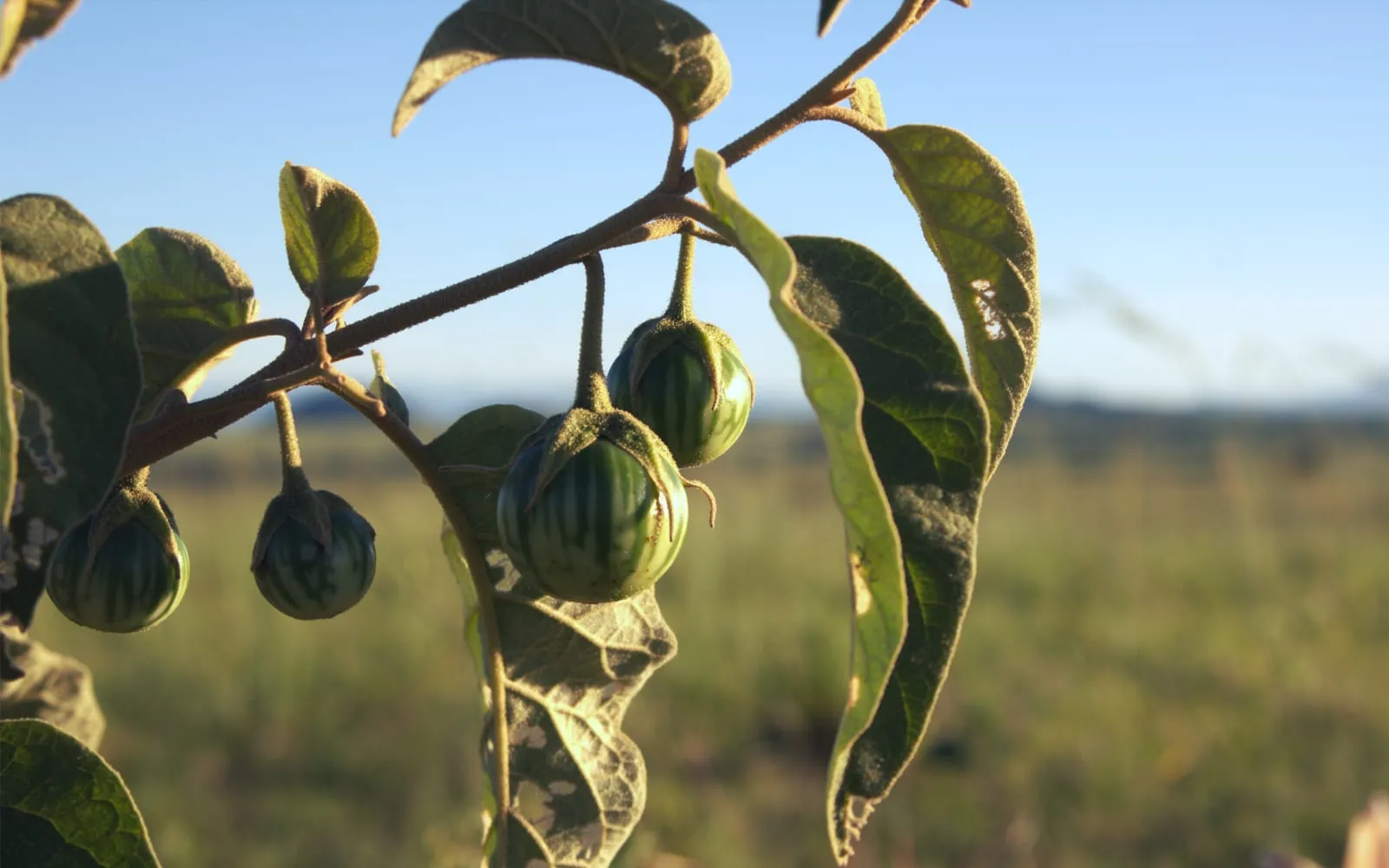
Leaves are broad and ovate with shallow lobes, 10 to 25 cm long, softly hairy, larger and thinner than a common aubergine’s.
Flowers are typical Solanum, 2 to 3 cm across, white to pale violet with a protruding cone of yellow anthers, in small clusters.
Fruit changes colour as it goes. Young fruit is white, cream or green, often striped; it ripens through orange to a strong scarlet red, and it is usually eaten at the pale or green stage rather than red.
Shape runs from a flattened ribbed tomato to a small round ball to a slim egg, 3 to 8 cm across.
Cut open, the flesh is white to greenish with numerous small flat seeds, and it firms and darkens with age.
The leaf-type cultivars look quite different, being lower, broader-leaved and grown as a cut-and-come-again green.
Where it is from
Solanum aethiopicum was domesticated in West and Central Africa from the wild Solanum anguivi, and it is one of the small number of vegetables that are entirely African in origin despite the Ethiopian name.
Cultivation spread across the continent, and it is now among the most important vegetables in Nigeria, Uganda, Cameroon, Ghana and the Democratic Republic of the Congo, grown both for fruit and for leaves.
Portuguese trade carried it to Brazil, where it became jilo and is a standard market vegetable in Minas Gerais and Rio de Janeiro, cooked with beef or fried in slices.
Southern Italy grows a small amount as a curiosity crop, and it turns up in Caribbean gardens.
It turns up in African and Caribbean grocers across Europe and North America, usually as small scarlet or striped fruit sold loose, and seed is now easy to buy from specialist suppliers.
How it grows
Sow in March or April at 22 to 25 deg C, as you would an aubergine, in modules or small pots.
Germination takes one to three weeks and is unreliable below 20 deg C.
Prick out into 9 cm pots and grow on warm and bright.
Plant out into a greenhouse or polytunnel border in late May or June, 45 to 60 cm apart, once nights hold above 12 deg C.
Give full sun and warmth. It is more tolerant of cool nights than a common aubergine but it still wants heat.
Pinch the growing tip at about 30 cm to make the plant branch, which increases the number of fruit.
Stake taller cultivars, since a plant carrying a heavy crop leans.
Water and feed steadily from the first flower.
Harvest fruit young, at the pale or green stage for most cultivars, when the skin is glossy and the flesh still firm.
Pick leaves as a cut-and-come-again crop from the leaf-type cultivars, taking the young growth from the tips.
Through the seasons
March and April are for sowing warm, on a propagator.
May is growing the young plants on somewhere bright and frost free.
June is planting out under cover.
July is branching growth and the first flowers, and the point to pinch the tips.
August is the main fruiting month, and the leaves are at their best for picking too.
September carries on, with fruit colouring up if left on the plant.
October ends it as the light fails.
Winter does not apply, though a plant kept warm and bright will survive to a second year and crop earlier.
Care difficulty
Moderate, and easier than a common aubergine under glass.
Germination needs 22 deg C and a little patience.
The plant is more tolerant of cool nights and less prone to sulking than Solanum melongena.
Red spider mite and whitefly are the two pests that decide how long the crop lasts.
Picking at the right stage takes learning, since the fruit changes fast.
Grown as a leaf crop it is easier still, and it crops from July to October.
Watering
Water twice a week from planting out.
Increase once fruit is setting, since irregular watering makes the fruit bitter and seedy.
Keep the plant evenly moist rather than swinging between dry and soaked.
Water at the root in the morning.
Mulch to hold moisture.
Reduce in October as the plant slows.
Warning signs, diseases and pests
Fine pale stippling with webbing under the leaves is red spider mite, and it is the main reason a greenhouse crop finishes early.
Clouds of small white insects rising from the plant are whitefly.
Curled tips with sticky residue are aphids.
Flower buds dropping without setting means cold nights or dry roots.
Fruit turning red on the plant is ripe rather than spoiled, though it will be seedier and more bitter than at the pale stage.
Grey fuzzy mould on a damaged fruit is botrytis in still humid air.
A plant that wilts in the middle of the day and does not recover, with brown staining in a cut stem, is verticillium wilt, and the border needs a rest from solanums.
Bitterness far beyond the usual usually follows a drought.
Colorado potato beetle strips outdoor plantings across North America and continental Europe, striped black and cream with a humpbacked orange grub. Hand-picking from shoot emergence keeps it off a garden-scale planting. It has never established in Britain, where DEFRA treats a sighting as notifiable.
Growing environment
A greenhouse or polytunnel where summers are cool. Outdoors is possible in a hot summer against a wall.
Full sun.
Minimum 12 deg C, with 22 to 30 deg C for growth.
Rich free-draining soil with compost dug in.
Spacing of 45 to 60 cm.
A stake for the taller fruiting cultivars.
Good ventilation, which keeps red spider mite and botrytis down.
Feeding
Dig in garden compost before planting.
Feed a balanced liquid feed fortnightly from planting out.
Switch to a high-potash tomato feed once the first fruit sets.
Feed weekly through the main cropping period.
Feed the leaf-type cultivars a balanced feed throughout instead, since leaf is the crop.
Stop feeding at the end of September.
Troubleshooting
Is this a tomato or an aubergine? An aubergine. Solanum aethiopicum is in the same genus as the common aubergine and looks like a tomato by coincidence rather than by relationship.
Why is it bitter? Because it is meant to be. The fruit carries more glycoalkaloid than a common aubergine and the bitterness is what African and Brazilian cooks want in the dishes it goes into.
When should I pick it? For most cultivars, at the pale cream or green stage when the skin is glossy and the flesh firm. Left to redden it grows seedier and more bitter.
Can I eat the leaves? Yes, cooked. The Shum group is grown specifically for them and they are a staple green in Uganda under the name nakati. Take the young growth from the tips.
Do I need to salt it like an aubergine? Not usually. Salting draws out some bitterness if a particular fruit is stronger than you want.
Can I grow it outdoors in a cool climate? Against a hot wall in a mild district, in a good summer, you may get a crop. Under cover is far more reliable.
What is jilo? The Brazilian name for the Gilo group, sold in every market in Minas Gerais and fried in slices.
Is it prickly? Some cultivar groups are, particularly the Aculeatum group. Check the description before you buy seed if that matters to you.
My plant wilted and will not recover. Cut a stem and look for brown staining in the tissue. Verticillium wilt is common where tomatoes and aubergines have grown in the same border for years, so use fresh site or fresh compost.
Ethiopian Eggplant problem guides
Not sure what is wrong? See the common vegetable pests guide.
- Red spider mite, which is the main pest under glass
- Whitefly, which aubergines attract as readily as tomatoes
- Aphids on soft growth
- Grey mould on damaged fruit in a still humid greenhouse
- Verticillium wilt in a border used for tomatoes year after year
- Colorado potato beetle where grown outdoors across North America and continental Europe