
Edible
Long Pepper
Piper longum
Also known as Pippali, Indian long pepper
How to grow long pepper, Piper longum. The whole spike used as a spice, the Roman trade that valued it above black pepper, and why chilli displaced it.
At a glance
- Difficulty
- Difficult
- Water
- Two or three times a week in summer, sparingly in winter
- Light
- Bright indirect light or dappled shade
- Temperature
- Damaged below 12 deg C and killed by frost
- Humidity
- High
- Hardiness
- USDA 10-12, RHS H1b, hardy to 12 C
- Type
- Tender evergreen perennial climber or trailing shrub
- Height
- 1-3 m
- Native to
- South Asia
- Best month
- July and August in the Northern Hemisphere, January and February in the Southern Hemisphere
Wet forest of India and Indochina. A smaller and more shade-demanding climber than black pepper, cropping from the second year.
Hardiness zones describe winter cold alone. Summer heat, humidity, rainfall and the length of the growing season decide as much, so treat the range as the outer limit rather than as a recommendation.
Every month named in this guide is for the temperate Northern Hemisphere. If you garden in the Southern Hemisphere, shift each one by six months, so July becomes January. Closer to the equator the wet and dry seasons matter more than the calendar, and the shift stops being a useful guide.
Not known to be toxic
- Safe to eat
- The fruit spikes
Non-toxic in food use. Long pepper is a culinary spice with a very long record of use and it appears on neither the RHS list of potentially harmful garden plants nor the ASPCA list. It also has a substantial place in Ayurvedic medicine, where it is used in preparations at doses well above culinary amounts, and standard references advise against those in pregnancy. Piperine and the related alkaloids are irritant in concentrated form, as they are in black pepper. The spice in cooking is safe and the medicinal preparations are a separate matter.
Sources: RHS potentially harmful garden plants, ASPCA toxic and non-toxic plants
About
Long pepper is used whole. The spice is the entire fruiting spike, a small grey-brown cone two or three centimetres long made of many tiny fruits fused together, and it is ground or crumbled rather than picked apart.
The flavour is hotter than black pepper and sweeter, with a lingering heat and a faint note of nutmeg and cinnamon behind it.
For centuries it was the more valuable of the two peppers. Roman writers distinguished them clearly and priced long pepper higher, and it stayed in European cooking until the sixteenth century. Chilli arriving from the Americas displaced it almost completely in the West, and it survived in India, Indonesia and north Africa.
Outside the subtropics it is a greenhouse plant. It wants the same heat and humidity as black pepper and it is a smaller, more manageable vine.
Appearance and character
A slender trailing or climbing perennial, 1 to 3 m, rooting where the stems touch the ground and climbing where it has support.
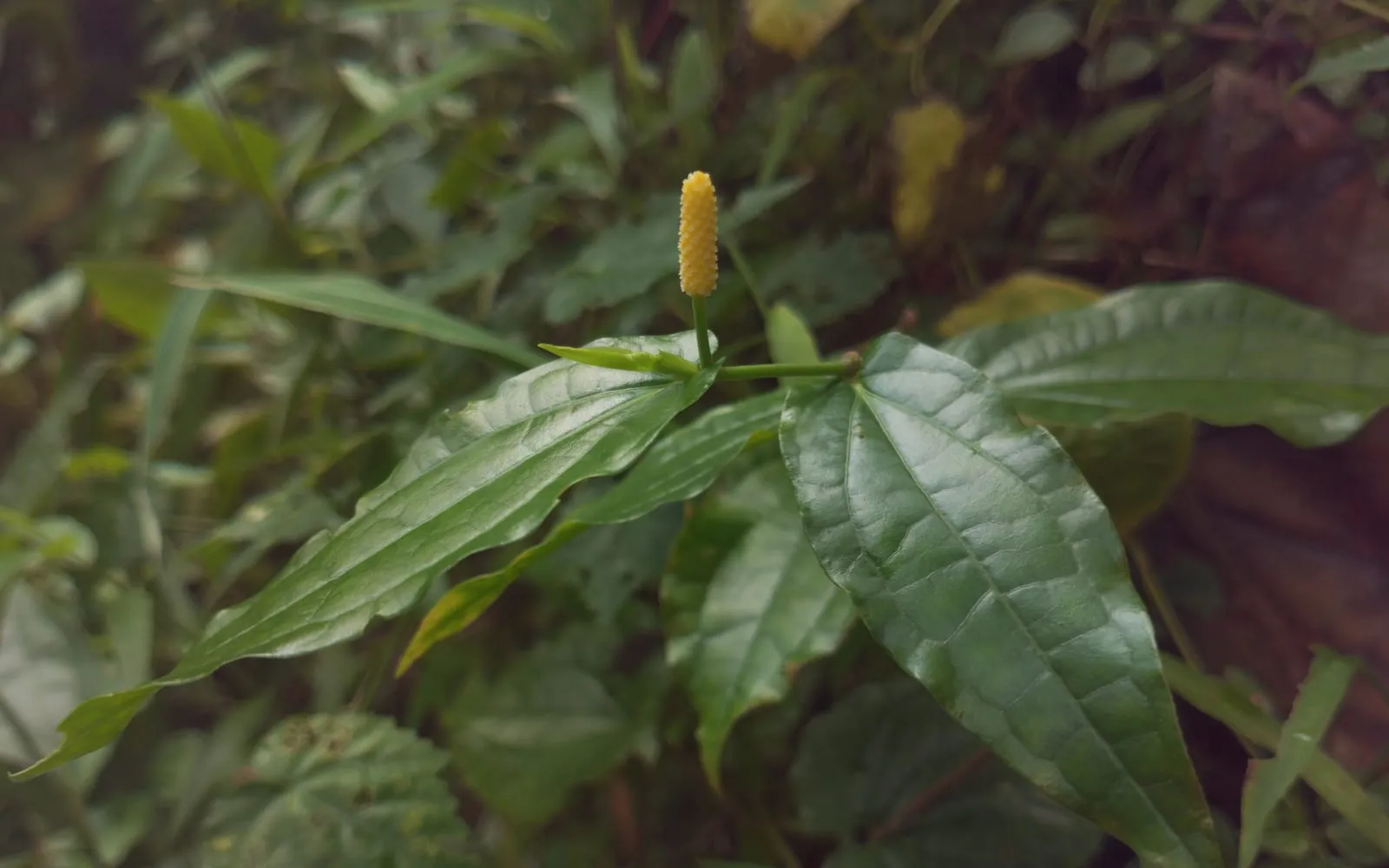
Leaves are heart-shaped, glossy dark green, 5 to 10 cm, with prominent veins curving from the base. The lower leaves are broader and the upper ones narrower.
Flowers are tiny and packed into upright cylindrical spikes at the leaf axils, with male and female spikes on separate plants in the wild.
Fruit is the spice. A dense cylindrical spike 2 to 3 cm long, made of many small fruits fused into a single cone, ripening from green to red and dried to grey-black.
The scent is peppery and sweeter than black pepper, with a warm note behind the heat.
The plant is smaller and less vigorous than black pepper, which makes it easier to accommodate under glass.
Where it is from
Long pepper is native to India and Nepal, particularly the foothills of the Himalaya and the Western Ghats, and it is cultivated across south and south-east Asia.
It reached the Mediterranean early and was the pepper that classical writers prized. Theophrastus distinguished long from round pepper in the fourth century BC, and Pliny recorded that long pepper cost around four times what black pepper did.
Medieval European cooking used it heavily, and English recipe collections from the fourteenth century call for it alongside black pepper and grains of paradise.
Chilli ended its European career. Once capsicums arrived from the Americas in the sixteenth century they supplied heat far more cheaply, and long pepper disappeared from European kitchens within a couple of generations.
It remains important in India as pippali, one of the three peppers in the Ayurvedic preparation trikatu, and it is used in Indonesian, Malaysian and north African cooking.
How it grows
Take cuttings, which is the usual route. Stem cuttings with three or four nodes root in warm humid conditions, and the plant roots readily at the nodes anyway.
Seed works if fresh, sown at 25 deg C, and it is rarely available.
Pot into rich humus-rich free-draining compost with a support to climb, or let it trail from a hanging pot.
Grow it in a heated greenhouse or conservatory at a minimum of 15 deg C.
Keep the humidity high. Dry air is what defeats most attempts with the peppers.
Give it dappled light rather than direct sun through glass.
Water regularly in summer and sparingly in winter.
Expect flowering from the second or third year on a well-grown plant.
Harvest the spikes when they are still green or just turning, since the flavour is at its best before full ripeness, and dry them whole in the sun or a very low oven.
Through the seasons
Winter is survival under glass above 15 deg C, watered sparingly with the humidity kept up.
Spring brings new growth from April. Repot, take cuttings and start feeding.
Early summer is rapid growth and flowering on an established plant.
Midsummer is when the spikes develop.
Late summer is harvest, cutting the spikes while still green or barely colouring.
Autumn is when to reduce watering and stop feeding as growth slows.
Care difficulty
Difficult outside the tropics for the same reasons as black pepper, and slightly easier because the plant is smaller.
Heat is the requirement. Minimum 15 deg C and preferably 20 deg C or more, which means a heated greenhouse or conservatory.
Humidity matters as much as heat. This is a monsoon forest plant and dry heated air causes the leaf browning and spider mite that finish most attempts.
Overwatering a cool plant in winter rots the roots.
Propagation is easy, which is the one straightforward part. The stems root at the nodes and cuttings take readily in warmth.
As a foliage plant it is attractive and manageable, and the spice is a bonus on a plant that has been kept well for a few years.
Watering
Water two or three times a week in summer, keeping the compost evenly damp.
Water sparingly in winter, letting the surface dry between times.
Never leave the pot standing in water.
Use tepid water in winter and rainwater where the tap water is hard.
Raise the humidity by misting, by standing the pot on damp gravel and by grouping plants.
Reduce watering from September as growth slows.
Warning signs, diseases and pests
Brown leaf edges and steady decline mean dry air, cold, or both.
Spider mite shows as fine stippling with webbing and thrives in dry heated air. Raise the humidity and use a predatory mite.
Mealybug sits in the leaf axils as white waxy fluff. Dab it out with a cotton bud.
Scale insects appear as brown limpets on the stems with sticky honeydew below.
Root rot from cold wet compost softens the base and kills the plant.
Leaf drop in winter usually means the plant is too cold.
No flowering on a young plant is normal. On an older plant it means too little warmth or light.
Growing environment
A heated greenhouse or conservatory. There is no outdoor option outside the tropics.
Minimum 15 deg C and preferably above 20 deg C.
High humidity throughout the year.
Bright indirect light or dappled shade, out of direct sun through glass.
Rich, humus-rich, free-draining compost, with a support to climb or a hanging pot to trail from.
pH from 5.5 to 7.
The plant is smaller than black pepper and suits a conservatory better, needing less headroom and less root space.
Feeding
Feed a balanced liquid feed fortnightly from May to August.
Potash suits a fruiting plant better than heavy nitrogen.
Stop feeding from September and give nothing over winter.
Repot into fresh compost every second spring.
Organic matter in the compost suits a forest floor plant better than fertiliser alone.
Troubleshooting
How do I use it? Whole or crumbled. The spike is the spice, ground or broken up rather than picked apart. It is hotter than black pepper and sweeter, with a warm note behind the heat.
Why is it so hard to buy? Chilli displaced it in European cooking in the sixteenth century and it never came back. It remains common in India, Indonesia and north Africa, and specialist specialist spice merchants stock it.
Is it related to black pepper? Yes, same genus. Piper longum and Piper nigrum are close relatives with different fruit structures.
It has never flowered. A plant needs two or three years and consistent warmth. Cool or dim conditions delay it further.
The leaves went brown at the edges. Dry air or cold. Raise the humidity and the temperature.
When do I harvest? While the spikes are still green or barely colouring, which is when the flavour is best, then dry them whole.
Can I grow it indoors? In a warm humid room as a foliage plant, yes. Fruit needs a heated greenhouse.