
Edible
Foxtail Millet
Setaria italica
Also known as Italian millet, German millet, Xiaomi, Kangni
How to grow foxtail millet, Setaria italica. The bristly head that gives it its name, a domestication as old as rice, and the weed it was made from.
At a glance
- Difficulty
- Moderate
- Water
- Water at sowing, then very little
- Light
- Full sun
- Temperature
- Wants 20-30 deg C and will not germinate below 10
- Hardiness
- USDA 8-11, RHS H2, hardy to 10 C
- Type
- Fast tender annual grass
- Height
- 60-150 cm
- Native to
- northern China, the Yellow river basin
- Best month
- May and September in the Northern Hemisphere, November and March in the Southern Hemisphere
The oldest cultivated millet in east Asia and one of the fastest crops there is, ripening in sixty to ninety days, which is what lets it fit between two other crops or salvage a season after a failed sowing. It uses less water than any cereal except proso millet. Soil must reach about 15 C before sowing, and it is a short-day plant, so long high-latitude days delay heading.
Hardiness zones describe winter cold alone. Summer heat, humidity, rainfall and the length of the growing season decide as much, so treat the range as the outer limit rather than as a recommendation.
Every month named in this guide is for the temperate Northern Hemisphere. If you garden in the Southern Hemisphere, shift each one by six months, so May becomes November. Closer to the equator the wet and dry seasons matter more than the calendar, and the shift stops being a useful guide.
Not known to be toxic
- Safe to eat
- The grain, hulled and cooked
Foxtail millet contains no gluten and carries no toxic compound worth naming. It is eaten daily by tens of millions of people across northern China and southern India, and it is sold in Britain mostly as birdseed and as sprays for cage birds. The grain has to be hulled before eating, since the hull is tight and indigestible, and birdseed millet is sold unhulled. Millets in general have a longstanding association with goitre in populations where a single millet supplies most of the diet, and that association is strongest for pearl millet rather than for this species. Nothing about it is relevant to anyone eating a mixed diet.
About
Foxtail millet is the second most widely grown millet in the world and one of the oldest crops anywhere. Northern Chinese farmers domesticated it from green foxtail around 6000 BC, at about the same time and in about the same place as proso millet, and the two of them fed the Yellow river civilisations for thousands of years before wheat and rice arrived from elsewhere.
It remains a staple in parts of northern China, where xiaomi porridge is everyday food, and in southern India, where it is one of the small millets grown on dry land. It grows fast, tolerates drought, and produces a crop off soil that would give a wheat sowing nothing.
The wild ancestor is still a common weed almost everywhere. Green foxtail, Setaria viridis, comes up in disturbed ground and in bird-feeder spillage, and it looks like a slighter version of the crop. It has also become a laboratory model for research into C4 photosynthesis, because it is small, fast and easy to transform.
Appearance and character
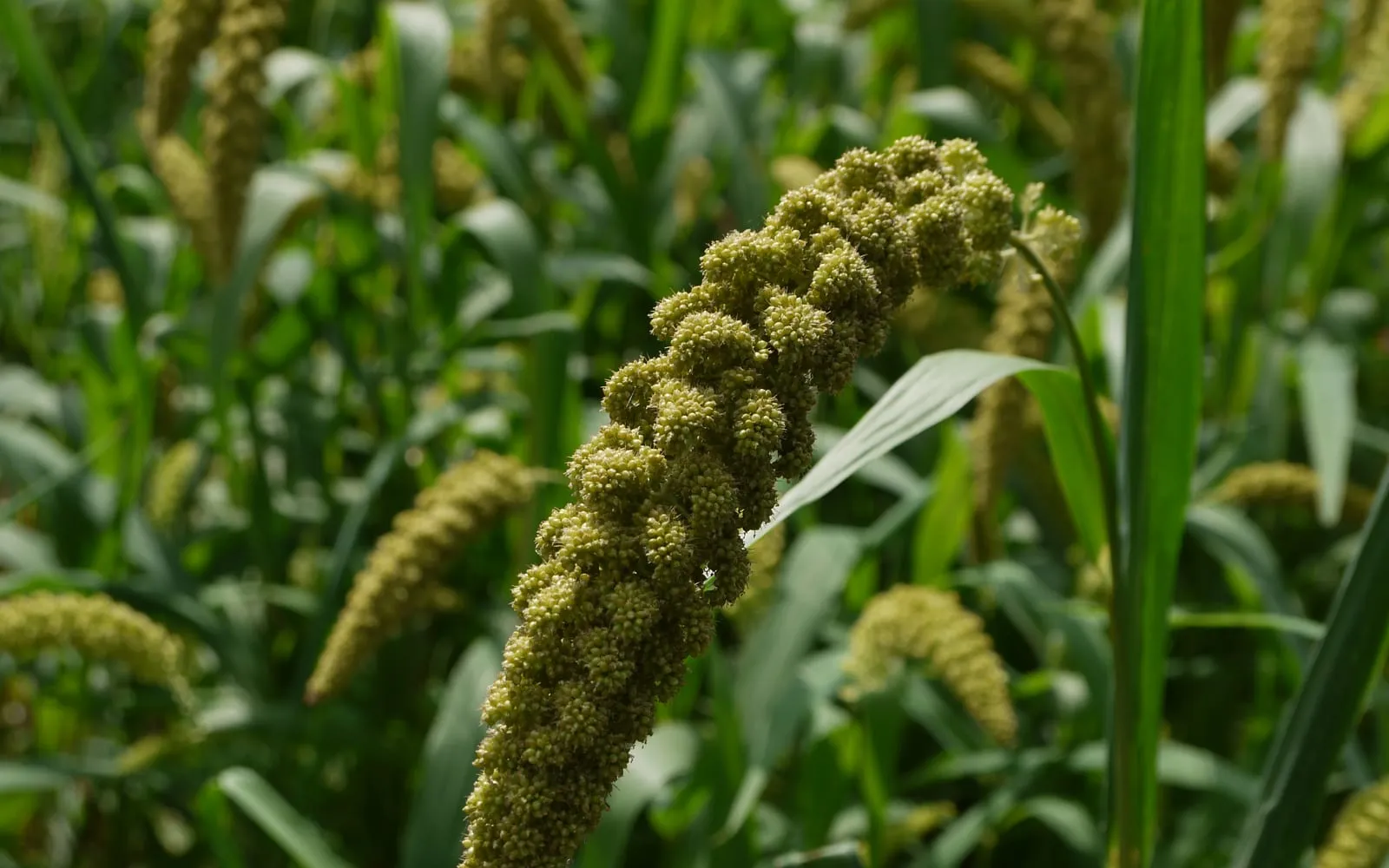
The head is the identification and the reason for the name. Foxtail millet carries a dense cylindrical panicle 10 to 30 cm long, packed so tightly that it looks solid, with fine bristles standing out all over it. The whole thing resembles a fat caterpillar or a bottle brush, and it usually nods over as the seed fills.
The colour varies by variety from pale green through yellow and orange to a deep red-brown, and a mixed planting is a striking thing in late summer.
The plant is a slender grass with narrow leaves and fine stems, and it tillers moderately. The seed is tiny, around 2 mm, shiny and enclosed in a tight hull. Hulled, it becomes a small pale yellow bead that cooks in twenty minutes.
Where it is from
Foxtail millet was domesticated in northern China from green foxtail, Setaria viridis, which grows wild across Eurasia. Archaeological remains from Cishan and Xinglonggou in northern China date cultivation to around 6000 BC.
The crop spread west across the steppe early, reaching central Asia and eastern Europe in the Bronze Age. Romans grew it, and the name Italian millet records European cultivation rather than any Italian origin.
It moved south and east into India, Korea and Japan, and in India it joined the group of small millets grown on dry land in the Deccan. Chinese production remains the largest in the world, and India is second.
How it grows
Foxtail millet germinates in five days in warm soil and grows quickly. It tillers from the base, throws up its head at about six to eight weeks, and finishes grain fill three to four weeks later.
It uses C4 photosynthesis, the efficient pathway that maize, sorghum and sugar cane also use, which lets it build tissue quickly while water is available. Its drought tolerance comes from that speed rather than from deep rooting, since the root system is shallow and fibrous.
The plant is self-pollinating and the head ripens from the top down. Ripe seed shatters less readily than proso millet’s, which makes harvest a little more forgiving, though it will still shed if left standing too long.
Through the seasons
Sow from late May once the soil has reached 15 deg C. Rows at 20 cm suit a seed crop, and shallow sowing at about 1 cm is right for such a small seed.
Growth is fast through June and July, and heads appear from mid-July on a late May sowing. The bristly panicles colour through August.
Harvest in September when most of the seed is hard. Cut the heads, dry them under cover, and rub the seed out. It still needs hulling before it can be eaten, and that is the difficult part.
Care difficulty
Foxtail millet grows itself once the soil is warm enough, and it is one of the more decorative cereals to have on a plot. Sow in late May, keep the slugs off early, net the heads before they colour.
Two problems. Birds treat a ripening head as a gift, since this is exactly what they are used to eating from a feeder. And the hull is tight, so eating your own crop takes equipment nobody has at home.
Do not sow before the soil is warm. Cold ground gives ragged germination and hands the surviving seedlings to the slugs, which is the commonest way a sowing in a cool climate fails.
Watering
Water at sowing to get even germination, and afterwards leave it alone. The crop is adapted to dryland farming and needs little once it is established.
A deep soak during a long dry spell in July supports the head as it fills. Light frequent watering is worse than none, because it keeps the shallow roots at the surface.
Waterlogging kills it. The root system is fine and fibrous and rots in standing water, so a free-draining bed matters far more than a rich one.
Warning signs, diseases and pests
Birds are the pest that costs the crop. Foxtail millet sprays are sold as cage bird treats, and wild birds recognise them immediately. Net the plants from the moment the heads begin to fill.
Head smut turns part or all of the panicle into a mass of dark spores. Cut and burn affected heads rather than composting them, and do not save seed from a crop where it appeared.
Downy mildew produces pale streaks on the leaves and can deform the head into a leafy green structure that sets no seed. It is uncommon outside the crop’s main growing regions.
Slugs take seedlings in a cool damp start. Aphids gather on the growing tips in a hot dry summer and rarely amount to much. Frost ends the crop at both ends of the season, which sets the sowing and harvest windows.
Fall armyworm feeds hidden in the whorl and can kill a seedling outright, and it has spread across Africa since 2016, Asia since 2018 and Australia since 2020. Check the whorl for frass from the seedling stage where it occurs. It has not established in Europe or New Zealand.
Growing environment
Full sun and a warm free-draining site. This is a warm-season C4 grass, and it does nothing useful in a cool shaded corner.
Soil should be light and can be poor. The crop grows on sand and thin ground, tolerates a pH from 5.5 to 8, and produces where wheat would not be worth sowing. Rich soil produces height and lodging.
The temperature limits are the practical constraint. Soil must reach 15 deg C for a clean sowing, growth needs 20 deg C and above, and frost kills the plant outright.
Feeding
Feed foxtail millet lightly or not at all. It is a short-season crop that takes what the soil offers, and extra nitrogen produces a taller softer plant that falls over before the seed has filled.
On exhausted ground a single dressing of a balanced granular feed worked in before sowing is reasonable. On a bed that grew a fed crop last year, apply nothing.
Its low demand is part of what the crop is for. It goes in late, after something else has come out or failed, and produces from soil that has already given a crop that year.
Troubleshooting
Why is it called foxtail? The head. It is a dense cylindrical bristly panicle that nods over as it fills, and it looks like a fat brush or an animal’s tail.
Is this the millet in birdseed? Some of it. The sprays sold as treats for budgerigars and canaries are foxtail millet heads. The pale round loose seed in a wild bird mix is more often proso millet.
Is it the same as the foxtail weed in my garden? It is the crop bred from it. Green foxtail, Setaria viridis, is the wild ancestor and a common weed of disturbed ground. The crop is bigger in every part and its head is far denser.
How do I hull it? With difficulty, as with every millet. A grain mill set very wide cracks a proportion, and rubbing and winnowing removes some. Buy hulled millet to eat and grow this one for the look of it.
Is it gluten-free? Yes. All millets are, and none is related to wheat in any useful way.
When should I sow? Late May at the earliest, and only once the soil is above 15 deg C. Sowing into cold ground gives patchy germination and the slugs take what comes up.
How is it different from proso millet? Different genus and a completely different head. Foxtail is Setaria with a dense cylindrical bristly panicle. Proso is Panicum with a loose open panicle that droops to one side.
Foxtail Millet problem guides
Not sure what is wrong? See the common vegetable pests guide.
- Birds, which find a ripening head within a day
- Aphids on the growing tips
- Slugs on seedlings in a cool damp start
- Head smut, which turns the panicle into a mass of dark spores
- Frost at either end of the season, which the crop does not survive
- Fall armyworm, established across Africa, Asia and Australia since 2016