
Edible
Millet
Panicum miliaceum
Also known as Broomcorn millet, Common millet, Hog millet, Panic millet
How to grow proso millet, Panicum miliaceum. The fastest cereal there is, ready in sixty days, and the grain that fed northern China before rice arrived.
At a glance
- Difficulty
- Moderate
- Water
- Almost none. It uses less water than any other cereal
- Light
- Full sun
- Temperature
- Wants 20-30 deg C and will not germinate below 10
- Hardiness
- USDA 4-11, RHS H2, hardy to 10 C
- Type
- Fast tender annual grass
- Height
- 60-120 cm
- Native to
- northern China, the Yellow river basin
- Best month
- May, June and September in the Northern Hemisphere, November, December and March in the Southern Hemisphere
It has the lowest water requirement of any cereal and one of the shortest seasons, at sixty to ninety days, which is why it is grown on the dry margins of the American high plains, Russia and China where nothing else will finish. It is shallow-rooted rather than drought-resistant in the usual sense, and it succeeds by escaping drought rather than enduring it. Soil needs about 15 C to germinate.
Hardiness zones describe winter cold alone. Summer heat, humidity, rainfall and the length of the growing season decide as much, so treat the range as the outer limit rather than as a recommendation.
Every month named in this guide is for the temperate Northern Hemisphere. If you garden in the Southern Hemisphere, shift each one by six months, so May becomes November. Closer to the equator the wet and dry seasons matter more than the calendar, and the shift stops being a useful guide.
Not known to be toxic
- Safe to eat
- The grain, hulled and cooked, and the whole seed as bird food
Proso millet contains no gluten and no toxic compound worth naming. It is one of the safer grains, and it is sold across Europe mostly as the pale round seed in wild bird and budgerigar mixes. Millet has a longstanding association with goitre in populations where it makes up most of the diet, because pearl millet in particular contains compounds that interfere with iodine uptake, and proso millet carries less of that than pearl millet does. Neither is relevant to anyone eating a mixed diet. The grain must be hulled before eating, since the hull is indigestible, and birdseed millet is sold unhulled.
About
Proso millet is the quickest cereal in cultivation. It takes sixty to ninety days from sowing to harvest, against a hundred and twenty for spring wheat, and it needs less water per kilogram of grain than any other grain crop measured. Those two properties have kept it in agriculture for eight thousand years as the crop you sow when something else has failed.
Northern China domesticated it, and it fed the Yellow river civilisations before rice moved north. Sites at Cishan in Hebei have produced millet remains dated to around 6000 BC and possibly earlier, which makes it one of the earliest cultivated plants anywhere.
Much of Europe knows it only as birdseed. The pale round seeds in a budgerigar mix and in most wild bird food are proso millet, and a spilled feeder frequently produces a crop under it. As human food it is eaten across Russia, China, India and eastern Europe as porridge and flatbread.
Appearance and character
The plant is a modest tufted grass with broad, softly hairy leaves and hollow stems, standing knee to waist high. It has a slightly shaggy look next to the tidier cereals, and the leaf sheaths carry noticeable hairs.
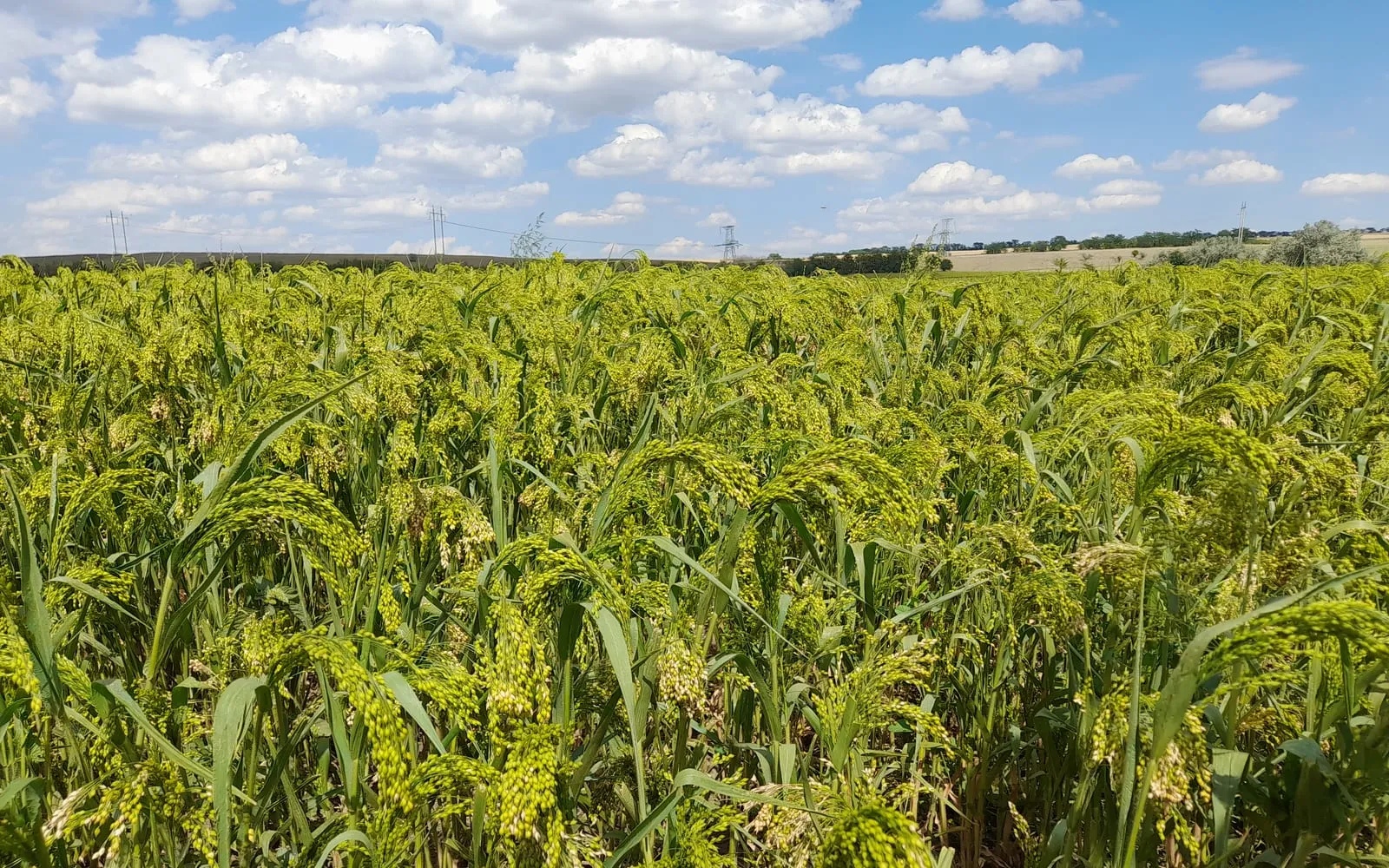
The panicle is the field mark. It is loose, open and heavy, and it droops to one side as the seed fills, which gives the plant its old English name of broomcorn millet. Each branch carries seeds at the tip rather than along its length.
The grain is round, about 3 mm across, and shiny under a tight hull that comes in white, cream, yellow, red, brown or almost black depending on the variety. Hulled, it is a small pale yellow bead that cooks in fifteen minutes to something between couscous and polenta.
Where it is from
Proso millet was domesticated in northern China from a wild Panicum ancestor, with the earliest secure archaeological evidence from Cishan in Hebei at around 6000 BC. It may share that region with foxtail millet, which was domesticated on a similar timetable.
The crop spread west across the Eurasian steppe remarkably early, reaching central Asia and eastern Europe in the Bronze Age. Millet grains turn up in European sites from around 2000 BC, and its speed made it valuable to mobile and pastoral societies who needed a crop that could be sown late and harvested before they moved on.
It reached north-west Europe but never took hold, since the climate there suits oats and barley better. Today the largest producers are Russia, China, India and Ukraine, and the United States grows a substantial crop for the bird food market.
How it grows
Proso millet germinates in four or five days in warm soil and grows fast. It tillers modestly, throws up its panicle within six weeks of sowing, and finishes grain fill three to four weeks after that.
The root system is shallow and fibrous, which sounds like a weakness for a drought crop. What makes proso drought tolerant is speed. It completes its life cycle before the soil dries out, using C4 photosynthesis to build tissue efficiently while the water lasts.
Ripening is uneven within a panicle, with the top seeds maturing well before the bottom ones, and the ripe seed shatters. Harvest is therefore a compromise, cut when about two-thirds of the seed has hardened, and some loss is unavoidable.
Through the seasons
Sow from late May into soil that has reached 15 deg C, and not before, since cold soil gives ragged germination. Broadcast thinly or sow in rows at 20 cm and rake in shallowly.
The crop emerges within a week and grows fast through June and July. Panicles appear from early July on a late May sowing, and the plant flowers within days of heading.
Harvest from late August into September, cutting when about two-thirds of the seed has hardened and before the birds have taken the rest. Dry the panicles under cover, thresh by beating them in a bag, and winnow. The seed still needs hulling to be eaten.
Care difficulty
Growing proso millet is easy and eating it is the hard part. The plant needs warmth to germinate, then grows itself, and it will produce a crop in a poor summer that would defeat maize or sorghum.
Birds are the main obstacle. This is birdseed, and a small patch of ripening panicles in a temperate garden will be found within a day. Net it as soon as the seed starts to fill.
Hulling is the second obstacle. The hull is tight, and no domestic appliance does the job well. A grain mill set very wide cracks some of them, rubbing between hands takes off a proportion, and most home growers end up feeding the crop to the birds it was going to attract anyway.
Watering
Proso millet uses less water per kilogram of grain than any other cereal, and in a temperate climate it needs next to none once it has germinated.
Water at sowing if the ground is dry, to get even emergence. After that, leave it alone. The plant’s strategy is to finish before the water runs out rather than to find more of it.
Waterlogging kills it. The roots are shallow and fibrous and they rot quickly in standing water, so a free-draining bed matters far more than a fertile one.
Warning signs, diseases and pests
Birds are the pest, and the crop’s use as birdseed tells you why. Pigeons, sparrows and finches will strip a small patch of ripening panicles within days, and netting from the start of seed fill is the only reliable answer.
Disease is uncommon in a short-season crop. Head smut appears occasionally, turning parts of the panicle into a mass of dark spores, and affected heads should be cut and burned. Leaf blights show as brown streaks in a wet season and rarely matter.
Shattering costs seed at harvest. Ripe proso drops readily, so cut a little early and finish the drying under cover rather than waiting for the whole panicle.
Slugs take seedlings in a cool damp start, which is an argument for waiting until the soil is properly warm rather than sowing at the first opportunity.
Growing environment
Full sun on a warm free-draining site. Proso millet is a warm-season C4 grass and it does nothing useful in cool shade.
Soil should be light and can be poor. The crop grows on sand and on thin ground where wheat would fail, tolerates pH from 5.5 to 8, and handles a degree of salinity. Rich ground produces leaf and lodging.
The temperature range is the limit rather than the water. Soil needs to reach 15 deg C for sowing, the plant grows properly above 20, and frost kills it. That sets a sowing window from late May and a harvest deadline in early October.
Feeding
Feed proso millet nothing on ordinary garden soil. It is a short-season crop that takes what is available, and extra nitrogen produces a taller softer plant that lodges before the seed fills.
On exhausted ground a light dressing of a balanced feed before sowing is defensible, applied once and not repeated.
The crop’s low nutrient demand is part of its agricultural role. It goes in as a catch crop after something has failed or come out early, and it produces something from soil that has already had a crop taken from it.
Troubleshooting
Is this the millet in birdseed? Yes. The pale round seeds in a budgerigar mix and in most wild bird food are proso millet, and a spilled feeder often produces a crop underneath it.
Can I sow birdseed millet? Often, yes. Whole unhulled seed from a bird food mix will frequently germinate, though some is heat treated to prevent exactly that. Sow a pinch on damp kitchen paper first to check.
How fast is it? Sixty to ninety days from sowing to harvest, which is the quickest of any cereal. That speed is why it survives in agriculture as a replacement crop when a first sowing has failed.
How do I hull it? With difficulty. The hull is tight and there is no good domestic method. A grain mill set very wide cracks some, and rubbing and winnowing removes a proportion. Buy hulled millet to eat and grow this for interest or for the birds.
Is millet gluten-free? Yes, all the millets are, and none of them is a wheat relative in any useful sense.
Why is my panicle drooping to one side? That is the species. The panicle of proso millet is loose and one-sided and hangs over as the seed fills, which is where the name broomcorn millet came from.
What is the difference between this and foxtail millet? Different genus. Proso is Panicum with a loose drooping panicle. Foxtail is Setaria with a dense cylindrical bristly head that looks like a fat caterpillar.
Does it need a hot summer? It needs a warm start. Soil above 15 deg C at sowing matters more than the rest of the season, since the crop is finished before high summer is over.
Millet problem guides
Not sure what is wrong? See the common vegetable pests guide.