
Edible
Pearl Millet
Cenchrus americanus
Also known as Bajra, Bulrush millet, Cattail millet, Sajje
How to grow pearl millet, Cenchrus americanus. The crop that grows where sorghum gives up, a candle-shaped head on a two-metre stem, and the grain that made the Sahel farmable.
At a glance
- Difficulty
- Moderate
- Water
- Almost none once established
- Light
- Full sun
- Temperature
- The most heat tolerant cereal there is, wanting 30 deg C and above
- Hardiness
- USDA 9-11, RHS H2, hardy to 10 C
- Type
- Tender annual grass
- Height
- 150-300 cm
- Native to
- the western Sahel, Mali and Mauritania
It is the crop of the Sahel and it wants more heat and less water than any other cereal, yielding on sand at 30 C and above where sorghum and maize fail. That heat requirement is exactly what a cool summer cannot supply, and grain outside the tropics and subtropics needs a photoperiod-insensitive short-season cultivar and a polytunnel. It tolerates acid and saline soil and a pH down to 4.5.
Hardiness zones describe winter cold alone. Summer heat, humidity, rainfall and the length of the growing season decide as much, so treat the range as the outer limit rather than as a recommendation.
Edible, with limits
- Safe to eat
- The grain, milled or cooked whole
- Do not eat
- Ergot bodies in the head
- Harm from
- Eating it
- Affects
- People
Pearl millet contains no gluten. Two points deserve naming. The crop cross-pollinates and its florets stand open, so it is susceptible to ergot in the same way rye is, and the fungus replaces a grain with a hard dark body carrying alkaloids that constrict blood vessels. Inspect a home-grown head before threshing and discard any carrying one. Second, pearl millet contains goitrogenic compounds that interfere with iodine uptake, and the association between heavy millet diets and goitre is documented in populations where it supplies most of the calories, particularly in Sudan and parts of India. That is a consequence of a monotonous diet in an iodine-poor region rather than a property that matters to anyone eating a mixed diet.
Sources: Food Standards Agency on the 14 named allergens, Food Standards Agency on mycotoxins
About
Pearl millet is the cereal of the last farmable land. It produces a crop on deep sand, in temperatures above 40 deg C, on 300 mm of annual rainfall, in conditions where sorghum fails and where maize would not germinate. The Sahel, the belt running along the southern edge of the Sahara, is farmed because this plant exists.
It is grown on around 30 million hectares worldwide, mostly in west Africa and in India, where it is bajra and the staple grain of Rajasthan and Gujarat. Indian production is the largest in the world and the crop supports tens of millions of people on land that would otherwise carry nothing.
The plant is tall, coarse and fast, with a head like a dense green candle. It is a C4 grass, related to the fountain grasses grown in temperate borders, and the botanical name has changed within living memory from Pennisetum glaucum to Cenchrus americanus, which is why references disagree.
Appearance and character
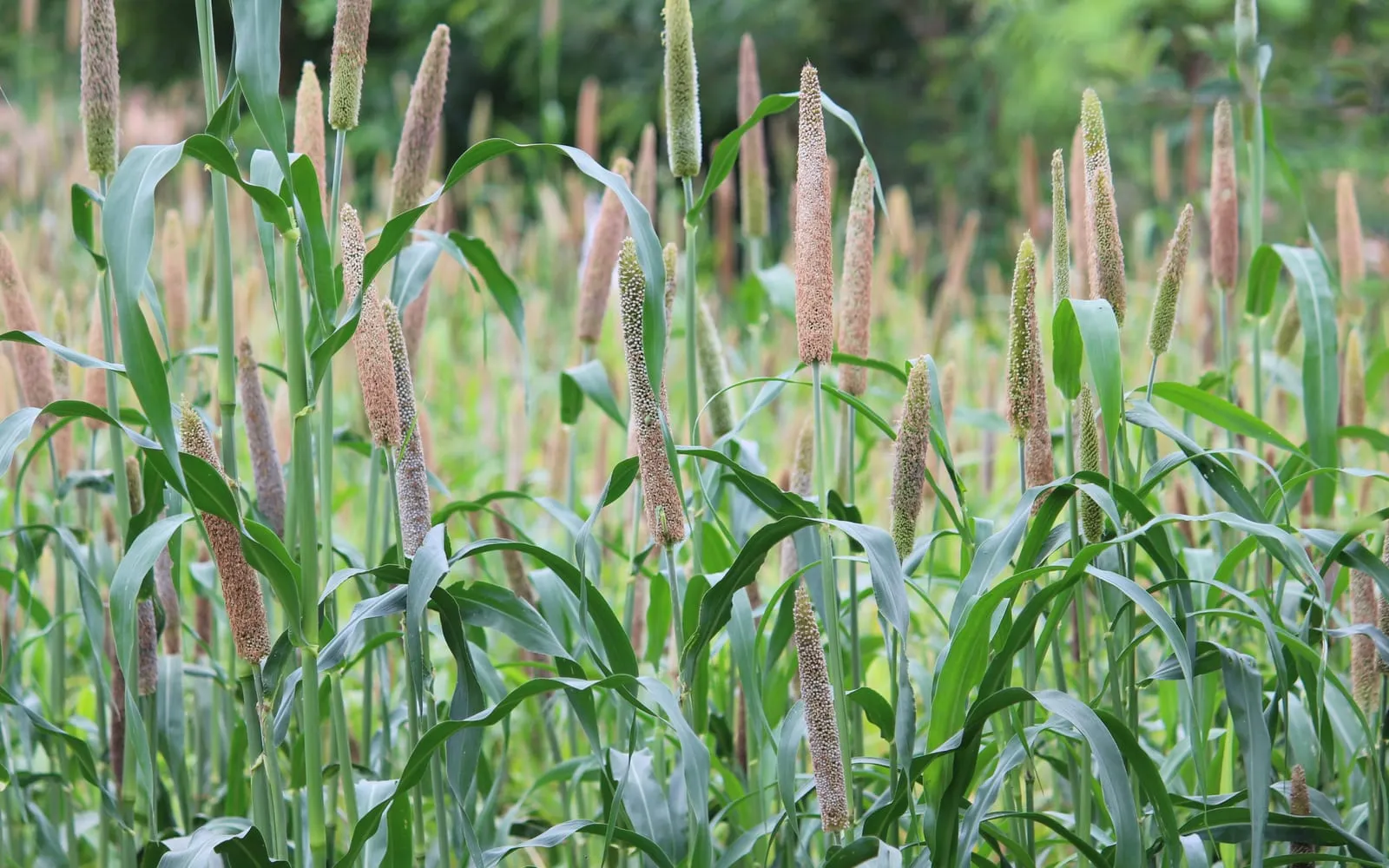
The head is a tight cylindrical spike, 15 to 40 cm long and about as thick as a thumb, standing stiffly upright at the top of the stem. It looks like a bulrush or a large green candle, which is where two of its common names come from.
As the grain fills the head becomes heavy and pale, and the colour of the mature grain ranges from slate grey through white to yellow and purple. The grains are larger than any other millet’s, around 3 to 4 mm, which is where the name pearl comes from.
The plant is tall and coarse, reaching two metres or more, with thick stems and broad leaves carrying a fine bristly edge. It tillers strongly, so one plant produces a clump of several stems each carrying a head, and those heads mature in sequence rather than together.
Where it is from
Pearl millet was domesticated in the western Sahel, in the region of modern Mali and Mauritania, from a wild Cenchrus ancestor. The archaeological evidence puts cultivation there by around 2500 BC, at sites in eastern Mali, which makes it one of Africa’s earliest crops.
It spread east across the Sahel and south into the savanna, and reached India by about 2000 BC, probably through Arabian trade routes. India adopted it thoroughly and it became the staple of the drier north west.
The crop reached the Americas in the transatlantic slave trade and is now grown in the southern United States as a forage and a grain, and in Australia and Brazil. Africa and India still account for the overwhelming majority of the area under it.
How it grows
Pearl millet germinates fast in hot soil, within three days at 30 deg C, and puts its early energy into a deep root system that can reach two metres. That rooting is the basis of its drought tolerance, and it is what separates it from the shallow-rooted millets that survive by finishing early.
Growth is rapid in heat, and a crop can go from sowing to head in six weeks. The plant tillers as it goes, and the tillers head in sequence over a period of weeks, which spreads the harvest and hedges against a bad week of weather.
The crop is cross-pollinated and wind-pollinated, and it is protogynous, meaning the female parts of a flower become receptive before the pollen is shed. A single plant therefore sets little seed, and the open flowers are the reason ergot finds this crop as it finds rye.
Through the seasons
Where summers are cool, start under cover in April and plant out at the end of May, or sow directly in June once the soil is above 18 deg C. Cold ground gives nothing.
Growth is slow in a cool June and rapid through a warm July and August. Heads appear from August, and the tillers follow over the weeks after that.
Harvest from late September, cutting individual heads as they harden. The first frost ends the plant, so a cool summer means the tillers that headed late will never fill. Dry the heads under cover and thresh by rubbing, and the grain comes free of its hull with a bit of work.
Care difficulty
This is the hardest of the millets to bring to grain outside the tropics, and heat is the limit. Pearl millet wants 30 deg C and above and grows properly at temperatures that a cool summer touches for a fortnight in a good year.
Under a polytunnel or against a hot south wall it will produce, and the plant itself asks for nothing beyond warmth. It needs no watering, no feeding worth mentioning, and no protection from anything except birds and frost.
Treat it as a demonstration crop outdoors and as a possible harvest under cover. The head is worth growing for its own sake, since nothing else in a temperate garden looks like a green candle on a two-metre stem.
Watering
Water at sowing and then stop. Pearl millet’s root system goes down two metres in loose soil and it is more drought tolerant than any other cereal in cultivation.
There is no stage at which a crop in a temperate climate needs watering, since the problem there is heat rather than water. In a container the calculation changes, and a large pot will need watering because the roots cannot go anywhere.
Waterlogging is fatal. The crop belongs on deep sand and its roots rot in standing water within days.
Warning signs, diseases and pests
Downy mildew is the disease that costs pearl millet most worldwide. It shows as pale streaks on the leaves with white felt underneath, and in its severe form it converts the head into a mass of leafy green structures that set no seed, a condition called green ear. Affected plants should be pulled and burned.
Ergot appears because the crop cross-pollinates and its florets stand open, in the same way that rye’s do. Look for hard dark bodies protruding from the head and discard any head carrying one, along with a sticky honeydew exudate that precedes them.
Smut turns individual grains into swollen dark spore masses. Cut and burn affected heads.
Birds take a ripening head readily, and the crop’s height makes netting awkward. Slugs take seedlings in a cool start, which is the usual early failure in a temperate climate.
Fall armyworm feeds hidden in the whorl and can kill a seedling outright, and pearl millet is grown across much of the range this pest has spread into since first reaching Africa in 2016, Asia in 2018 and Australia in 2020. Check the whorl for frass from the seedling stage. It has not established in Europe or New Zealand.
Desert locust swarms can strip a pearl millet field to bare stems within hours during an upsurge, across an invasion area spanning North and West Africa, the Middle East and south-west Asia, much of it overlapping the crop’s own growing range. It is the most destructive migratory pest on earth, and a hopper band or swarm should be reported to the national locust control authority immediately.
Growing environment
Full sun and the hottest position available. Pearl millet performs at temperatures that damage other cereals and grows through conditions that stop maize entirely.
Soil should be sand or a light free-draining loam, and poor is better than rich. The crop grows at pH from 5 to 8 and tolerates salinity and aluminium toxicity that would kill most cereals.
A cool summer is at the extreme edge of what the plant will do. A polytunnel, a south-facing wall with a raised bed at its foot, or a large container that can be moved into shelter all improve the odds. Frost ends it completely.
Feeding
Feed lightly. The plant grows to two metres unaided and extra nitrogen produces soft growth that lodges in the first wind.
One dressing of a balanced granular feed at around six weeks is the most a garden crop should get, and on reasonable soil none is needed.
The crop’s efficiency on poor ground is what it was selected for, over four thousand years of farming on sand that nothing else would take. Feeding it generously works against everything the plant is.
Troubleshooting
Why has the botanical name changed? The species moved from Pennisetum glaucum to Cenchrus americanus when molecular work showed Pennisetum sat inside Cenchrus. Older books and seed packets use the old name and mean the same plant.
Is bajra the same as pearl millet? Yes. Bajra is the Hindi name, and bajra roti is the flatbread made from the flour across northern and western India.
Will it fill a head where I am? It wants sustained heat above 30 deg C, which the dry tropics and subtropics supply and a cool summer touches for a fortnight in a good year. Below that you can grow the plant and probably not fill a head, and under a polytunnel the answer changes.
What is green ear? The severe form of downy mildew, which turns the head into a mass of small leafy structures instead of grain. Pull affected plants and burn them.
Will one plant produce seed? Very little. Pearl millet is wind-pollinated and its female parts mature before its own pollen is shed, so it needs a stand of plants flowering together.
Is it gluten-free? Yes, like all the millets.
Why does the head look like a bulrush? Because the spikelets are packed tightly onto a cylindrical axis with no branching visible, which is the same structure that gives a reedmace its shape. Two of the plant’s common names, bulrush millet and cattail millet, record the resemblance.
Is millet linked to thyroid problems? Pearl millet contains compounds that interfere with iodine uptake, and goitre is documented in populations where millet supplies most of the diet in iodine-poor regions. A mixed diet makes it irrelevant.
Pearl Millet problem guides
Not sure what is wrong? See the common vegetable pests guide.
- Downy mildew, the most damaging disease of the crop
- Birds on the ripening heads
- Aphids on the growing tips
- Slugs on seedlings in a cool start
- Ergot, which pearl millet suffers because it cross-pollinates
- Smut in the head
- Frost, which kills the plant outright
- Fall armyworm, established across Africa, Asia and Australia since 2016
- Desert locust, capable of stripping a whole crop in a swarm year