
Edible
Tartary Buckwheat
Fagopyrum tataricum
Also known as Bitter buckwheat, Kuqiao, Himalayan buckwheat, Duckwheat
How to grow Tartary buckwheat, Fagopyrum tataricum. The bitter buckwheat of the Himalaya, self-fertile where its cousin is not, and the highest rutin content of any crop.
At a glance
- Difficulty
- Easy
- Water
- Through establishment, then rain-fed
- Light
- Full sun to light shade
- Temperature
- Tolerates cold better than common buckwheat, and still dies at 0
- Hardiness
- USDA 3-9, RHS H2, hardy to 2 C
- Type
- Fast tender annual, killed by frost
- Height
- 60-150 cm
- Native to
- the eastern Himalaya, western China
- Best month
- May and September in the Northern Hemisphere, November and March in the Southern Hemisphere
Hardier, higher-altitude and more tolerant of cold and poor ground than common buckwheat, which is why it is grown in the Himalaya and south-west China where the common sort will not finish. It self-pollinates rather than needing insects, so it crops reliably in weather that would leave common buckwheat empty. It carries far more rutin and is correspondingly bitter, which is the trade for the hardiness.
Hardiness zones describe winter cold alone. Summer heat, humidity, rainfall and the length of the growing season decide as much, so treat the range as the outer limit rather than as a recommendation.
Every month named in this guide is for the temperate Northern Hemisphere. If you garden in the Southern Hemisphere, shift each one by six months, so May becomes November. Closer to the equator the wet and dry seasons matter more than the calendar, and the shift stops being a useful guide.
Toxic if eaten
- Safe to eat
- The seed, hulled or milled
- Do not eat
- Large quantities of the green plant, for grazing animals
- Harm from
- Eating it and handling it
- Affects
- People and horses
Tartary buckwheat contains no gluten. It carries the same two hazards as common buckwheat, and one of them in a stronger form. Buckwheat allergy can be severe, and in Japan and Korea buckwheat is among the leading causes of food-induced anaphylaxis in children. It is not one of the 14 named allergens in Britain, so British products often do not declare it. The photosensitising pigment fagopyrin is present in the green plant, and Tartary buckwheat carries more of it than common buckwheat does. Livestock fed the green crop and then exposed to sunlight develop fagopyrism, with inflamed and blistered skin on unpigmented areas. Do not graze animals on it. The bitterness of the grain comes from high levels of rutin and from the enzyme that breaks it down, and it is a flavour rather than a toxicity.
Sources: Food Standards Agency on food allergy, British Horse Society on poisonous plants
About
Tartary buckwheat is the mountain sibling of common buckwheat, grown across the Himalaya, Tibet, Yunnan, Sichuan and the Central Asian highlands. It goes higher, stands more cold, and yields more reliably than its better-known cousin, and it tastes bitter, which is why the rest of the world eats the other one.
The bitterness comes with a benefit. Tartary buckwheat carries far more rutin than common buckwheat, sometimes by a factor of a hundred in the seed, and rutin is the flavonoid the plant’s reputation as a health food rests on. Chinese kuqiao tea is made from the roasted grain and is drunk for that reason.
Its other advantage is reproductive. Common buckwheat needs insects to move pollen between two flower forms, and a crop flowering in a cold wet week sets almost nothing. Tartary buckwheat pollinates itself, so it crops in weather and at altitudes where the other fails. That reliability is why Himalayan farming chose it.
Appearance and character
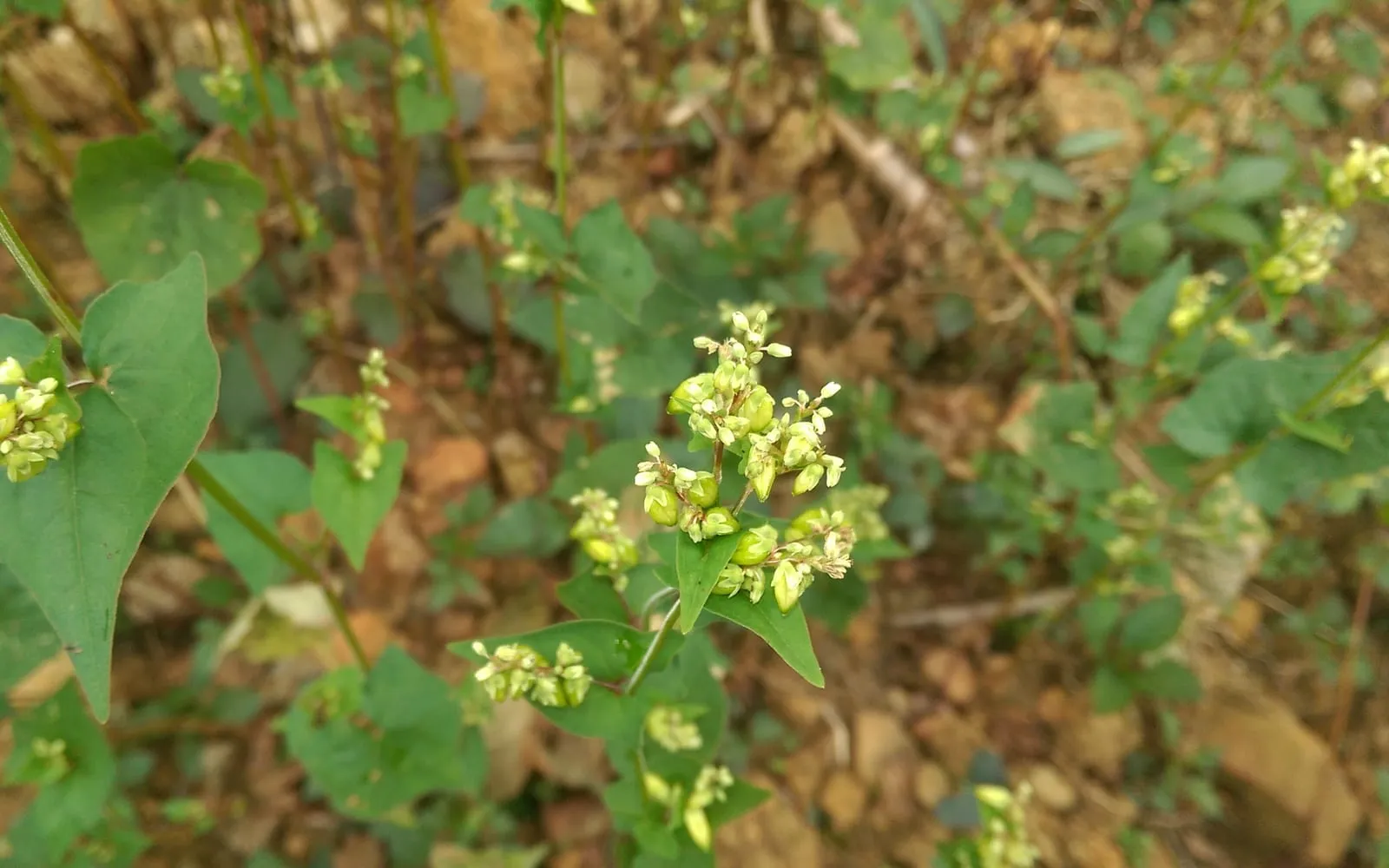
The plant looks like a leaner, greener version of common buckwheat. The stems are usually green rather than red, the leaves are arrow-shaped with the basal lobes more sharply drawn, and the whole thing has a wirier appearance.
The flowers give it away. Where common buckwheat carries showy white or pink clusters, Tartary buckwheat’s are small, greenish-white and inconspicuous, and they do not attract insects because they have no need to. A field in flower looks green from a distance.
The seed is the clearest difference. It is smaller and duller than common buckwheat’s, dark grey-brown, with rounded rather than sharp edges and often a wrinkled or grooved surface. The hull clings much harder, which is the main practical objection to the crop.
Where it is from
Tartary buckwheat was domesticated in the eastern Himalaya, in the region where Yunnan, Sichuan and Tibet meet, and its wild relatives grow there still. The crop has been cultivated in that area for at least two thousand years.
It spread through the mountain belt rather than across the lowlands, into Nepal, Bhutan, northern India, Tibet and Central Asia, everywhere following the altitude band where common buckwheat becomes unreliable. Farming at 3,000 m and above depends on it.
Europe knew it as a minor crop and largely as a weed of common buckwheat fields, which is where the alternative name duckwheat comes from. Interest has revived since the 1990s on the strength of its rutin content, and small commercial plantings now exist in France, Italy and Luxembourg.
How it grows
Germination and early growth are as fast as common buckwheat’s, with a crop covering the ground within three weeks of sowing in warm soil.
Flowering starts about five weeks in and continues for a month, with the plant setting seed while still flowering. Since the flowers self-pollinate, seed set is reliable regardless of insect activity or weather, which is the whole point of the species.
Maturity comes at ten to fourteen weeks, a little later than common buckwheat. The crop ripens unevenly and the ripe seed shatters, so harvesting means cutting the plants when about three-quarters of the seed has darkened and accepting some loss.
Through the seasons
Sow from May once the soil has reached 10 deg C and the frosts have gone. Rows at 20 cm suit a seed crop; broadcast it for green manure.
It emerges within a week and grows quickly, flowering from late June and running through the summer. The flowering is unremarkable to look at, so do not expect the show that common buckwheat puts on.
Harvest from September, cutting when most of the seed has gone dark. Dry the plants under cover and thresh by beating them in a bag. Frost kills the crop, so the weather sets the deadline.
Care difficulty
Tartary buckwheat is as easy to grow as common buckwheat and more reliable to crop, because it does not depend on pollinators. Sow it in warm soil, keep the slugs off the seedlings, and cut it in September.
The difficulty is at the kitchen end. The hull clings tightly and is hard to remove, and the grain is bitter, so most people who try it once do not make it a habit. Roasting reduces the bitterness and is what Chinese practice does.
Shattering is worth planning for. Ripe seed drops at a touch, so cut the crop a little before you think it is ready and let it finish drying under cover.
Watering
Water through establishment and then rely on rain. The root system is shallow and fibrous like common buckwheat’s, so a long drought on sand will check it.
A weekly soak in a dry July keeps a seed crop going. There is no benefit to watering once the seed has started to darken.
Waterlogging is poorly tolerated and produces yellow collapsing plants. Free drainage matters more than fertility, and a thin stony bed produces a better crop than heavy wet ground.
Warning signs, diseases and pests
Disease is close to absent in Britain, as with common buckwheat. The crop is a useful break in a rotation for that reason.
Slugs take seedlings in a cool damp start, and a warm May sowing outruns them. Aphids gather on the growing tips in a hot dry summer without doing much harm.
Shattering is what costs you seed. Ripe Tartary buckwheat drops at a touch, and a week of indecision empties a crop onto the soil.
Frost ends the season in both directions. A plant caught at 0 deg C blackens within a day, which sets both the earliest sowing date and the latest possible harvest.
Growing environment
Full sun is best and light shade is tolerated. The plant is adapted to open mountain ground and copes with wind better than its height suggests.
Soil should be poor, free-draining and preferably acid. Tartary buckwheat grows on thin stony ground from pH 4.5 to 7 and produces a better crop there than on a rich bed, where it makes leaf and lodges.
Cold tolerance is where it beats common buckwheat, and it grows at altitudes up to about 4,000 m in the Himalaya. It still dies at 0 deg C, so the advantage is in cool weather rather than in frost.
Feeding
Feed it nothing. The species was selected on mountain soils with no inputs, and fertility produces leaf, height and lodging rather than seed.
On exhausted ground it will still crop, which makes it a useful occupant of a bed that has been worked hard.
As with common buckwheat, a green manure crop should not be fed, since the point is to gather nutrients already in the soil and return them when the crop is dug in.
Troubleshooting
Why is it bitter? High rutin content and the enzyme that breaks rutin down, which together produce the bitter taste when the grain is wetted. Roasting the grain before use, as Chinese kuqiao tea does, moderates it.
How is it different from ordinary buckwheat? It self-pollinates, so it crops reliably without insects. It stands more cold and grows higher. The seed is smaller, duller, harder to hull and much richer in rutin. The flowers are small and greenish rather than showy and white.
Will it cross with common buckwheat? No. The two species do not interbreed naturally, so a patch of each can stand side by side without either affecting the other.
Why is my seed shattering onto the ground? That is the plant’s habit. Cut the crop when about three-quarters of the seed has darkened rather than waiting for all of it, and finish the drying under cover.
Is it worth growing over the common sort? For seed in a bad summer, yes, since it does not depend on bees. For a bee plant and for flavour, common buckwheat wins on both counts.
Is it gluten-free? Yes. Both buckwheats are pseudocereals with no gluten. If you have been diagnosed with buckwheat allergy, note that buckwheat is not one of the 14 named allergens in Britain and often goes undeclared here.
Can I make soba with it? Yes, and some Japanese regional soba uses it, though the standard product is common buckwheat. The dough behaves the same way and the noodles taste stronger and slightly bitter.
Tartary Buckwheat problem guides
Not sure what is wrong? See the common vegetable pests guide.